1. Background
Genotyping, or the precise distinction of genetic diversity between individuals, is now a well-established component of modern molecular biology, with far-reaching implications for research and medical treatment. Modern technologies such as SNP microarrays, quantitative polymerase chain reaction (qPCR), and next-generation sequencing (NGS) enable high-resolution analysis of disease-risk genetic variations, pharmacogenomic phenotypes, and hereditary features. This approach to precision medicine is evident in the practical application of NGS-based customized medicine in oncology and the diagnosis of uncommon illnesses. This has resulted in significantly increased diagnostic yield and treatment specificity.
It takes two general approaches to building a genomically proficient health workforce: Teaching existing health professionals through continuing education to improve patient care and referrals, and educating students so they have a solid foundation of genomic understanding from the start. Although professional organizations emphasize the incorporation of genetics into health education, little information is available about students' genomics education (1).
Starting with methodological roots like restriction fragment length polymorphism (RFLP) and allele-specific polymerase chain reaction (AS-PCR), genotyping has evolved into massively scalable and cost-effective forms. Allele-specific and real-time polymerase chain reaction (PCR) methods now achieve > 99% call rates and can handle large volumes of samples efficiently (2). Among these, Kompetitive Allele Specific polymerase chain reaction (KASP) achieves 99.8% call rates with a variety of samples without the need for expensive labeled probes, allowing for scalable low-cost genotyping (LGC Biosearch). Concurrently, clustered regularly interspaced short palindromic repeats (CRISPR)-associated systems such as specific high-sensitivity enzymatic reporter unlocking (SHERLOCK) and DNA endonuclease targeted CRISPR trans reporter (DETECTR) provide ultrasensitive, rapid, and instrument-free detection of genetics, ushering in a new age of point-of-care diagnostics (3).
In spite of these technologies, education in genetics is still rooted in Mendelian principles and concrete lab procedures, overstating the ability and range of current genotyping. Students might thus lack conceptual knowledge regarding sources of errors, the complexity of data, or the interpretation of assays central to genomic activities today. Closing this gap requires pedagogical content knowledge (PCK): An educational framework uniting content knowledge and tactics with a purpose to counteract students' misunderstandings — such as misinterpreting allele frequency distributions or error rates in variant calling (4).
Successful PCK design for genotyping education starts by recognizing typical stumbling blocks to student understanding — e.g., separating genotype and phenotype, reading fluorescence plots, or understanding multiplex assay limitations. Active-learning strategies, such as virtual PCR labs, case studies in pharmacogenomics, and data visualization tools for NGS, enable educators to build student knowledge step by step (5). Long-term intensive training programs in continuing professional development workshops like "Teaching the Genome Generation" show that such approaches are successful in enabling teachers to implement genomics-enriched curricula at secondary and tertiary levels (6).
As genotyping speed has kept pace — namely, from PCR to CRISPR diagnostics to AI-assisted variant analysis — it is essential to survey both the technologies themselves and their pedagogical comprehension.
2. Objectives
This paper aims to (1) integrate recent genotyping breakthroughs, (2) challenge evidence-based PCK measures to teach effectively, and (3) provide curriculum blueprints that promote pupil comprehension from theory to practice.
3. Methods
This study employed a design-based research approach to develop an instructional module aimed at enhancing the teaching of genotyping technologies in molecular genetics education. Grounded in the PCK framework, the module integrates foundational content knowledge with evidence-based instructional strategies to address common student misconceptions, scaffold complex concepts, and foster ethical awareness. The module was structured in four progressive phases, each aligned with specific learning objectives and PCK principles.
3.1. Design Framework and Pedagogical Rationale
The instructional design was guided by Shulman’s model of PCK, which emphasizes the integration of disciplinary knowledge with pedagogically sound strategies that directly target student learning barriers. The module also drew on elements of technological pedagogical content knowledge (TPCK), incorporating bioinformatics tools and virtual lab simulations to support student engagement and conceptual understanding. Design decisions were informed by a review of current literature on genotyping education, active learning strategies, and blended instructional models, as well as an analysis of frequently observed student misconceptions in molecular genetics.
3.2. Target Learners and Learning Environment
The module was developed for upper-level undergraduate or master's students enrolled in molecular genetics, biomedical sciences, or teacher education programs. It is intended for use in blended learning environments combining face-to-face instruction with digital resources. The structure is adaptable to diverse teaching contexts, including laboratory-based courses, virtual genomics workshops, and preclinical modules in medical education.
3.3. Module Structure and Phase Objectives
The module consists of four sequential phases, each with clearly defined goals, instructional tools, and PCK-informed activities.
3.3.1. Phase 1: Conceptual Foundations
Students explore genotype–phenotype relationships, PCR principles, and basic data interpretation through virtual simulations and case-based discussion. Common misconceptions — such as the belief that PCR directly reveals genotype — are explicitly addressed using prediction tasks and guided reflection. Tools include the University of Utah’s Learn Genetics PCR module and conceptual quizzes focused on primer design and allele interpretation.
3.3.2. Phase 2: Practical Application of Allele-Specific Polymerase Chain Reaction
This phase emphasizes hands-on learning in a low-throughput wet-lab setting. Students perform AS-PCR experiments in small groups targeting real-world SNPs. Emphasis is placed on proper primer use, gel-based band interpretation, and allele frequency estimation. Prior to experimentation, students identify potential sources of error (e.g., nonspecific binding) and propose mitigation strategies. Post-lab peer discussions support critical thinking and collaborative troubleshooting.
3.3.3. Phase 3: Exploration of High-throughput and Emerging Genotyping Technologies
Students engage with simulations and digital datasets to investigate NGS and CRISPR-based diagnostics. Platforms such as DETECTR and SHERLOCK are introduced via virtual lab simulations, while NGS concepts (e.g., basecalling, variant calling) are taught using tools like the integrative genomics viewer (IGV). Technical discussions compare platform strengths, limitations, and applicability in research or clinical settings.
3.3.4. Phase 4: Reflective Synthesis and Ethical Integration
The final phase focuses on the societal and ethical dimensions of genotyping. Students analyze anonymized case data to interpret potential clinical implications, such as hereditary cancer risk or pharmacogenomic response. Group debates on genetic privacy, incidental findings, and clinical responsibility are held to foster ethical reasoning. Students also complete a peer-reviewed report evaluating the accuracy, clarity, and ethical depth of each other's analyses.
3.4. Integration of Formative Assessment and Feedback
Throughout all four phases, formative assessments — including short quizzes, prediction tasks, reflective prompts, and peer feedback — are embedded to support learning progression and address misconceptions in real time. Instructors are encouraged to adapt these assessments to their own course contexts and student needs.
3.5. Ethical Considerations
As this study describes a curriculum design and does not involve the collection of sensitive personal data or implementation with human subjects, ethical review was not required at this stage. However, the proposed module includes extensive training in ethical genomics practice, with a strong emphasis on informed consent, genetic privacy, and responsible interpretation.
4. Results
The PCK-informed instructional module was designed to progressively develop students’ understanding of genotyping technologies, from foundational PCR methods to advanced high-throughput and CRISPR-based platforms. The module is expected to address common conceptual challenges, support procedural competence, and foster ethical reasoning among learners. The anticipated outcomes are presented below, mapped to each phase of the instructional design.
4.1. Anticipated Learning Outcomes and Educational Impact
The designed instructional module, informed by PCK, was structured to foster progressive learning across four educational phases (Figure 1). In the first phase, students are introduced to foundational concepts such as the relationship between genotype and phenotype, PCR mechanics, and primer design logic. Through virtual simulations and conceptual case discussions, learners are encouraged to confront and correct common misconceptions — for example, the belief that PCR output directly reveals genotype or that any primer can be used universally. Prediction-based quizzes and guided analysis tasks help solidify students' understanding of threshold cycles, amplification specificity, and how environmental versus genetic factors affect phenotypic expression.
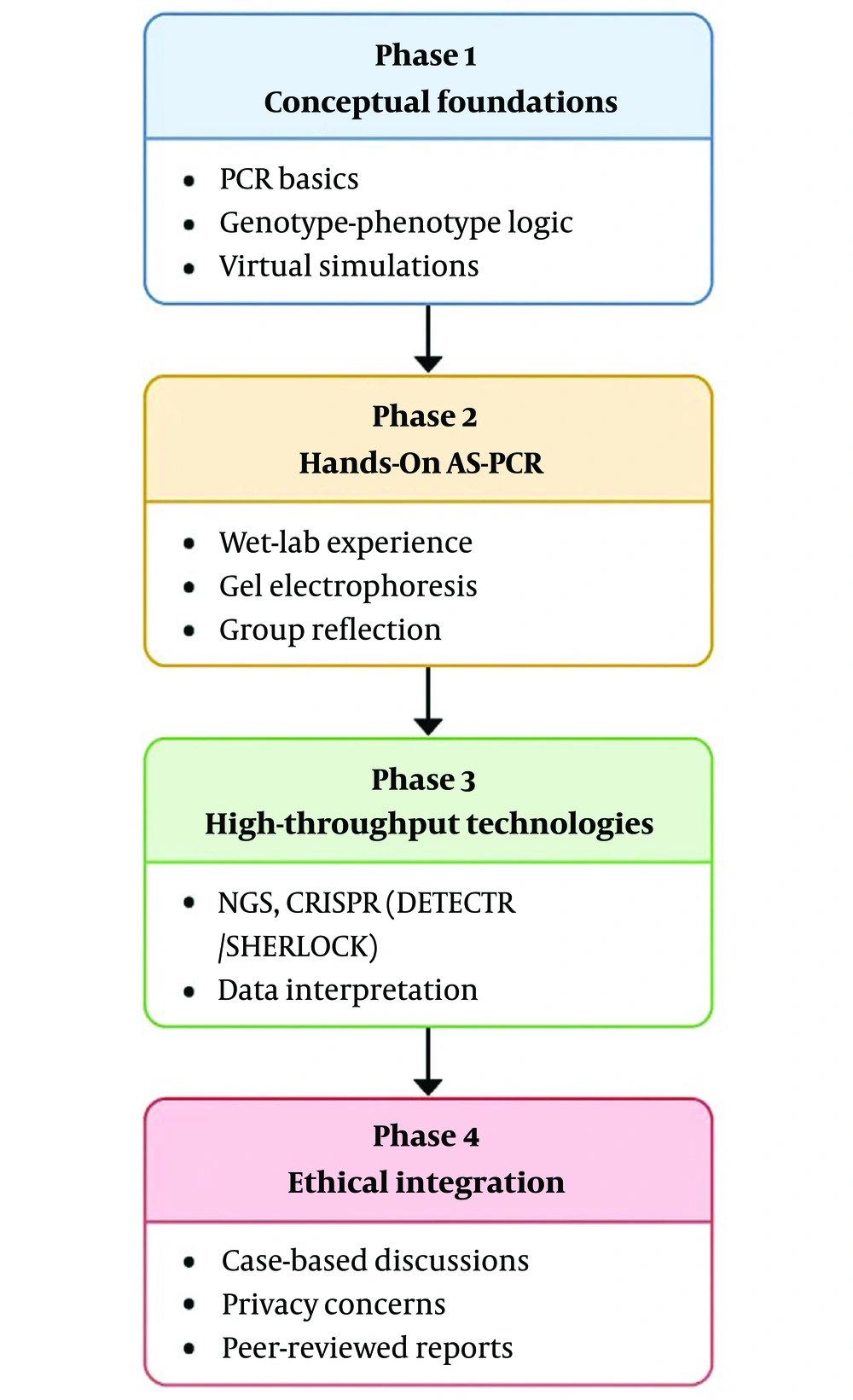
Figure 1.
A four-phase pedagogical content knowledge (PCK)-guided instructional model for genotyping education; this flowchart illustrates the structured integration of genotyping tools into molecular genetics education, guided by PCK. Each phase scaffolds learning objectives from foundational concepts to ethical reasoning.
In the second phase, the focus shifts to procedural competence through the wet-lab execution of AS-PCR. Students perform targeted SNP amplification and interpret gel electrophoresis band patterns to derive genotypic classifications. Embedded in this phase are guided error-prediction tasks and reflective peer discussions, which aim to deepen students' understanding of assay limitations and encourage troubleshooting. Students are expected to develop technical fluency in PCR protocol execution, identify potential causes of non-specific amplification, and evaluate the accuracy and reproducibility of experimental results through collaborative analysis.
The third and fourth phases are designed to advance student familiarity with emerging technologies and to cultivate ethical reasoning. In phase 3, students engage with simulated datasets and digital platforms to explore high-throughput systems such as NGS and CRISPR-based diagnostics. This phase emphasizes data interpretation, platform comparison, and technical literacy, using tools like the IGV to guide hands-on variant analysis.
The final phase, focused on synthesis, challenges students to integrate ethical considerations through clinical case assignments and structured group debates on issues such as genetic privacy and incidental findings. Peer review of written genomic reports further reinforces communication skills and scientific accuracy. A detailed overview of the structure, instructional tools, and intended learning outcomes for each phase is presented in Table 1.
Table 1.
Structured Phases of the Genotyping Instructional Module Aligned with Pedagogical Content Knowledge Principles
| Module Phase | Focus | PCK Strategy | Instructional Tools | Anticipated Learning Outcomes |
|---|---|---|---|---|
| Phase 1: Conceptual foundations | Understanding genotype-phenotype relationships and PCR basics | Addressing misconceptions and case-based discussion | Virtual PCR simulations (Learn Genetics) and prediction quizzes | Distinguishing genotype vs. phenotype; explaining PCR principles; identifying primer design errors |
| Phase 2: Hands-on AS-PCR | Wet-lab practice and allele interpretation | Predictive questioning and peer reflection | AS-PCR assays, gel electrophoresis, and small-group lab work | Performing allele-specific PCR; interpreting gel band patterns; identifying and correct assay errors; estimating allele frequencies |
| Phase 3: High-throughput and emerging tools | NGS and CRISPR-based diagnostics | Simulation-based learning and technical comparison | DETECTR/SHERLOCK platforms (virtual), IGV, and simulated NGS data | Comparing genotyping platforms; analyzing digital sequencing data; understanding CRISPR diagnostics; interpreting variant calling output |
| Phase 4: Reflective ethical integration | Data ethics, clinical context, and communication | Case-based learning and structured ethical debate | Anonymized genotyping reports and precision medicine case scenarios | Reflecting on genetic privacy and incidental findings; writing structured genomic case reports; engaging in ethical decision-making |
Abbreviations: PCK, pedagogical content knowledge; PCR, polymerase chain reaction; AS-PCR, allele-specific polymerase chain reaction; NGS, next-generation sequencing; CRISPR, clustered regularly interspaced short palindromic repeats; DETECTR, DNA endonuclease targeted CRISPR trans reporter; SHERLOCK, specific high-sensitivity enzymatic reporter unlocking; IGV, integrative genomics viewer.
In addition to its phased structure, the module was deliberately designed to embed core elements of PCK across all components. Each phase integrates targeted strategies to confront student misconceptions, such as confusing PCR output with direct genotype identification or misunderstanding primer specificity. Formative assessments — including prediction tasks, guided discussions, and peer critiques — are incorporated throughout the module to enhance conceptual engagement and self-regulation.
The educational design also emphasizes the contextualization of content using authentic case scenarios and virtual simulations, encouraging learners to apply technical knowledge in realistic problem-solving settings. These approaches are intended not only to strengthen subject mastery but also to promote student agency and metacognitive reflection, in line with PCK principles.
To support instructional delivery and facilitate implementation in diverse academic settings, a comprehensive instructional toolkit was developed as part of the module. This includes lab protocols for allele-specific PCR, simulation links and annotated tutorials for CRISPR diagnostics and NGS platforms, conceptual worksheets for virtual lab engagement, and case-based prompts for ethical debates. Supplementary teaching materials also provide example genomic case reports, rubrics for peer evaluation, and discussion guides for analyzing the implications of genotyping in clinical or research contexts. These resources offer educators a flexible, ready-to-adopt framework that aligns instructional strategies with defined learning outcomes and PCK-informed pedagogy.
5. Discussion
Genotyping technologies have come a long way — from slow assays to high-throughput, effective, and ubiquitous technologies. A good molecular genetics curriculum should start students along this technology track so that they are able to appreciate both the earlier methods and the newer innovations. The AS-PCR, of which ARMS-PCR is a member, began the use of directed variant detection by employing primers that diverged differently to varying alleles. For example, AS-PCR is routinely used in the detection of MTHFR gene mutations and BRCA1 single-nucleotide polymorphisms (7, 8). These assays instruct students in primer specificity, annealing conditions, and the problem of preventing non-specific amplification.
TaqMan assays — based on allele-specific fluorescent probes — are common in research as well as clinical laboratories because they are easy to reproduce and do not require much post-PCR processing (9). The education of students in these approaches exposes them to actual applications in candidate-gene research and accuracy diagnostics. Advancement in PCR technology enables it to screen several loci at the same time with maximum efficiency and least expenditure. For instance, multiplex-capable PCR reagents can be utilized to amplify six gene targets in a single reaction — commonly applied in plant genetics and pathogen tracing for higher throughput and cost-effectiveness.
MALDI-TOF/MS-based iPLEX genotyping platforms can process tens of SNPs per well, a process widely used in microbial typing and hospital surveillance (10, 11). The inclusion of these techniques into the course syllabus simplifies students' understanding of multiplex assay design, primer interactions, and challenges in data interpretation.
The KASP entails the use of competitive allele-specific primers with distinctive fluorophore tails and a universal reverse primer for the genotyping of SNPs. Two-step touchdown PCR increases specificity through reduced non-specific amplification prior to fluorescence-based allele calling. Endpoint fluorescence data are binned for calling genotypes with extremely high accuracy (99 - 99.8%) and remain robust even with fluctuating DNA quantity or quality. It is commonly applied in plant breeding, genetic quality control, and teaching contexts (2). It provides a user-friendly platform for students to study primer efficiency, allele discrimination by fluorescence, and genotype-calling algorithms, which can be used in the analysis of larger-scale genetics.
MIPs are padlock probes that become circularized only when the probe ends perfectly hybridize to the genomic target spanning a SNP or indel, with enzymatic gap fill and ligation favoring allele-specific capture. Linear probes are subsequently degraded by exonucleases, and only the successfully circularized molecules are amplified by universal primer PCR with embedded barcode tags. In one of the pioneering human genomics projects, 12,000 MIP probes were multiplexed in one assay, with SNP call completeness > 98% and > 99.6% trio concordance on HapMap samples that were typed. The design is FFPE or degraded DNA tolerant (just ~40 bp of intact target), and therefore usable with ancient DNA or forensic genomics (12, 13). MIPs also provide a great pedagogical tool to practice probe circularization, enzymatic decontamination, target amplification, and barcode-based allele calling — fundamental principles of high-end genotyping and NGS pipelines.
Two CRISPR-based systems, DETECTR (Cas12) and SHERLOCK/SHINE (Cas13), utilize this system for genotyping and infectious disease detection. These techniques are independent of expensive machinery and are efficient even in remote locations far from laboratories. The DETECTR, which is a fusion of isothermal amplification (RT-LAMP) and Cas12-based detection, demonstrated 90% sensitivity and 100% specificity in SARS-CoV-2 detection from clinical samples. Similarly, SHINEv2, an improved SHERLOCK derivative, facilitates direct detection from patient swabs on lateral flow strips — paper-based, like pregnancy tests — yielding visual results in under 90 minutes, without RNA extraction and high-cost machines (14-16). Education-directed use of CRISPR diagnostics engages students in guide RNA design, isothermal amplification tactics, and assay verification in low-resource environments.
5.1. Recent Advances and Trends: Single-Cell, Portable, and AI-powered Platforms
One new method, SCOUT, is a technique where researchers can accurately pinpoint genetic variation in single cells — far more challenging than in traditional bulk samples due to the limited amount of DNA and the ease of contamination. SCOUT employs the surrounding sequence of DNA close to each target area to gain a better understanding of genuine genetic change, with improved accuracy by up to 77% over previous methods. Another exciting innovation is the use of small DNA-sequencing machines, such as Oxford Nanopore's MinION. The portable device, powered by a USB, can sequence DNA anywhere, in the laboratory or out in the field, during an outbreak. It reports results in hours and has already been used to track viruses, identify antibiotic resistance, and investigate environmental samples (17, 18). Combined, these new tools are accelerating genotyping, making it easier to perform outside the laboratory, and more accurate — perfect for teaching modern genetics and allowing students to learn about applications in real life.
State-of-the-art educational modules like the virtual diagnostic lab for undergraduate genetics courses successfully apply case-based learning to balance theory and practice. In virtual laboratories, students participate in virtual patient case studies where they are required to choose proper genetic tests, interpret genotype data, and consider the ethical aspects of genetic diagnosis. This active learning style has proven to be high-impact education: Ninety-two percent of the students who participated considered it extremely valuable, and 94% said that it efficiently met their learning goals (4, 19).
Similarly, computer-interactive 3D virtual models of PCR and genetic screening used with Chinese medical students were shown to be effective in enhancing conceptual understanding and experimental preparedness before students' exposure to physical laboratories (20). The simulations provide a safe, controlled setting in which students can observe complex molecular processes, practice experimental procedures, and learn lab safety protocols without the constraints or hazards of hands-on experiments. The combination of hands-on laboratory training with virtual simulations under a blended learning scheme considerably improves student engagement and comprehension of molecular biology methods.
Haberbosch et al. showed that integrating virtual modules on molecular biology methods and laboratory safety with actual experiments for lower secondary students contributed to elevated knowledge and enhanced laboratory practice. The virtual aspect allowed the students to witness intricate protocols and learn safety protocols before engaging in the laboratory space (21). In a similar vein, Vedova et al. demonstrated the efficacy of integrating face-to-face lab classes with computer simulation in educating undergraduate genetics students on the concepts of gene editing and DNA sequencing. This hybrid pedagogy assisted students in understanding complex molecular processes like CRISPR-based gene editing and sequencing pipelines through virtual debugging and probing of processes, minimizing cognitive load during hands-on experiments (22).
Presenting students with their own or anonymous genomic information provokes interest, enhanced learning, and future patient empathy. At Mount Sinai and Stanford, medical students who saw their own SNP or whole-genome information realized far more knowledge gain, empathy, and enthusiasm than peers given access only to public data (23). With the inclusion of PCK, instructors can create opportunities for reflection about individual risk, data privacy, ethical issues, and the meaning of the data — fostering technical proficiency and professional accountability.
Technical knowledge — particularly in bioinformatics — constitutes a central component of effective genotyping teaching. The TPCK model focuses on embedding Technological Knowledge (TK) into content and pedagogy. A recent example is the integration of molecular visualization and sequence-variant analysis into education: In a university module focused on HIV genomics, students aligned nucleotide sequences of the HIV 1 env gene and went on to visualize associated mutations onto the 3D structure of the gp120 protein using structural modeling tools. This multimodal approach was far more effective for students' ability to connect genotype with protein function, grasp vaccine design implications, and use bioinformatics critically in context — performance scores were enhanced by statistically significant margins on several objectives (24).
In the same vein, modules incorporating interactive genome visualization programs — like the IGV, a software package designed by the Broad Institute for the viewing and interpretation of NGS data — along with protein structure visualization tools provide students with the ability to correlate DNA sequence variation with its putative impact on protein structure and biological function (4). Virtual tools provide an opportunity for learning and simulate real research settings. Students can employ interactive databases like GenBank and Ensembl in primer design.
A directive for generating a PCK-guided curriculum starts with the inclusion of contemporary research examples directly within the course material. For instance, while learning CRISPR diagnostics, teachers can cite contemporary field applications like the smartphone-readable RPA-CRISPR assay to detect plant pathogens. Zhao et al. designed a handheld RPA-CRISPR-Cas12a system for the early diagnosis of potato late blight — a virulent crop disease caused by Phytophthora infestans. Through this process, DNA is taken from plant leaves in a non-invasive and rapid microneedle patch and then detected by an isothermal RPA-CRISPR assay. The test directly detects P. infestans DNA with high specificity and no cross-reactivity with any other disease-causing agent. It can detect the pathogen three days post-infection — before apparent symptoms — and has the same sensitivity as laboratory PCR without the need for bulky laboratory equipment. The measurement is then read out using a smartphone fluorescence reader, making the system highly suited to field diagnostics (25).
Successful genotyping training is supported by a modular education model that progressively develops from core methods — e.g., PCR — to sophisticated platforms such as NGS. One example is the Undergraduate Training in Genomics (UTRIG) program, which stratified learning targets from foundational PCR to the clinical use of NGS, employing active learning interventions and hierarchical tests to improve teacher expertise as well as student engagement (26).
Strong genotyping curricula start with conceptual introductions followed by the disclosure of technical protocols. For example, a 2023 article in BMC Medical Education reports an online module in genetics training that initially introduces students to laboratory biosafety, the concept of DNA extraction, amplification (PCR), and genetic testing workflows — prior to students undergoing mock or in-lab procedures (20). This pre-virtual acclimation before actual lab exposure ensures that students understand the "why" and step-by-step process involved in molecular workflows, from the handling of PCR reagents to machine usage and the rationale of experimental design, before actually facing the complexity of a real lab.
To introduce inaccessible approaches to students, online simulations and interactive labs are essential. To ensure sophisticated genotyping methods are more accessible and stimulating, blended lab models that combine virtual simulations and in-class experiments provide significant value. As shown in a recent paper, combining in-class molecular biology labs with virtual laboratory simulations enhanced students' confidence, interest, and appreciation of concept-based DNA diagnostic approaches (27).
5.2. Conclusions
Integrating advanced genotyping technologies into genetics education through a PCK-based framework enhances students’ conceptual understanding, technical skills, and ethical awareness. The instructional module developed in this study addresses key learning challenges using scaffolded, evidence-based strategies. By aligning educational content with current genomic advances, this model supports the development of competent and ethically responsible professionals in the life sciences.