
1. Background
In Iran, sheep are considered multipurpose animals for meat, wool, and milk production and are raised accordingly. There are approximately 50 million sheep in Iran, which are particularly important in meeting the country’s protein needs. Currently, approximately 300,000 tons (14%) of the total meat produced in the country is sourced from more than 5 million sheep, which does not meet the country’s population growth needs. Therefore, increasing the efficiency of sheep production is of particular importance (1, 2). Since most of Iran’s rangelands are in poor to moderate condition in terms of vegetation cover, reducing the number of livestock units per unit area can reduce the pressure of livestock on the rangelands. One solution to this problem is to reduce the number of productive livestock without reducing income. This goal can be achieved by using multiple-twin-producing animals instead of single-twin-producing animals (3, 4). By using the appropriate method, reproductive efficiency can be significantly increased. Multiple-twin production is one of the most important economic traits that is influenced by the environment and genetics. However, it is believed that reproductive activities in sheep are influenced by many genes (5, 6).
Ovulation technology is used to increase the number of offspring per individual and shorten generation intervals. To date, treatments and methods for stimulating follicle-stimulating hormone (FSH) have been used in sheep breeding, but many of the genes, pathways, and biological functions involved in follicular development remain unknown. Follicle-stimulating hormone receptor (FSHR) is located on ovine chromosome 3, is involved in follicular development, and plays an important role in fertility (7, 8). Differences in amino acid sequence arise from point mutations. The FSHR is a glycoprotein hormone secreted by the anterior pituitary gland and is associated with major ovarian functions such as growth, maturation, and ovulation (9). The FSH consists of 695 amino acids, including three folds: (A) ninety-two amino acids; (B) 111 amino acids; and finally, our desired fold; (C) 366 amino acids (10). The FSHR gene is also a member of the rhodopsin receptor family of G protein-coupled receptors, which activates the FSH receptor gene by binding to it and plays a central role in the reproductive function of mammals (11).
2. Objectives
The present study was conducted on this gene due to the high importance of FSHR in fertility.
3. Methods
Genomic and protein data, including nucleotide and amino acid sequences of FSHR, were extracted from the National Center for Biotechnology Information (NCBI) website with accession number (P35379) related to the sheep species, to investigate the physical and chemical properties and also predict the three-dimensional structure. The tertiary (three-dimensional) structure of FSHR was predicted using bioinformatics methods. Based on these methods, after extracting the amino acid sequences through the software and online servers Swiss-Model and Uniprot, the predicted three-dimensional structures were used, and their structure was downloaded and saved in PDB format. 2-acetamido-2-deoxy-beta-D-glucopyranose was also downloaded from GenBank to investigate its interactions with FSHR. Using AutoDock software, ligand, additional cofactors, and water molecules present in the crystal structure of the protein were removed. The software selected and used to perform these interactions was UCSF Chimera and Molegro Virtual Docker.
4. Results
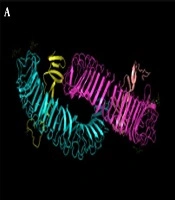
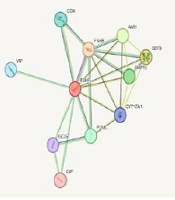
Finding the best orientation of the ligand to the receptor active site and estimating the binding energy are two important aspects of the docking algorithm. The structure of the receptor and ligands is shown in Figures 1. and 2. The FSHR has 366 amino acids, the number and type of which are given in Table 1. Examination of the amino acids constituting FSHR showed that the most abundant ones were leucine, serine, isoleucine, and asparagine. These results indicate that the number of essential amino acids was greater than that of non-essential amino acids. The role of extracellular stimuli in the control of differentiation remains largely unresolved. Leucine and lysine, as essential amino acids, may be important in the control of growth. Leucine is well known as a regulator of muscle protein synthesis. Leucine and isoleucine are essential amino acids that have been proven to increase growth and development when present in the diet. Serine is vital for the production of body proteins, enzymes, and muscle tissue.
![A, 3D structure of the follicle-stimulating hormone (FSH) complex [National Center for Biotechnology Information (NCBI)]; B, protein-protein interaction network analysis by database (STRING); and C, 3D structure [follicle-stimulating hormone receptor (FSHR)] isolated from the complex](https://brieflands.com/journals/gct/articles/165928/figures/gct-12-3-165928-g001-preview.webp "A, 3D structure of the follicle-stimulating hormone (FSH) complex [National Center for Biotechnology Information (NCBI)]; B, protein-protein interaction network analysis by database (STRING); and C, 3D structure [follicle-stimulating hormone receptor (FSHR)] isolated from the complex")
Figure 1.
A, 3D structure of the follicle-stimulating hormone (FSH) complex [National Center for Biotechnology Information (NCBI)]; B, protein-protein interaction network analysis by database (STRING); and C, 3D structure [follicle-stimulating hormone receptor (FSHR)] isolated from the complex
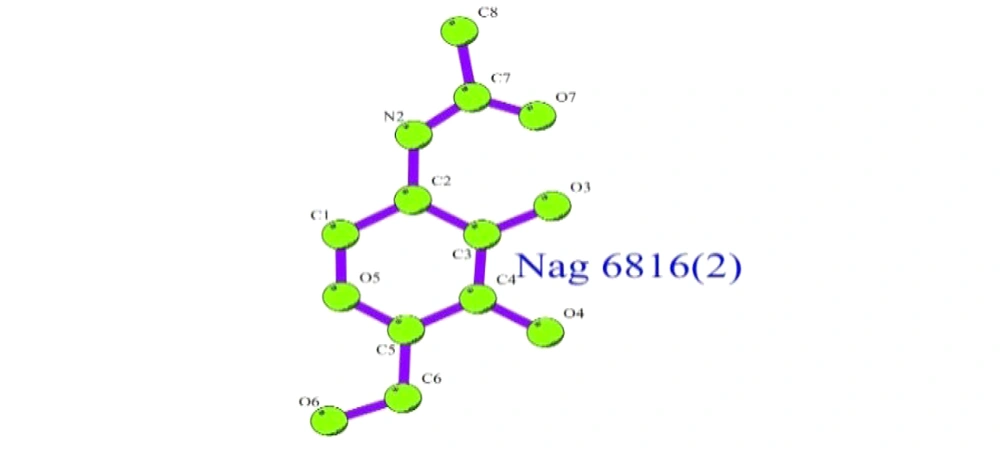
Figure 2.
Structure of 2-acetamido-2-deoxy-beta-D-glucopyranose
Table 1.
Number and Types of Amino Acids of Follicle-Stimulating Hormone Receptor
| Amino Acid | Number |
|---|---|
| Ala | 15 |
| Arg | 18 |
| Asn | 30 |
| Asp | 19 |
| Cys | 10 |
| Gln | 13 |
| Gly | 14 |
| His | 13 |
| Ile | 28 |
| Leu | 43 |
| Lys | 17 |
| Met | 4 |
| Phe | 14 |
| Pro | 15 |
| Ser | 28 |
| Val | 17 |
| Thr | 13 |
The results of the amino acid sequence analysis of FSHR and the accuracy assessment with SAVES 0.v5 software and the Ramachandran map analysis were predicted with an accuracy of about 70%, indicating that this structure has a good steric chain. The percentage of the remaining groups that are in the red area has the best acceptance rate (Figure 3).
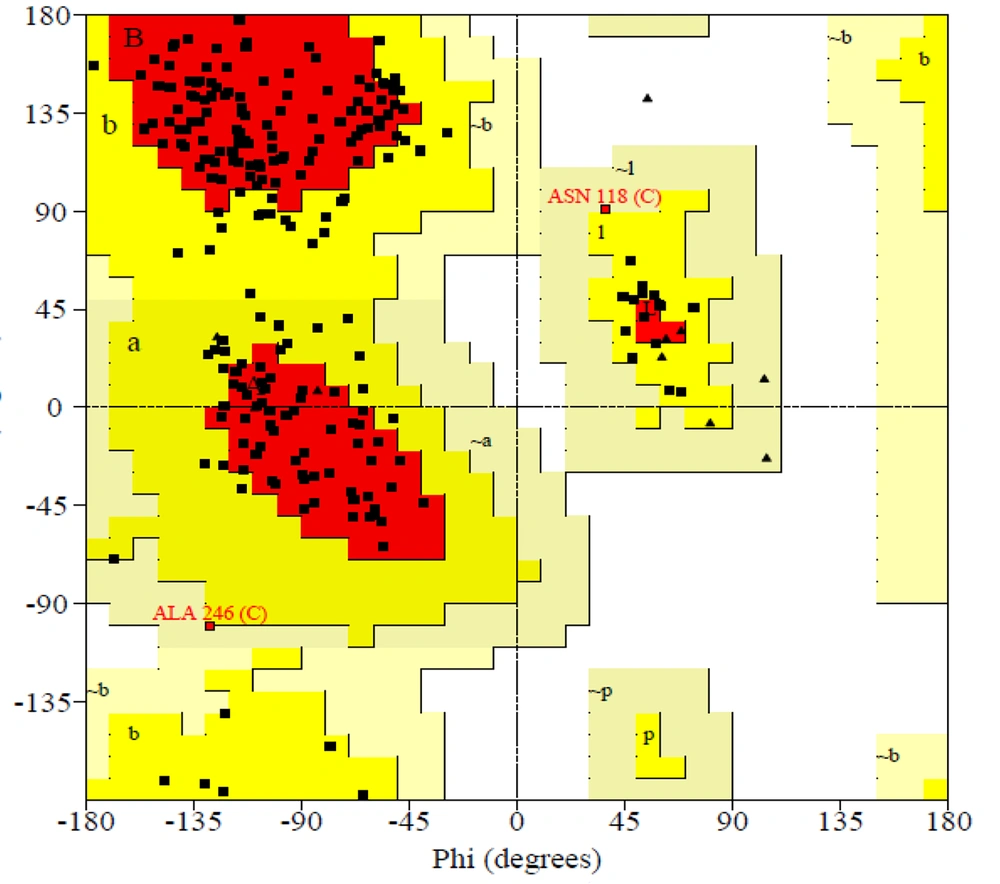
Figure 3.
Ramachandran map of the predicted protein structure of follicle-stimulating hormone receptor (FSHR)
The coordinates for the ligand 2-acetamido-2-deoxy-beta-D-glucopyranose to determine the active site amino acids were obtained as X: 21.62, Y: -13.44, and Z: 52.39. After the docking process, the results obtained in terms of the best binding energy were compared, and the best pose with the most negative energy and the largest number indicated the best binding of the ligand-protein complex. The binding energy indicates the strength of the binding between the designed molecular compounds and the active site of the enzyme, and for 2-acetamido-2-deoxy-beta-D-glucopyranose, it was determined to be -66.4759 (Figure 4).
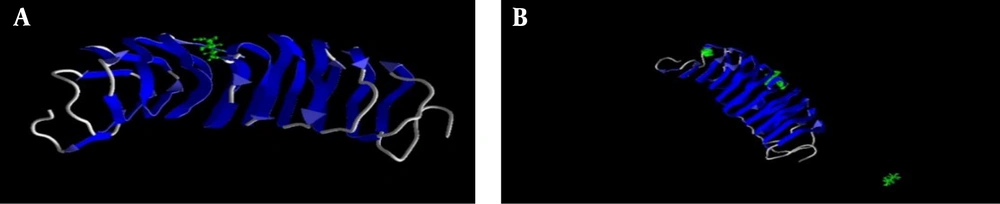
Figure 4.
A, before ;and B,after the interaction of follicle-stimulating hormone receptor (FSHR) with 2-acetamido-2-deoxy-beta-D-glucopyranose
For the molecular docking of FSHR with 2-acetamido-2-deoxy-beta-D-glucopyranose, five cavities were predicted for the placement and interaction of the receptor and ligand. Finally, the ligand correctly contacted and docked in one of the cavities with the receptor amino acids, which were the active amino acids of that site. The study of ligand-acetamido-2-deoxy-beta-D-glucopyranose interactions showed that the amino acids histidine 139, valine 138, leucine 135, asparagine 163, serine 164, and proline 163 with red dashed lines participated in the formation of the ester bond, while valine 138, histidine 139, proline 136, leucine 135, and serine 164 with blue dashed lines also participated in the formation of hydrogen bonds. Organic oxygen-containing compounds that have an ester functional group -COO- are called esters. Esters are carboxylic acids in which an alkyl or aryl group has replaced the carboxyl group. Esters are formed from carboxylic acids. The research showed that in these compounds, a bond is formed between the hydrogen atom and another atom that is small but has a high electronegativity, and that bond was called a hydrogen bond. In the investigation of the researched ligand, isoleucine 25, proline 24, valine 68, and tyrosine 80 were involved in hydrophobic bonds (Figure 5).
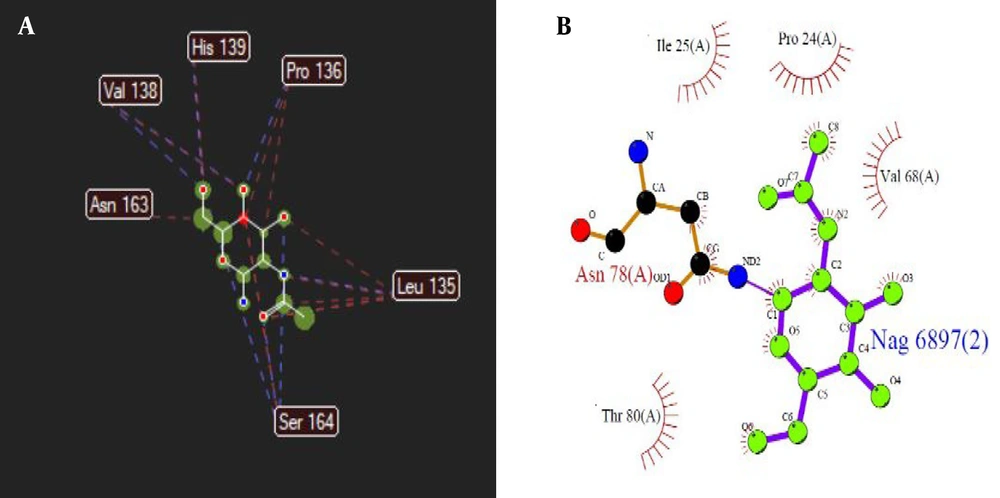
Figure 5.
A, examination of residues (amino acids) involved in the formation of the bond with follicle-stimulating hormone receptor (FSHR) with 2-acetamido-2-deoxy-beta-D-glucopyranose (blue dashed line indicates hydrogen bond formation; red dashed line indicates ester bond formation); B, examination of amino acids involved in the formation of a hydrogen bond, indicated by a green dashed line, and the hydrophobicity of the combination with 2-acetamido-2-deoxy-beta-D-glucopyranose with FSHR, analyzed by LigPlot software.
5. Discussion
Molecular docking, as a powerful tool in structural biology and bioinformatics, allows researchers to simulate and analyze interactions between proteins and their ligands (12). Using molecular docking software can help identify key points in the FSHR structure that are effective in interacting with FSH and other related ligands (13, 14). This method can lead to a better understanding of how this receptor functions and its effects on reproductive processes. Recent studies have shown that genetic variations in FSHR can have significant effects on reproductive traits (15, 16). For this reason, the study of molecular docking of FSHR in sheep can be used as an effective tool in improving breeding strategies and increasing reproductive efficiency in this livestock species (17-19). This article examines the molecular docking of FSHR in sheep, and its results can be used as a scientific basis for developing new methods in breeding and improving reproduction in sheep.
This study aimed to find the best ligand for electron transfer for energy production. The contribution of essential amino acids in this study was greater, and it was also found that the number of hydrogen bonds was greater than ester and hydrophobic bonds. Hydrogen bonding plays a fundamental role in the three-dimensional structure of molecules such as DNA, RNA, sugars, proteins, and lipids. The results of this study showed that investigating and identifying the effective factors of important and effective cofactors can contribute significantly to optimal reproductive performance and identifying the factors affecting them. By the interaction between functional ligands and receptors, it is possible to identify the amino acids that have the most interaction concerning the optimal energy selected in the best suitable pose and to investigate their mechanism in production and efficiency.
One of the interesting compounds in this field is 2-acetamido-2-deoxy-beta-D-glucopyranose, which has been introduced as an FSH analog in various studies. This compound can act as a ligand for FSHR, and studying its interaction with this receptor can help to better understand how FSH works and its effects on biological processes (20, 21).
Especially in sheep, due to their economic and production importance in the livestock industry, a detailed study of these interactions can help improve fertility strategies and increase reproduction. Given the importance of this issue, this study aims to investigate the interactions of 2-acetamido-2-deoxy-beta-D-glucopyranose with FSHR in sheep using molecular docking. This study can help identify the molecular mechanisms and potential effects of this compound on FSHR function and lead to the development of new methods for improving fertility in sheep and other livestock.
In this study, it was found that the amino acids asparagine, leucine, isoleucine, and serine had the highest number of interactions and bonds, which have a great impact on the expression of genes and growth factors, muscle building, and energy production (22, 23). Poultry meat and eggs also provide high-quality animal protein (containing sufficient amounts and appropriate ratios of amino acids) for human consumption and therefore play an important role in the growth, development, and health of all individuals. Due to the economic, environmental, and welfare benefits for birds, there is considerable interest in developing low-protein diets with supplementary amino acids for broilers. The role of amino acids in livestock and poultry nutrition is essential. In both young and adult animals, amino acid deficiencies cause reduced body weight and reduced overall muscle growth. For younger animals, this can have long-term effects, including reduced growth rate, prolonged time to maturity, and reduced size at maturity.
Considering that energy metabolism is important for animal health, and knowing that other genes and ligands also play a role in energy production and electron transfer, it is suggested that other ligands related to useful and effective genes in production are also investigated. By knowing the effective factors, we can identify and examine energy production pathways and use the results in the field of livestock production (24-26).
5.1. Conclusions
In conclusion, molecular docking successfully identified the optimal binding orientation and energy for the ligand 2-acetamido-2-deoxy-beta-D-glucopyranose within the FSHR active site. The interaction is stabilized by key amino acids forming hydrogen, ester, and hydrophobic bonds, confirming a strong and specific ligand-receptor complex.