Gene Cell Tissue

Image Credit:Gene Cell Tissue

Study of the Distribution of the Frequency of Heart Diseases Caused by Fine Dust and Pollen in Zabol City

Author(s):
Khadijeh SaravaniKhadijeh Saravani1,*, Reza NooriReza Noori2, Mohamad Hasan MohamadiMohamad Hasan Mohamadi3, Maryam NakhaeiMaryam Nakhaei4
1Faculty of Medicine, Zabol University of Medical Sciences, Zabol, Iran
2Department of Surgery, Amir al Momenin Hospital, School of Medicine, Zabol University of Medical Sciences, Zabol, Iran
3Department of Pediatrics Neurology, Amir al Momenin Hospital, School of Medicine, Zabol University of Medical Sciences, Zabol, Iran
4Department of Obstetrics and Gynecology, Amir al Momenin Hospital, School of Medicine, Zabol University of Medical Sciences, Zabol, Iran

Gene, Cell and Tissue:Vol. 12, issue 4; e166793
Published online:Oct 21, 2025
Article type:Research Article
Received:Oct 04, 2025
Accepted:Oct 08, 2025
How to Cite:Saravani K, Noori R, Mohamadi MH, Nakhaei M. Study of the Distribution of the Frequency of Heart Diseases Caused by Fine Dust and Pollen in Zabol City. Gene Cell Tissue. 2025;12(4):e166793. doi: https://doi.org/10.5812/gct-166793

Abstract

Background:

Climate is a variable phenomenon, and its variability has always been of interest to climatologists.

Objectives:

Since climate plays an important role in all aspects of life, attention to its changes has become one of humanity's concerns, especially in recent decades, and it can be considered the greatest challenge of the 21st century. Dust is one of the atmospheric phenomena that occur in many regions of the world.

Methods:

This study is a cross-sectional study. Data on air pollutants, particulate matter, and dust were collected from the Zabol Meteorological Center, and the resulting information was plotted in appropriate graphs. Descriptive statistics and Pearson's correlation coefficient were used to analyze and determine the relationship between air pollution and resulting heart diseases.

Results:

This study is a descriptive cross-sectional study conducted in 1404 AH. Data on air pollutants, particulate matter, and dust were collected from the Zabol Meteorological Center. Additionally, 96 patients referred to Amir al-Momenin Hospital in Zabol were examined in this study. The results showed that the highest prevalence was blood pressure (26.04%), and the lowest prevalence was rheumatoid arthritis (1.04%).

Conclusions:

The results indicated that with the increase in fine dust, the number of cardiovascular patients visiting the hospital increased.

1. Background

Climate is a variable phenomenon, and its variability has always been a topic of interest to climatologists. Since climate plays an important role in all aspects of life, attention to its changes has become one of mankind's concerns, especially in recent decades. The frequency of occurrence is much higher in arid and semi-arid regions and has significantly affected living conditions in many countries in the arid and semi-arid regions of Asia (1).
In the study of air pollutants and particles, dust and fine dust occupy an important part. The phenomenon of fine dust and its invasion from the west of the country and the Arabian Peninsula towards our country has been intensifying for some time and has affected most parts of the country with its destructive effects. It is a fatal phenomenon that has many effects on health. According to the World Health Organization, more than 300 million people die annually due to the harmful effects of outdoor air (2). One million people suffer from lung cancer (3). Various diseases, including mental retardation, respiratory disorders, acute heart attacks, neurological and visual complications, anemia, and increased mortality from heart attacks and strokes, have been identified by researchers as frightening consequences of urban air pollution (4). Dust storms cause significant reductions in visibility, respiratory symptoms, and eye problems in people, and cause significant damage to animals, plants, industries, and social activities (1).
Globally, one of the natural sources of dust entering the atmosphere is the rise and horizontal movement of air masses containing dust particles and desert dust due to temperature changes. The residence time of these particles in the atmosphere is long and sometimes may range from several days to several weeks. Iran is located in a dry and desert belt, and the most important factor in the drought is the high pressure adjacent to the tropics.

2. Objectives

The aim of this study is to investigate the frequency distribution of heart diseases caused by particulate matter and dust in Zabol city.

3. Methods

This is a descriptive cross-sectional study conducted in 2024-2025. Data on air pollutants, particulate matter, and dust were collected from the Zabol Meteorological Center. In this study, 96 patients who referred to Amir al-Momenin Hospital in Zabol with complaints of respiratory disease were examined.
The results of this section were used to determine the relationship between air pollution and the diseases resulting from it using descriptive statistics and Pearson's correlation coefficient.

4. Results

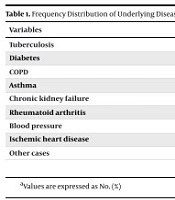
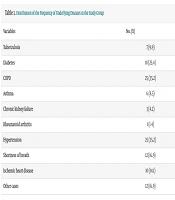
This is a descriptive cross-sectional study conducted in 1404 AH. Data on air pollutants, particulate matter, and dust were collected from the Zabol Meteorological Center. Additionally, 96 patients referred to Amir al-Momenin Hospital in Zabol were examined in this study. The results showed that the highest prevalence was blood pressure (26.04%), and the lowest prevalence was rheumatoid arthritis (1.04%, Table 1).
Table 1.Frequency Distribution of Underlying Diseases in the Study Group
VariablesValue a
Tuberculosis5 (5.20)
Diabetes15 (15.62)
COPD20 (20.83)
Asthma 6 (6.25)
Chronic kidney failure2 (2.08)
Rheumatoid arthritis1 (1.04)
Blood pressure25 (26.04)
Ischemic heart disease10 (10.41)
Other cases12 (12.5)

a Values are expressed as No. (%)

5. Discussion

In a case-crossover study conducted by Li et al. in eight major cities in China, a 10 μg/m3 increase in the 2-day moving average of PM10, SO2, and NO2 concentrations was significantly associated with an increase in daily cardiovascular disease mortality (5). Another study examined 12 years of time series in the United States. The results showed that daily changes in PM10-2.5 were associated with emergency room admissions due to cardiovascular disease among the elderly (over 65 years of age) (6). In a case-crossover study in ten southern European cities, results showed that forest fires and PM10 were associated with increased cardiovascular disease mortality in city dwellers (7). In a time-series study by Zhao et al., 56,940 outpatients in China were examined. Results showed that a 10 μg/m3 increase in present-day PM10, SO2, and NO2 concentrations was associated with a 0.56%, 2.07%, and 2.90% increase in outpatient visits for arrhythmia (8).
A study conducted on 5,973 cases between 2000 and 2010 in Stockholm showed that exposure to moderate levels of O3 increased the risk of cardiac arrest in patients (9). In a study conducted in a region in northeastern China, the results indicated that air pollution increases cardiovascular disease in overweight and obese individuals (10). Increasing the amount of nanograms per cubic meter caused an increase in coronary events (11). Another study that examined data from 22 European groups found that 0.1% of air pollutants were associated with mortality from heart disease (12). In another study, results showed that short-term exposure to fine particle air pollution was mainly associated with the onset of acute ischemic events (myocardial infarction and stroke) (13).

5.1. Conclusions

The findings of this study indicate that exposure to dust above the permissible limit causes a significant increase in symptoms of heart disease and a significant decrease in heart function parameters. Therefore, to reduce or eliminate the prevalence of these symptoms, plans should be made to reduce the amount of dust in the area.
Acknowledgments

Footnotes

References

  • 1.
    Wang Y, Stein AF, Draxler RR, de la Rosa JD, Zhang X. Global sand and dust storms in 2008: Observation and HYSPLIT model verification. Atmos Environ. 2011;45(35):6368-81. https://doi.org/10.1016/j.atmosenv.2011.08.035.
  • 2.
    Salvi S. Health effects of ambient air pollution in children. Paediatr Respir Rev. 2007;8(4):275-80. [PubMed ID: 18005894]. https://doi.org/10.1016/j.prrv.2007.08.008.
  • 3.
    World Health Organization. The World health report : 2002 : Reducing risks, promoting healthy life. Geneva, Switzerland; 2002.
  • 4.
    Negi KS, Kandpal SD, Kukreti M. Epidemiological factors affecting low birth weight. JK science. 2006;8(1):31-4.
  • 5.
    Li H, Chen R, Meng X, Zhao Z, Cai J, Wang C, et al. Short-term exposure to ambient air pollution and coronary heart disease mortality in 8 Chinese cities. Int J Cardiol. 2015;197:265-70. [PubMed ID: 26142971]. https://doi.org/10.1016/j.ijcard.2015.06.050.
  • 6.
    Powell H, Krall JR, Wang Y, Bell ML, Peng RD. Ambient Coarse Particulate Matter and Hospital Admissions in the Medicare Cohort Air Pollution Study, 1999-2010. Environ Health Perspect. 2015;123(11):1152-8. [PubMed ID: 25872223]. [PubMed Central ID: PMC4629736]. https://doi.org/10.1289/ehp.1408720.
  • 7.
    Faustini A, Alessandrini ER, Pey J, Perez N, Samoli E, Querol X, et al. Short-term effects of particulate matter on mortality during forest fires in Southern Europe: results of the MED-PARTICLES Project. Occup Environ Med. 2015;72(5):323-9. [PubMed ID: 25691696]. https://doi.org/10.1136/oemed-2014-102459.
  • 8.
    Zhao A, Chen R, Kuang X, Kan H. Ambient air pollution and daily outpatient visits for cardiac arrhythmia in Shanghai, China. J Epidemiol. 2014;24(4):321-6. [PubMed ID: 24835409]. [PubMed Central ID: PMC4074637]. https://doi.org/10.2188/jea.je20140030.
  • 9.
    Raza A, Bellander T, Bero-Bedada G, Dahlquist M, Hollenberg J, Jonsson M, et al. Short-term effects of air pollution on out-of-hospital cardiac arrest in Stockholm. Eur Heart J. 2014;35(13):861-8. [PubMed ID: 24302272]. https://doi.org/10.1093/eurheartj/eht489.
  • 10.
    Qin XD, Qian Z, Vaughn MG, Trevathan E, Emo B, Paul G, et al. Gender-specific differences of interaction between obesity and air pollution on stroke and cardiovascular diseases in Chinese adults from a high pollution range area: A large population based cross sectional study. Sci Total Environ. 2015;529:243-8. [PubMed ID: 26022408]. https://doi.org/10.1016/j.scitotenv.2015.05.041.
  • 11.
    Wolf K, Stafoggia M, Cesaroni G, Andersen ZJ, Beelen R, Galassi C, et al. Long-term Exposure to Particulate Matter Constituents and the Incidence of Coronary Events in 11 European Cohorts. Epidemiol. 2015;26(4):565-74. [PubMed ID: 25978793]. https://doi.org/10.1097/EDE.0000000000000300.
  • 12.
    Beelen R, Stafoggia M, Raaschou-Nielsen O, Andersen ZJ, Xun WW, Katsouyanni K, et al. Long-term exposure to air pollution and cardiovascular mortality: an analysis of 22 European cohorts. Epidemiol. 2014;25(3):368-78. [PubMed ID: 24589872]. https://doi.org/10.1097/EDE.0000000000000076.
  • 13.
    Combes A, Franchineau G. Fine particle environmental pollution and cardiovascular diseases. Metabolism. 2019;100S:153944. [PubMed ID: 31610849]. https://doi.org/10.1016/j.metabol.2019.07.008.

Crossmark
Crossmark
Checking
Share on
Cited by
Metrics

Ordering Reprints

Articles are published under the Creative Commons license stated on each article. No permission or royalty fee is required for uses permitted by that license. CCC handles optional bulk and customized reprint orders. Any quotation covers production and delivery services only, not copyright permission. > Request Reprints from CCC 

Search Relations

Author(s):

Related Articles