
1. Background
Recombinant follicle-stimulating hormone (rFSH) remains a vital therapeutic agent in reproductive medicine, offering a highly pure and consistent formulation for infertility treatment. Most clinical research has focused on optimizing its use in assisted reproductive technology (ART), primarily in vitro fertilization (IVF), where its main application is controlled ovarian stimulation to induce the development of multiple follicles (1, 2). Studies continue to confirm the high efficacy and safety of rFSH preparations (follitropin alfa and beta) in achieving high oocyte yield and favorable clinical pregnancy rates, even when compared against biosimilar or urinary-derived alternatives (2, 3). A key area of recent investigation involves individualizing treatment, with growing evidence suggesting that adding rFSH may benefit specific patient groups, such as women of advanced maternal age, by significantly increasing live birth rates (4, 5). Furthermore, rFSH was efficient in the super-stimulation of the ovary and embryo recovery in dairy cattle, too (6).
Estrous cycle irregularities are a significant challenge across the Felidae family, impacting both companion animal management and endangered species conservation. In the domestic queen, common problems involve abnormal cyclicity, such as prolonged estrus, which is sometimes linked to cystic ovarian follicles, and ovarian remnant syndrome, where signs of heat behavior unexpectedly recur in a spayed cat due to residual functional ovarian tissue (7, 8). More broadly across the Felidae, a major hindrance to captive breeding is ovarian quiescence or anestrus, where the female fails to cycle altogether; this condition is often linked to the stress of the captive environment, which can increase glucocorticoid levels and negatively affect ovarian function (9). Furthermore, while all felids are induced ovulators, the frequency of spontaneous ovulation varies widely between species, creating management difficulties for assisted reproduction techniques like artificial insemination in certain wild cats, such as the clouded leopard (10). Therefore, non-invasive techniques like fecal hormone monitoring and accelerometry are increasingly studied to better characterize and manage these complex estrous variations in both domestic and wild felids (9, 10).
The application of FSH in Felidae is fundamental to ART, serving primarily to induce multi-follicular development for the collection of oocytes (gamete rescue) and subsequent use in IVF or AI, particularly for endangered wild felids (10). Current research using the domestic cat as a model has demonstrated that serial exogenous FSH administration effectively reverses the negative effects of the non-breeding season. For instance, treatment of anestrous queens with porcine FSH was found to improve oocyte quality and enhance in vitro developmental competence, resulting in higher rates of blastocyst formation (11). The goal of FSH treatment is to overcome the typical induced-ovulation cycle by promoting the synchronous maturation of multiple follicles (12, 13). However, high variability in individual and species-specific ovarian response to exogenous FSH remains a significant challenge for predictable ART success across the broader Felidae family (10).
2. Objectives
The present study aimed to explore the efficacy of rFSH on ovarian response during early seasonal estrus in domestic cats in Iran.
3. Methods
All experimental procedures involving the domestic cat (Felis catus) were conducted in strict accordance with institutional and national guidelines for animal care and use. The study protocol was reviewed and approved by the Institutional Animal Care and Use Committee at Shahrekord University (IR.SKU.REC.1402.045). All animals were housed under standardized conditions with a natural daily light cycle of 14 hours light/10 hours dark and were provided fresh water and a commercial processed diet (Fidar, Iran) ad libitum.
A total of 12 reproductively intact adult domestic queens, aged 1 - 5 years and weighing 2.5 - 3 kg, were selected during the early seasonally active period (October 2022 - February 2023). Cats were randomly allocated into four experimental groups (n = 3 cats per group); groups 1 and 2 were cats that received daily 2.0 and 2.5 mg rFSH for 2 consecutive days, respectively. Group 3 comprised cats that received daily 2.5 mg rFSH for four consecutive days. Group 4 was designed as a control receiving normal saline. The treatment consisted solely of rFSH (Cinnal-F, Cinnagen, Iran). All injections were administered intramuscularly at approximately 08:00 - 10:00 hours daily.
All cats were examined for ovaries to confirm the lack of corpus luteum on their ovary at the beginning of the study using a 10 MHz abdominal transducer (Mindray, China). The ovary volume was measured using the dimensions (length, width, and height) of both ovaries. Ovarian volume was calculated using the formula for a prolate spheroid: The total ovarian volume for each cat was recorded as the left and right ovarian volumes. Volume was estimated based on the formula: V = (4/3)πa2c; where a = W/2 and c = L/2, W = mean radii of width and height, and L = radius of length.
Ovariectomy was performed surgically 24 hours after the final rFSH. Ovaries were immediately transported to the laboratory in warm phosphate-buffered saline (PBS) supplemented with 1000 IU/L penicillin (Denazist Asia Co., Iran) and 1 mg/L streptomycin (Denazist Asia Co., Iran). Oocytes were recovered by surgically slicing the ovarian cortical tissue into small fragments and flushing the fragments with the previous medium supplemented with 5% fetal bovine serum (Zistpajouh Co., Iran) and 100 IU/L of sodium heparin sulfate (10000 IU/mL; Alborzdaru, Iran).
All recovered oocytes [cumulus-oocyte complexes (COCs)] were counted under a stereomicroscope to determine the total number of retrieved oocytes per cat. The oocytes were categorized based on cumulus investment and morphological integrity into grades A, B, and pooled C and D. Briefly, COCs with more than 3 granulosa layers and homogeneous cytoplasm were considered as grade A. The COCs with less than one and two layers of granulosa layers were grade B. Denuded recovered oocytes with homogeneous cytoplasm were considered as C, and decomposed cytoplasm were categorized as D.
3.1. Statistical Analysis
Logistic regression was used to analyze the effects of treatments on the quality of retrieved oocytes. Ovarian volume was compared among groups using the Kruskal-Wallis test. Results are presented as the mean ± standard error of the mean (SEM), with significance set at P < 0.05. The data were analyzed using the Statistical Analysis System (SAS) 9.4.2.
4. Results
A total of 470 oocytes were recovered from the ovaries of all cats, with 194 (41.3%), 85 (18.1%), and 191 (40.6%) being qualified as grades A, B, and C/D, respectively. By pooled data, the total oocytes per ovary were 10.7 ± 6.19 (n = 3) for cats that did not receive rFSH and 19.6 ± 3.2 (n = 12) for cats that received rFSH (P = 0.1989). Table 1 shows the effects of different treatments on ovary volume and the number of retrieved oocytes. Based on Table 1, ovary volume was significantly higher in group 1 compared to other groups. Logistic regression analysis (Figure 1) shows no difference among groups for the odds ratios of good quality oocytes (grade A+B) to low quality oocytes (C+D).
Table 1.
The Effects of Different Doses of Recombinant Follicle-Stimulating Hormone on the Ovarian Response of Domestic Cats a
| Variables | rFSH (means) | SEM | P-Value b | |||
|---|---|---|---|---|---|---|
| Control | 4 mg | 5 mg | 10 mg | |||
| Ovary volume (mm3) | ||||||
| Right | 60.2 A | 178.7 B | 69.4 A | 114.6 A | 16.8 | 0.0237 |
| Left | 40 B | 128.2 A | 80.9 A, B | 106.05 A | 17.1 | 0.0405 |
| Oocyte per ovary (No.) c | ||||||
| Grade A | 5.2 (31) | 5.5 (81) | 13.5 (51) | 8.5 (31) | 3.1 | 0.3243 |
| Grade B | 1.7 (10) | 2.7 (25) | 4.2 (35) | 5.2 (19) | 1.14 | 0.2515 |
| Grade CD | 3.8 (23) | 9.3 (71) | 3 (51) | 8.5 (46) | 2.84 | 0.2542 |
| Total | 10.7 | 17.5 | 18.7 | 22.3 | 6.07 | 0.4037 |
| Proportion of oocytes | ||||||
| Grade A | 0.41 | 0.3 | 0.5 | 0.4 | 0.06 | 0.2921 |
| Grade B | 0.2 | 0.16 | 0.16 | 0.25 | 0.06 | 0.5506 |
| Grade CD | 0.38 | 0.53 | 0.34 | 0.36 | 0.09 | 0.2699 |
Abbreviations: rFSH, recombinant follicle-stimulating hormone; SEM, standard error of means.
a Same capital letters indicate not significantly difference (P > 0.05).
b Kruskal-Wallis multiple comparison test.
c Data in parenthesis are absolute values of oocytes within each group.
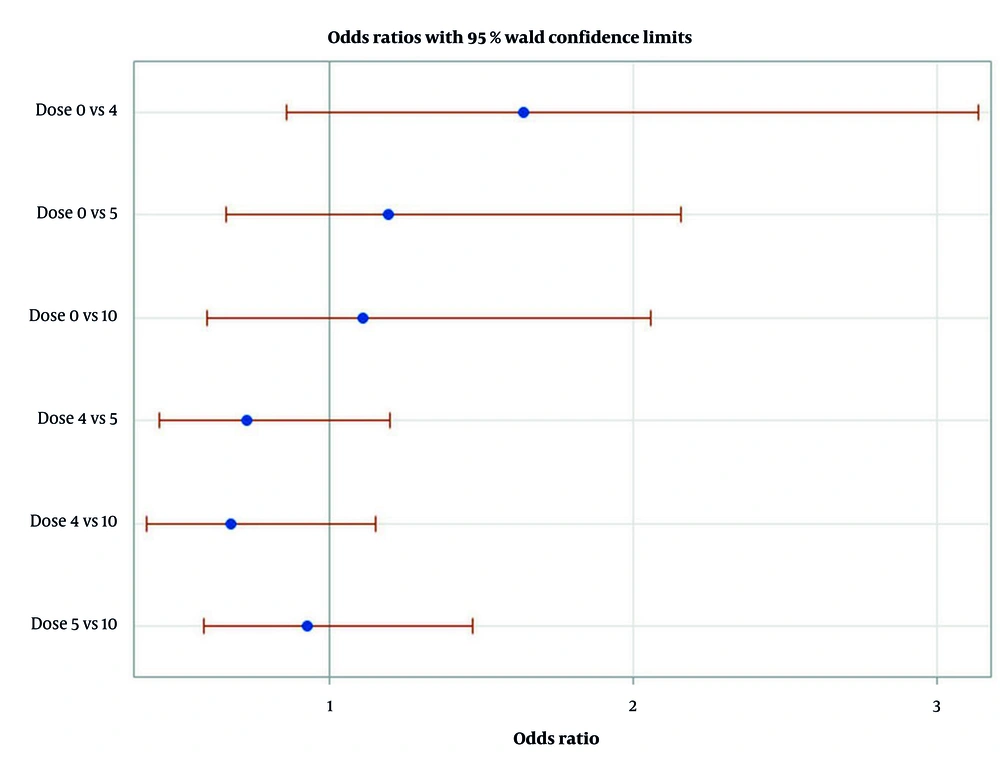
Figure 1.
Estimated odds ratios with a 95% confidence interval of good quality oocytes (grades A and B; n = 279) to low quality oocytes (grades C and D; n = 191) compared between different doses
5. Discussion
Our results showed no beneficial effects of rFSH on follicle development and oocyte retrieval in Iranian domestic cats. Comparative studies on feline ovarian stimulation often focus on optimizing the type and total dose of gonadotropin to move the anestrous queen into the follicular phase. Historically, many protocols relied on pituitary-derived porcine follicle-stimulating hormone (pFSH), which yielded variable results due to its inconsistent purity. The shift to rFSH was aimed at providing consistent biological activity and reducing the risk of immune reactions (11).
The ovarian estimated volume was the highest in the 4 mg group among all, which can be considered as a status of follicular development. Achieving maximal follicular recruitment requires hitting a specific concentration threshold, but increasing the dose beyond this point does not necessarily improve the developmental competence of the retrieved oocytes; instead, it may lead to the retrieval of more atretic or morphologically poor-quality oocytes (13). Our findings suggest that all the active treatment groups (G1 through G3) might have exceeded this minimum threshold, effectively placing them on a response plateau, where further dose increases (e.g., from 4 mg total to 10 mg total) yield statistically similar results in terms of overall ovarian volume and raw oocyte counts.
A critical point of comparison is the duration of treatment, which relates directly to follicular synchronization. The goal of using rFSH is to recruit and synchronize a cohort of follicles that are all ready for final maturation at the time of retrieval. Protocols using shorter durations (e.g., 2 days, like G1 and G2) rely on the high FSH dose overcoming the natural follicular attrition cycle quickly. Conversely, longer protocols (e.g., 4 days, like G3) mimic a more gradual, physiological increase in FSH, theoretically leading to a more evenly developed group of follicles (10). However, published outcomes show that longer durations can increase the risk of cystic follicular development or premature luteinization, which dramatically reduces the yield of viable, fertilizable oocytes, potentially offsetting any benefit gained from the higher total dose (13). Therefore, if both the short and long protocols resulted in some degree of suboptimal synchronization or hyperstimulation-related issues, the final measured outcomes might indeed converge, masking the intended difference between the 2-day and 4-day regimes.
The intrinsic biological variability frequently overrides subtle differences in hormonal protocols. Published data consistently highlight that the success of ovarian stimulation is highly dependent on the donor cat’s inherent physiological state, including age, body condition score, and most importantly, the depth of anestrus at the time of the first rFSH injection (10). Even within a strictly controlled cohort of domestic cats, the number of resting primordial follicles available for recruitment, the individual cat’s sensitivity to exogenous rFSH, and the timing of the initiation of the protocol relative to the natural follicular wave all introduce noise. If there was slight variation in the reproductive history or baseline health of the animals within the groups, this physiological variability could easily introduce enough scatter in the final outcome data (ovary volume and oocyte count) to prevent the relatively small, incremental differences in rFSH doses from reaching statistical significance (11).
On the other hand, the variability in FSH receptor genes and downstream molecular pathways affecting follicular growth in felids may contribute to explaining variable ovarian responses to FSH (14). The results of the present study showed no effects of the administered doses of rFSH for oocyte retrieval in cats. Further studies with a higher sample size are needed to explore the efficacy of rFSH for ovary management in cats.