1. Background
Breast Cancer is a multifactorial disease; it is a complex combination of genetics with intrinsic factors (host genetic) and extrinsic factors (environmental factors).
For breast cancer, the list of environmental risk factors includes an individual’s development, exposure to microbes, therapeutic involvement, toxicants, body fat, smoking and alcohol intake, and occupational exposures, including shift work as well as metabolic and physiologic processes, that may modify the body’s internal environment.
The most intrinsic cases of breast cancer are associated with 2 abnormal genes, BRCA1 and BRCA2.
Genome-wide association studies (GWAS) have identified many loci associated with breast cancer risk as rs2363956 and rs3803662 are associated with ER-positive breast cancer
GWAS identified genome-wide association with breast cancer risks in European, (1, 2) African, (3, 4), and American populations (5-7).
Recently, genome-wide association studies (GWAS) have come to know that more than 80 loci are associated with breast cancer. Individually, these variants define only 16% of breast cancer heritability (7).
This is important that they find a ratio of the genetic risk factors in GWAS, including limitations of genotype variation.
In the past, breast cancer rapidly increased around the world and indicated that genetic factors are responsible for 27% of the total breast cancer risk (8).
The international agency for research on cancer (IARC) published, in 2012, that there were 1.68 million breast cancer patients (9).
Therefore, it is interesting to note that SNPs are the main factor in the development of cancers (10, 11).
Breast cancer is associated with low penetrant risk, quite similar to FGFR2, MAP3K1, LSP1… (12), however, only 5% of mutations induce cancer (13).
Therefore, it seems important to evaluate the association between low penetrant and breast cancer risk.
We studied the association between polymorphism and breast cancer while assaying 3 markers, namely estrogen receptor, progesterone receptor, and human epidermal growth factor receptor-2.
2. Methods
2.1. Patients and Controls
The study population consisted of 160 controls and 126 women patients with histologically diagnosed Grade-4 carcinoma breast cancer.
They were enrolled in the study from the Khas medical center, Hazrat Rasoul medical complex, Tehran, Iran was considered for our study that included women aged 30 - 55 years.
Histochemopathological were carried out by experiences Lab. The patients and healthy females were from different areas in Iran. This study was ethically approved by the local ethical committee of Islamic Azad University from the point of view of patients’ and also control group samples’ rights.
2.2. Genotyping
Genomic DNA was obtained from peripheral blood leucocytes by salting out method or using the FelxiGene DNA extraction kit (Qiagen, Germany).
DNA samples were genotyped for the 2 SNPs: rs2363956 from 19p13.1 locus, gene ANKLE1 (ankyrin repeat and LEM domain containing 1), and rs3803662 of CASC16 (cancer susceptibility 16) (Table 1). SNPs were selected based on the highest association in GWAS studies (14, 15).
Table 1.
Internal Primers and External by Tetra-Primer ARMS –PCR Technique
| Primers | Size, bp | ||
|---|---|---|---|
| CASC16 (rs3803662) | |||
| F- inner | CCTTAATGCCTCTATAGCTGGCT | T | 184 |
| R- inner | CACAGTTTTATTCTTCGCTACGG | C | 126 |
| F- outer | AACTATGAGAGATATCTATGTGCAATGGT | 264 | |
| R- outer | GTTTATACAGGAGTGAAAATCAGGAAGT | ||
| ANKLE1 (rs2363956) | |||
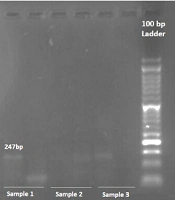
| F- inner | TGCAGAGGTGACAACAGGGACATTGGTTT | T | 247 |
| R- inner | GGGGGTCCTGGGTCAGCCTTCC | G | 167 |
| F- outer | TCATCGCTGTCTCATCCCTCCTCCTCTC | 364 | |
| R- outer | CATGGACAACATGCAGAAGTCCCTGCCT |
Genotyping of the SNPs, primer sequences, and cycling conditions [rs2363956: 94°C, 30 seconds; 37°C, and for rs3803662: 35°C, 30 seconds; 72°C, 60 seconds [35 cycles] for analyses were performed by PCR, followed by appropriate Tetra-Primer ARMS –PCR digestion according to the Primer3, Gene runner (Table 2).
Table 2.
Gene Genotype Frequencies for Cases and Controla
| SNP/Genotype | Cases, (n = 126) | Controls (n = 160) |
|---|---|---|
| CASC16 (rs3803662) | ||
| CC | 48 (38.09) | 48 (30.00) |
| TC | 54 (42.85) | 60 (37.5) |
| TT | 24 (19.04) | 52 (32.5) |
| ANKLE1 (rs2363956) | ||
| TT | 33 (26.19) | 24 (15.00) |
| GT | 60 (47.61) | 116 (72.5) |
| GG | 33 (26.190) | 20 (12.5) |
aValues are expressed as No. (%).
2.3. Statistical Analysis
The Hardy-Weinberg equilibrium (HWE) was evaluated by Chi-squared (χ2) statistics. The data was tested for association with breast cancer.
The distinction in the allele and genotype frequencies between cancer patients and healthy persons is determined using standard χ2. The odds ratio (OR) and the associated 95% confidence intervals (95%CI) were also calculated.
The SNPs were assessed under recessive and dominant inheritance models.
3. Results
The present study explores the association of CASC16 (rs3803662) and ANKLE1 (rs2363956) with breast cancer risk, due to the fact that it was for first time of our population.
We considered these genotypes and 3 hormone markers relating to the risk factors of breast cancer (Tables 3 and 4 and Figure 1).
Table 3.
Comparison Between Genotypes, Odds Ratio and P Value
| SNP/Genotype | OR | 95% CL | Chi2 | P Value |
|---|---|---|---|---|
| CASC16 (rs3803662) | ||||
| CC | 0.900 | 0.523 - 1.550 | 0.14 | 0.70387 |
| TC | 0.462 | 0.246 - 0.865 | 5.91 | 0.01502a |
| TT | 1.950 | 1.062 - 3.580 | 4.70 | 0.03020a |
| ANKLE1 (rs2363956) | ||||
| TT | 0.376 | 0.204 - 0.693 | 10.17 | 0.00143b |
| GT | 1.200 | 0.559 - 2.578 | 0.22 | 0.64021 |
| GG | 0.313 | 0.166 - 0.593 | 13.41 | 0.00025b |
aP ≤ 0.05
bP ≤ 0.001.
Table 4.
Test Histochemical Upon Triple HER2- , HER2+, ER-, ER+, PR- and PR+ Tumor
| ER+ | ER- | PR+ | PR- | HER2+ | HER2- | |
|---|---|---|---|---|---|---|
| CASC16 (rs3803662) | ||||||
| CC | 16 | 2 | 16 | 2 | 10 | 10 |
| TC | 25 | 5 | 25 | 5 | 10 | 20 |
| TT | 5 | 3 | 5 | 3 | 3 | 5 |
| ANKLE1 (rs2363956) | ||||||
| TT | 24 | 3 | 24 | 3 | 8 | 19 |
| GT | 8 | 8 | 8 | 8 | 8 | 8 |
| GG | 19 | 0 | 19 | 0 | 7 | 12 |
![Column Chart genotypes frequencies [n (%)] for cases and control: Analyses of 126 affected women and 160 controls.](https://brieflands.com/journals/gct/articles/63407/figures/gct-In_Press-In_Press-63407-i001-preview-preview.webp "Column Chart genotypes frequencies [n (%)] for cases and control: Analyses of 126 affected women and 160 controls.")
Figure 1.
Column Chart genotypes frequencies [n (%)] for cases and control: Analyses of 126 affected women and 160 controls.
In the current study, ANKLE1 (rs2363956) GG and then TT polymorphisms were significantly associated with breast cancer (26.190, frequency, odd ratio; 0.313, CI; 0.166 - 0.593, P value; 0.00025***) and; ( 26.19, frequency, odd ratio; 0.376, CI; 0.204 - 0.693, P value; 0.00143***) respectively and compared to CASC16 (rs3803662) TC; Frequency; 42.85; OR; 0.462, CL; 0.246 - 0.865, Chi2; 5.91, P value; 0.01502**.
On the other hand, it has been shown that there is a significant association between low allele in ANKLE1 (rs2363956) GT and CASC16 (rs3803662) TT with ER- and PR- negative tumors through immunohistochemistry pathology (Table 4 and Figure 2)
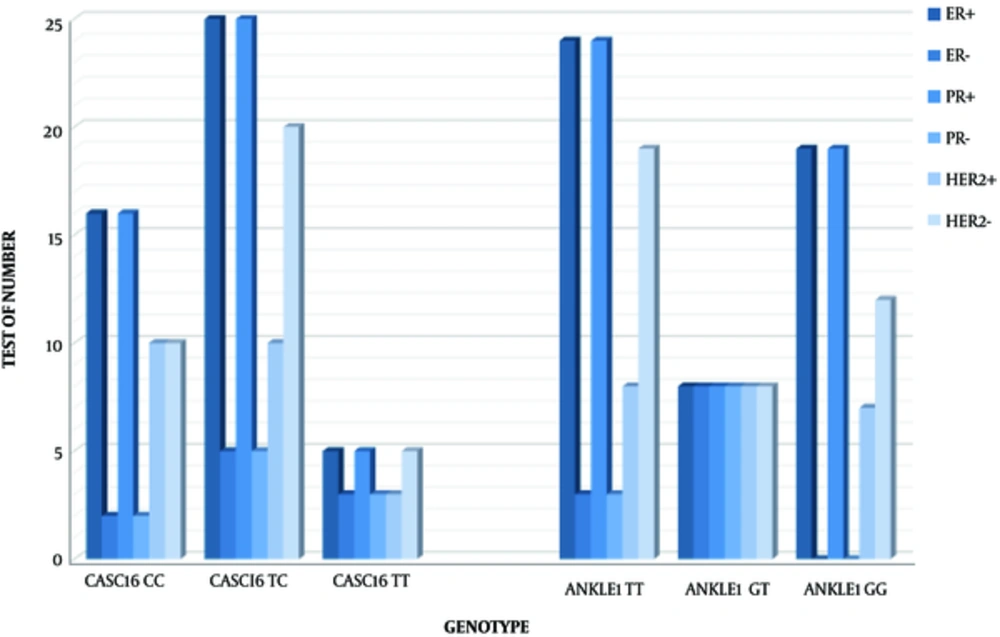
Figure 2.
Column Chart Test Immunohistochemically Tumor; genotypes were highest positive in, HER2+, ER+ and PR+ tumor.
That of course, in the strongest level of PR, ER were equal in every group. The 2nd strongest in 3 groups, include ANKLE1 (rs2363956) TT and CASC16 (rs3803662) TC, level of Her2 negative were increased to compare Her2 positive.
In addition, we observed strongly, ANKLE1 (rs2363956) TT and GG association with ER-positive, even equally to PR-positive tumors. It means that amount of number ER Positive = PR positive in all genotype that include; ANKLE1 (rs2363956) GG, GT, and TT similarity CASC16 (rs3803662), CC, TC, and TT.
Next, we show an increase in Her2-negative compared to Her2-positive in rs2363956 TT, rs2363956 GG, and rs3803662 TC SNPs.
We also observed an equal number in all negative- and positive-marker tumors in ANKLE1 (rs2363956) GG (it means of, ER+ =ER- =PR+ = PR- = Her2+ = Her2-).
4. Discussion
Recent GWAS have cleared several of SNPs in novel independent loci to markers of breast cancer (1, 16).
The present study aims to discover whether 2 SNPs could be associated with tumor subtypes or not. We hypothesized that genetics vary differently in each ethnic population. Recent studies have identified the association of rs3803662 with the risk of breast cancer in Swedish, Russian, Chilean, Chinese Han, and Caucasian populations including data: 3.76 (95%CI 1.02 - 13.84, P = 0.046) (10), (95% CI, 1.52 (1.30 - 1.77) (17), 3.76 (95%CI 1.02 - 13.84, P = 0.046) (18). 1.25 (95% CI, 1.00 - 2.51) (19), 2.04 (95 % CI, 1.14 - 3.66, P = 0.017) (20), 1.53 (95% CI ,1.08, 2.15, P = 0.004) (21), 0.83, (95% CI ,0.75 - 0.92, P = 0.0003) (22). An association between rs2363956 and breast and ovarian cancer was found by Antoniou, in 2010, with estrogen receptor-negative breast cancer 0.83, 95% CI 0.75 - 0.92, P = 0.0003) and an association with estrogen receptor-positive (1.07, 95% CI 1.01 - 1.14, P = 0.016) (15, 23).
Importantly, the numbers of triple, double, and mono negative basal patients may increase, and there may be an association between ER-negative, ER-positive, and triple-negative (23), 1.17 (95% CI, 1.09 - 1.26; P = 3.66 × 10⁻⁵ (24), as well as rs3803662 to positive estrogen receptor tumors disease (25).
Yang XR and Millikan RC, upon the United States, African-American, and Latina stated that triple-negative breast cancer woman are younger, have an early age menarche, higher body mass, and lose breast feeding.
In the current study, ANKLE1 (rs2363956) GG and then TT polymorphisms were significantly associated with breast cancer (26.190, frequency, Odd Ratio; 0.313, CI; 0.166 - 0.593, P value; 0.00025***).
In addition, it has been shown that a significant association in low allele in ANKLE1 (rs2363956) GT and then CASC16 (rs3803662) TT to ER and PR negative tumor by Immunohistochemi- pathology.
That of course, in strong level of PR, ER was equal in every group. The 2nd strongest in the 3 groups include ANKLE1 TT and CASC16 TC, level of Her2 negative were increased to compared Her2 positive.
In conclusion, the genetic and functional mechanism of negative marker breast cancer in some SNPs will be studied.
Now, we report that there is no association between this SNPS and the triple negative marker, however, there is some significant association between positive estrogen and progesterone tumor markers.