
1. Background
Studies revealed that employees sit more than 8 hours per day in their working place (1). The long sitting time may cause health-related problems for the employees (2, 3). This situation can be further detrimental when employees do not use a healthy posture for sitting during the long working time (4). Up to now, several studies have investigated the diseases associated with extended sitting posture (1). Sitting in an awkward posture in prolonged sitting time may cause spinal or musculoskeletal disorders (1, 5-8). Musculoskeletal disorders (MSDs) have been recognized as the most common deriders associated with sitting for long periods (9). MSDs have been defined as muscular pain or injuries to the human support system (10). MSDs are among the leading causes of occupational health problems, imposing burdens for workers, employers, and society (11, 12). Particularly, 25% - 51% of office workers who sit for a long time suffer from low back pain (LBP) (1, 13), and neck (41.6%), and shoulders (40.6%) (13) symptoms, which are the most common symptoms of MSD. Hence, among all work-related complications, MSDs may be considered as a prevalent disease in the worksite (14). The MSDs are not limited to western countries, and our investigation shows that they are also common among office workers in Iran (12, 15, 16). According to a systematic review conducted among Iranian workers, LBP is highly observed in middle-aged patients (17), which is the most productive period of working life for a worker (17, 18). Employees are among occupational groups who have internationally been found with relatively high rates of MSDs (19). A recent study on workers with MSDs revealed a decrease in the quality of life score by 31% among them (20).
The mechanisms causing work-related musculoskeletal pain are multi-factorial (21). This complaint can be attributed to numerous risk factors, including a workstation, repetitive movements, long sitting hours, psychological factors, and posture. In the meantime, improper posture acts as a key factor leading to the incidence of MSD (22-25). Poor sitting posture in the workplace (e.g., leaning forward causes upper limb and neck pain) not only influences the personal life and productivity of a worker but also causes significant burdens on the health system (26). On the contrary, studies have shown that correct sitting posture has positive effects on the musculoskeletal system, leading to a reduction in occupational accidents in the workplace (27, 28). Nonetheless, working with prolonged fixed and awkward postures is an inherent part of some jobs (29).
Although some research has been carried out on improper posture (30-32), there is no study on determinants of this behavior among employees. For investigating the determinants of poor sitting posture, both physical and psychosocial factors should be considered to identify perceived determinants of behavior and barriers to a proper sitting posture in office workers before developing effective interventions (23). Most studies have tended to focus on diseases rather than finding factors related to behavior. Thus, the question is that why some employees take a healthy sitting posture and other do not. Preliminarily, Michie et al. (33) expanded a framework taken from 33 commonly used behavioral theories and 128 psychological constructs named the theoretical domain framework (TDF) for identifying the determinants of behavior and barriers to behavior change. The current available theoretical foundations show that still little is known about the underlying mechanism, which can explain the extent to which improper sitting posture can result in various negative outcomes (34-38). Besides, recent studies have used the TDF to develop behavior change interventions in various contexts (38-40), but his behavior has not yet been applied in relation to improper sitting posture among employees.
2. Objectives
Therefore, this study used this comprehensive framework to identify enablers and barriers for taking a healthy posture in the offices from the employees’ point of view.
3. Methods
3.1. Design
This study was done using qualitative semi-structured interviews with office workers between May and June 2019. Purposively selected participants from health care systems, and universities were recruited to participate in an interview. Inclusion criteria were at least working for 2 years in one of the hospitals, health care systems, or university office and willingness to share views.
One of the reasech team members (PH) contacted each of the participants to clarify objectives and study questions, and after obtaining the agreement of the participant, the interview was carried out. A topic guide with reference to a TDF framework was developed by team members with extensive experience in health services that directed semi-structured interviews. Interventions through interviews using TDF-based guides conducted at the workplace are highly successful if they address multiple influences on behavior, including individual, interpersonal, and organizational factors. The researcher conducted interviews at times most convenient for the participants in their workplace for piloting, and two interviews were done with two office workers at Shahid Beheshti University of Medical Sciences. Interviews lasted 18 - 30 minutes. Open-ended questions facilitated exploration of workers; views regarding proper sitting posture which was salient to the interviewees. Interviews were continued until data saturation. When no new code was produced in the last three interviews, data collection was stopped. Key questions were asked from all participants related to taking a healthy posture in their workplace; for example, regarding the working environment, it was asked that how does your work environment influences your sitting posture? After transcribing the interviews, an email or letter was sent to the participants, and they were asked to confirm the interview text and sign it.
3.2. Ethics
This study is part of a PhD thesis in health education and promotion, which was approved by the Ethics Committee of Shahid Beheshti University of Medical Sciences (code: IR.SBMU.PHNS.REC.1397.038). Before interviews, the interviewer tried to make a good relationship with the participants by clarifying the purpose of the study. Participants were confident not only about the confidentiality of their names but also about the reasons for being selected.
3.3. Data Analysis
All interviews were transcribed verbatim, coded, and then analyzed using the method suggested by Hsieh and Shannon (2005), in which the textual data are read, and those parts of the text that on the first impression appear to be related to the predetermined codes are highlighted and are coded using the predetermined codes.
According to directed content analysis, phrases and sentences that referred to determinants of the sitting posture in the workplace were identified and mapped to the TDF domains.
To ensure the credibility of the finding, sufficient time was allocated to collect data; also, we collected data from different people involved with the topic. For external checking, two colleagues who were experienced in qualitative research investigated data and based on their feedback, domains were reviewed (41). To ensure the transformability of findings, a description of the characteristics of participants and the methods and stages of data collection and analysis, along with the examples of participations’ statements, were prepared.
4. Results
4.1. Characteristic of Participants
Among 30 office workers invited to the interview, 25 cases accepted, and 5 workers rejected participation in the study. The age range of workers was 30 - 45 years (mean, 39.8 ± 9.7 years). Ten out of the 25 participants were university employees, while the remaining were from the healthcare system. The work experience of the participants ranged from 5 to 28 years.
4.1.1. Core Theme-Determinants of Taking a Healthy Sitting Posture in the Workplace (TDF Constructs)
The explored themes were mapped to 11 constructs of TDF (skills, knowledge, beliefs about outcomes, environmental context and resources, memory and attention, beliefs about capability, goals, social influences, emotion, reinforcement, intentions, and behavioral regulation). Some of the TDF constructs, which were not relevant to the context of healthy posture among employees were optimism, social/professional role, and identity. The identified determinants according to TDF domains are displayed in Figure 1.
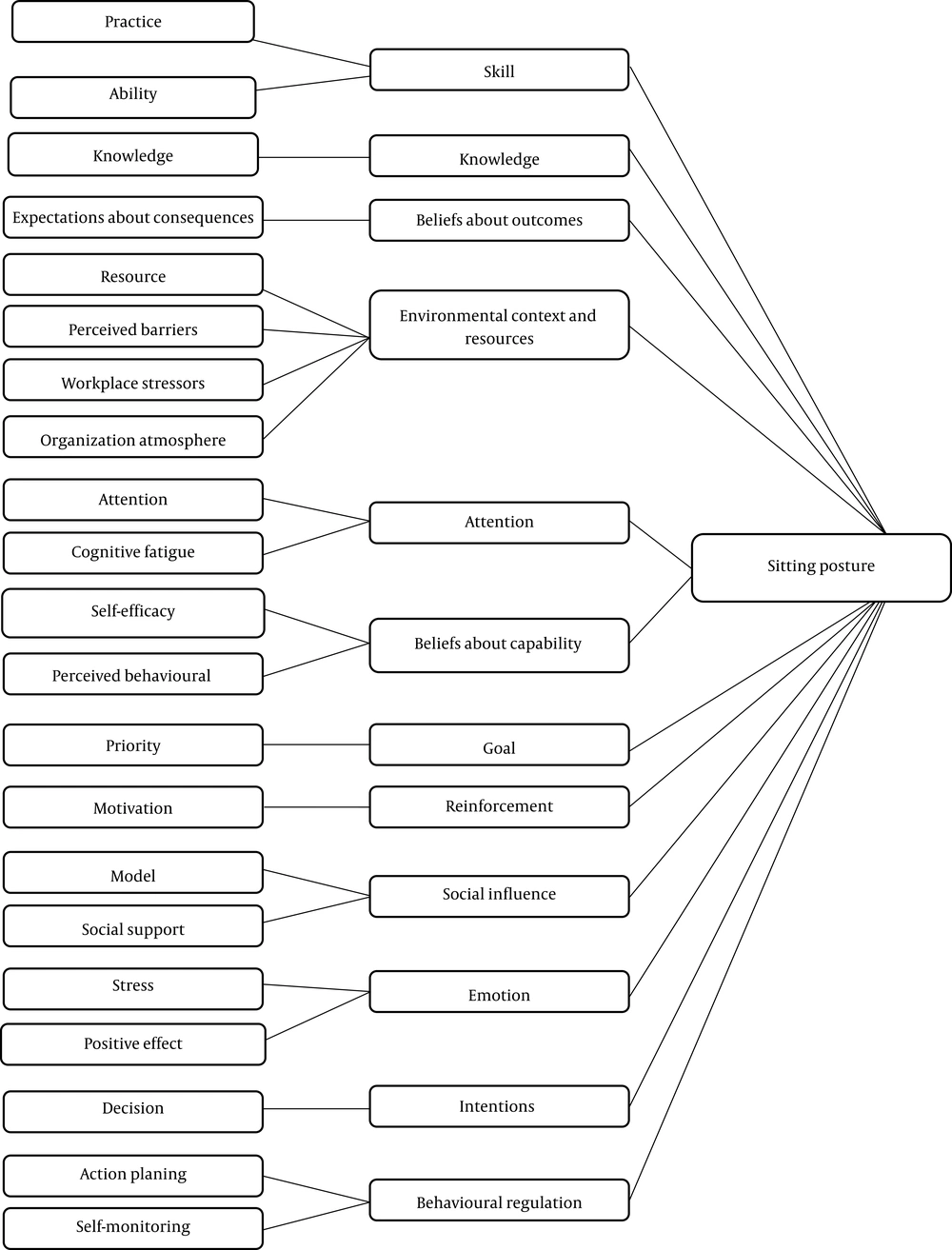
Figure 1.
Identified determinants according to the theoretical domains framework (TDF) Constructs
4.2. Key Domains
4.2.1. Skill
In terms of the construct of “having skill about taking proper posture” cases participated in the interview stated that skill is the key factor in doing a behavior. An employee declared that “Certainly, such behavior (proper posture)should be practiced much enough so that, it would be possible for a person to put it in the treasure of his behavior” (interview no.: 3).”The employee should learn skill of any behavior” (interview no.: 4).
Furthermore, an employee, who had a problem in having proper posture, described his situation in the office as follows: “the problem with this behavior is that I really have never received practical education for doing that so, I think I have not enough skill for taking proper posture” (interview no.: 19).
4.2.2. Lack of Knowledge
Lack of knowledge was another barrier among employees. “To be honest, I’m not alerted about what principle a clerk should do because nobody has told us about the kind of things that we should perform” (interview no.: 1).
Furthermore, workers emphasized the importance of awareness in doing a behavior. “In this context, there is also a need for awareness of the knowledge and the knowledge possessed by a person about his or her own health, how to get better, or how to deal with it badly” (interview no.: 7).
4.3. Beliefs About Consequences
In terms of “beliefs about consequences”, participants commented on many positive and negative consequences as a result of taking a proper posture.
Positive outcomes of a proper posture mostly reported by the workers included reducing fatigue and stress, preventing MSDs, improving the quality of life in worksite, increasing self-esteem, and job performance. Some participants stated:
“Sitting in right position gives me confidence”. Another one who has a good sitting posture feels that “With proper posture, minimum advantage is having less fatigue in the work environment” (interview no.: 11). “The most important consequence is that, we can prevent musculoskeletal disorder in long time” (interview no.: 25).
4.4. Environmental Context and Resources
According to this construct, every situation, or environment that can be an obstacle or encouraging for developing skills, independence, social competence, and behavior is described as environmental context and resources.
Several statements were related to this domain; participants not only complained about ergonomic furniture in their workplace but also discussed an organizational atmosphere and obstacles in the organization. “Our manager believes that, he is responsible about existence of healthy atmosphere in the office thus, in this regard, among organizational courses, he also has designed health-based courses for us in the office” (interview no.: 16).“To be honest, we have good furniture available for us in the workplace” (interview no.: 13)“The manager considers us as a vulnerable resource so, we easily ask for everything that we need (interview no.: 17)”.
4.5. Memory and Attention
It was a common view among the participants (clerks) that “they do not pay attention to their sitting in proper posture if someone doesn’t say that you have not proper posture” (interview no.: 15). Another common thought repeated by participants was that “task overload can cause forgetting of proper posture during worktimes” (Interview no.: 26). Another participant said that “Forget to take proper posture because of being focused on work-task”.
4.6. Beliefs About Capability
Some participants described that “it is difficult for us to have a proper sitting posture, so we aren’t capable to do it”. In this type of beliefs, self-efficacy, perceived behavioral control, and self-esteem are more important notions mostly reported by the interviewer.
“I’m sure not only in normal situation but also in the presence of stress; I’m able to take proper posture in worksite” (Interview no.: 13)“I should say that, taking proper posture during working isn’t easy for me, but it is under my control, if I want, I can do it” (interview no.: 30).
4.7. Goals
Several participants believed that sometimes, this behavior is “less important for them across other health problems”.
Most of the participants neglected this behavior in difficult situations indicating that this crucial factor in preventing MSD has not been highlighted enough among workers.
4.8. Reinforcement
The participants emphasized the importance of reinforcement in doing and also improving sitting posture. One of occupational health office workers said that “which organization has this policy that whoever has a healthy behaviour among other employees, needs to be appreciated by the organization? Organizations can reinforce this behaviour easily” (Interview no.: 20).
A clerk said that “I receive others' appreciate when I take a proper sitting posture while I’m doing my tasks” (Interview no.: 22).
4.9. Social Influences
This domain refers to the interactive behavior between individuals so that they can change each other’s behavior, thinking, and emotion. For example, one participant explained her observation, “my husband believes that I should observe proper posture while working so as to remain healthy” (interview no.: 17).
Another interviewee stated that “existence of a good model who observed proper posture motivated me to have a proper posture”.
4.10. Emotion
The participants reported that emotions can lead to a proper sitting posture. For example, one interviewee said that “you can’t imagine how my emotion can influence my behavior during working; I have a good mental emotion while I’m sitting in proper position” (Interview no.: 14).
Also, one of the participants declared that “when I imagine myself with straight body position in next years, I become motivated to maintain my straight position” (Interview no.: 19).
4.11. Intention
Intention was mentioned by most clerks during the interview. For instance, one employee said: “I know taking proper sitting posture is good for me, but I postponed performing it, because I little knew about its importance” (Interview no.: 20).“Actually, I’m a little lazy regarding following a healthy behavior, whenever I decided to do a healthy behavior, although I had it in my mind, unfortunately, I called it off after a time” (Interview no.: 22).
4.12. Behavioral Regulation
Behavioral regulation was a common theme repeatedly mentioned. Breaking habitual behavior is not easy enough to overcome. In this case, planning and self-regulation for changing behavior were crucial factors as declared by everyone.
One employee said that “I get used to sit with improper sitting posture, but henceforth, I try to improve this behavior” (Interview no.: 15).
Another participant who had not a good posture declared that “I intended to have planning for healthy behavior exactly for proper posture that influenced my body” (Interview no.: 16).
These results provide important insights into taking healthy posture among university employees.
5. Discussion
Office workers are known to be at high risk of MSDs (42). Being in a sitting posture for long hours can develop musculoskeletal symptoms of the waist, neck, shoulders, hands, and fingers (20, 43, 44).
Hence, the present study was conducted to identify the factors influencing sitting healthy posture among office employees. As mentioned earlier, we undertook this study according to the TDF framework, which is used primarily in healthcare settings to investigate the factors influencing clinical behavior in order to design interventions to improve public and occupational health (45).
Identified domains were supported by at least three individual quotations. According to TDF framework, knowledge was the first domain that was questioned. It is important to note that knowledge was mentioned several times by the workers. It is the basis of an intention and whether an intention is translated into action (46).
According to previous studies, although knowledge is necessary for taking suitable posture (14, 47-50), it is not sufficient for doing a behavior; thus, we discussed other determinants, like skill. As stated by Mohammadi Zeydi et al. (50, 51), we found the importance of knowledge and skill in adapting ergonomic principles in the worksite.
Furthermore, behavior change can be influenced by the expected consequences of the target behavior. According to the health behavior goal model and social cognitive theory, perceived health costs and benefits and also perceived emotional costs and benefits are core parts of outcome expectancy. Cognitive, emotional, and behavioral outcomes related to the future are classified into this domain.
Participants frequently referred to the health benefits of healthy sitting posture. Also, they mentioned that an upright sitting posture increases their self-esteem (52). For changing behavior, a person must consider that his current behavior will have a negative effect on his health, and changing it has health benefits (33), which is consistent with previous findings (53).
Current health problems and treatment intensity may also be related to psychosocial factors (54). Attitudinal influences arise from the provision of information by the schools, mass media, religion, and other people. People obtain information on health and health-related behavior, shaping their health-related knowledge, and health-related values, which along with expectations about the consequences of health-related behavior and evaluations of consequences shape attitudes towards health-related behavior contribute to making decisions about engaging in health-related behavior (33). Also, according to the theory of social change and the theory of triadic influence, social influences are effective in changing behavior.
The emotion was another factor mentioned by the workers. In this study, positive and negative effects and also anxiety were highlighted frequently. Previous studies have revealed that job burnout and emotional fatigue, and safe climate at the workplace were the most important determinants in the incidence of work -related MSDs (55-57). Also, studies have confirmed that an upright sitting posture compared with a slumped posture may result in less negative and more positive emotions (52), maintaining self-esteem, and reducing negative and increasing positive mood (52). Negative emotional states are associated with a stooped body posture (41, 58-60). Prior studies have suggested significant associations between MSD complaints and physical (61-) and psychosocial (64-67) factors of the work environment. Materials and resources were other barriers that frequently were mentioned in the interviews. This factor was widely discussed in the TDF framework; thus, we discuss it in detail. Workplace stressors named psychosocial factors are among the most important components affecting the health and safety of a workplace (68). Perceived barriers as one of core constructs of the transtheoretical model (TTM) in the resource category include the lack of ergonomic furniture, organizational atmosphere, environmental stressors, and environmental barriers. In some studies, using proper furniture along with education has been found to decrease the intensity of MSDs (48, 69).
In some studies, psychological factors have been mentioned as risk factors for work-related musculoskeletal disorders (WRMDs) (70, 71); for example, work stress not only causes backward posture but also leads to WRMDs (72). In addition, the management of the organization, especially its workers with a high level of responsibilities, has an important role in leading workers toward having healthy behavior. The manager acts as a model in the worksite so that he/she can boost workers' healthy behavior. Health-promoting leadership can affect employees’ health, which can also be achieved by changing working conditions. Thus, managers are responsible for the employee’s health (73).
According to the theory of the triadic influence model and health action process approach model, self-efficacy has a crucial effect on doing a behavior. This term is the fourth component in TDF as beliefs about ability. Self-efficacy has been reported in many theories, such as self-efficacy theory, health belief model, health promotion model, I-change model. Several studies have shown that perceptions of a person’s ability to do a targeted behavior is an important factor in doing that behavior (74, 75) and increasing self-efficacy, which leads to overcoming barriers for doing the behavior (76). It seems that perceived self-efficacy can be helpful for designing educational programs aimed at improving proper posture among clerks. Some participants declared that taking a healthy posture is difficult for them to show perceived behavioral control among employees. According to the theory of planned behavior (TPB), individuals have different beliefs about behavior, ranging from easy to difficult. The employee’s beliefs can affect the perception of the advantages of having proper posture and evaluation of the outcomes of improper posture along with perceived beliefs about effectual feasibility of the behavior regardless of existing environmental obstacles and having confidence about the ability for having suitable posture (23). Behavioral control is considered as being able to perform a specific type of behavior. Consistent with our study, perceived behavioral control in some previous studies has been mentioned as a strong predictor of behavior (77, 78). Also, there is a direct relationship between taking proper posture and perceived behavioral control (79). However, Abedi et al. (80), in a study, found no relationship between these two factors.
The goal was another category that was discussed by the participants. Interviewees said that in some cases, they do not consider a priority for this behavior against health problems. When the targeted change is compatible with a person’s personal goal structure, the health behavior change is most probable to happen as mentioned in the health behavior goal model. Besides, the personal goal structure consists of higher-order goals. Higher-order goals include goals related to health (e.g. to stay healthy), wellbeing (e.g. to enjoy life to the fullest), personal growth (e.g. to develop talents), and social goals (e.g. to be a good father) (33). The effects of goal in behavior change in different fields have been mentioned (81-83).
As explained in the TDF definition, memory shapes other parts of this framework. In response to interview questions, most participants stated that cognitive fatigue and attention are remarkable elements in taking a healthy posture. For cognitive control, inhibition can be conceptualized as a procedure that blockes the extension of activation and maintenance of the focus on the task at hand (84). Among postures, various levels of autonomic activation provide differences in mental fatigue (85). Exhaustion of (bodily or mental) resources may cause fatigue while carrying out a task (86). In general, evidence suggests that individuals become more tired (87-89) and fall asleep earlier (90) when they are in a lying position compared with an upright posture.
TTM was developed to describe behavioral intention. As some participants declared that they think about changing this behavior, but they postpone it, we used this category for describing this statement. Furthermore, behavioral intention is the most important determinant of individual behavior, according to TPB (80). Abedi et al. (80) introduced behavioral intention as the only predictor of taking correct posture among the nurses. There was a significant link between the constructs of TPB and MSDs among the nurses so that when people with a history of MSD in each organ were compared with people who did not have this problem, they showed lower levels of subjective norm, attitude, perceived behavioral control, and behavioral intention for taking correct body positions at work (91).
The probability of carrying out an action is determined by three factors: (1) Strengthening of the good habits for carrying out the action (reflected by the time spent by a person who has previously performed that task); (2) strengthening of behavioral intention to carry out the action; and (3) the existence of conditions facilitating the performance of the action. The probability of carrying out an action is proportional to the strengthening of good habits and intention. Also, self-monitoring in this category is a process involving self-observation and self-control to maintain an appropriate behavior (33). Lenzen et al. (92) stated that nearly half of the studies (47%) have revealed a theoretical structure for action planning as a crucial factor in behavioral regulation. Behavior change theories are the most common frameworks for goal setting or action planning to change a person’s behavior. Nearly 24% of studies reported self-efficacy -one of the constructs of the Social Cognitive theory (93), - as a key concept for setting goals (94) Using these theories can overcome the intention-behavior gap and barriers to behavior change. Self-Regulation theory, Proactive Coping theory, Health Action Process approach, Self-Determination theory, and TPB other behavioral change theories. These theories were reported to be used because of their focus on bridging the intention-behavior gap and barriers to behavior change. In the present study, 11 domains of the TDF were identified as determinants. In each study, depending on the type of behavior, different domains of the TDF have been selected. In line with our study, in a qualitative study on TDF aimed to investigate barriers and facilitators to breaking up and reducing sitting time, 11 domains related to this behavior were identified (95).
5.1. Conclusions
The results of the present study indicated that taking a healthy sitting posture in employees is a multi-level factor. Also, effective comprehensive interventions are needed to target determinants of doing a behavior at the individual, interpersonal, and organizational levels. Through adopting a theory-based approach, we identified 12 determinants to taking proper sitting posture among office workers. TDF was designed as a theoretical lens to observe the cognitive, emotional, environmental effects on behavior. Its domains are derived from a large number of theories of behavior change. Behavior change requires an understanding of the effects of behavior on the context, in which behavior occurs.
5.2. Strengths and Limitations
The present study was a first attempt to understand determinants of proper sitting posture based on TDF. In this study, only Iranian office workers were included as the study sample. Factors discouraging proper posture may vary between other countries.