
1. Background
Physical activity (PA) is considered as one of the cornerstones for a healthy lifestyle and well-being (1). It is a preventive factor against cardiovascular diseases and many chronic diseases, including diabetes mellitus, cancer, obesity, hypertension (2-5), arthritis, and bone diseases (3, 6). Inactivity and inadequate PA have been identified as the fourth risk factor for non-communicable diseases (NCDs) (6), responsible for more than 41 million deaths annually, within which one-third occur before the age of 70 (7). Despite the known benefits of PA worldwide, 31% of adults are physically inactive (8, 9). According to the third national surveillance on the NCDs risk factors, about 55% of Iranian adults are less physically active than those recommended by the World Health Organization (WHO) (10).
A low level of PA is currently a global concern; so, encouraging PA in current public health policies is a priority (9). At the 57th Assembly of the WHO on May 22, 2004, The Global Strategy on Diet, Physical Activity and Health (DPAS) was adopted (11), providing a clear message about the importance of policies promoting PA (12). In 2013, the World Operational Program for the Prevention and Control of Non-Communicable Diseases (2013 - 2020), creating a political commitment to member states to take measures to control NCDs by targeting four key risk factors, including inadequate PA and nutrition (13). In 2018, Global Health recommended 20 policy actions for countries as part of the Global Physical Activity plan (GPAP) (14). In addition, numerous policy documents such as the European Union (EU) Physical Activity Guidelines and the Healthy Human Services Program goals of the United States (US) Department of Health (2020) show strong support for PA programs (15). Since 2004, different countries have tried to develop various PA programs. For instance, in 2000, the Japanese government adopted a health promotion program called “Health Japan 21”, within which one of the goals was PA (5). Turkey also introduced the “Healthy Nutrition and Active Life program” in 2010 (16), and Qatar developed the Qatar National Nutrition and Physical Activity Action Plan 2011 - 2016 (17). PA has been considered in Iran’s macro-policies presented in the following documents: the third principle of the constitution (as the highest law of the country), general policies of the Supreme Leader (as the highest governing body in Iran), parliamentary laws (Laws on the five-year Economic, Cultural, and Social Development Plans of the Islamic Republic of Iran (first to sixth) (18), Cabinet approvals (for example, Sports Development Regulations for Government employees; National Program for Promoting the Health and Vitality of Women and Girls), Policies of the Supreme Council of the Cultural Revolution, National Programs of the Ministry of Health and Medical Education, Ministry of Education, Ministry of Labor Cooperation and Social Welfare, and Ministry of Sports and Youth. In addition, a reduction of 20% in the prevalence of sedentary behavior within the country was also a goal of the national document to prevent and control NCDs and related risk factors (19). Despite the different policies adopted in Iran, the level of PA is still low (20), and the community seems to not be ready to change its behavior in the field of PA promotion (21). There appear to be many individual, environmental, and socio-cultural factors that influence the successful implementation of policies at both national and local levels (15, 21). On the other hand, various determinants may lead to the adoption of effective PA policies (22). Many policymakers consider environmental and socio-cultural measures as two effective strategies to promote PA of populations (23). Despite the great importance of such policies in promoting PA, lack of development in such policies and poor implementation of such public policies in the Middle East and North African (MENA) region are still one of the biggest health challenges for these countries (24). Several reasons for such challenges are reported, which may include the lack of attention to policymaking research, structural issues in the development process of such countries, inadequate compliance to executive capacities, and lack of attention to social, economic, and cultural context of such societies (24). Limited research has also been conducted on the impacts of PA policies on adults’ activity behaviors (25), which has resulted in a lack of evidence for health policymakers in developing countries (24).
Policy analysis studies with a prospective approach will enable policymakers to analyze current policies and propose practical and appropriate policy options to improve current conditions. This study will be carried out to analyze and recommend policy options to promote PA among urban middle-aged adults in Tabriz, one of the metropolitan cities in Iran.
2. Methods
This research is a multi-method study with an analysis for policy approach including four phases as follow (Figure 1):
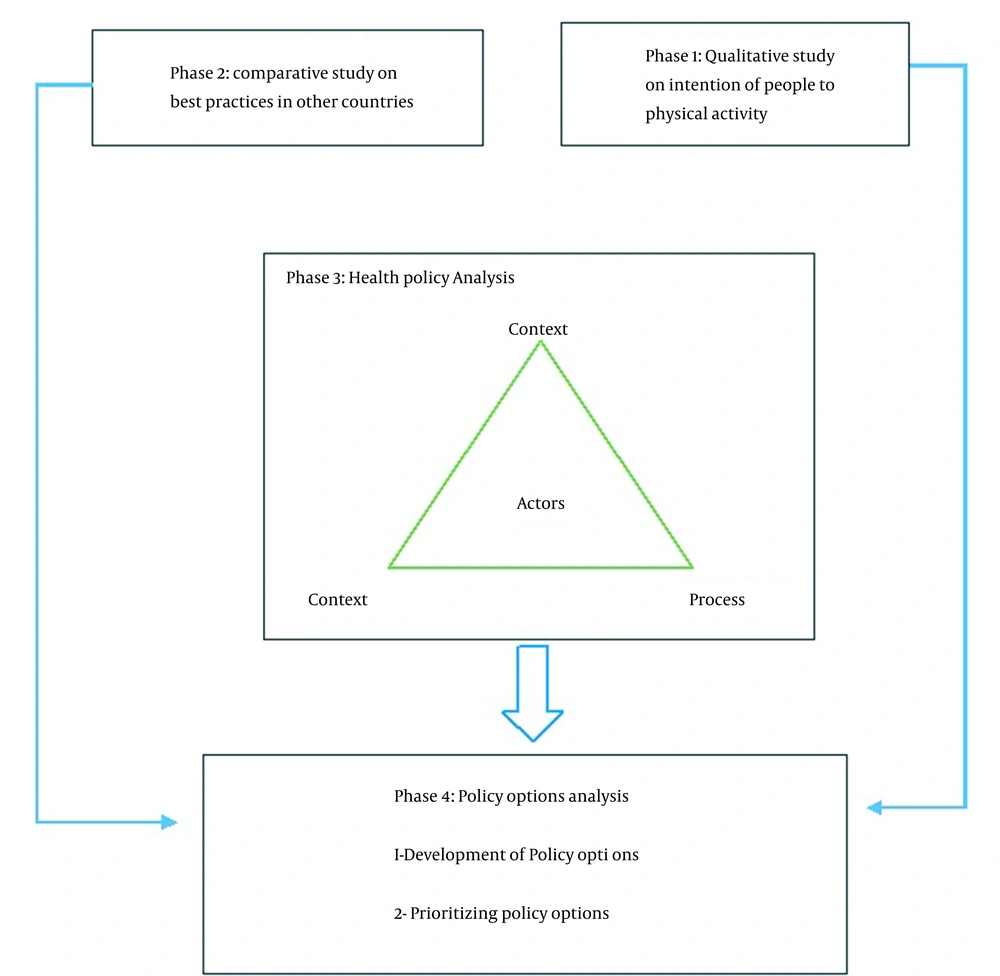
Figure 1.
Study flowchart
2.1. First Phase: Qualitative Study
The first phase is a qualitative study with a conventional content analysis approach (26) that will be carried out to explore the reasons for inactivity of those citizens living in Tabriz. The duration of this phase will depend on the saturation of data which will take at least six months.
2.1.1. Participants and Sampling
The study population in this step will be the people aged 30 - 59 years old living in Tabriz and with health records in Tabriz Health System. Using purposive sampling method, participants will be selected with maximum variation from those individuals with the lowest level of PA, yet with a high level of behavioral intention (to engage in PA) based on the registration data in the records of Tabriz Health System. It is expected that 14 to 26 participants will enter the study (27). The level of PA as well as behavioral intention (intention to start a PA program in the next month) to engage in PA for all individuals will be documented in their health records in urban health centers based on the Stage of Change theory (28). Referring to urban health centers, the researcher will identify inactive individuals who are reported to be at the “contemplation” or “preparedness” stage of change for PA (as core participants). Through a phone call, the participants will first be asked whether they have been physically active [Having daily physical activities, like walking, cycling, and running in a park for at least half an hour for 5 days a week] (29) for the past two weeks, and if not, whether they still intend to have regular PA. If yes, they will then be invited to sign the consent forms in the health center and participate in the interview sessions. Besides core participants, when needed during the interviews, other individuals who do not intend to engage in PA (at the pre-contemplation stage) or those who do engage in regular PA plan (at the practice and maintenance stages) may also be invited for individual interview as extreme cases.
2.1.2. Data Collection
Individual semi-structured interviews will be employed to collect data. Interviews will be continued until data saturation, i.e., when the researcher hears the same points repeating again and again with no new theme or idea emerging (30). The interview time may vary depending on the situation and circumstances of the participants and will be conducted in one or more sessions. Interviews will be conducted in a face-to-face manner, using the interview guide by the first author (Box 1) in an agreed environment between the researcher and the participant and where the participant feels comfortable. The main question that will be initially asked from the participants is ‘how would you explain your PA level?’ Then, some probing questions will be asked according to the interview schedule and the participants’ answers.
Box 1.
The Main Interview Questions Regarding PA in Participants
| Questions |
|---|
| 1. How would you explain the level of your PA? (meaning exercising daily for at least half an hour, 5 days a week so that you feel sweaty and short of breath, such as walking, cycling, or running in the park)? |
| 2. What are the barriers of exercising for you? |
| 3. As a man/woman, in our city, what problems have you experienced while exercising? |
| 4. How exercising can be easier for you? |
| 5. As a housewife/worker/man, how can you exercise at home/work? |
| 6. To what extent are training and sports promotion programs provided in health care centers effective in motivating you to exercise? |
| 7. What programs of exercise are you interested in? |
| 8. What is the best approach that motivates you to exercise? |
2.1.3. Data Analysis
The interviews will be transcribed verbatim immediately after each interview session, and the text will be reviewed for accuracy. Re-reading the transcripts and accompanying commentary notes will help to identify the primary relationships between the concepts extracted from the individuals’ statements. We will read and re-read the transcripts and draw the initial codes from the data. Then, the data will be broken down to extract the meaning from the statements and then will be labeled with conceptual names (codes). After the open coding stage, the codes will be compared based on similarities and differences and then classified into subcategories. Each subcategory with a similar means will be grouped in the relevant categories (31). MAXQDA 10 software will be used to manage the textual data during the data analysis.
2.1.4. Trustworthiness
The criteria outlined by Lincoln and Guba (32) will be applied for data rigor, that is, credibility, transferability, dependability, and confirmability. To establish the credibility of findings, an attempt will be made to select participants with a maximum variation approach, as it will yield to inviting participants who will represent a wide range of socioeconomic status, educational attainment, and work experience. Moreover, the sampling will be continued until data saturation. In order to increase the content validity, member checking will be used, and then the transcribed and encoded data will be returned to the participants in order to confirm and comment. Transferability of data will be provided by offering a comprehensive report of the subject, contextual conditions, participants, data gathering, and data analysis. Then, the team members will discuss each coded transcript in detail to ensure dependability and accuracy in coding. Finally, to enhance confirmability, several research collaborators will recheck the analytical codes.
2.2. Second Phase: Comparative Study
The second phase that will take two months is a comparative study in which we will investigate and compare the criteria for successful PA programs between Iran and developing countries with some similar characteristics.
2.2.1. Study Design
In this step, a variable-based comparative-qualitative study will be conducted to compare the criteria for successful PA promotion programs (having political commitment, funding, stakeholder support, and having a cooperation team) in developing countries. The results of this step will be helpful in providing policy options appropriate to the circumstances of the Iranian community.
2.2.2. Sampling
In this phase of the study, successful PA programs in middle-income developing countries will be compared to the current programs in Iran as a unit of comparison. The basis for sample selection will be the classification of the WHO areas (Europe, America, Western Pacific, Southeast Asia, Africa, and Eastern Mediterranean), and the countries’ criteria of critical infrastructures (having a political commitment, budget, stakeholder support, and having a cooperation team). Then, one successfully implemented program based on evidence will be selected for the comparison process from each region. The list of member countries in WHO will be categorized according to the World Bank’s latest middle-income classification. Next, from each region, one country with a lower prevalence of PA than Iran, with the most similarities to Iran in terms of social, cultural, health and population characteristics will be selected to be included in the study.
2.2.3. Data Collection and Analysis
To collect data, a data collection checklist will be developed based on the critical infrastructure and important infrastructure metrics for successful applications. These data will be obtained from the review of literature as follows:
Peer-reviewed articles on PA interventions in the selected countries will be searched through electronic databases (Web of Science, PubMed, Embase, Google Scholar, and Scopus). In addition, manual searches will be performed on the WHO website and the Google for related documents published from 2000 to 2020. An example of a search strategy in the PubMed database is provided in Table 1.
Table 1.
An Example of a Search Strategy in the PubMed Database Is Provided Belowa
| Keywords | Search Query | Search Results (Number of Studies) |
|---|---|---|
| Physical activity | (((((Physical activity[Title/Abstract])) OR (exercise[Title/Abstract])) OR (Physical fitness[Title/Abstract])) OR (Sport*[Title/Abstract])) OR ("leisure activities"[Title/Abstract]) | 451529 |
| Intervention | Intervention*[Title/Abstract]) OR (Program[Title/Abstract])) OR (programme[Title/Abstract])) OR (Plan[Title/Abstract])) OR (Project[Title/Abstract])) OR (Initiative[Title/Abstract])) OR (polic*[Title/Abstract]) | 2088312 |
| Developing country | Developing country[Title/Abstract]) OR (low[Title/Abstract] AND middle income countries[Title/Abstract])) OR (less developed countries[Title/Abstract])) OR (Jordan[Affiliation])) OR (Turkey[Affiliation])) OR (South-Africa[Affiliation])) OR (Cuba[Affiliation])) OR (Thailand[Affiliation])) OR (Fiji[Affiliation]) | 486612 |
| total | 1#2#3; (((((((Physical activity[Title/Abstract])) OR (exercise[Title/Abstract])) OR (Physical fitness[Title/Abstract])) OR (Sport*[Title/Abstract])) OR ("leisure activities"[Title/Abstract])) AND (((((((Intervention*[Title/Abstract]) OR (Program[Title/Abstract])) OR (programme[Title/Abstract])) OR (Plan[Title/Abstract])) OR (Project[Title/Abstract])) OR (Initiative[Title/Abstract])) OR (polic*[Title/Abstract]))) AND (((((((((Developing country[Title/Abstract]) OR (low[Title/Abstract] AND middle income countries[Title/Abstract])) OR (less developed countries[Title/Abstract])) OR (Jordan[Affiliation])) OR (Turkey[Affiliation])) OR (South-Africa[Affiliation])) OR (Cuba[Affiliation])) OR (Thailand[Affiliation])) OR (Fiji[Affiliation])) | 2629 |
aFilters activated: Full text, Publication date from 2000/01/01 to 2021/07/17, English.
2.3. Third Phase: Health Policy Analysis
The third phase that will take seven months is the analysis of PA promotion policies in Tabriz using the analysis of relevant documents and key informants’ views.
2.3.1. Study Design
At this phase, a qualitative study will be conducted to analyze policies related to PA promotion with a framework analyses approach (33) based on Walt and Gilson’s policy triangle components (Figure 2) in the Tabriz metropolis. This model covers four general sections: content, context, stakeholders/policymakers, and the policy process (34).
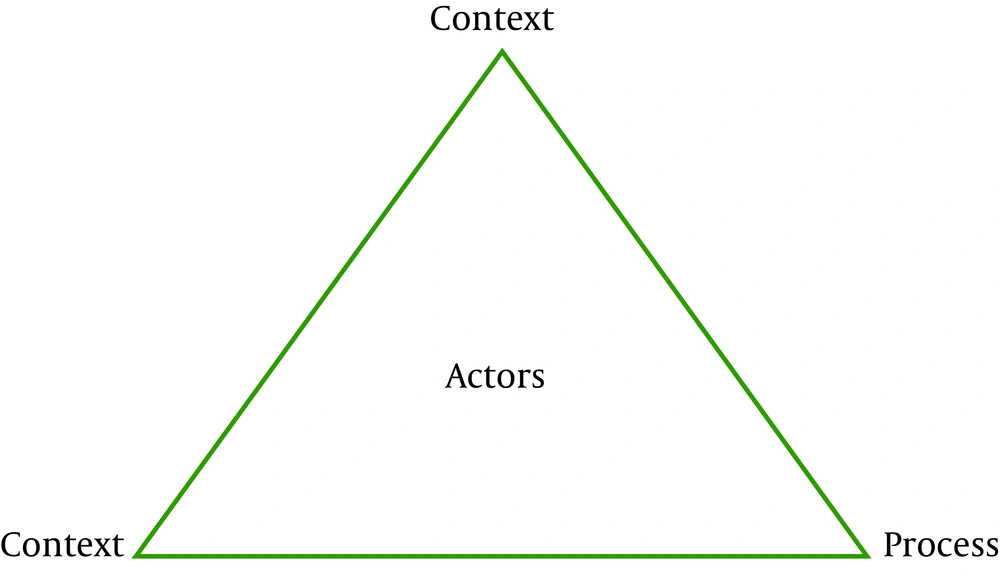
Figure 2.
Walt and Gilson’s policy triangle
2.3.2. Data Collection
This phase will begin with analyzing policy documents and then completed with semi-structured interviews with key informants comprising three groups. Policy documents published on prestigious scientific databases and the websites of official legislative authorities in Iran such as the Supreme Leader, the Islamic Consultative Assembly, President and Council of Ministers, Supreme Council for Cultural Revolution, Ministry of Sport and Youth, Ministry of Health, Ministry of Education, Ministry of Cooperatives, Labor and Social Welfare, Islamic council of the city, non-governmental organizations (NGOs), and Google search engine will be retrieved. The Persian equivalent of the following keywords will be used to search in Persian websites and databases for policy documents. In addition, the search for keywords in each database will be done with its specific strategy:
(physical activity OR exercise OR sport OR Physical Education) AND (Women OR Men OR Middle-aged OR teachers OR Workers OR Employees OR Guild) AND (Policy OR Law Regulation OR Regulations OR Instructions OR Program OR Plan OR National program OR National plan).
We will also review the policies mentioned in the policy documents, programs, reports, and their associated references in order to find a comprehensive collection of policy documents. In the case of lack of access to existing documents, in-person visits will be conducted by the first author to find the documents. The data collection tool for this section will be a data extraction form designed to create a uniform mechanism for dealing with document data and preventing data loss.
The research participants will be selected from three groups of key informants (relevant experts, executives in organizations, senior managers, and provincial and national policymakers) in the Ministry of Health and Medical Education, Ministry of Education, Ministry of Sports and Youth, Ministry of Cooperatives, Ministry of Science, Research and Technology, Labor and Social Welfare, Municipality, Provincial Government, Iran Sport for all Federation (ISFAF), Federation of Amateur and Workers Sports, physical activity NGOs, and other stakeholders who have cooperated in developing PA policy programs in Iran; these people have experience (rich knowledge and information) in the phenomenon under study. In the cases where in-person interviews are not possible, telephone or video interviews will be conducted. Semi-structured individual interviews will be conducted by the first author based on the questions in the interview guide (Box 2). This guide is designed by the research team based on the conceptual model of the study (Walt and Gilson’s Policy Triangle components). The time and place of the interview will be determined by the mutual agreement of the interviewee and researchers. At the beginning of the interviews, informed consent will be obtained from all participants. At first, a brief explanation of the purpose of the study will be provided to participants. Then interviews will be recorded with their permission, emphasizing the confidentiality of their identities and conversations. A complete note-taking interview will be conducted in cases where a participant is not satisfied with the audio recording. Interviews will continue until theoretical data saturation, when no new code, category, and theme emerge in the last interview.
Box 2.
The Main Interview Questions Regarding PA in Key Informants
| Questions |
|---|
| 1. What are the current laws and policies in the country regarding the promotion of PA behavior? |
| 2. Please explain the structures and policy-making process of PA in the country? [Both in the formulation of policies and their implementation and evaluation] |
| 3. What underlying factors affect to policies and policy-making of PA? |
| 4. What is the content of PA policies in the country? Is there a proper targeting? |
| 5. Which organizations and institutions are interested in PA? What is their role in policymaking? And have they been able to get involved? |
| 6. How do you assess the current situation of the policy process of PA in the country? [In the field of compilation-implementation-evaluation] |
| 7. Have the policies of PA in the country reached their goals? Explain your reasons. |
| 8. In your opinion, what are the obstacles to improving the behavior of PA? |
| 9. To what extent do these barriers relate to the formulation, implementation, and evaluation of laws and policies? |
| 10. What are the challenges in the PA, especially in the policy-making aspect of this field, and what solutions do you suggest? |
2.3.3. Data Analysis
In this phase, framework analysis will be used for data analysis at three stages (35), including description, analysis, and interpretation which will be conducted in five steps: (1) Familiarisation (by immersing in the data); (2) identifying a thematic framework; (3) indexing and creating tables or diagrams; (4) charting (summarizing the data in the analytical framework; and (5) Data synthesis by mapping and interpretation (33, 35).
Data analysis will be conducted immediately after each interview. To familiarize the research team with the data, the transposed text, as well as the policy documents in question, will be studied repeatedly. The analysis phase will involve classifying and identifying the main categories in the interview text, and the documents based on the main conceptual framework of the research. The coding process will be performed at the interpretation stage. Two types of coding will be used in this study: descriptive coding to identify superficial and structural relationships between data and inferential coding to identify deep and structured relationships in the texts and documents. At the final step, two types of data analysis will be conducted: perceptual analysis to investigate the occurrence, presence, repetition, and alternation of concepts (codes), and relational (semantic) analysis to examine the deep relationships between concepts, that will ultimately lead to the final synthesis of data. MAXQDA 10 software will be used to manage data analysis.
2.4. Fourth Phase: Analysis and Prioritizing the Policy Options
In the fourth phase that will take three months, the results found in the previous phases will be used to provide the best-fit policy options for PA promotion in Tabriz.
Finally, the results found in the previous phases will be used to provide the best-fit policy options for PA promotion in Tabriz. Three groups of people will be included in the panels: citizens (people affected by the policy), professionals and senior executives (people who can provide or interpret information about the policy), and policymakers (people who administer resources related to the policy). Participants will be selected mainly from those who participated in the earlier stages of the study.
At first, the policy options derived from the results of previous steps will be organized. Second, a panel of experts will be selected from among the three groups of the participants mentioned above. In the panels, the policy options and the primary criteria for reviewing literature will be discussed to rank the options. Finally, policy options and the prioritization criteria will be determined along with the weight of each criterion. At this stage, if key informants suggest a criterion other than those presented in the list of options, it will be added to the list. Important criteria for policy options derived from the initial literature review are suggested to be health impact, cost of implementation, and feasibility (36). Finally, these options will be ranked using the analytic hierarchy process (AHP) technique (37) to provide the most appropriate policy options in the current situation for Tabriz metropolis, possibly implementable in other cities with similar characteristics.
3. Discussion
Applying prospective policy analysis, ensuring that a systematic process is conducted to select the best option for the current situation in the studied setting. Triangulating data from the three stages of this study will provide us with a rich data set to form a comprehensive vision. Using the views of three key informants, expert citizens and senior executives, and policymakers, as well as studying successful programs in other communities, we will examine community-based PA policies and the most appropriate policy options taken from the context of society, which will be presented to Tabriz Municipality to promote the PA behavior under current conditions.
Moreover, focusing on the prerequisites and barriers of PA among individuals at each stage of the behavior change process will help us to develop more appropriate and adaptive policies for society. The present study results would provide policy options for addressing the challenges of PA at both local and national levels and could provide the basis for broader international discourse to develop strategies for promoting PA among adults.
3.1. Conclusions
This study will provide scientific evidence of the obstacles to the implementation of PA policies in Iran by analyzing policies in the elements of content, process, context, stakeholders using the Policy Triangle model, so that Iranian health policymakers consider the policy options while developing PA promotion programs among community-dwelling adults. Also, the results of our study will represent the challenges of the PA policymaking cycle, and the barriers to the implementation of existing policies. This study will provide the literature with most appropriate policy options based on the criteria of acceptability, effectiveness, and feasibility for addressing physical inactivity at the local and national levels. Our findings will also prepare a basis for broader international discourse to develop strategies compatible with national and local structures and their challenges for promoting PA among adults.