
1. Context
The type 2 diabetes pandemic and its complications are a worldwide threat to all people's health. The International Federation of Diabetes has estimated that one out of 11 adults between the ages of 20 and 79 (i.e., 415 million adults) had diabetes worldwide in 2015. It is predicted that this figure will rise to 642 million by 2040. Currently, Asia is the epicenter of the type 2 diabetes pandemic, which is increasing on an unprecedented scale, particularly in China and India (1).
According to the IDF report, 30.3 million (9.4%) people had type 2 diabetes in the US in 2017 (2). In the eastern Mediterranean region, Kuwait (19.4%) and Yemen (3.9%) recorded the highest and lowest rates in the development of type 2 diabetes in the 20 - 79 age group in 2019, with Iran somewhere in the midpoint with a 9.4% rate (2). According to the World Health Organization (WHO), nearly five million people aged between 20 and 79 died of diabetes in 2015. This figure is tantamount to one death every six seconds, making diabetes the seventh leading cause of death worldwide in 2016. Fatal cases of diabetes among Iranian adults have increased to 37,075 (10.8%), ranking third in the Middle East, following Pakistan (86,365 cases) and Egypt (78,184 cases) (3).
Several factors can contribute to type 2 diabetes, including overweight, hypertension, high triglycerides, age of 45 or older, stress, genetics, inactivity, gestational diabetes, race, poor economic and social conditions, policies and social norms, environmental factors, inadequate health care, public and social media, changing food consumption patterns, culture, urbanization, society, smoking, alcohol consumption, vitamins D and K deficiency, and insufficient sleep (less than five hours or more than eight hours) (3). Type 2 diabetes can increase the likelihood of many health issues. These health complications include heart attack, stroke, kidney failure, amputation, injuries, and nervous breakdown (4). Disability, low-quality life, and untimely death can be some of the consequences of diabetes (5). Thirst, polyuria, blurred vision, and weight loss might also be related to diabetes (6).
The WHO has a strategic plan to prevent this disease by providing training and education aiming at changing the lifestyle, reaching and retaining the right weight (physical fitness), physical activity (at least 30-min regular and vigorous exercise on most days), a healthy and balanced diet, cutting down sugar and fat, and quitting smoking (7). In order to prevent the high cost of treatment, it is imperative to train and raise people's awareness of diabetes. As a result, "education and prevention" was the slogan used by the International Federation of Diabetes from 2009 to 2013 (8).
2. Objectives
This study aimed to survey the effectiveness of interventional studies on type 2 diabetes from one decade ago in Iran and the world to highlight its significance to policymakers. A structured review of documents and their syntheses can illuminate all dimensions of this epidemic in Iran and the world. In addition, this research study can help decision-makers adopt appropriate strategies and training in their interventions to prevent type 2 diabetes.
3. Methods
3.1. Study Question
What is the impact of interventional studies on controlling, managing, and preventing type 2 diabetes?
This research was a systematic review that followed these procedures.
3.2. Search Strategies
This study aimed to identify and explore the factors related to the effectiveness of health education and promotion interventions for type 2 diabetes. For this purpose, an electronic search was systematically carried out on Persian databases of SID and Magiran and English databases of PubMed, Science Direct, Scopus, Web of Science, and Google Scholar between 2010 and 2019 (January - December). The search focused on type 2 diabetes interventions in Iran and the world. At first, all related keywords (MeSH and non-MeSH) were identified. Then, the keywords were combined using the operators AND and OR and were applied to the search database. The search strategy is shown in Table 1. Also, additional articles were obtained by evaluating the references of the selected articles. There was no limitation regarding the kind of intervention, length of intervention, type of participants, and the location of the research study (Appendix 1 in Supplementary File).
Table 1.
PICOS and Criteria for Study Inclusion
| Criteria | Definition |
|---|---|
| Population | Patients, high-risk groups, and healthy people |
| Intervention | Interventions aimed at controlling, managing, and reducing complications of type 2 diabetes, reducing type 2 diabetes incidence, risk behaviors, changing type 2 diabetes attitudes, and increasing type 2 diabetes knowledge |
| Comparison | Comparison between intervention and control groups |
| Outcome | Incidence of type 2 diabetes, control, management, complications, knowledge, attitude, and high-risk behaviors |
| Study Design | Pre- and post-intervention, RCT, quasi-experimental |
3.3. Inclusion Criteria
The study was designed based on the PICOS format (9), as listed in Table 1. We included interventional studies, such as experimental studies, quasi-experimental studies, clinical trials, pre-treatment and post-treatment observations, and research papers in Persian and English published in prestigious journals between 2010 and 2019, with access to their full texts.
3.4. Exclusion Criteria
The exclusion criteria were case studies, short articles, cross-sectional studies, descriptive and analytic studies, letters to the editor, and systematic reviews.
3.5. Study Selection
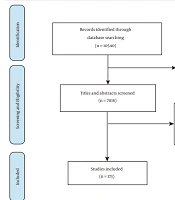
The paper selection followed this procedure. First, an initial search by the two researchers (S. R. and A. P.) was done individually. Second, similar papers were removed. Third, a narrower search was done by omitting irrelevant matters. Next, having studied each paper's title and abstract for relevance and suitability, we selected the potential research papers. In order to reach a consensus, the papers were read, analyzed, and discussed by both researchers (S. R. and A. P.). Finally, the articles were reviewed and evaluated by the third author (M.GH) (Figure 1).
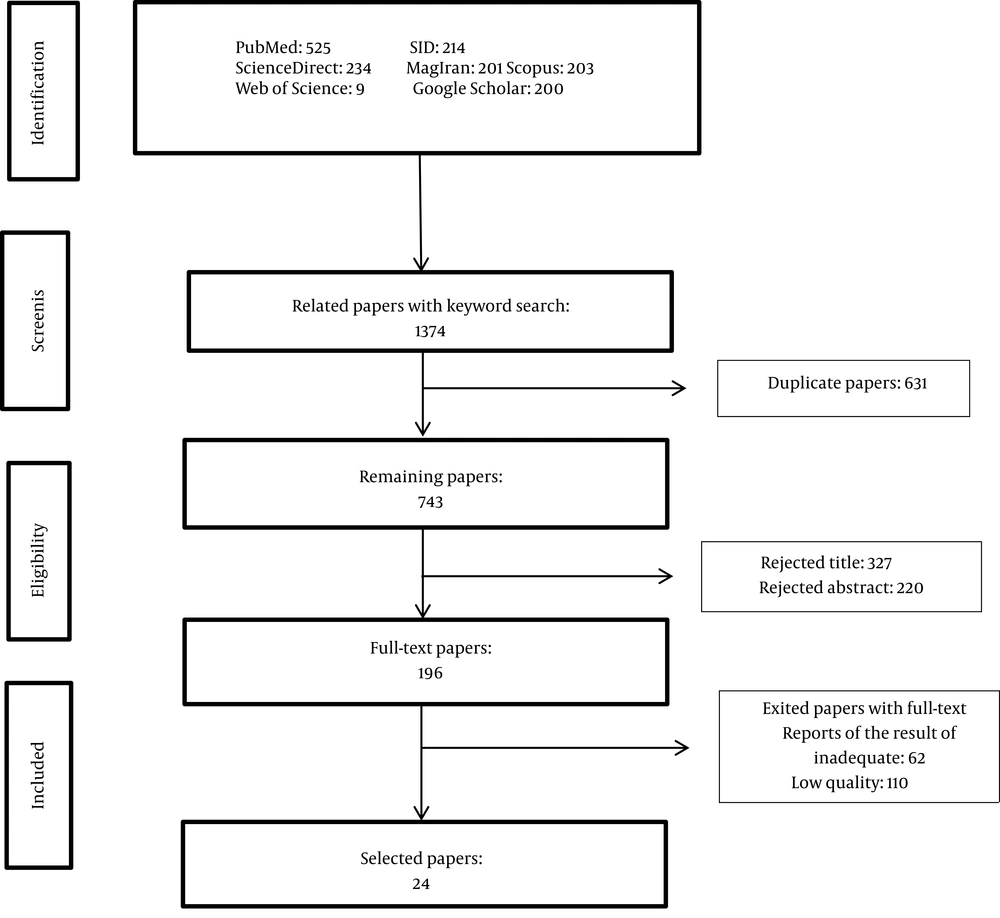
Figure 1.
PRISMA flow diagram
3.6. Evaluation of Quality of Papers
In order to report the standard of studies, an interventional study checklist was used, including consolidated standards of reporting trials with 25 items (10), checklist for experimental design with nine items (11), checklist for quasi-experimental studies with nine items (12), and Transparent reporting of evaluations with non-randomized designs with 22 items (10).
Depending on the checklists and the acquired scores, papers meeting the requirements for entry in the study were classified as high-quality papers. Twenty-four appropriate research papers entered the final analysis, all having full texts (Appendix 2 in Supplementary File).
3.7. Data Extraction
The specific features of the studies were introduced in a form including the researchers' names, year of publication, the location of study, the year of study, study type, participants, the sample size, intervention description, theoretical framework with the model, and significant findings (Appendix 2 in Supplementary File).
4. Results
In the initial search, 1,374 papers were obtained. Similar papers (631 ones) were omitted in the second stage, and 743 papers remained. Next, 327 papers were omitted after reading their titles, and 220 were removed after closely studying their abstracts. The remaining 196 papers were reassessed through the checklist, and finally, 24 research papers were selected. Figure 1 illustrates the research papers' selection process.
From our pool of studies (24 papers), 11 papers were randomized clinical trials, seven were quasi-experimental studies, and six were experimental studies. The location of the studies was as follows: 11 in Iran, seven in the USA, two in Germany, and one in each of the countries Malaysia, Japan, Columbia, and New Zealand. Most RCT papers focused on therapeutic interventions, while experimental and quasi-experimental studies focused on blood pressure, BMI, dietary intakes, physical activity, TG, HbA1C, FBS, and 2-h glucose. Out of these 24 studies, seven interventional studies were conducted based on theories and models: Three studies following the BASNEF model, one study based on the Theory of Planned Behavior (TPB), one study with the PRECEDE-PROCEED model, one study based on the ability, information, motivation (AIM) model, and one study following planned approach to community health (PATCH) model.
Six studies primarily employed lecturing, question and answer, group discussion, brainstorming, practical demonstrations, DVD playing, photo/film/slide presentations, and pamphlets (13-18). In two studies, the education intervention was only done through lectures (19, 20), and in one study, education centered on websites (21). In another study, the workshop was the medium of education (22). In the other studies (23-30), education largely depended on group training, individual training, individual counseling, group counseling, and counseling by phone. All the papers were published between 2010 and 2019, most of which were from 2015 onwards (Appendix 2 in Supplementary File). According to Appendix 3 in Supplementary File, the mean scores of all study structures based on theories and models increased significantly in the intervention group after the educational intervention. However, changes were insignificant in studies that did not work with theories and models. The health education programs designed based on theories and models effectively promote the preventive behaviors of type 2 diabetes and enhance the treatment of diabetic patients and lifestyle changes.
5. Discussion
This systematic study investigated 24 intervention research papers regarding type 2 diabetes. The study showed that the interventions positively influenced biomarkers, improved the performance of the sufferers and high-risk people, and played a preventive role in type 2 diabetes. The studies on type 2 diabetes are open to discussion from different dimensions.
5.1. The Design of Interventions
Most studies under investigation were randomized clinical trials (16, 24-28, 30-34) and the others were quasi-experimental (13-15, 17-19, 23) and experimental studies (18, 20-22, 35, 36). The length of the interventions was between one and 12 months. Only one study had an 18-month intervention. The result of the previous study indicates that for an intervention to be effective, a longer period is required. In addition, even though short-term studies are more feasible, long-term follow-ups and investigations are needed to explore the stability and consistency of research findings. Another finding of this research study was that in most interventions made for type 2 diabetes on either patients or high-risk groups, only diet, and physical activities had been the focus of studies (13, 15, 16, 20, 21, 29, 31-33) and other contributory factors to diabetes such as smoking, alcohol consumption, vitamins D and K deficiency, inadequate sleep and stress, and depression were ignored. Therefore, it is recommended that a constellation of factors (biological, sociocultural, geographical, and local) should be considered in the design of educational interventions.
5.2. Participants
In general, 19 interventional studies had been made on patients; another five had been made on high-risk groups and only one on teenagers. The results showed that the majority of interventions focused on patients (13, 16-19, 22-28, 31, 37) and a few (18, 20, 23, 30) had a high-risk group as participants, and only one study (21) made a preventive intervention on teenagers. As type 2 diabetes is an acute disease, its complications can lead to disability, low life quality, and premature death (5). Furthermore, this disease can take a heavy economic toll, a serious obstacle to sustainable economic development (38). The abovementioned studies have disregarded teenagers and young adults, who comprise the most vulnerable age groups. Thus, it is suggested that effective and timely measures be taken to design and implement improved preventive actions.
5.3. Interventions Description
A review of the studies showed that most educational interventions in Iran have been in the form of lectures, question and answer, group discussion, brainstorming, photo/film/slide displays, pamphlets, and websites (13, 15, 17, 37). However, the studies conducted in other countries heavily relied on group training, individual training, individual counseling, group counseling, counseling by phone, and practical demonstrations (16, 18, 23-25, 27, 28, 30, 31, 39). In these studies, less emphasis has been placed on modern communication devices such as computer programs, mobile phones, and the internet despite their potential and accessibility to many people. Several options are available to be employed effectively: Innovative teaching methods such as virtual and digital teaching and applications with reminders, group training to improve lifestyle, consciousness-raising, changing people's attitude and performance, particularly people at risk of type 2 diabetes, and preventing high-risk behaviors. Future studies must pay special attention to factors such as the target group's culture and age to improve the training's efficacy.
Since health education and promotion strategies are not limited to a specific health problem or a specific set of behaviors, educational interventions can use health education strategies to prevent type 2 diabetes by creating healthy public policy, creating supportive environments, strengthening community action, enhancing individual skills, reorienting health services.
5.4. The Application of Theories and Models
Most studies had an approach without a theory. However, a few were based on theories (one study based on TPB (21), three studies following the BASNEF model, one study with the PRECEDE-PROCEED model, one study based on the AIM model, and one study following the PATCH model) (13, 15, 17, 20, 22, 37). Out of these 24 studies, only one was performed on adolescents with first-level approach prevention, while fear-based theories such as HBM were not used (21). It is argued that the efficacy of health education dramatically depends on the appropriate use of theories and frameworks. Theories and frameworks offer a systematic view of the events and present a regular procedure to evaluate the successes and failures (40). Besides, maximizing the efficacy of the plans requires an understanding of the behavior and its contributing factors to change or accommodate the current behavior or replace it with a new one (41). It also calls for a theory-driven procedure based on theories of behavior change and learning (42). Theory-driven interventions have facilitated the health-behavior changes through increasing the understanding of behavior-change processes and individual and environmental features affecting the behavior. All these factors can contribute to the efficacy of the education offered (39). Therefore, it is apt to mention that reforming the lifestyle requires consideration of people's lifestyles, beliefs, and attitudes within the health education programs. As there is insufficient evidence to prescribe the optimal education theory for future interventions, the decisions regarding the appropriate theory and model for every intervention should be based on the performance of models and theories, the purpose of the study, and the intended factors.
5.5. Limitations
This study has some limitations that must be mentioned. Although searches were performed on many databases, the overall search strategy may have been biased towards public health. Another limitation of this study is that while the review included any paper published in any language, our search was conducted only using Persian and English keywords (language bias). Also, the small sample owning to a limited number of included studies with a small sample size for all included studies was another limitation of this study. Moreover, a wide range of the intervention period, from one to 12 months, and follow-up duration (from three to 12 months) could limit the research. The last limitation is reporting bias.
5.6. Practical Implications
Considering the findings of studies and the global prevalence of type 2 diabetes, and the impact of health education and promotion interventions on preventing chronic diseases such as type 2 diabetes, implementers should use new educational strategies that are appropriate concerning culture and age factors. Also, all risk factors for type 2 diabetes should be considered, and efforts to encourage and persuade people to adopt a healthy lifestyle should be augmented.
6. Conclusions
Considering the findings, an overwhelming majority of the interventions regarding type 2 diabetes had these common themes: (1) a positive effect on the reduction of factors under study (2-h post glucose, FBS, HbA1C, BMI, blood pressure, and TG); (2) a raised awareness; and (3) a positive change in attitude and mindset in the sample; also, the target group was primarily patients assessed for diet and physical activity. Educational interventions, other crucial factors leading to type 2 diabetes, and the most effective and appropriate teaching methods with the target group of healthy people should be considered to prevent this disease.