
1. Background
COVID-19 has been damaging public health and lifestyle for more than 2 years since its declaration as a pandemic in March 2020 (1). The number of new cases has led to high rates of hospital visits. Because of the increased workload of health care institutions, elective surgical operations and emergency operations have been stopped or postponed (2). To reduce the spread of the virus and the increased workload of health care institutions, most governments have implemented isolation measures, and people have been advised not to visit health care facilities unless absolutely necessary.
Appendicitis is the most common emergency abdominal surgical pathology in the pediatric age group (3, 4). It has been reported that the rate of complications related to appendicitis due to delayed admission to hospital in both adult and pediatric patients has increased during the pandemic (3, 5). There are a limited number of publications in the literature on how appendicitis has affected patients in the pediatric age group during the COVID-19 pandemic (3). It is predicted that the isolation measures and the fear of contracting COVID-19 in the hospital environment may cause a delay in getting emergency medical care (6, 7).
2. Objectives
We examined pediatric patients operated on for appendicitis during the pandemic. We compared the data of those pediatric patients who had undergone surgery for appendicitis in the same period a year prior to COVID-19 and evaluated the surgical results of the 2 periods.
3. Methods
This study is a retrospective observational study carried out in the Department of Pediatric Surgery, Faculty of Medicine, Health Sciences University, Şişli Hamidiye Etfal Training and Research Hospital, Istanbul, Turkey.
This study was carried out in accordance with the Declaration of Helsinki and approved by the Local Ethics Committee (Ethics Committee approval date: 30.06.2020; Ethics Committee approval number: 2868). Written informed consent was obtained from the parents or guardians of all patients.
Patients operated on for appendicitis between 11 March 2019 and 13 May 2019 and between 11 March 2020 and 11 May 2020 in our Pediatric Surgery Clinic were retrospectively reviewed. In other words, the appendectomies performed during the pandemic were compared to those performed in the same period of the previous year.
Patients aged 18 years and younger who were operated on for appendicitis between 11 March 2019 and 11 May 2019 were classified as group 1, and patients aged 18 years and younger who were operated on for appendicitis between 11 March 2020 and 11 May 2020 (during the pandemic) were classified as group 2. Both groups were compared in terms of age, gender, symptoms, duration of symptoms, surgical method, duration of operation, length of hospital stay, and postoperative complications.
The cases were classified as complicated appendicitis and uncomplicated appendicitis, according to the operative findings. Perforated, necrotic, gangrenous, and phlegmonous cases were considered complicated appendicitis. Acute and suppurated cases were considered uncomplicated appendicitis (8, 9).
Cases operated on for appendicitis outside the specified dates, and incidental appendectomies were excluded. Moreover, patients diagnosed with acute respiratory tract infection due to COVID-19 during the diagnosis of appendicitis were also excluded because treatment changes and gastrointestinal effects were unknown.
3.1. Statistical Analysis
Descriptive statistics were used to determine the mean, minimum, maximum, ratio, and frequency values. The distribution of the data was evaluated by the 1-sample Kolmogorov-Smirnov test. Quantitative, independent, non-normally distributed data were evaluated by the Mann-Whitney U test. The chi-square test was used to evaluate qualitative independent data, and the Fisher exact test was used in inappropriate conditions. Data analysis was performed using SPSS version 27 (SPSS Inc, Chicago, Ill, USA). P-values less than 0.05 were considered statistically significant.
4. Results
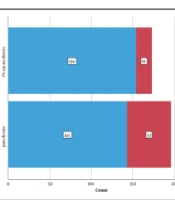
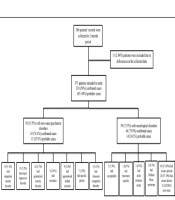
Initially, there were 85 patients in group 1 and 49 in group 2. However, 5 patients with COVID-19 from group 2 were excluded from the study; hence, the data of 129 patients (85 in group 1 and 44 in group 2) were evaluated. The mean age, gender, duration of symptoms, complaint at admission, laboratory/radiological findings, surgical method, duration of operation, complications, and length of hospital stay of the 2 groups were compared.
The mean age was 11.5 ± 3.5 years in group 1 and 12.2 ± 3.0 years in group 2. The mean duration from symptom onset to admission was 52.2 ± 38.5 hours in group 1 and 50.2 ± 40.0 hours in group 2. There was no statistically significant difference between the groups in terms of mean age, gender, duration of symptoms, and complaints at admission (P > 0.05; Table 1).
Table 1.
Demographic Characteristics and Symptoms of the Groups
| Group 1 | Group 2 | P-Value a | |||
|---|---|---|---|---|---|
| Mean ± SD | Median | Mean ± SD | Median | ||
| Age (y) | 11.5 ± 3.5 | 11.0 | 12.2 ± 3.0 | 12.0 | 0.372 b |
| Sex | 0.876 c | ||||
| Male | 61 ± 71.8 | 31 ± 70.5 | |||
| Female | 24 ± 28.2 | 13 ± 29.5 | |||
| Symptoms | 0.404 c | ||||
| Pain | 20 ± 23.5 | 6 ± 13.6 | |||
| Pain, vomiting | 59 ± 69.4 | 34 ± 77.3 | |||
| Pain, vomiting, diarrhea | 6 ± 7.1 | 4 ± 9.1 | |||
| Symptom duration (h) | 52.2 ± 38.5 | 48.0 | 50.2 ± 40.0 | 24.0 | 0.387 b |
a P-values less than 0.05 were considered statistically significant.
b Chi-square test
c Mann-Whitney u test
The patients were compared in terms of laboratory and radiological findings. There was no statistically significant difference between the groups (P > 0.05; Table 2).
Table 2.
Laboratory and Radiological Findings of the Patients in Both Groups
| Group 1 | Group 2 | P-Value a | |||
|---|---|---|---|---|---|
| Mean ± SD | Median | Mean ± SD | Median | ||
| Ultrasound | 0.352 b | ||||
| Positive | 57 ± 67.1 | 33 ± 75.0 | |||
| Negative | 28 ± 32.9 | 11 ± 25.0 | |||
| Appendix diameter in ultrasound (mm) | 8.5 ± 2.0 | 8.0 | 9.6 ± 2.6 | 9.0 | 0.164 c |
| CT | 0.736 b | ||||
| Positive | 19 ± 22.4 | 11 ± 25.0 | |||
| Negative | 66 ± 77.6 | 33 ± 75.0 | |||
| Appendix diameter in CT (mm) | 11.0 ± 2.6 | 10.0 | 9.9 ± 1.9 | 11.0 | 0.562 c |
| WBC count (×103) | 15.7 ± 5.2 | 15.6 | 16.4 ± 6.7 | 15.9 | 0.843 c |
| Neutrophil count (×103) | 12.5 ± 5.3 | 12.4 | 13.5 ± 6.1 | 12.9 | 0.516 c |
| CRP | 68.5 ± 91.9 | 38.0 | 66.9 ± 78.8 | 38.0 | 0.992 c |
a P-values less than 0.05 were considered statistically significant.
b Chi-square test
c Mann-Whitney u test
No statistically significant difference was found between the groups in terms of surgical methods and duration of operations (P > 0.05). In group 1, 82 cases were started laparoscopically, 80 cases were completed laparoscopically, and 2 cases were converted to open surgery. Open surgery was initially preferred in 3 cases. In group 2, 41 operations were started laparoscopically, 39 cases were completed laparoscopically, and 2 cases were converted to open surgery. Open surgery was preferred directly in 3 cases. There was no significant difference between the cases converted from laparoscopy to open surgery (P > 0.05; Table 3).
Table 3.
Surgical Methods Used for the Patients in Both Groups
| Surgical Method | Group 1 | Group 2 | P-Value a | ||
|---|---|---|---|---|---|
| Mean ± SD | Median | Mean ± SD | Median | ||
| Laparoscopy | 80 ± 94.1 | 39 ± 88.6 | 0.449 b | ||
| Open surgery | 3 ± 3.5 | 3 ± 6.8 | 0.409 b | ||
| Conversion | 2 ± 2.4 | 2 ± 4.5 | 0.605 b | ||
| Duration of operation (min) | 64.0 ± 24.4 | 60.0 | 69.0 ± 33.0 | 60.0 | 0.643 c |
a P-values less than 0.05 were considered statistically significant.
b Chi-square test
c Mann-Whitney u test
No significant difference was observed between the complicated appendicitis and uncomplicated appendicitis cases, according to the operative findings (P > 0.05). There were 7 negative explorations in group 1 and 4 in group 2 (Table 4). There was no statistically significant difference between the groups in terms of postoperative complications and length of hospital stay (P > 0.05; Tables 5 and 6).
Table 4.
The Type of Appendicitis of the Patients in Both Groups a
| Type of Appendicitis | Group 1 | Group 2 | P-Value b |
|---|---|---|---|
| Uncomplicated | 46 ± 54.1 | 29 ± 65.9 | 0.3483 c |
| Complicated | 32 ± 37.6 | 11 ± 25.0 | |
| Negative d | 7 ± 8.2 | 4 ± 9.1 |
a Values are expressed as mean ± SD.
b P-values less than 0.05 were considered statistically significant.
c Chi-square test
d Negative explorations
Table 5.
Length of Hospital Stay of the Patients in Both Groups
| Group 1 | Group 2 | P-Value a | |||
|---|---|---|---|---|---|
| Mean ± SD | Median | Mean ± SD | Median | ||
| Length of hospital stay (d) | 2.9 ± 2.0 | 2.0 | 3.1 ± 3.4 | 2.0 | 0.578 b |
a P-values less than 0.05 were considered statistically significant.
b Mann-Whitney u test
Table 6.
Postoperative Complication Status of the Patients in Both Groups a
| Group 1 | Group 2 | P-Value b | |
|---|---|---|---|
| Complications | 0.562 c | ||
| No | 78 ± 91.8 | 39 ± 88.6 | |
| Yes | 7 ± 8.2 | 5 ± 11.4 | |
| Abscess | 1 ± 1.2 | 1 ± 2.3 | |
| Abscess, empyema, surgical site infection | 0 ± 0 | 1 ± 2.3 | |
| Abscess, surgical site infection | 0 ± 0 | 1 ± 2.3 | |
| Ileus | 1 ± 1.2 | 0 ± 0 | |
| Hemorrhage | 1 ± 1.2 | 0 ± 0 | |
| Umbilical discharge | 4 ± 4.7 | 2 ± 4.5 |
a Values are expressed as mean ± SD.
b P-values less than 0.05 were considered statistically significant.
c Chi-square test
One of the patients in group 2 with an intra-abdominal abscess had empyema and wound infection, and the other patient with an intra-abdominal abscess had wound infection. Both patients were classified as perforated appendicitis cases. The case with empyema and wound infection was converted from laparoscopy to open surgery, and the other case underwent open surgery. No additional surgical intervention was required for any of the complications in the 2 groups.
5. Discussion
The fight against COVID-19 began with the slogans “Stay at home” and “Life Fits into Home.” Hospital attendance rates decreased due to isolation measures and the fear of virus transmission. Accordingly, elective admissions to hospitals and emergency services decreased significantly (5).
The studies conducted during the pandemic observed a decrease in non-COVID-19 emergencies (10). In this study, we examined appendicitis cases since they constitute an important part of emergency attendance in pediatric surgery. The annual number of appendicitis cases remains steady; thus, it was investigated whether the pandemic had any effect on this number. Similar studies concluded that the number of patients diagnosed with appendicitis has decreased. Kumaira Fonseca et al. stated that the number of adult patients who were operated on for appendicitis between March and April 2020 decreased by 56.8% compared to the same period of the previous year. They also argued that the COVID-19 outbreak was effective in emergency surgeries as in all other surgical cases (8). Likewise, Meric et al. stated that the number of patients decreased significantly during the pandemic (10). We concluded that the number of patients operated on for appendicitis during the pandemic decreased by 48.2% compared to the previous year, and these results are consistent with the literature. We think that the decrease in the number of appendicitis cases (which could be applied to all non–COVID-19 emergencies) is due to the fact that people avoid going to hospitals because of the isolation measures and, most importantly, their fear of the pandemic.
The appendix itself may also be a reason for this decrease. That is, the appendix is a lymphoid organ that is particularly prominent in children. The obstruction of the lumen marks the beginning of the development of appendicitis. The most common cause of this is the swelling of the mucosal lymph plaques and the occlusion of the lumen. In children, the most common cause of this event is upper respiratory tract infection (URTI) and gastroenteritis, where viral infections are common (11). We consider that the widespread use of face masks and maintaining social distance during the pandemic, as well as the decrease in appendicitis cases secondary to mesenteric lymphadenopathy due to respiratory pathogens, also led to a decrease in the number of patients.
In the study of Pham et al., the frequency of complicated appendicitis was found to be higher in pediatric patients with symptoms lasting more than 24 hours compared to those with symptoms lasting less than 24 hours (12). According to the study by Gerall et al., during the pandemic, the period until hospital attendance was longer compared to the previous year, which increased intra-abdominal abscess formation (3). They stated that the most important reason for a longer period until hospital attendance was the fear of contracting COVID-19 in the hospital. In another recent study, it was emphasized that the decrease in the number of patients with acute appendicitis was related to the risk of COVID-19 infection in places such as emergency rooms. In the same study, it was stated that the frequency of complications increased in direct proportion to the duration of hospital admission. The study detected a statistically significant decrease in uncomplicated appendicitis cases compared to the same time periods between 2018 and 2020. Moreover, a significant increase in complicated appendicitis cases was found (5). Contrary to the literature, our study revealed no significant difference between the 2 groups in terms of the duration of admission to the hospital after the onset of symptoms. In addition, when the operations performed in the previous year were considered, no increase was found in the rate of complicated appendicitis. It may be that whatever the circumstances may be, parents would always take their children to the hospital if they think it is an emergency. We consider that another reason for this finding is that only real emergency cases come to the emergency department (which are examined in more detail) because more time can be allocated to each patient. Thus, they are operated on earlier because of the reduced number of elective surgeries. Although elective surgical procedures have been postponed during the pandemic, we believe that surgical interventions were performed rapidly by our team for emergency or life-threatening situations.
In the adult series published by Orthopoulos et al., 79 of the 91 patients admitted during the pandemic were operated on laparoscopically, and 1 patient underwent open surgery. They treated a total of 9 patients with antibiotics (5). In a study conducted on pediatric patients, 36 out of 48 patients admitted during the pandemic were operated on regardless of the operation method, and 12 patients were treated non-operatively (3). In an operation-method-independent study, no statistically significant difference was found in the duration of the operation, although the number of complicated appendicitis cases increased during the pandemic (13, 14). No statistically significant difference was found in terms of the surgical method and the duration of the operation. The cases converted to open surgery in the 2 groups were complicated cases, accompanied by diffuse perforated appendicitis. Starting the operation directly as open surgery depended on the preference of the surgeon. In our study, appendicitis cases encountered during the pandemic were treated in the same way as in the normal period. Since our clinic was a reference clinic, emergency cases were operated on without delay, and surgical treatment was preferred for all patients. None of our patients was treated non-operatively. Five COVID-19-positive patients excluded from the study were operated on laparoscopically. Surgery was not contraindicated, as these patients were stable in terms of COVID-19 findings. As repetitive studies and knowledge about the virus increase, non-operative treatment alternatives may be considered (5).
Despite the decrease in the number of patients due to the pandemic, it was reported that cases with late presentation caused worse postoperative complications (7, 15, 16). The complication rate seen after the appendectomies performed during the pandemic was related to complicated appendicitis cases resulting from late presentation to the hospital; as a result, the length of hospital stay was prolonged (3, 5, 10). In another study, it was concluded that although the rate of postoperative complications increased due to late admission to the hospital during the pandemic, there was no difference between the 2 periods in terms of length of hospital stay. This was associated with early discharge when possible (8). We noticed that despite the decrease in the number of patients admitted to the emergency department, postoperative complication rates and length of hospital stay were statistically the same in both groups. We continued our standard approach during the pandemic. Our most common complications were umbilical discharge and intra-abdominal abscess. All of our cases were treated medically in terms of these complications. This showed that the quality of service prevailing in the pre-pandemic period was maintained, as there was no difference between the complicated appendicitis cases and the patients diagnosed and treated early.
5.1. Conclusions
Due to isolation measures and fear of COVID-19 transmission, there have been decreases in emergency patient visits, which enabled faster examination and diagnosis for real emergency cases. In addition, the decrease in appendicitis cases secondary to mesenteric lymphadenopathy due to respiratory pathogens, the widespread use of face masks, and the decrease in social contact during the pandemic caused a decrease in emergency patient visits. Therefore, there was no increase in our complicated cases. All these or the psychosocial effects of the pandemic have not prevented real emergency cases with appendicitis from coming to the hospital.
Although elective surgical procedures were postponed during the pandemic, as we were working in a reference hospital, necessary surgical interventions were performed for emergency and life-threatening situations. As seen during the pandemic, certain health care facilities should be identified as reference hospitals to sustain the health care system.
Although the inclusion of COVID-19-positive patients would have reflected more real data value, we consider that the treatment of the disease and the duration of treatment might have been different since there was not enough information about the disease and its side effects during the pandemic. Therefore, multicenter prospective clinical studies with larger numbers of patients are needed in the future.
5.2. Limitations of the Study
Our study is retrospective and observational and covers a short period of time. We also excluded COVID-19-positive patients from the study to compare 2 patient groups with similar characteristics and treatment types. Although including COVID-19-positive patients would have reflected more real data value, we think that the treatment of the disease and the duration of treatment might have been different because there was insufficient information about the disease and its side effects during the pandemic.
Although our study offers a single-center evaluation, since our hospital is a large reference center, it can provide general patient information. Studies comparing pediatric appendectomies during the pandemic are limited. Thus, multicenter prospective clinical studies on a larger number of patients are needed.