1. Background
Nowadays, waste production in the world has increased due to population growth, improvement of living standards, economic conditions, and development of industries (1). In Iran, approximately 60 tons of solid waste are produced per day that more than 70% of them are converted into organic fertilizer. There are different methods for organic waste disposal including landfilling, incineration, composting, and pyrolysis (2). One of these methods is composting in which leachate is produced as 100 liters per ton of waste production (3). Municipal solid waste leachate, a very strong wastewater, contains a large amount of priority pollutants (carcinogens), pathogenic organisms, persistent organic compounds, and heavy metals (4-6). Therefore, special attention should be paid to control, collection, treatment, and disposal of this pollutant, while the lack of an appropriate method for its treatment, collection, and disposal causes severe contamination of soil, groundwater, and surface water to persistent and toxic organic compounds, nitrogen compounds, aromatic and phenolic compounds. Moreover, it threatens human life and aquatic organisms (7, 8). Leachate contains a large amount of pollutants which their treatment is very complicated and expensive, and generally requires various and combined processes; therefore, the treatment and disposal of leachate must be done carefully. The appropriate treatment of leachate is also a major problem in different countries. For leachate treatment usually different physical, chemical, and biological methods are used (9). Among the various leachate treatment methods, biological processes have priority due to their lower cost, easy operation, and environmental compatibility (10, 11). One of the most common modified conventional activated sludge processes is biological sequencing batch reactor (SBR). This system is used for treatment of municipal and industrial wastewater as well as leachate (12-14). The SBR process includes 5 steps: filling, reaction (aeration), sedimentation, discharge, and rest. All of these steps are done in one reactor with a discontinuous input flow (10, 13, 15).
In Laitinen et al. (2006) study on landfill leachate treatment using SBR, the concentrations of TSS, BOD5, phosphorus, and ammonia nitrogen in effluent were 475, 1240, 10, and 210 mg/L, respectively (16). Zhou et al. (2006) could remove 93.76% COD, 98.28% BOD5, and 84.74% total nitrogen in landfill leachate treated by SBR (14). A study conducted by Hajiabadi et al. showed that COD removal efficiency was above 97% for strong synthetic wastewater using SBR (17). Karimi et al. (2011) studied WAO (Wet air oxidation), WPO (Wet peroxide oxidation), and a combination of WAO/GAC (Granular activated carbon) processes for organic matter removal from Isfahan composting factory leachate under different conditions. They found that the combined process had higher efficiency than two other methods, while BOD5/COD ratio reached 90% (7). Amin et al. (2015) studied a complementary treatment of leachate using SBR. Their results demonstrated that COD removal efficiency increased with time in the bioreactor in all experiments and reached up to 70% (2).
In Isfahan, about 60% of municipal solid waste is converted into compost that produces almost 50 m3 leachate daily (18, 19). Therefore, treatment of this leachate is a key factor in the success of municipal solid waste management in Isfahan. To the best of our knowledge, there is no available paper on determination of SBR performance in treatment of leachate from the composting plant located in Isfahan.
2. Objectives
Owing to the high efficiency of SBR and due to leachate problems, the aim of this study was to determine SBR performance in treatment of composting plant leachate.
3. Methods
In this experimental study, an aerobic biological SBR with two liters capacity was used for treatment of composting plant leachate in Isfahan, Iran. The samples were taken from leachate inlet to the leachate ponds of Isfahan composting plant. Since, leachate is generated from different parts of composting plant including sections of receiving solid wastes, grinders, wastes compactor, and fermentation site, the sampling was done from final channel in which the leachate is a mixture from different parts of production process of the organic fertilizer plant. The leachate was filtered and diluted and then injected into the SBR reactor after pH adjustment by caustic soda. The organic loading rate (OLR) increased from 0.25 to 6.3 gCOD/L.d in 11 runs during the 280-day study period. To determine the reactor performance during the period, COD, SCOD, rbCOD, BOD5, TKN, and TP were measured in accordance with procedures provided in standard methods. In this study, the average amounts of the influent COD, BOD5, TKN, TP, EC, and pH were 95.5, 55.2, 2.3, 0.28 (g/L), 33.5 (ms/cm), and 4.4, respectively.
After determination of COD: N: P in the raw leachate, ammonium chloride (NH4Cl) and/or potassium dihydrogen phosphate (KH2PO4) were added, if necessary, to provide the required nitrogen and phosphorus for the biological process. The sludge from aeration basin of municipal wastewater treatment plant in the north of Isfahan was used for seeding the aerobic reactor. During this study, COD, SCOD, rbCOD, BOD5, TKN, and TP parameters were analyzed, while DO, pH, and temperature parameters were controlled.
3.1. Specifications of SBR Pilot
In this study, a combination of anaerobic and aerobic methods including anaerobic reactors (AMBR and ASBR) and aerobic reactors (SBR and SBR-MBR) were used. The data of this study were the measured parameters in input and output of SBR. The SBR was made of plexiglass with 16.5 cm in diameter and 35.5 cm in height. Total volume of the reactor was 5 liters that just 2 liters were used, while discharge volume was selected one liter based on the flow rate for subsequent reactors. Each reactor cycle lasted for 24 hours. This process included discharge time (10 minutes), filling time (10 minutes), and sedimentation (60 minutes). The reactor was aerated in the remaining time and equipped with substrate injection tube and effluent discharge pipe. Substrate injection and effluent discharge from the reactor were performed by a peristaltic pump made by Etatron Co, Italy. The reactor was aerated using an air pump connected to the diffuser. To control the function and operation of pumps, an electronic processing system known as programmable logic controller (PLC) Omron Manufacturing Co., Japan, was used (Figure 1).
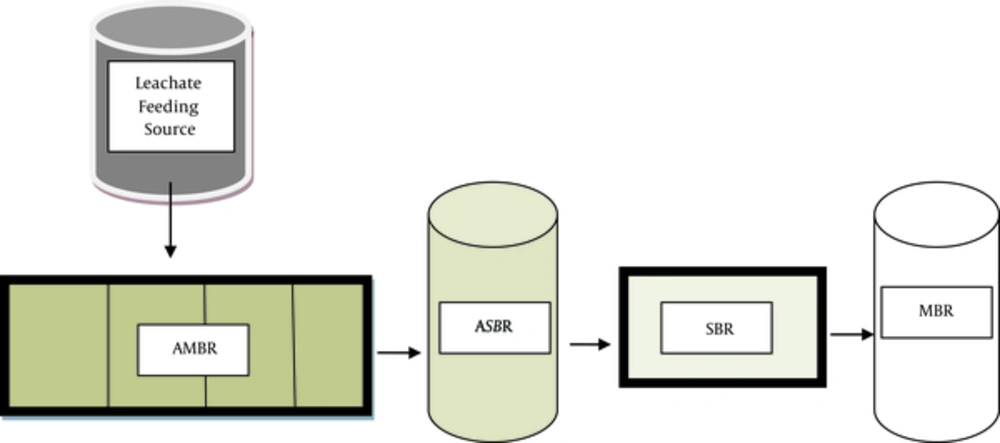
Figure 1.
General Schematic of Leachate Treatment Process
3.2. Reactor Operation
To launch the reactor and reach appropriate COD removal efficiency, reactor operation began with 1 g COD/L.d. The Injection rate was one liter in 24 hours and the amount of dilution gradually reduced; therefore, in the ninth month of operational period, leachate was injected into the reactor without any dilution. In the tenth and eleventh months, the input flow rate increased to two liters and then the reactor performance was evaluated.
The measurement of all parameters was based on standard methods (20). The experiments were done with three replicates to determine the accuracy and precision, and then the results were compared with available data. The accurate data were transferred to Excel 2007 and then the required diagrams were plotted by the software.
4. Results
4.1. COD, SCOD, rbCOD and BOD5
The average concentrations of COD, SCOD, rbCOD, and BOD5 in different OLRs are shown in Table 1. The concentrations of these parameters in the input of the reactor were in range of 400 to 6300, 100 to 1600, 10 to 330, and 90 to 1,600 mg/L, respectively, while in the output of the reactor, they were in range of 82 to 992, 19 to 216, 0 to 18.3, and 12 to 143 mg/L, respectively. In this table, F/M ratio in the different ORLs was in the range of 0.023 to 0.435 day-1.
Table 1.
The Average Concentration of COD, SCOD, rbCOD, and BOD5 in the Input and Output of the SBR
| Time, d | Level | OLR, gCOD/L.d | COD, mg/L | SCOD, mg/L | rbCOD, mg/L | BOD5, mg/L | F/M (1/d) | ||||
|---|---|---|---|---|---|---|---|---|---|---|---|
| Input | Output | Input | Output | Input | Output | Input | Output | ||||
| 1 - 37 | 1 | 0.25 | 500 ± 75 | 109 ± 14 | 100 ± 15 | 21 ± 5 | 10 ± 2 | 0 | 90 ± 27 | 14 ± 3 | 0.023 |
| 38 - 46 | 2 | 0.20 | 400 ± 50 | 82 ± 25 | 120 ± 18 | 18 ± 6.5 | 21 ± 4 | 0 | 110 ± 28 | 12 ± 2 | 0.028 |
| 47 - 59 | 3 | 0.36 | 720 ± 100 | 162 ± 32 | 180 ± 27 | 29 ± 7 | 20 ± 4 | 0 | 200 ± 50 | 24 ± 6 | 0.053 |
| 60 - 74 | 4 | 0.35 | 700 ± 110 | 102 ± 13.5 | 130 ± 20 | 19 ± 5.5 | 20 ± 5 | 0 | 190 ± 42 | 19 ± 5 | 0.052 |
| 75 - 98 | 5 | 0.50 | 1000 ± 160 | 160 ± 35.4 | 330 ± 50 | 39 ± 8 | 30 ± 7 | 0 | 120 ± 34 | 14 ± 3 | 0.035 |
| 99 - 128 | 6 | 0.75 | 1500 ± 260 | 114 ± 27 | 290 ± 44 | 28 ± 7.5 | 20 ± 5 | 0 | 400 ± 120 | 23 ± 4 | 0.100 |
| 129 - 159 | 7 | 1.10 | 2200± 440 | 198 ± 55 | 420 ± 63 | 32.5 ± 8 | 80 ± 21 | 0 | 500 ± 100 | 32 ± 7 | 0.118 |
| 160 - 189 | 8 | 1.55 | 3100 ± 470 | 239 ± 60 | 610 ± 92 | 52 ± 22 | 100 ± 27 | 12 ± 2.5 | 300 ± 72 | 23 ± 4 | 0.089 |
| 190 - 248 | 9 | 2.00 | 4000± 1200 | 416 ± 125 | 1100 ± 165 | 165 ± 25 | 100 ± 27 | 13.5 ± 2.2 | 1000 ± 260 | 114 ± 16 | 0.250 |
| 249 - 263 | 10 | 5.50 | 5500 ± 770 | 825 ± 115 | 1600 ± 240 | 202 ± 42 | 100 ± 27 | 16 ± 4.1 | 1500 ± 270 | 143 ± 23 | 0.417 |
| 264 - 279 | 11 | 6.30 | 6300 ± 1070 | 992 ± 155 | 1500 ± 225 | 216 ± 45 | 100 ± 27 | 18.30 ± 4.3 | 1600 ± 320 | 131 ± 26 | 0.435 |
| Minimum | 400 ± 50 | 82 ± 25 | 100 ± 15 | 19 ± 5.5 | 10± 2 | 0 | 90 ± 27 | 12 ± 2 | 0.023 | ||
| Maximum | 6300± 1070 | 992 ± 155 | 1600 ± 240 | 216 ± 45 | 330 ± 69 | 18.30 ± 4.3 | 1600 ± 320 | 143 ± 23 | 0.435 | ||
Figure 2 shows the removal efficiencies of COD, SCOD, and BOD5 in different operation periods. When OLR was 0.25 g COD/L.d, the average removal efficiencies of COD and SCOD were 78.2% and 79.5%, respectively; and when OLR was in range of 0.75 to 1.55 g COD/L.d, they were 92.4% and 93.3%, respectively. In addition, by increasing OLR up to 6.3 g COD/L.d, average COD and SCOD removal efficiencies decreased to 84.3% and 85.6%, respectively.
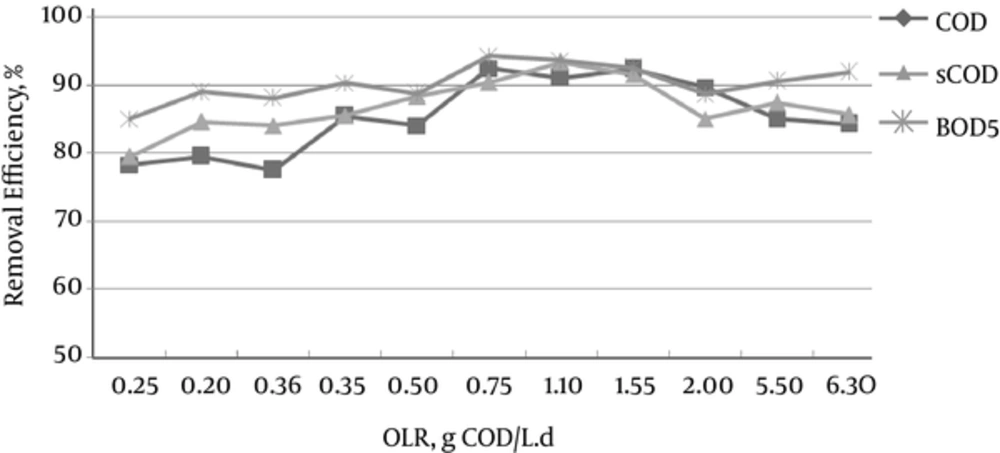
Figure 2.
Average Removal Efficiencies of COD, SCOD and BOD5 in the SBR
4.2. Total Nitrogen and Phosphorus
The concentrations of total nitrogen and phosphorus in the input and output of the SBR at different organic loading rates are shown in Table 2. In this study, the concentrations of total nitrogen and phosphorus in the input of the reactor at OLR of 0.25 g COD/L.d were 122.12 and 27.57 mg/L and in the output of the reactor were 37.25 and 14.11 mg/L, respectively. The concentrations of total nitrogen and phosphorus in the input of the SBR at OLR of 6.3 g COD/L.d were 1443.4 and 217.26 mg/L and in the output of the reactor were 477.76 and 69.52 m/L, respectively.
Table 2.
The Concentration of Total Nitrogen and Phosphorus in the Input and Output of the SBR
| Time, d | Level | TP, mg/L | TKN, mg/L | ||
|---|---|---|---|---|---|
| Input | Output | Input | Output | ||
| 1 - 37 | 1 | 11.14 ± 5.5 | 27.57 ± 5.8 | 37.25 ± 9.5 | 122.12 ± 30.53 |
| 38 - 46 | 2 | 12.01 ± 5.7 | 32.29 ± 8 | 34.68 ± 9 | 141.55 ± 31.2 |
| 47 - 59 | 3 | 10.16 ± 4.8 | 30.48 ± 8.6 | 70.13 ± 25.6 | 265.64 ± 53.1 |
| 60 - 74 | 4 | 11.36 ± 5 | 31.09 ± 10 | 68.92 ± 28.3 | 282.47 ± 50.9 |
| 75 - 98 | 5 | 25.24 ± 8 | 78.24 ± 27.4 | 106.60 ± 33 | 493.54 ± 78.9 |
| 99 - 128 | 6 | 30.23 ± 9.5 | 98.47 ± 32.5 | 142.49 ± 27.8 | 698.46 ± 69.9 |
| 129 - 159 | 7 | 36.85 ± 10.6 | 113.10 ± 31.7 | 172.99 ± 35 | 4816.00 ± 122.4 |
| 160 - 189 | 8 | 42.13 ± 712 | 147.30 ± 26.5 | 308.96 ± 55.4 | 1197.50 ± 215.6 |
| 190 - 248 | 9 | 49.12 ± 15.5 | 154.62 ± 30.2 | 380.90 ± 76 | 1354.06 ± 338.5 |
| 249 - 263 | 10 | 57.10 ± 18 | 172.00 ± 36.2 | 462.72 ± 72.6 | 1341.21 ± 388.9 |
| 264 - 279 | 11 | 69.52 ± 20.5 | 217.26 ± 54.4 | 477.76 ± 75.5 | 1443.40 ± 461.9 |
Figure 3 shows the concentrations of total nitrogen and phosphorus in SBR reactor in different OLRs. According to the results, the minimum and maximum removal efficiencies for total nitrogen were 65.5% and 79.6% (mean = 73.6%), respectively, while for total phosphorus they were 71.4% and 59.6% (mean = 66.5%), respectively. The results showed that by increasing OLR and decreasing hydraulic retention time (HRT), the removal efficiency of these parameters decreased.
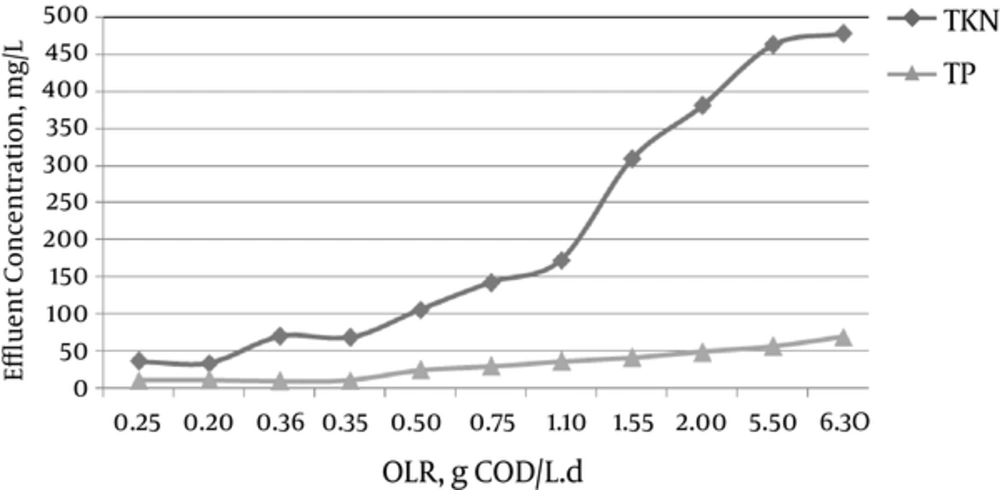
Figure 3.
The Concentration of Total Nitrogen and Phosphorus in the Output of the SBR
5. Discussion
5.1. COD, SCOD, rbCOD and BOD5
Based on the results, the average concentrations of COD, SCOD, rbCOD, and BOD5 in the first period of operation at 0.25 g COD/L.d loading rate were 500, 100, 10, and 90 mg/L in the input and 109, 21, 0, and 14 mg/L in the output, respectively. The removal percentages of these parameters were 78.2, 79.5, 89.6, 86.3%, respectively. An increase in the concentration of these parameters in the input and output of the reactor was observed with increasing OLR of the reactor. As Figure 2 shows, the maximum removal percentage was achieved when OLR was in the range of 0.75 to 1.5 g COD/L.d. The maximum removal rates of these parameters were 92.4, 93.33, 99.8, and 96%, respectively, in the same loading rate. In this loading rate, the concentrations of COD, SCOD, rbCOD, and BOD5 in the effluent of the reactor were 110, 28, 0, and 23 mg/L, respectively. During the ninth month of operation in which the reactor was loaded with non-diluted leachate, the removal efficiencies of COD, SCOD, rbCOD and BOD5 were 89.6, 85, 98.9, and 92%, respectively, while their concentrations in the effluent of the reactor were 420, 165, 0, and 114 mg/L, respectively.
It was also observed that by increasing OLR, the removal efficiency decreased so that by doubling the OLR (in the tenth and eleventh month of operation period), the removal efficiency decreased again.
At 6.3 g COD/L.d loading rate, the concentrations of COD, SCOD, rbCOD, and BOD5 in the input were 6300, 1500, 330, and 1600 mg/L, while their concentrations reached to 990, 216, 11, and 131 mg/L in the output giving 84.25, 85.6, 98, and 91.8% removal efficiencies, respectively. Comparison of these results with the standards of effluent discharge to the environment shows that the SBR operated at 0.75 to 1.5 g COD/L.d loading rate can comply with the allowable limits for discharging the effluent; nonetheless, there are some limitations for all the parameters by increasing loading rate to double. Therefore, the removal efficiencies of the above mentioned parameters decreased by increasing OLR and decreasing HRT. The F/M ratio which was 0.023 day-1 at 0.25 g COD/L.d loading rate also changed with different loading rates. By increasing BOD5 concentration in the input, the F/M ratio increased to 0.25 day-1 in the ninth month of operation at 2 g COD/L.d loading rate; when no dilution was applied, the ratio increased to 0.43 day-1 by doubling flow rate and increasing OLR to 6.3 g COD/L.d. The results of Zhou et al. (2006) study on landfill leachate treatment by SBR indicated that the average removal efficiencies of BOD5 and COD were 98% and 94%, respectively (14). While in our study, the average removal efficiencies of BOD5 and COD were lower due to the presence of interfering matters in the leachate such as nitrogen compounds, volatile fatty acids, heavy metals, ammonium, toxic, and pharmaceutical substances which inhibit biological activity. Hajiabadi et al. (2009) showed that COD removal efficiency was above 97% in treatment of strong synthetic wastewater in SBR reactor in different cell residence times (CRT). Their results also showed that F/M ratio was in the range of 0.42 to 0.79 day-1 and the amount of MLSS was 3,200 mg/L. They also found that by decreasing HRT, the removal efficiency decreases (21). El-Fadel et al. (2004) studied the treatment of landfill leachate by SBR system. The results showed that the COD removal was in the range of 75.9 to 99.8% (22). In a study on WAO, WPO, and a combination of WAO/GAC processes for organic matter removal from leachate of Isfahan composting factory under different conditions carried out by Ehrampoush et al. (2011), the results showed that the combined process had higher efficiency than two other methods while BOD5/COD ratio was achieved as 90% (7). Diamadopoulos et al. (1997) showed that BOD5 and COD removal efficiencies in the treatment of mixed landfill leachate and domestic sewage in SBR were 98.7% and 85.5%, respectively (23). Schwarzenbeck et al. (2005) revealed that SBR system could remove 90% of COD from dairy wastewater (24). Yoong et al. (2000) investigated the treatment of wastewater containing phenol in SBR and found 97% COD removal at OLR of 3.12 gCOD/L.d (25). Hashemi et al. (2016) studied an anaerobic migrating blanket reactor (AMBR) for polycyclic aromatic hydrocarbons (PAHs) and heavy metals removal and found that the AMBR process presented high removal efficiencies in removal of COD, especially when OLR was lower than 4 g COD/L.d (6). Amin et al. (2015) investigated a complementary process for leachate treatment using SBR. They found that COD removal efficiency increased in the bioreactor with time in all the experiments and reached up to 70% (2).
The results of this study on removal efficiencies are consistent with the results of other studies, while in some cases our reactor showed lower performance probably due to the nature of leachate and presence of various impurities and pollutants.
5.2. Total Nitrogen and Phosphorus
In this study, the average removal percentage of phosphorus in the SBR was 66.5%. The removal efficiency increased from 59.6 to 71.4% by increasing OLR from 0.25 to 1.5 g COD/L.d; then, it decreased to 68% when OLR increased to 6.3 g COD/L.d; this was because by doubling the input flow rate HRT decreased in this loading rate. For phosphorus removal, at first it needs anaerobic condition followed by aerobic condition. In our study, this sequence may not happen well. Total nitrogen removal efficiency was higher than phosphorus removal efficiency. Average total nitrogen removal efficiency was 73.6%. In the present study, the anoxic condition perhaps did not happen; therefore, denitrification and consequently nitrogen removal did not happen well. El-Fadel et al. (2004) investigated the treatment of landfill leachate by SBR process. The results showed that ammonia nitrogen removal rate was in range of 31 to 99.8% (22). Spagni et al. (2009) showed 95% nitrogen removal efficiency for treatment of an old landfill leachate by SBR system (26). The nitrogen removal efficiency for treatment of mixed landfill leachate and domestic sewage in the SBR based on Diamadopoulos et al. (1997) study was 50% (23). The dairy wastewater treatment in SBR employed by Schwarzenbeck et al. (2005) showed that the removal efficiencies of TKN and TP were 80% and 67%, respectively (24). Chong and Flinders (1999) showed 50 to 90% phosphorus removal efficiency for treatment of municipal wastewater by SBR (27). The results of Hamamoto et al. (1997) study on the treatment of wastewater by SBR showed that the average nitrogen and phosphorus removal rates of 86% and 82% were achieved in the pilot plant and 96% and 93% in the full-scale plant, respectively (28). Zhou et al. (2006) studied a laboratory-scale SBR for treatment of landfill leachate containing high concentration of ammonium nitrogen with municipal fecal supernatant. Their results indicated that the average removal efficiency of TKN was 85%. They also found that there is a stable simultaneous nitrification and denitrification in this system (14). In some cases, the removal percentages obtained in this study were in agreement with the results obtained in some studies, while they were in contrast to some others. It should be noted that leachate nature is different from wastewater nature used in some previous studies. Since the required C: N: P for operating an aerobic system is 100: 5: 1, this ratio was controlled in this study that showed no violation. Therefore, there is a possibility for leachate treatment using this biological method which is environmentally acceptable.
5.3. Conclusions
The results of this study revealed that the best performance of the SBR was observed in the range of 0.75 to 1.5 g COD/L.d loading rate. The maximum removal rates for COD, SCOD, rbCOD, and BOD5 were 92.45, 93.33, 99.8, and 96%, respectively. The average removal efficiencies of total nitrogen and phosphorus were 73.6 and 66.5%, respectively. According to the results, we can conclude that the performance of SBR in the removal of organic matter, nitrogen, and phosphorus in low OLR was satisfactory and the removal efficiency decreased by increasing OLR and decreasing HRT. On the other hand, this technique had some disadvantages such as: 1. The presence of toxic substances and metals can cause disturbance in the removal of nitrogen and phosphorus, 2. pH of the leachate was low that needs pH adjustment; 3. System was difficult to operate, 4. There was an unpleasant smell during the operation and, 5. High dilution was required for measurement of the parameters.