
1. Context
Fungal infections cause many diseases around the world. The most common fungal infections are superficial fungal infections, which have a high prevalence rate (1). The analysis of the frequency of fungal infections shows that as people get older, the prevalence of fungal infections increases (2). Dermatophytes are a group of molds that can invade tissues with keratinous, such as hair, nails, and the outer layer of skin (3). Previous reports stated that in COVID-19 patients, the most reported infections were aspergillosis, candidiasis, and mucormycosis (4). Moreover, oral candidiasis is rampant in cancerous patients who have a wound in their mouth and are undergoing chemotherapy (5). Aspergillus fumigatus spores can be found almost all over the world. These spores can effortlessly get to the airways and sensitize people who are suffering from asthma (6). Sanitation of public places has a direct connection with people's health in society. Contagious diseases are among the most significant public health challenges (7). For instance, the hygiene of hotels is very important, and it is a criterion for their ranking and star rating (8). Nowadays, the consumption of confectionery products is high in society, and the hygiene of pastry workshops is very important because these pastries are exposed to microbes, which can cause different types of infections or poisonings (9). Oral prostheses may be contaminated with microbes and cause illness to dental staff and patients. These microbes can cause systemic infections, pneumonia, and heart infections in the elderly and people with immune system defects (10). Fungal infections are very important, and many people are infected every year, but they are disregarded in Iran. Health authorities should pay more attention to fungal infections. To the best of our knowledge, although there have been dispersed studies on the evaluation of fungal infections in different parts of Iran, there was no investigation that reports the diverse dimensions of the type of infection in a region or province, the evaluated parameters, and the various types of fungal infection with a comprehensive approach. In addition, knowledge and awareness of various aspects of fungal infections in public places can provide a basis for managers and policy makers in the health field to take necessary measures.
2. Objectives
The aim of this research was to show the importance, prevalence rate, and associated factors of fungal infections in public locations in Iran.
3. Study Selection
The present study is a systematic review. In the first step, after determining the objectives of the research, we extracted the published articles from 6 databases: PubMed, Web of Science, and Google Scholar as a comprehensive search engine, and Scopus, Magiran, and SID (Scientific Information Database) by combining 2 groups of words. The first group of words includes “public location*” OR “hotel*” OR “hostel*” OR “public convenience” OR “sport center*” OR “theatre*” OR “public bath” OR “swimming pool*” OR “school*” OR “shopping center*” OR “hair dresser*” OR "mosque*”. The second group of selected terms includes “fungal infection*” OR “mycosis*”. In addition to consulting with specialists in the field of fungal and public health infections, medical subject heading (MeSH), Emtree thesaurus, and related articles were used to identify the main keywords. In order to perform a more comprehensive search in different databases and identify relevant articles, we applied no time limitation during the search. As an example, the search strategy used in the Web of Science database was:
(TITLE-ABS-KEY (hotel*)) OR (TITLE-ABS-KEY (hostel*)) OR (TITLE-ABS-KEY (“public convenience”)) OR (TITLE-ABS-KEY (“sport center*”)) OR (TITLE-ABS-KEY (theatre*)) OR (TITLE-ABS-KEY (“public bath”)) OR (TITLE-ABS-KEY (“swimming pool*”)) OR (TITLE-ABS-KEY (“school*”)) OR (TITLE-ABS-KEY (“shopping center*”)) OR (TITLE-ABS-KEY (“hair dresser*”)) OR (TITLE-ABS-KEY (“mosque*”))
In addition, the review of the papers was performed by 3 members of the research team in order to assess compliance with the inclusion and exclusion criteria of the studies and the duplicate papers, as follows, the lack of communication with the study area and different geographical areas were removed. The evaluation of the quality of the articles was also done using the Strobe checklist, and the articles were selected by 2 experts. Endnote software was used to organize the study titles and abstracts.
The inclusion criteria were the examination of the subject of fungal infection in a public place within Iran, including schools, hairdressers, and pools. In terms of language, English and Persian articles were analyzed, and review studies were not selected. The PRISMA (Preferred Reporting Items for Systematic Reviews and Meta-Analyses) flow diagram shown in Figure 1 shows that 25 articles were reviewed out of a total of 5 339 documents retrieved from different databases according to the different criteria for inclusion and exclusion.
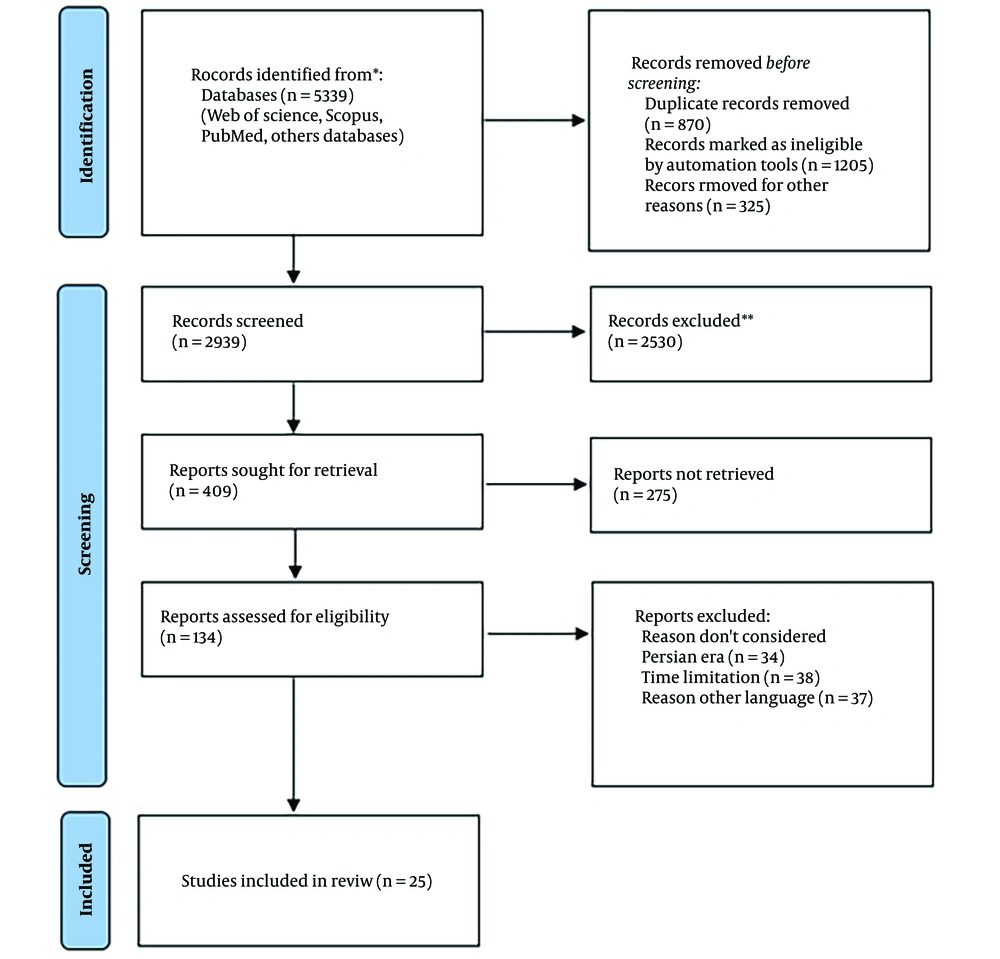
Figure 1.
PRISMA flow diagram for retrieved and selected studies
4. Results
The findings from the analysis of the articles showed that 25 of the 5,339 papers met the criteria and were selected for other research. From a methodological point of view, the most common type of paper was cross-sectional. Fungal infection studies have been conducted in swimming pools, bathrooms, hospital wards, schools, and soil samples of an area (Table 1).
Table 1.
Characteristics of Fungal Infections and Public Community Literature
| Author | Design/ Type of the Study | Location of The Study | Evaluation Parameters | Key Findings | Aim of the Study |
|---|---|---|---|---|---|
| Sarmadian et al. (11) | Cross-sectional study | Indoor public swimming pools/Arak | Water temperature, pH, turbidity, and residual chlorine | Of the samples, 79% had fungal agents. The most common species were saprophytic (74%), yeast (25%), and dermatophyte (2.5%). | The aim of his study was to evaluate the amount of mycological, parasitological, and physicochemical parameters of swimming pools in Arak. |
| Haghighat and Rezazadeh (12) | Cross-sectional study | Oral Medicine Department of Shiraz Dental School | Oral mucosal infectious wounds | The most frequent infection was fungal. The most frequent species were candidiasis. The second common infection was herpes simplex virus (HSV). | The purpose of this study was to ascertain the epidemiology of oral mucosal infectious wounds in patients visiting the Oral Medicine Department of Shiraz Dental School, Iran, for 11 years. |
| Rafiei and Amirrajab (13) | Cross-sectional study | Indoor public swimming pools/Ahwaz | Fungal agents | Aspergillus, Penicillium, and Mucor were the most frequently isolated saprophytic fungi. | The aim of this study was to discover fungal agents in Ahwaz's indoor swimming pools. |
| Soltanpoor et al. (14) | Quantitative | Elementary schools/Koohrang | Doubtful head, nail, or cutaneous lesions | Lifestyle plays an important role in the prevalence of dermatophytosis; 70% of positive cases lived with poor sanitation. | The aim of this study was to ascertain the prevalence of fungal infections among elementary school students. |
| Kachuei et al. (15) | Quantitative | Isfahan Province | Soil samples | Chrysosporium keratinophilum (31.4%), C. pannicola (16.9%), C. tropicum (15.4%), Microsporum gypseum (12.4%), Chrysosporium spp. (9.9%), C.indicum (7%), Sepedonium spp. (3.3%), Malbranchia spp. (1%), Trichophytonterrestre (0.8%), T.ajelloi and Paecilomyces lilacinus (0.4%), Engyodontium album and Acremonium spp. (0.3%), Curvularia spp., Fusarium spp., and Ulocladium spp. (0.1%). In this study, E. album was isolated for the first time in Iran. | The aim of this study was to determine the epidemiology of keratophilic fungi in Isfahan Province. |
| Afshar et al. (16) | Quantitative | Mazandaran Province | Suspected cases and patients with onychomycosis | Candida spp. was isolated in (61.9%) of the cases and was the most common agent of onychomycosis. | The purpose of this study was to evaluate the epidemiology and identify the etiological factors of onychomycosis. |
| Amanati et al. (17) | Case report | Shiraz | leukemic children | Mucormycosis-associated neutropenic enterocolitis is one of the most unfavorable and untreatable side effects of salvage chemotherapy in leukemic children with disease relapse. | This report could help better understand, diagnose, and manage fungal infections during febrile neutropenia. |
| Badiee et al. (18) | Quantitative | Shiraz | Bronchoalveolar lavage and sputum samples | The most common species identified were Candida albicans, C. glabrata, C. krusei, Aspergillus flavus, and A. fumigatus. Pneumocystis jirovecii | The purpose of this study was to determine the rate of fungi identified in the respiratory tract system of patients suffering from recurrent lung disorders. |
| Barati et al. (19) | Quantitative / mycological methods | Otolaryngology Clinic of Isfahan University of Medical Sciences | Patients with clinical suspicion of otomycosis | A. flavus was the most frequent fungus in otomycosis. | The purpose of this study was to ascertain the prevalence of fungal agents, predisposing factors, and characteristics of patients. |
| Kelarestaghi et al. (20) | Case report | Amol | Brown macules | Most patients were from rural areas in tropical and humid locations and resided near the sea, salt marshes, or river estuaries. | The aim of this study was to give more specific features about tinea nigra. |
| Khodadadi et al. (1) | Retrospective study | Shiraz | Clinical samples of patients' affected area | Candida spp. was the most common fungi in the yeast group. Dermatophytes were the most common fungi among filamentous fungi. | The aim of this study was to give some basic information about superficial and cutaneous mycoses. |
| Khodaveisi et al. (21) | Quantitative | Kurdistan | The walls and floors of the bathrooms | The most common fungi were Cladosporium spp. (28.9%), Exophialla spp. (23.3%), and Rodutorella spp. (13.2%). | The aim of this study was to discover the fungal corruption in student hostels of Kurdistan University of Medical Sciences. |
| Mohammadi et al. (22) | Quantitative/survey | Isfahan | Patients with fungal sinusitis | A. flavus was the most common fungal species. | The purpose of this study was to identify fungal species isolated from noninvasive fungal sinusitis by molecular methods. |
| Rezvani et al. (23) | Quantitative | Babol | Patients with dermatophytosis. | The results show that tinea cruris and tinea pedis were the most common dermatophytosis in Babol. | The purpose of this study was to ascertain the clinical patterns and etiology of dermatophytosis. |
| Sadeqi et al. (24) | Quantitative/survey | Tehran | Plucked hairs, skin, and nail scraping were examined. | The most common pathogen isolated was Trichophyton rubrum (28.7%). | The aim of this study was to analyze the spectrum of dermatomycoses in Tehran. |
| Yaghoobi et al. (25) | A prospective clinical study | Khuzestan | Nail specimens | The most frequent clinical form of psoriasis was psoriasis vulgaris (63.3%). | The aim of this study was to determine the connection between fungal infections and nail psoriasis. |
| Mikaeili and Karimi (26) | Quantitative /mycological methods | Kermanshah | Nail | C. albicans isolated in (45.0%) and other Candida spp. isolated in (54.0%) of the cases as the most common agents of onychomycosis. | The aim of this study was to isolate and identify the causative fungi of onychomycosis. |
| Omidynia et al. (27) | Quantitative | Hamadan | Cutaneous mycoses | Dermatophytes were the most frequent infections. | The aim of this study was to determine the extent and causative agents of dermatophytes in Hamadan. |
| Khalili et al. (28) | Case report | Tehran | Biopsy of the liver lesion | A diagnosis of hepatosplenic mucormycosis was made. | The aim of this study was to show mucormycosis is an important cause of morbidity and mortality in immunocompromised patients. |
| Afshari and Riazipour (29) | Quantitative | Taibad | Suspected superficial lesions | The prevalence of superficial fungal diseases in military staff in the Taibad region was less than expected. | The purpose of this study was to determine the frequency of superficial cutaneous fungal infections among the military staff of Taibad. |
| Arastehfar et al. (30) | Quantitative | Tehran, Mashhad, Shiraz | C. parapsilosis species complex blood isolates | A low level of antifungal resistance for Iranian C. parapsilosis blood isolates was found. | The aim of this study was to figure out the antifungal susceptibility pattern, genetic diversity, and clinical information. |
| Ansar et al. (31) | Retrospective study | Iran | Subjects suspected to have dermatophytoses. | The most frequent type of infection was tinea corporis. | The aim of this study was to identify the clinical aspects and types of dermatophytes involved in tinea incognito cases in Iran during 1993-2008. |
| Anoushiravani et al. (32) | Cross-sectional study | Arak | Immunocompromised patients suspicious of pulmonary infections | The most frequently isolated fungi were C.albicans, A. fumigatus, and Mucor species. | The aim of this study was to fungal contamination of the respiratory system in immunocompromised patients. |
| Sadeghi Dehkordi (33) | Descriptive cross-sectional study | Hamadan | Shower, saunas, and pool walls | The highest rate of fungal contamination were saprophytes (52%), Aspergillus (41%), Penicillium (15%), and yeast (42.1%), respectively. | Reporting the first fungal pollution in swimming pools |
| Hoseinzadeh et.al. (34) | Descriptive -cross-sectional study | Hamadan | indoor public swimming pools | The most frequent fungal types were Clado Sporium spp and Aspergillus spp. | Evaluation of fungal contamination in swimming pools |
| Sajjadi et al. (35) | Cross-sectional study | Mashhad, Mashhad University of Medical Sciences | The type and amount of fungal contamination in an organ transplantation hospital | Comparing fungal contamination of different parts of the operating room with the European Union guidelines showed that the hospital is classified in Class b in terms of fungal contamination. | Fungal assessment of indoor air quality in sections and operation halls |
5. Conclusions
The occurrence of fungal contamination in public environments is one of the important issues that should be taken into account, considering the referrals of different groups of people, the type of environment, and the place and platforms of fungal infection transmission. At the national level, various studies have evaluated the prevalence of these infections in different places (36-38). The efforts of health institutions also indicate that the World Health Organization (WHO) published a list of fungal priority pathogens (Fungal Priority Pathogens List) at the end of 2022 with the aim of directing research and investment towards fungal infections (36).
On the other hand, researchers have described the lack of epidemiological data on fungal infections as a challenge for the diagnosis and management of fungal diseases, especially in Middle Eastern countries (39). In Iran, one of the most overcrowded areas of the Middle East, it is essential to know the different types of fungal infections in numerous public places to reinforce appropriate therapeutic strategies. In this regard, the present research was conducted to identify different types of fungal species in public environments and places inside Iran and according to different geographical areas.
In addition, the research studies were analyzed in terms of the type of study, the examined environment, the appraised parameters, and the categorization of fungi based on superficial, deep, and other cases. One of the objectives of the research was to know the location or place of study of fungal infections in different geographical regions of Iran. The review of studies showed that in some case reports, the incidence or prevalence of fungal infections had been investigated in swimming pool environments, departments affiliated with hospitals or medical centers such as oral medicine units, elementary schools, agricultural and soil environments, public baths, saunas, and the walls of swimming pools (2, 11-13, 25, 26, 33, 34, 37, 40, 41).
The results of the review indicated that, from the point of view of the type of research design, the studies considered were mostly cross-sectional. In terms of the reasons and types for the spread and transmission of fungal infection, various factors can be considered to be involved in this matter, according to the studies. It has been mentioned in some studies that the most common fungal skin pathogens are dermatophytes, which are found in all parts of the world. The results of the studies showed that the amount of dermatophyte fungal contamination in the locker room and showers were higher than in other places. In addition, it has been stated that the cause of the fungal contamination was the large number of visitors per day, the oldness of the pool building, non-compliance with international standards, the short distance between the showers and the changing room, and the lack of a suitable location (24, 33, 36).
Based on the researchers' findings, saprophytic fungi were the most prevalent, constituting 74% of the fungal species found in the public pool, followed by yeast fungi (25%) and dermatophyte spp. (2.5%). These types of fungi can act as causative agents for superficial, cutaneous, and systemic infections in immunocompromised patients, as classified into 5 categories: superficial, cutaneous, subcutaneous, mucosal, and visceral fungi (11). Furthermore, the assessment of wound infections in the oral mucosa revealed that the primary fungal species responsible for causing ulcers were candidiasis and herpes simplex virus (HSV) in the majority of cases. As per the proposed classification, this group of infections can be categorized under immune-related infections (12). Rafiei and Amirrajab conducted an investigation into pool environments and identified the most abundant fungal species, Aspergillus, Penicillium, and Mucor, in that order. The species highlighted in their study are known factors contributing to systemic infections in various individuals, especially those undergoing high-dose chemotherapy and other susceptible populations (13).
In a distinct environment, Soltanpoor et al. conducted an experiment on samples from patients residing in underprivileged areas, reporting a 70% prevalence of dermatophyte infections. These infections are classified in the subgroup of skin fungal infections (14). Furthermore, in a study involving soil samples from Isfahan, it was distinguished that Chrysosporiumkeratinophyllum and Panicula tropicum were the most abundant fungal species in the soil (15). Afshar et al. discovered that Candida species were the most commonly found pathogens in patients suspected of having onychomycosis, which is categorized among skin fungal infections (16). Similarly, Amanati et al. examined the enterocolitis form of mucormycosis in nephropathy patients with leukemia, finding that there was a poor prognosis among the patients. It emerged as one of the side effects of chemotherapy in children with leukemia experiencing disease recurrence or severity (17). In a study by Badiee et al., the most prevalent species identified in sputum samples obtained from lung alveolar washings included C. albicans, C. glabrata, C. krusei, A. flavus, and A. famigatus fungi. These species are known to contribute to systemic fungal infections, particularly in individuals with compromised immune systems (18).
In other studies (19), patients suspected of having fungal infections of the external ear were evaluated, and it was reported that A. flavus was the most frequent causative agent of this disease. These infections are classified within the group of superficial fungal diseases. Another research effort (20) focused on individuals with skin moles in hot and humid rural areas, particularly those residing in the suburbs of Darya, and identified tinea nigra as the prevailing condition. Furthermore, in examinations of clinical samples (21), researchers found that surface and skin fungal infections most commonly involved Candida and dermatophytes, respectively. These types of fungi are recognized as potential causes of systemic infections. Additionally, Khodaveisi et al. conducted a study in student dormitories' bathroom environments and observed the highest frequencies of Cladosporium spp. (28.9%), Exophialla spp. (23.3%), and Rhodutorella spp. These fungi can lead to superficial, subcutaneous, and systemic fungal diseases, particularly in susceptible individuals (21).
In their evaluation of patients with fungal onychomycosis, Mohammadi et al. found that A. flavus was the most common fungal species responsible for this condition, which can encompass a spectrum of superficial, cutaneous, and systemic fungal diseases (22). Other researchers conducted an evaluation of dermatophyte patients in Babol, revealing that ringworm of the groin and ringworm of the foot were the most prevalent dermatophyte skin infections (23). Direct testing of skin, hair, and nail samples in Tehran indicated that Trichophyton was the most frequently identified dermatophyte responsible for ringworm (24). Furthermore, in correlation analysis of nail samples, Yaghoobi et al. concluded that nail psoriasis vulgaris was more prevalent than other nail fungal infections (25). An investigation into fungal agents causing Onychomycosis revealed that the most common agents were C. albicans and other Candida species (26). In an analysis of skin infections acquired from the environment, Dermatophyte infections were reported as the most prevalent type in Hamedan. Henry's studies have identified over 40 types of dermatophyte infections affecting the skin, with three primary species being Microsporum, Trichophyton, and Epidermophyton. In ecological terms, dermatophytes exhibit a relationship between humans, animals, and soil (42, 43).
Additionally, Khalili et al. diagnosed opportunistic systemic fungal infections, including mucormycosis, in liver biopsy samples of immunocompromised individuals, highlighting the potential for serious diseases in susceptible patients (28). The frequency of surface and skin fungal infections was analyzed in military personnel, and it was found to be lower than expected (28). Ansari et al. reported body tinea as the most common form of tinea in Iran between 1992 and 2008. Anoushiravani et al. noted C. albicans and other Mucor species had a higher frequency in patients suspected of pulmonary fungal infections (32). Sadeghi Dehkordi in their evaluation of swimming pool and bathroom environments, observed that the most contamination was associated with Aspergillus and Penicillium species, as well as yeasts (33). Furthermore, in a survey of public swimming pools, the most common fungi identified were Chladosporium and Aspergillus species, which have the potential to cause skin infections, ranging from superficial to systemic, in immunocompromised individuals and organ transplant recipients (31).
In general, it can be stated that the research design of most of the texts was cross-sectional. Most of the studies in the field of fungal infections in public environments in Iran have been conducted in places such as swimming pools, schools, some health care settings, cultivation environments, and soil. Examination of different species and also the environment indicated that a combination of superficial, skin, mucosal, and visceral fungal infections was observed in public places. The researchers believe that other research needs to be done in macro-country areas to understand the fungal infection of each region and their epidemiology so that appropriate prevention and treatment strategies can be carried out and strengthened. Furthermore, to reinforce the health situation and prevent the occurrence of invasive fungal infections in the community, health policy-makers should take appropriate measures into consideration. Considering the limitation of searching for studies in databases, it is suggested that other future studies use data mining techniques to investigate other dimensions of fungal infection.
5.1. Limitations
One of the limitations of the research was access to the full text of some articles. To overcome this limitation, the research team tried to collect articles by contacting their authors or publishers. Some articles were also removed due to lack of access to the full text.