
1. Background
Mental well-being is a crucial component of overall well-being, significantly influencing a person's sense of positivity and contentment. However, this subject is complex and multifaceted (1). For example, mental well-being and psychological well-being are often used interchangeably, and hedonic experiences, happiness, and liveliness are sometimes referred to as mental well-being. Therefore, before aiming to enhance people's well-being, it is essential to have a reliable and valid scale to describe and evaluate it (2).
Many standardized instruments have been developed to assess people's mental well-being. Some focus on effective factors, while others measure the status of people's mental well-being or are developed for specific groups. The Warwick-Edinburgh Mental Well-Being Scale (WEMWBS) is one of the best scales, developed at Warwick and Edinburgh universities in 2007, using mental well-being research conducted in England (3). The scale's origins can be traced back to the 1980s, first introduced in a research study conducted in New Zealand entitled “Affectometer 2” (4).
Initially, it gained popularity in the UK, but over time, it has been translated, validated, and utilized in multiple languages worldwide. The first Persian version of the WEMWBS was developed by Rajabi in 2013. This study was conducted among cancer patients, and according to the results, by removing questions 12 and 13, the correlation between items improved (5). Another psychometric study of the Persian version of the WEMWBS was conducted in 2020 by Mavali et al. They introduced the 13 items as a latent component, naming it the Iranian version of the Warwick-Edinburgh Mental Well-being Scale “WEMWBS-P.” This study specifically focused on the elderly population in Iran, suggesting that the scale was suitable for this group (6).
The use of this scale in special groups with high and low clinical levels, such as cancer patients or the elderly, can result in differences in psychometric coefficients (2). These groups have a unique perception of well-being compared to the general population due to their uncommon living conditions.
In the current study, a group of employees was considered to ensure the scale fulfills the requirements for comprehensiveness of the target group. Based on the most recent census in Iran, more than ten million people are employed by the government. This population can serve as a reliable representation of the total Iranian population over 16 years old. Employee well-being is also recognized as a crucial area in Iran's health system research (7). Improving employee well-being has various dimensions, all aiming to enhance quality of life and satisfaction with the work environment. However, mental well-being in the workplace has a more significant impact on employee performance than other dimensions of well-being. Therefore, it is crucial for organizations to prioritize the mental health of their employees and consistently monitor it. This is essential for the effective management of human capital and has a positive impact on society as a whole (7, 8). Finally, including employees in the study of the psychometric properties of the WEMWBS will provide better generalization for the whole society.
2. Objectives
This study aimed to examine the psychometric properties of the Pr-WEMWBS among employees of Iranian organizations and administrative departments. This will provide a reliable and evidence-based instrument in Persian for Iranians seeking to measure their well-being.
3. Methods
3.1. Study Design and Procedures
This was a tool development study in which quantitative and qualitative psychometric methods were used. The original version was translated into Persian based on the model of Wild et al. (9, 10). To achieve this goal, an initial step was taken by reaching out to the primary developers of the WEMWBS through email. Obtaining approval for the translation and psychometric assessment of the Persian version was also communicated to them (preparation). Then, the original version of the scale was given to two independent translators fluent in Persian and English to translate the items into the new (Persian) language (forward translation). After that, both translations were compared by a psychology expert to ensure the words and specialized terms were correctly translated (reconciliation). Then, the modified version was given to a third translator fluent in English and Persian to be translated back to the original language of the scale (backward translation). This translator was entirely unaware of the study process. The three versions (original, forward translation, and backward translation) were compared by the research team to achieve final harmonization and confirmation (harmonization).
In the cognitive review stage, the items were examined through face-to-face interviews with 11 employees, and any ambiguities and unfamiliar terms in the common language were corrected (cognitive debriefing and finalization). Participants in the translation process included official employees and experts in psychology, health education and health promotion, and social medicine.
After the translation process, validity indices were assessed through both quantitative and qualitative methods. Face validity, content validity (measured by calculating the CVR and the CVI), and construct validity [determined by the exploratory factor analysis (EFA) and the confirmatory factor analysis (CFA)] were all considered. The reliability of the Pr-WEMWBS was calculated by examining Cronbach's alpha coefficient, the intraclass correlation coefficient (ICC), and the correlation of the items with the test-retest method.
3.2. Sample Size
Participants were selected from among employees of administrative departments who volunteered and had lighter workloads to ensure more accurate and focused responses to the questionnaire. Based on access conditions, participants were chosen from the administrative departments of medical sciences universities in southeast Iran, including Kerman University of Medical Sciences, Bam University of Medical Sciences, and Zahedan University of Medical Sciences. The details of the employees' characteristics are presented in Table 1. Following the "rules of thumb" and based on Munro's suggestion of at least 100 to 200 people for the optimal sample size (11), 200 employees were initially selected for construct validity analysis. After removing distorted responses, data from 193 employees were included in the study. Additionally, 11 employees (excluding the 193 employees) were invited to evaluate face validity, and eight experts were invited to assess content validity. To confirm the reliability of the Pr-WEMWBS through test-retest analysis, 36 other employees participated in the study over 21 days.
Table 1.
Demographic Characteristics of Participants a
| Characteristics | Validity Analysis (N = 193) | Test-Retest (N = 36) |
|---|---|---|
| Gender | ||
| Female | 137 (71.0) | 19 (52.8) |
| Male | 56 (29.0) | 17 (47.2) |
| Marriage status | ||
| Married | 127 (65.8) | 26 (72.2) |
| Single | 56 (29.0) | 9 (25.0) |
| The widow/divorced | 10 (5.2) | 1 (2.8) |
| Educational level | ||
| High school/diploma | 5 (2.6) | 1 (2.8) |
| AD | 21 (10.9) | 5 (13.9) |
| BD | 89 (46.1) | 11 (30.6) |
| MD | 67 (34.7) | 18 (50.0) |
| PhD | 11 (5.7) | 1 (2.8) |
| Employment situation | ||
| Commitment/part-time | 25 (13.0) | 4 (11.1) |
| Corporate/seasonal | 33 (17.1) | 6 (16.7) |
| Temporary/contract | 68 (35.2) | 12 (33.3) |
| Permanent | 67 (34.7) | 14 (38.9) |
| Job position | ||
| Expert/staff | 159 (82.4) | 29 (80.6) |
| Administrator/supervisor | 14 (7.3) | 3 (8.3) |
| Manager | 14 (7.3) | 1 (2.8) |
| Chief/director | 6 (3.1) | 3 (8.3) |
| Income level | ||
| ≤ common mean | 103 (53.3) | 14 (38.90 |
| Common mean | 83 (43.0) | 20 (55.6) |
| ≥ common mean | 7 (3.6) | 2 (5.6) |
| Number of children | ||
| 0 | 67 (34.7) | 12 (33.3) |
| 1 | 40 (20.7) | 6 (16.7) |
| 2 | 69 (35.8) | 12 (33.3) |
| ≥ 3 | 17 (8.8) | 6 (16.7) |
| Age | 36.15 ± 8.07 | 36.14 ± 8.62 |
a Values are expressed as No. (%) or mean ± SD.
3.3. Face Validity
In the first step, a cognitive interview was conducted to confirm the qualitative face validity of the items. This involved psychology experts and available administrative staff, who provided their opinions on the difficulty, wording, purpose fit, and possible ambiguities in the items. Eight available employees were evaluated for the quantitative face validity of the Pr-WEMWBS to confirm the appropriateness of the items by calculating the impact score. Participants were asked to answer each item on a five-point scale ("appropriate" to "inappropriate"). The impact score for each item was then determined by multiplying the number of participants who selected “appropriate” and “almost appropriate” by the average score for that item. The minimum acceptable impact score for each item was 1.50.
3.4. Content Validity
Qualitative content validity was conducted through face-to-face interviews with three experts in health education and social medicine, and their opinions on the items' comprehensibility were considered. Two methods, CVR and CVI, were used for quantitative content validity. To calculate the CVR, eight psychology experts were asked via email to rate each item on a two-point scale (“necessary” or “not necessary”). The CVR was then calculated for each item and for the entire Pr-WEMWBS, according to the number of experts who had chosen “necessary,” based on Lawshe’s table.
To assess the CVI, eight experts were asked to rate the items for relevancy using a four-point scale. The S-CVI-Avg and the item-CVI (I-CVI) were estimated based on the ratio of the number of experts who scored three and four for each item to the total number of experts. The S-CVI-UA was estimated based on the ratio of the number of items that scored three and four to all items. The acceptance rates for the I-CVI and the S-CVI-UA were determined to be above 0.7 and higher than 0.8, respectively (12).
3.5. Construct Validity
The EFA was used to extract latent factors. The adequacy of the sample size was assessed with the KMO and Bartlett’s tests. A KMO coefficient above 0.8 was considered acceptable. The number of latent factors was determined by analyzing the scree plot and performing principal component analysis (PCA) with Direct Oblimin rotation. Eigenvalues above one were used to determine the number of latent factors. The correlation of the items was analyzed using the Pearson correlation coefficient. The minimum cut-off point for assessing the power of commonalities was set at 0.4 (13).
Then, CFA was performed to confirm the construct validity. The goodness of fit and scale modeling based on maximum likelihood were investigated, and the assumption of normality of the data was checked and confirmed using Skewness and Kurtosis. For final confirmation, CMIN/DF, GFI, CFI, PNFI, PCFI, and RMSEA were presented as the most important goodness of fit indices, based on the instrument developers' recommendations (14).
3.6. Reliability
First, the consistency reliability was examined to evaluate the validity of the Pr-WEMWBS. For this purpose, the test-retest method was used with 36 available employees over a period of 21 days. The correlation between the answers for each item was then assessed. Additionally, Cronbach's alpha coefficient and the ICC were calculated using the Two-Way Mixed-Effects Model.
3.7. WEMWBS (Original Version)
The WEMWBS consists of 14 items that assess various aspects of mental well-being, such as positive and negative emotions, self-control, healthy relationships, self-esteem, motivation, social connection, concentration and attention, sense of worth, resilience, and creativity. These items are designed as a Likert Scale, with answers scored from “1” to “5.” The overall mental well-being score is computed from the total scores of each item, ranging from 14 to 70 (3). The WEMWBS has several advantages, such as its simplicity and ease of understanding. It can be utilized in various settings and is known for its reliability and validity. Additionally, it can be compared to other scales and indicators like “The General Well-Being Questionnaire” or “The Psychological Well-Being Scale” for mental well-being assessment. The scale is concise and accurate, and evidence supporting its effectiveness has been available for over a decade through multiple articles and studies (15).
3.8. Persian Version of the Warwick-Edinburgh Mental Wellbeing Scale (Pr-WEMWBS)
The scale consists of 14 items. Respondents are asked to rate how often they have experienced each item on a scale of 1 (never) to 5 (always). The overall EMW score is calculated by summing the scores (resulting in a score range between 14 and 70), with a higher score indicating better mental well-being (Appendix 1).
4. Results
After the qualitative psychometric assessments for face and content validity, it was determined that no specific modifications were necessary for the translated version. Furthermore, all the data were confirmed through quantitative analysis.
After reviewing the data from 193 participants (Tables 1 and 2), it was found that 3.1% received the lowest possible score and 0.5% received the highest possible score. As a result, there were no ceiling or floor effects observed, and the normality test of the data was confirmed.
Table 2.
Descriptive Statistics of Responses for the Warwick-Edinburgh Mental Well-being Scale (Pr-WEMWBS) in Validity Analysis
| Items | No. | Mean ± SD | Skewness | Kurtosis | % | ||||
|---|---|---|---|---|---|---|---|---|---|
| 5 a | 4 b | 3 c | 2 d | 1 e | |||||
| I1 | 193 | 1.65 ± 0.829 | 1.347 | 1.957 | 53.4 | 32.1 | 11.9 | 1.6 | 1.0 |
| I2 | 193 | 1.60 ± 0.772 | 1.526 | 3.188 | 53.9 | 35.8 | 8.3 | 1.0 | 1.0 |
| I3 | 193 | 2.06 ± 0.792 | 0.916 | 1.915 | 21.8 | 56.0 | 18.7 | 2.1 | 1.6 |
| I4 | 193 | 2.07 ± 0.753 | 0.692 | 1.460 | 20.2 | 56.0 | 21.2 | 1.6 | 1.0 |
| I5 | 193 | 1.64 ± 0.766 | 1.286 | 2.029 | 50.3 | 38.9 | 8.3 | 2.1 | 0.5 |
| I6 | 193 | 2.03 ± 0.676 | 1.392 | 4.488 | 15.0 | 72.0 | 8.8 | 3.1 | 1.0 |
| I7 | 193 | 2.13 ± 0.770 | 0.951 | 2.139 | 16.6 | 59.6 | 19.7 | 2.6 | 1.6 |
| I8 | 193 | 1.58 ± 0.833 | 1.754 | 3.619 | 58.5 | 30.1 | 8.3 | 1.6 | 1.6 |
| I9 | 193 | 1.67 ± 0.843 | 1.206 | 1.112 | 52.3 | 32.1 | 11.9 | 3.1 | 0.5 |
| I10 | 193 | 1.96 ± 0.636 | 1.384 | 5.767 | 17.6 | 72.5 | 7.3 | 1.6 | 1.0 |
| I11 | 193 | 1.91 ± 0.723 | 1.146 | 3.240 | 25.9 | 61.7 | 9.3 | 2.1 | 1.0 |
| I12 | 193 | 1.73 ± 0.953 | 1.159 | 0.744 | 56.0 | 20.7 | 19.7 | 2.1 | 1.6 |
| I13 | 193 | 1.74 ± 0.871 | 1.068 | 0.869 | 49.7 | 30.6 | 17.1 | 1.6 | 1.0 |
| I14 | 193 | 2.20 ± 0.826 | 0.950 | 1.656 | 15.5 | 57.0 | 21.2 | 4.1 | 2.1 |
a All of the time.
b Often.
c Some of the time.
d Rarely.
e None of the time.
In the quantitative face validity analysis, the mean impact score for all items ranged from 4.32 to 5.00 (above 1.5). The CVR for all items was higher than 0.75, and for the entire Pr-WEMWBS, it was equal to 0.96. Additionally, the I-CVI ranged from 0.87 to 1.00, while the S-CVI-UA and S-CVI-AVG were 0.71 and 0.96, respectively.
The adequacy of the sample size was confirmed based on the KMO=0.87 and Bartlett's test (χ2=1216.28, P ≤ 0.000). The anti-image table showed that the correlation between all items was above 0.80, confirming their adequacy. The EFA revealed three latent factors with eigenvalues above one, and the commonality coefficient for all items was above 0.40. Additionally, in the pattern matrix, after performing direct Oblimin rotation, all items were well distributed across the three latent factors. The initial eigenvalue of 6.185 had the highest contribution to the variance of items at 44.18%. The second eigenvalue of 1.251 and the third eigenvalue of 1.074 accounted for 8.93% and 7.67% of the variance, respectively.
Finally, items 1, 2, 3, 8, 10, 12, 13, and 14 (8 items) loaded on the first latent factor (self-contentment), items 5, 6, 7, and 11 (4 items) loaded on the second (self-efficacy), and items 4 and 9 (2 items) loaded on the third latent factor (social harmony). Therefore, the Pr-WEMWBS was extracted with three latent factors and 14 items (Tables 3 and 4).
Table 3.
Communalities and Initial Eigenvalues in the Exploratory Factor Analysis (EFA) for the Warwick-Edinburgh Mental Well-being Scale (Pr-WEMWBS)
| Items | Extraction | Total | % of Variance | Cumulative % |
|---|---|---|---|---|
| I1 | 0.600 | 6.185 | 44.182 | 44.182 |
| I2 | 0.651 | 1.251 | 8.936 | 53.118 |
| I3 | 0.690 | 1.074 | 7.670 | 60.788 |
| I4 | 0.480 | 0.927 | 6.622 | 67.410 |
| I5 | 0.466 | 0.790 | 5.640 | 73.050 |
| I6 | 0.627 | 0.673 | 4.807 | 77.857 |
| I7 | 0.671 | 0.533 | 3.810 | 81.667 |
| I8 | 0.639 | 0.508 | 3.626 | 85.293 |
| I9 | 0.756 | 0.485 | 3.462 | 88.755 |
| I10 | 0.769 | 0.441 | 3.147 | 91.902 |
| I11 | 0.527 | 0.328 | 2.341 | 94.244 |
| I12 | 0.571 | 0.314 | 2.243 | 96.486 |
| I13 | 0.452 | 0.256 | 1.828 | 98.314 |
| I14 | 0.612 | 0.236 | 1.686 | 100.000 |
Table 4.
| Items | Component | ||
|---|---|---|---|
| 1 | 2 | 3 | |
| I3 | 0.931 | ||
| I1 | 0.772 | ||
| I2 | 0.685 | ||
| I14 | 0.668 | ||
| I12 | 0.655 | ||
| I8 | 0.617 | ||
| I13 | 0.476 | ||
| I10 | 0.411 | ||
| I7 | 0.812 | ||
| I11 | 0.798 | ||
| I6 | 0.743 | ||
| I5 | 0.384 | ||
| I9 | 0.850 | ||
| I4 | 0.798 | ||
a Rotation converged in 10 iterations.
b Extraction method: Principal component analysis.
c Rotation method: Oblimin with Kaiser normalization.a.
In the absolute fit indices, GFI = 1.000 and RMSEA = 0.10; in the comparative fit indices, CFI = 1.00 and CMIN/DF = 2.91; and in the parsimonious fit indices, PNFI = 0.673 and PCFI = 0.714 were acquired. All correlations were above 0.50, confirming the goodness of fit for the final model (Figure 1).
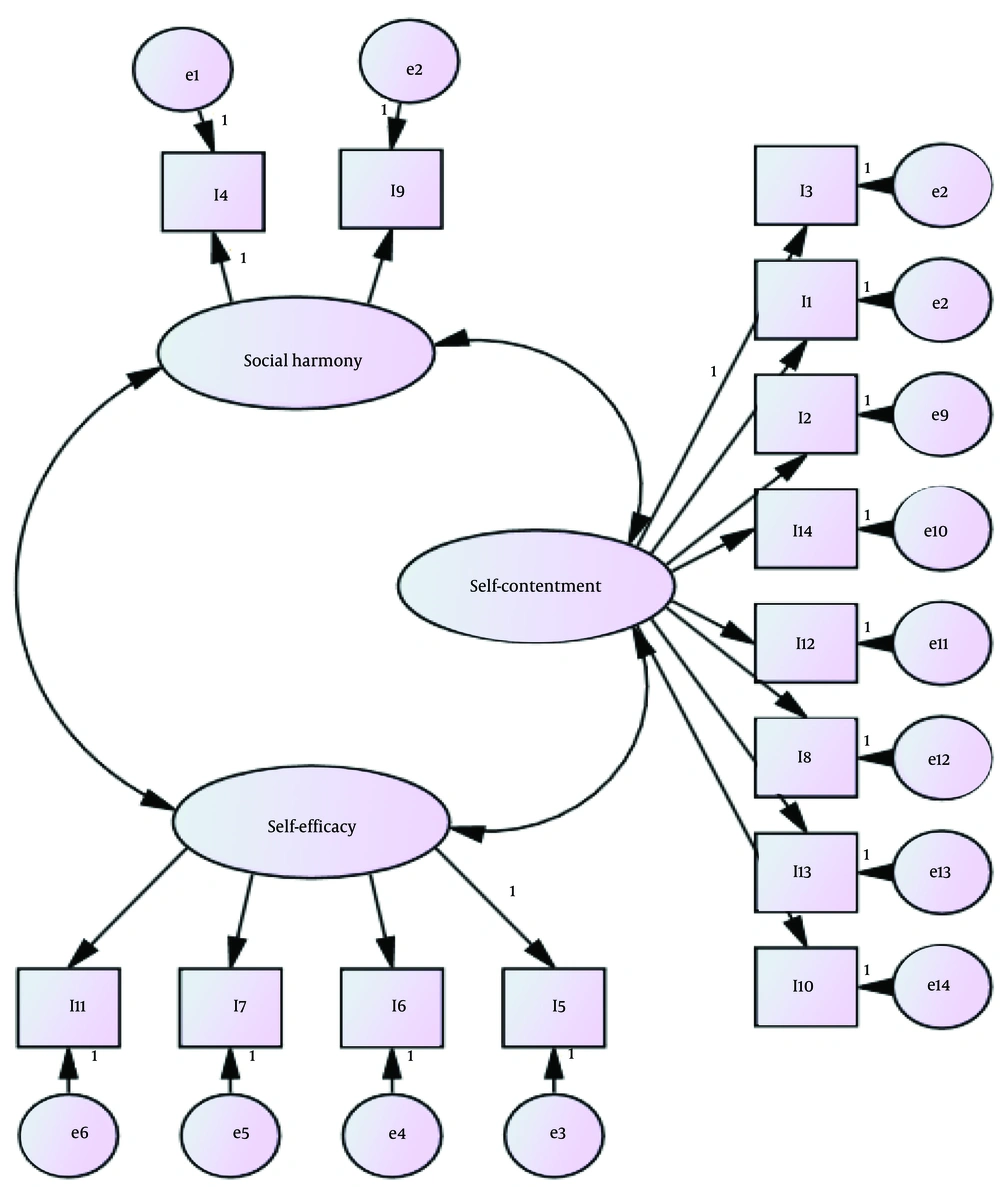
Figure 1.
Path diagram of three factors model of the Warwick-Edinburgh Mental Well-being Scale (Pr-WEMWBS) using the confirmatory factor analysis (CFA)
Cronbach's alpha coefficient for the entire Pr-WEMWBS was 0.901, and the Corrected Item-Total Correlation for all items was above 0.30. The mean ICC was estimated to be 0.889 (confidence interval 0.863 to 0.912). The test-retest correlation within 21 days was above 0.60 for all items. Additionally, the mean correlation between the items was 0.395 (Table 5).
Table 5.
| Items | Corrected Item-Total Correlation (N = 193) | Cronbach's Alpha If Item Deleted (N = 193) | Test-Retest Correlations (N = 36) | |
|---|---|---|---|---|
| Pearson Correlation | Sig. (2-Tailed) | |||
| I1 | 0.629 | 0.892 | 0.687 | 0.000 |
| I2 | 0.717 | 0.888 | 0.849 | 0.000 |
| I3 | 0.588 | 0.893 | 0.891 | 0.000 |
| I4 | 0.618 | 0.892 | 0.840 | 0.000 |
| I5 | 0.599 | 0.893 | 0.885 | 0.000 |
| I6 | 0.554 | 0.895 | 0.878 | 0.000 |
| I7 | 0.524 | 0.896 | 0.761 | 0.000 |
| I8 | 0.504 | 0.897 | 0.827 | 0.000 |
| I9 | 0.454 | 0.899 | 0.767 | 0.000 |
| I10 | 0.578 | 0.894 | 0.819 | 0.000 |
| I11 | 0.625 | 0.892 | 0.903 | 0.000 |
| I12 | 0.643 | 0.891 | 0.915 | 0.000 |
| I13 | 0.603 | 0.893 | 0.858 | 0.000 |
| I14 | 0.692 | 0.889 | 0.881 | 0.000 |
a P = 0.01.
b Cronbach's alpha based on standardized items = 0.901.
c Average measures of intraclass correlation coefficient = 0.889, P ≤ 0.0001.
d Inter-item correlations = 0.395.
5. Discussion
The study shows that most of the psychometric indices for the Pr-WEMWBS have been acceptable at a high level. Most of the studies on the development and psychometrics of the WEMWBS indicate that it is well-received among different communities (16, 17). Since 2007, the initial developers of the WEMWBS have repeatedly tested its validity and reliability in various target groups. For example, in 2011, the test-retest correlation of the WEMWBS was reported at a high level (0.83), and Cronbach's alpha was also reported to be high (0.89) (18). In the current study, the validity and reliability of almost all items and the entire Pr-WEMWBS were appropriate, demonstrating that the Pr-WEMWBS can be a reliable version for assessing mental well-being among Persian-speaking people, along with other available translations.
The original version of the WEMWBS includes a full version with 14 items and a short version with seven items (the Short Warwick-Edinburgh Mental Well-being Scale or SWEMWBS). However, in 2009, Stewart-Brown et al. conducted a study that found the original scale of 14 items did not fit satisfactorily. As a result, they recommended using the SWEMWBS. Nonetheless, in both versions, a single latent factor has been extracted in the EFA (19). In contrast, the current study extracted three latent factors for the 14-item scale. These three factors accounted for 60.78% of the total variance of the items. Since 2007, almost all psychometric studies on the English and non-English versions of the WEMWBS have reported a single fitting latent factor (20). For the WEMWBS-P in Mavali et al.'s research in Iran, one latent factor was reported covering 13 items, with one item removed (6). Similarly, in Lloyd and Devine's study in Northern Ireland, one latent factor was extracted for this scale (21).
In 2013, Alonso developed the Spanish version of the WEMWBS. The study initially found more than two latent factors, but the results were affected by a high ceiling effect among the student participants. The difference between the original version and the study's outcome was attributed to the sample size (22). To address this, they conducted another comprehensive study among a more general group in Spain, which generated more complete data and finally extracted a single latent factor similar to the original version of the scale (23). In the development of the French version of the WEMWBS, Trousselard et al. fit a single latent factor during the psychometric process (24). In recent years, the psychometrics of the scale in the Sinhalese (Indo-European), Chinese, Korean, Polish, and Arabic versions all confirmed the fitting of a single latent factor (25-29). However, in the current study, three latent factors were extracted without removing any items.
A report by Rajabi published in 2013 is the only study that aligns with the current study, confirming the fit of three latent factors. However, two items were removed during his analysis (5). According to the psychometric analysis of the German version of the WEMWBS by Lang and Bachinger, the two-factor model fits better than the one-factor model. However, their study did not completely rule out the one-factor model as a good fit for the scale (30).
Hence, it is clear that only the findings of the current study and the results of Rajabi's study consider more than one factor fit for the WEMWBS (5). After examining the WEMWBS usage guide by Prof. Sarah Stewart-Brown and Janmohamed (3), it is evident that the 14 items of the WEMWBS emphasize the assessment of positive aspects of mental well-being such as self-belief and self-efficacy, self-confidence and self-esteem, positive social relationships, positive thinking, life satisfaction, optimism, and resilience. This scale aims to measure the positive aspects of a person's mental well-being with components such as internal attitudes (“I’ve been feeling relaxed,” “I’ve been feeling optimistic about the future,” “I’ve been feeling cheerful”), relationships with others (“I’ve been feeling interested in other people,” “I’ve been feeling close to other people”), and self-confidence and self-efficacy (“I’ve had energy to spare,” “I’ve been able to make up my own mind about things”) when exposed to different situations (3, 18). Therefore, the three-factor model in the Pr-WEMWBS may be justifiable. This classification may arise from the nature of the items, and the target group can significantly impact the results.
Rajabi's research determined three factors based on cancer patients' attitudes toward life and their circumstances. For example, “optimism,” as a latent factor in his study, is essential for the feeling of well-being in cancer patients. Thus, the characteristics of the participants determined the results of his study (5). In the current study, the target group was employees of organizations, making the generalizability of employees to the entire Iranian population more reliable compared to cancer patients or students. This is one of the main advantages of the current study compared to other similar studies. Additionally, differences in sample size can be a critical factor distinguishing the results. However, the main advantage of the Pr-WEMWBS compared to the other two Persian versions is that all 14 items remained in this scale, with no items removed, and the Pr-WEMWBS demonstrated a good fit.
5.1. Conclusions
The Pr-WEMWBS demonstrates good validity and reliability across most psychometric indices, making it suitable for use in Persian-speaking communities. It is suggested to conduct psychometric evaluations of the Persian version of the WEMWBS among various other Persian-speaking groups. Additionally, psychometric assessments of the Persian version of the SWEMWBS are also recommended.