
1. Background
Since hearing loss is painless and occurs gradually, it is not immediately noticeable to people and becomes apparent in the long term with symptoms such as reduced hearing ability, ringing, and tinnitus. Therefore, occupational hearing loss is common among many people in society who are exposed to noise in their workplaces, and the costs of compensating for it are very high. In recent years, the use of personal audio devices such as headphones and portable audio devices has increased in all societies, especially among young people (1, 2). In a paper published by Kumar et al., significant attention has been paid to the risk of noise-induced hearing loss (NIHL) associated with the use of personal audio devices and personal music systems (3). One major source of noise exposure is non-professional music listening through headphones, attendance at music concerts, and increased exposure to portable music players among adults, adolescents, and children. Listening to music using a phone or headphones has been identified as the worst scenario for auditory perception (4). Today, communication between individuals through telephones, mobile phones, and video conferencing systems, with or without the use of headsets, is common, especially during the COVID-19 pandemic. Some modifiable health behaviors, such as how and how much hands-free use, among young people may prevent or delay the onset of hearing impairment in adulthood.
A 2011 study investigating the effects of listening to music and using mobile phones and headsets on cyclists' behavior concluded that listening to music impairs auditory perception, especially when using headphones. This has a negative impact on perception and poses a potential threat to cyclists' traffic safety (5). Sharifian Alborzi et al., in 2014, investigated the effect of listening to music on cochlear function with the aim of examining the effect of long-term listening to music at high intensity levels on the hearing of Iranian youth using distortion product otoacoustic emission (DPOAE) tests. The results of this study showed that the amplitude of DPOAEs was reduced in the user group compared to the control group, and the change in hearing sensitivity measured through DPOAEs indicated the harmful effects of listening to loud music on hearing and cochlear function (6).
A study investigating the impact of music on the hearing of string instrument players was conducted on 30 individuals (15 string instrument players with over 10 years of experience and 15 individuals with normal hearing). Based on pure-tone audiometry (PTA), transient evoked otoacoustic emissions (TEOAEs), and DPOAEs, the study revealed that playing a string instrument significantly affected TEOAEs (7). Vogel et al., in a study of adolescent MP3 users, found that 90% of those who listened to music with headphones used only 6.8% of them with volume limiters (8). Lee et al. asked 16 volunteers to set their headphones to their usual listening level and use them for three hours. After that, changes in each individual's hearing threshold were assessed. The results showed that six volunteers had a hearing threshold decrease of about 10 dB, and one volunteer showed a decrease of 30 dB. This temporary threshold change returned to normal after 24 hours. This experiment suggests that excessive use of portable music devices can lead to temporary changes in hearing thresholds (9).
Given that by 2050, approximately 2.5 billion people will experience some degree of hearing loss, at least 700,000 will need hearing rehabilitation, and more than one billion young people are at risk of permanent, preventable hearing loss (10). Given the results of some studies and the high percentage of hands-free users, especially among students, and their harmful effects, such studies are necessary.
2. Objectives
Dormitory students, typically aged 18 - 24, are at risk of hearing damage from the sounds of hands-free devices and earbuds. The frequent commutes between the dormitory, faculty, cafeteria, and hometowns have led to a high prevalence of hands-free and earbud use among these students. This study aims to: (1) Assess the prevalence of hands-free and earbud use among students; (2) evaluate the potential negative effects of headphone use on hearing health; (3) investigate the impact of sound exposure from headphones on DPOAEs in headphone users.
3. Methods
This study examined how female students interacted with sound via headphones in 2020 and the potential effects of this practice on their hearing. To determine the sample size, we calculated the required sample size (with a 10% increase) of 39 participants in each group, based on the results of the study titled "The Effect of Listening to Music on Cochlear Function in Young People Using Music Players" (2). Using the formula for comparing two means with a 95% confidence level and 80% power, the mean in the control group was 12.3, in the exposure group 7.64, the standard deviation (SD) in the control group was 6.1, and in the exposure group 8.2. We calculated the required sample size (with a 10% increase) of 39 participants in each group.
Consequently, 78 students were selected using a purposive sampling method from the dormitories of Mashhad University of Medical Sciences. None of the study participants had a family history of hearing loss, a history of childhood infectious diseases such as measles, rubella, or mumps, a history of head trauma, or had taken antibiotics or had a cold within the previous ten days.
Thirty-nine participants were selected as a control group, consisting of students who either did not use hands-free devices or used them for less than one hour per day at a minimal volume. The remaining 39 participants served as the case group, composed of students who used hands-free devices for more than one hour per day at high volume levels, while meeting the same inclusion criteria as the control group. To gather data, age, duration of dormitory residence, type of hands-free device, and average daily hands-free usage were assessed using a checklist for both groups. To determine hearing status and the relationship between hands-free use and hearing, DPOAEs were measured.
The DPOAE test was conducted using an Otoread device (Intracoustic) with the following parameters: Stimulus intensities were set at L1 = 65 dB SPL and L2 = 55 dB SPL, with a frequency ratio (F2/F1) set at 1.2. The device automatically checks the validity of the response, accepting only genuine DPOAE responses based on a comparison with background noise according to its algorithm. In this study, the reliability of the responses was assessed in two ways: The device confirmed the repeatability of the responses by comparing results obtained over time. The experimenter performed the test twice for each individual to ensure consistent repeatability of the responses. Finally, the collected data were analyzed using t-tests and chi-square tests to achieve the study objectives.
4. Results
In this study, data were analyzed using SPSS version 16, and Excel software was used to draw the graphs. Based on the study results, 51.3% of students used hands-free devices for listening to music, 11.5% for voice calls, and 37.2% for both music and voice. Among the case group students, 82.5% (32 individuals) used hands-free devices for more than 3 hours daily for various purposes. The mean and SD of the age and duration of hands-free use by female students were 21 ± 3.3 and 3 ± 1 years, respectively. Among the students studied, 5.1% reported using hands-free devices for more than 5 hours a day, and 51% of them used them only to listen to music. Figure 1 presents the mean and SD of the signal-to-noise ratio (SNR) for the right and left ears in both groups: Students using hands-free devices for less than one hour and those using them for more than one hour (quantitative interpretation). Table 1 shows the frequency of presence or absence of responses in each ear for both groups (qualitative interpretation) based on DPOAE test results. The results of this study showed that in students who used hands-free devices for a longer period of time, the average SNR in both ears decreased more at frequencies from 1000 to 4000 Hz, and especially at the frequency of 4000 Hz.
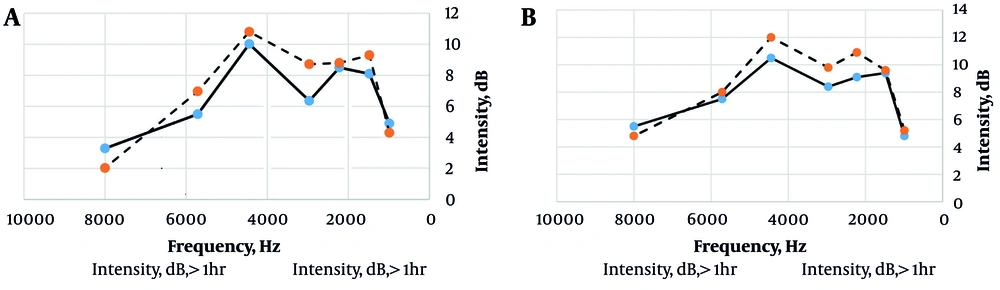
Figure 1.
Mean signal-to-noise ratio (SNR) of ears (quantitative interpretation) based on the duration of hands-free usage (A, left ear; and B, right ear)
Table 1.
The Frequency and Percentage of Response (Qualitative Interpretation) of the Ears at Different Frequencies a
| Frequencies (Hz) | Frequency of Ear Response | Frequency of Ear Response | P-Value Left Ear | P-Value Right Ear | ||
|---|---|---|---|---|---|---|
| RE < 1 (h) | RE > 1 (h) | LE < 1 (h) | LE > 1 (h) | |||
| 988 | 9.63 (23) | 8.73 (31) | 7.66 (24) | 9.61 (26) | 0.4 | 0.2 |
| 1481 | 6.80 (29) | 1.88 (37) | 1.86 (31) | 7.85 (36) | 0.6 | 0.2 |
| 2222 | 2.97 (35) | 5.90 (38) | 9.88 (32) | 5.90 (38) | 0.5 | 0.2 |
| 2963 | 2.97 (35) | 3.83 (35) | 1.86 (31) | 81 (34) | 0.2 | 0.06 |
| 4444 | 4.94 (34) | 9.92 (39) | 1.86 (31) | 2.76 (32) | 0.3 | 0.5 |
| 5714 | 3.83 (30) | 1.88 (37) | 3.83 (30) | 69 (29) | 0.1 | 0.3 |
| 8000 | 1.61 (22) | 69 (29) | 9.38 (14) | 8.54 (23) | 0.1 | 0.3 |
| Mean | 83.96 | 83.67 | 76.6 | 74.1 | 0.7 | 0.9 |
Abbreviations: RE, right ear; LE, left ear.
a Values are expressed in No. (%).
The quantitative interpretation based on the Student’s t-test revealed no significant difference in the mean SNR values at the tested frequencies (P > 0.05). However, the difference in mean SNR between the two groups was smaller in the left ear compared to the right ear, becoming significant with P = 0.08. Additionally, the mean SNR at the measured frequencies was higher for students who used hands-free devices for less than one hour compared to those who used them for more than one hour, and this difference was significant with P = 0.001.
Table 1 shows that the average percentage of presence or absence of responses across all measured frequencies in both the right and left ears was higher for students who used hands-free devices less frequently compared to those who used them more frequently. However, the t-test indicated no significant difference between the means (P > 0.05) (Figure 2).
![Frequency and percentage of response presence (qualitative interpretation) at different frequencies [sample of distortion product otoacoustic emission (DPOAE) analysis tables for left and right ears]](https://brieflands.com/journals/healthscope/articles/156564/figures/healthscope-156564-i002-F2-preview.webp "Frequency and percentage of response presence (qualitative interpretation) at different frequencies [sample of distortion product otoacoustic emission (DPOAE) analysis tables for left and right ears]")
Figure 2.
Frequency and percentage of response presence (qualitative interpretation) at different frequencies [sample of distortion product otoacoustic emission (DPOAE) analysis tables for left and right ears]
5. Discussion
This study revealed that a majority of female students at Mashhad University of Medical Sciences used hands-free devices for more than an hour daily. In fact, researchers found it challenging to identify students who used them for less than one hour, which was noted as one of the limitations of the study. Due to the significant amount of time spent commuting between the dormitory, university, and dining halls, as well as traveling from their hometowns to the university, dormitory students are at a high risk of hearing damage caused by hands-free devices and earbuds, which directly transmit sound to the middle and inner ear. The findings of this study also indicated that 51.3% of students used hands-free devices primarily for listening to music.
Jiang at al., in a systematic review titled "Daily Dose of Music Exposure and Hearing Problems with personal listening devices (PLD) in adolescents and young adults", concluded that providing essential guidelines and effective education to adolescents and young adults can increase awareness, knowledge, and consequently change attitudes and listening habits (11). Therefore, increasing awareness and necessary training are necessary to maintain students’ hearing health. Additionally, Adamu et al. found in their study that knowledge and adherence to protective measures against hearing risks from mobile phones were poor among students (12). Hussain et al., in a study aimed at identifying early signs of NIHL in young adult users of PLD, concluded that preventive measures are necessary to address the potential increase in clinical NIHL among users of these devices in the future (13).
The findings of this study indicated that, although there was no statistically significant difference in the mean SNR between the ears of individuals who used hands-free devices for less than one hour compared to those who used them for more than one hour at different frequencies, the mean SNR was better in the middle frequency range (1400 - 3000 Hz) for individuals with less than one hour of exposure. Furthermore, the overall mean for both ears displayed a significant difference with a P-value of 0.001, suggesting that prolonged and continuous use of hands-free devices, particularly in susceptible individuals, may contribute to hearing loss.
In this regard, Widen et al., in a study titled "Headphone listening habits, hearing thresholds, and loudness perception in Swedish Adolescents with severe to profound hearing loss and in normally hearing adolescents", concluded that adolescents with severe to profound hearing loss significantly listened at the highest sound levels. They concluded that those who listened at higher sound levels had poorer hearing thresholds (14). Also, Velayutham et al. demonstrated a stronger correlation between chronic cellphone usage and higher-frequency hearing loss, with the dominant ear (the ear typically used for phone calls) exhibiting a more pronounced decline in auditory function (15). This finding is particularly concerning for individuals with pre-existing hearing loss. A study investigating the effects of personal listening device use on hearing in young people concluded that prolonged use of these devices can impair hearing function (16).
Also, Kumar et al., in a study aiming to determine changes in hearing thresholds using high-frequency audiometry in PLD users aged 15 - 30, showed that significant changes in hearing thresholds were not observed in PLD users before 5 years of use (17). However, there was a considerable increase in hearing thresholds at 3 kHz, 10 kHz, and 13 kHz after 5 years of use. Similarly, in a study conducted to determine the frequency of hearing loss in medical students using electroacoustic devices such as hands-free and headphones through pure tone audiometry, it can be logically inferred that high frequencies can be used for early detection of NIHL in PLD users (14, 15). The results of the study showed that one-third of the medical students had sensorineural hearing loss at frequencies of 0.25 kHz and 0.5 kHz. Additionally, 9.5% reported tinnitus. The duration of daily listening was more than one hour among 78.8% of students; however, their average audiometric threshold was not significantly different from those with less exposure (18).
Due to their small size, portability, affordability, and non-interference during activities, hands-free devices have gained significant popularity. Since the average duration of hands-free use among students in this study was relatively short (3.1 ± 1 year), it appears that prolonged headphone use, especially at high volumes and given their direct placement in the ear canal, could contribute to a decrease in auditory threshold. Mirzaei et al. found that participants in their study on noise pollution awareness in Zahedan city (Iran) believed that public education was the most effective strategy for mitigating urban noise (19). Sharma et al., in their study on the effects of mobile phone use on hearing loss in young adults, found no short-term effects on hearing in young adults. However, they stated that the long-term effects of mobile phone use on hearing with increasing age cannot be ruled out (20). For people exposed to noise, it is necessary to use protective earplugs that fit the size of the ears (21), while using a loud hands-free device does not protect hearing. The findings of this study and other researchers mentioned in the discussion indicate that extensive measures are needed to protect the hearing health of students and other hands-free users.
5.1. Conclusions
Considering the widespread use of hands-free devices among students and the possibility of hearing loss due to their use, it is necessary to provide students with the necessary education to make informed decisions about maintaining their health. Furthermore, conditions should be created to facilitate less use of these devices, such as locating dormitories closer to universities and providing more sports facilities for students.
5.2. Limitations
In this study, it was found that almost all students use hands-free devices, making it very difficult to find a student who does not use them. Additionally, the cooperation of students in attending audiometry tests was low, and they had little information about the effects of noise exposure.