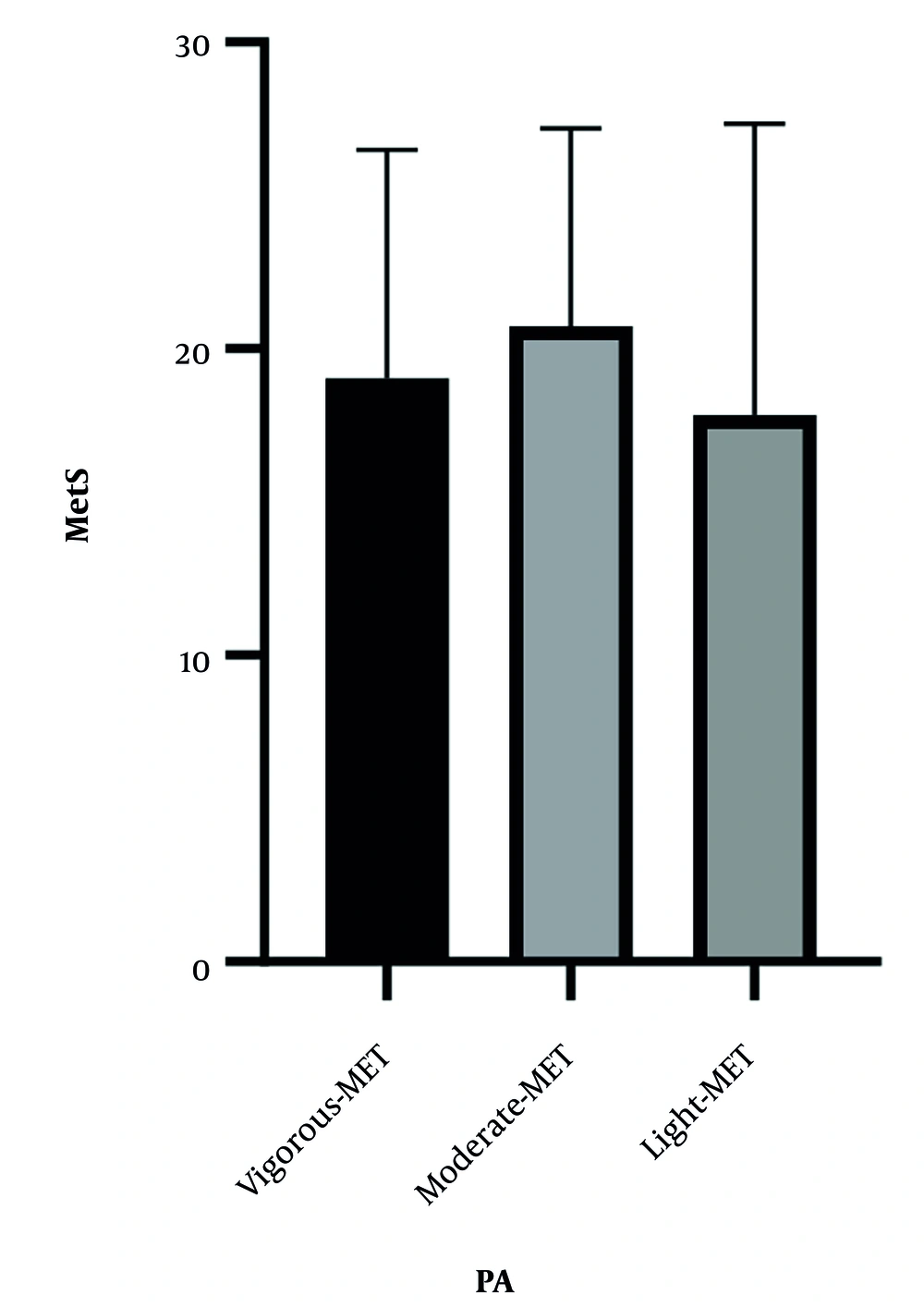
Our study aimed to determine the correlation between the MD, MetS, and PA variables in adults with MetS in Iran. In summary, our findings showed that there were no significant gender differences in PA and MD, while men had significantly higher MetS risk scores compared to women. The younger age group exhibited significantly higher scores in vigorous, moderate, and total PA compared to the older age group, while older adults showed higher adherence to MD compared to younger adults. At the same time, no significant differences in MetS were observed across age groups. Individuals with low MD scores had higher levels of light PA compared to those with moderate or high MD scores. However, we did not observe any significant differences in MetS or overall PA. There was no significant relationship between MD and MetS based on PA levels. Moreover, a significant correlation was found between PA levels and MD, as well as light PA. No substantial correlation was observed between MetS and PA/MD. Finally, the results of the study may vary depending on the participants' city of residence. This is the first study to compare the dependent variables (PA, MD, and MetS) across multiple cities. It has been well-established that there is a positive relationship between waist circumference and higher levels of body mass, body fat percentage, and BMI (
22). These factors are associated with MetS (
5). Previous studies have demonstrated that the prevalence of MetS may vary by gender (
22,
28-
30). Higher TG levels, lower low-density lipoprotein, higher BMI, and higher waist circumference are the most important predictors of MetS prevalence (
22,
28).
In the present study, we observed that men were at higher risk of MetS than women. While no significant differences were found in waist circumference, self-reported hypertension, and self-reported hyperlipidemia between genders, men showed a higher mean weight and an overall higher risk of MetS. Additionally, our study revealed that the prevalence of self-reported diabetes was significantly higher in men, a finding consistent with international studies suggesting that men are more prone to developing MetS-associated comorbidities, such as diabetes (
31). These differences may be attributed to a combination of biological, hormonal, and lifestyle factors. Insulin resistance, or its associated condition, hyperinsulinemia, directly contributes to other metabolic risk factors and is also a key factor in the development of type 2 diabetes. However, identifying the unique role of insulin resistance is complicated by the fact that it is closely linked to obesity. Therefore, further investigation is needed to determine whether insulin resistance specifically causes other metabolic risk factors in men.
We also observed no significant difference in PA or MD adherence between genders. Recently, a cohort study reported no significant difference in Mediterranean lifestyle adherence between genders in individuals at high risk for MetS (
13). Contrary to our findings, past studies have indicated that men are generally more physically active and have better adherence to the MD compared to women (
15,
32). Another study showed that, although men are more physically active, they may not adhere as well to dietary recommendations, while women often report a more structured eating routine. Despite these observations, we found no significant differences in PA or MD adherence between genders (
33). Although these factors are important, it has been observed that other protective lifestyle factors, such as income level, educational attainment, occupation, and other social factors, are also associated with the risk of developing MetS (
34,
35). Therefore, future studies should investigate the combination of these factors to better understand their role in the development of MetS.
Moreover, we hypothesized that the prevalence of MetS increases with age, as it has been confirmed that basal metabolism, lean body mass, and energy requirements decrease with age, contributing to obesity (
36). Our results demonstrated that although the younger age group was more active than the older age group, there was no significant difference between age groups in terms of MetS. It is possible that our participants over-reported their PA levels. Additionally, our results showed that individuals aged 30 - 60 years had significantly lower scores compared to those over 60 years, with significantly higher average weight, self-reported diabetes, and self-reported hypertension in the younger age group. These results suggest a higher prevalence of metabolic disorders among younger adults in our study. Therefore, interventions should focus on improving diet quality and PA in adults.
We also observed no significant difference between MD levels in MetS or overall PA. However, a significant difference was observed between MD levels in light PA. Indreica et al. showed that participants with higher adherence to MD engaged in more intense PA (
37). Our statistical analyses showed no significant correlation between MetS and PA/MD. However, a significant relationship was found between MD and light PA. High adherence to MD has been well-defined as being associated with a lower MetS risk (
16,
17,
21,
38-
42). Fish, olive oil, and nuts, which are components of MD, are known to reduce the MetS risk (
43). Previous studies have reported that low-fat diets enriched with polyunsaturated fatty acids also reduce TG levels (
19,
44,
45). Additionally, the consumption of vegetables, olive oil, and Low-Glycemic Index Foods has been shown to lower blood glucose, C-peptide values, fasting serum testosterone levels, and insulin resistance, while increasing serum insulin-like growth factor binding proteins (IGFBP) 1 and 2 levels (
46-
49). Nitric oxide levels and endothelin-1 are modulated by consuming extra virgin olive oil and nuts (
43).
Regular PA is associated with reduced MetS (
50-
54). This may be due to significant improvements in systolic and diastolic blood pressure, fasting blood glucose, insulin, interleukin 6, and TGs through PA (
51,
54). However, we did not find a significant correlation between MetS and MD/PA. More specifically, we found moderate adherence to MD in our study. Seventy-seven percent of our participants consumed pasta or rice at least five days a week, 82% consumed grains or carbohydrates every morning, and 30 to 36% regularly consumed vegetables, olive oil, and fish. Adherence to MD is influenced by sociocultural, religious, and economic factors (
29). In Iran, the typical diet includes foods such as rice, bread, vegetables, legumes, yogurt, and meats like lamb and chicken, which share similarities with the MD, particularly in terms of plant-based foods, legumes, and moderate meat consumption. However, the Iranian diet differs in its higher consumption of rice, specific herbs, and spices not commonly emphasized in the MD diet. Also, nuts, extra virgin olive oil, and fish may be difficult for our participants to provide. Additionally, while self-reported data is a commonly used method in large-scale epidemiological studies due to its practicality, participants may have inaccurately reported their responses. Future studies could benefit from incorporating objective measures, such as food diaries for dietary assessment, to minimize recall bias and provide more accurate and reliable data. Furthermore, combining self-reported data with biochemical measurements (e.g., blood tests) could offer a more comprehensive understanding of the relationship between diet and MetS. However, more research is needed to conclude for larger populations.
Finally, we observed that the city of residence of the participants influenced MD, PA, and MetS. To the best of our knowledge, no previous studies have reported on the relationship between these dependent variables and the city of residence in Iran. This finding is consistent with other research demonstrating significant effects of city of residence on MD and PA outcomes (
36). Notably, we observed significant differences in MD and PA across cities. These disparities may reflect variations in urban infrastructure, cultural dietary patterns, socioeconomic status, and access to recreational and health-promoting facilities. Such city-specific characteristics likely play a key role in shaping health-related behaviors and outcomes, emphasizing the importance of considering environmental and geographical factors in public health planning.
In contrast, although differences in MetS were observed across cities, these differences did not reach statistical significance. This suggests that MetS may be more strongly influenced by individual-level factors (e.g., genetics, chronic conditions) or may require a larger sample size to detect city-level effects. Therefore, we recommend that future studies use a larger and more representative sample to provide more accurate and generalizable conclusions. Another key strength of this study was the use of a validated MetS Questionnaire, an appropriately explored alternative to blood tests (
26). This approach may offer a cost-effective and time-efficient method for MetS assessment. However, further research is needed to validate its effectiveness.
5.1. Conclusions
Our study aimed to determine the correlation between MD, PA, and MetS among adults in Iran. There was no significant difference in MD and PA based on gender, while men reported higher MetS risk scores. Younger adults were more active than older adults, while older adults showed higher adherence to MD. However, no significant difference was observed between younger and older age groups in MetS risk score. MetS was not correlated with PA and MD. City of residence influenced MD, PA, and MetS. It seems that the prevalence of metabolic disorders begins at a younger age. Central obesity and a history of metabolic disorders are the main reasons for the prevalence of MetS in our study. Due to lower PA in older adults and the possibility of MetS from an early age, social policies should encourage the promotion of a Mediterranean lifestyle. Further research needs to be conducted to better understand this topic.
5.2. Limitations
There are a few limitations to our study that should be addressed. Firstly, participants were selected from a specific and accessible population, which may limit the generalizability of the findings to the broader population. Secondly, since only clinics that were accessible and willing to participate were included, the sample may not represent the full diversity of the broader population. Finally, we relied on self-reported PA, which may not accurately reflect actual behavior. Future studies should use more comprehensive random sampling methods to improve the generalizability of the results. Additionally, participants were asked to report their PA levels and dietary habits, and such self-reports may be influenced by factors such as forgetfulness, social desirability bias, or inaccurate recall. Investigating this issue in diverse populations and using accelerometers for more accurate PA assessment or food diaries would be beneficial.