
1. Context
The significance of physical activity for the health of children and adolescents is well recognized (1). Research has shown that sufficient physical activity enhances cognitive performance and academic outcomes (2), helps control weight (3), and improves cardiorespiratory and musculoskeletal fitness in this age group (4, 5). Importantly, adequate physical activity during childhood and adolescence is recognized as a healthy behavior that can persist into adulthood (6). Therefore, this period represents a valuable opportunity for interventions to achieve long-term and intergenerational health benefits (7).
In recent years, policymakers at both international and national levels have increased efforts to develop policies and guidelines to promote physical activity among children and adolescents (8-10). Nevertheless, the level of physical activity remains low. An analysis of data from 1.6 million students in 146 countries showed that 81% were not sufficiently active, and a similar figure was observed in 2020 (11). Furthermore, reviews by the Global Active Healthy Kids Alliance indicate that only a small proportion (27% to 33%) of children and adolescents meet the recommended amount of moderate to vigorous physical activity needed for health (12). Evidence suggests that many policies, if wisely chosen and properly implemented, can positively impact physical activity levels in children and adolescents (13, 14). For example, Belgium and France have successfully promoted physical activity by developing national policies (15).
According to our preliminary search, no systematic study has been conducted to identify policies promoting physical activity among children and adolescents on a global scale. Most studies have described these policies (8) or examined their effects (9). Therefore, the present study aimed to identify the nature and common dimensions of policies promoting physical activity in children and adolescents worldwide. The goal is to guide the development and revision of necessary policies.
2. Evidence Acquisition
The PRISMA 2020 checklist (16) was utilized to ensure the quality of the study. This systematic review addressed the question, "What are the common dimensions of policies, programs, and guidelines for promoting physical activity among children and adolescents globally"?
2.1. Search Strategy
A systematic search of articles was conducted in electronic databases, including Web of Science, ScienceDirect, and PubMed, covering studies up to March 2025. Additionally, Google Scholar and ProQuest were searched to ensure a comprehensive review and access to grey literature. The keywords included "Physical Activity", "Sedentary Behavior", "Policy", "Child", and "Adolescent", along with their corresponding Medical Subject Headings (MeSH) terms. The search strategy was tailored to the characteristics of each database and was developed through consultation with a medical librarian and information specialist. A sample search strategy is provided in the Appendix 1 in Supplementary File.
2.2. Inclusion and Exclusion Criteria
The inclusion criteria encompassed studies on programs, policies, and guidelines for promoting physical activity among children and adolescents aged 5 - 18. Only studies published in English with full-text availability were considered. In this study, programs, policies, and guidelines refer to electronic documents issued by governmental executive bodies that outline strategies and measures to promote physical activity among children and adolescents. This comprehensive definition aims to review all policies promoting physical activity in children and adolescents.
The exclusion criteria included studies without available full-texts (e.g., letters to the editor, comments, editorials, conference abstracts), review articles, studies focusing solely on physical activity data without addressing policies, studies conducted on individuals outside the age range of 5 - 18 years, and studies targeting treatment of illnesses or overweight/obesity in children or adolescents.
2.3. Selection of Study
The searched articles were imported into EndNote 8 software. After removing duplicates, the titles and abstracts of the retrieved studies were initially screened. Studies that met the eligibility criteria were then selected for full-text review. If necessary, an extensive search was conducted on related websites to obtain the full texts of policies and programs mentioned in some articles, and the relevant documents were collected. Each search typically began in the policy sections of the websites and continued in sections related to physical activity, sports, and health. The search was conducted using the keywords mentioned above.
Two individuals independently conducted these steps, and the full texts of the relevant studies were also reviewed separately by the same individuals. Any disagreements in both cases were resolved through consultation with a third researcher.
2.4. Data Extraction
The researchers designed a data extraction table in Excel 2016. The extracted items included the author’s name, research date, research method, policy name, program or guideline, study quality, country, and the main focus of the policy document.
2.5. Data Analysis
The data analysis was conducted using the thematic analysis model by Braun and Clarke (17), which involves a six-step process. The data were read and reviewed in the first step to familiarize the researchers. The next step included organizing the data into smaller meaning units and creating initial codes. Subsequently, similar codes were grouped to develop initial themes. These themes were then reviewed and refined to fit the entire data set. Following this, sub-themes were consolidated to achieve the main themes. Finally, the relationships of themes within the overall pattern were interpreted, and the report was prepared. One of the authors carried out the coding and theme development process and validated it through consensus meetings to ensure the accurate grouping of the identified themes. MAXQDA 2018 software was used to perform these steps.
2.6. Quality Assessment
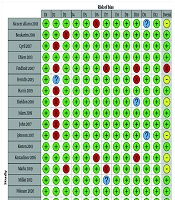
The "Mixed Methods Appraisal Tool" (MMAT) was used to evaluate the quality of the articles. This tool assesses the quality of five types of studies: Non-randomized controlled trials, randomized controlled trials, qualitative studies, quantitative studies, and mixed-methods studies. Articles were evaluated according to the tool’s guidelines as "yes" (criterion met), "no" (criterion not met), or "can’t tell" (insufficient evidence to make a judgment) (18, 19). The quality assessment was conducted independently by two authors. In cases of disagreement, the article was reviewed by a third researcher.
3. Results
3.1. Study Selection Process
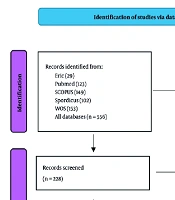
Initially, 13,842 articles were identified through a search in electronic databases. After removing duplicates, 8,582 articles remained for title and abstract screening. Of these, 8,474 articles were excluded because they were not relevant to policy-related interventions, often focusing instead on disease treatment, individual behavior change, or weight reduction. Subsequently, 108 articles were selected for full-text review. After applying the inclusion and exclusion criteria, 19 articles were finally included in the study. Figure 1 illustrates the detailed process of study selection.
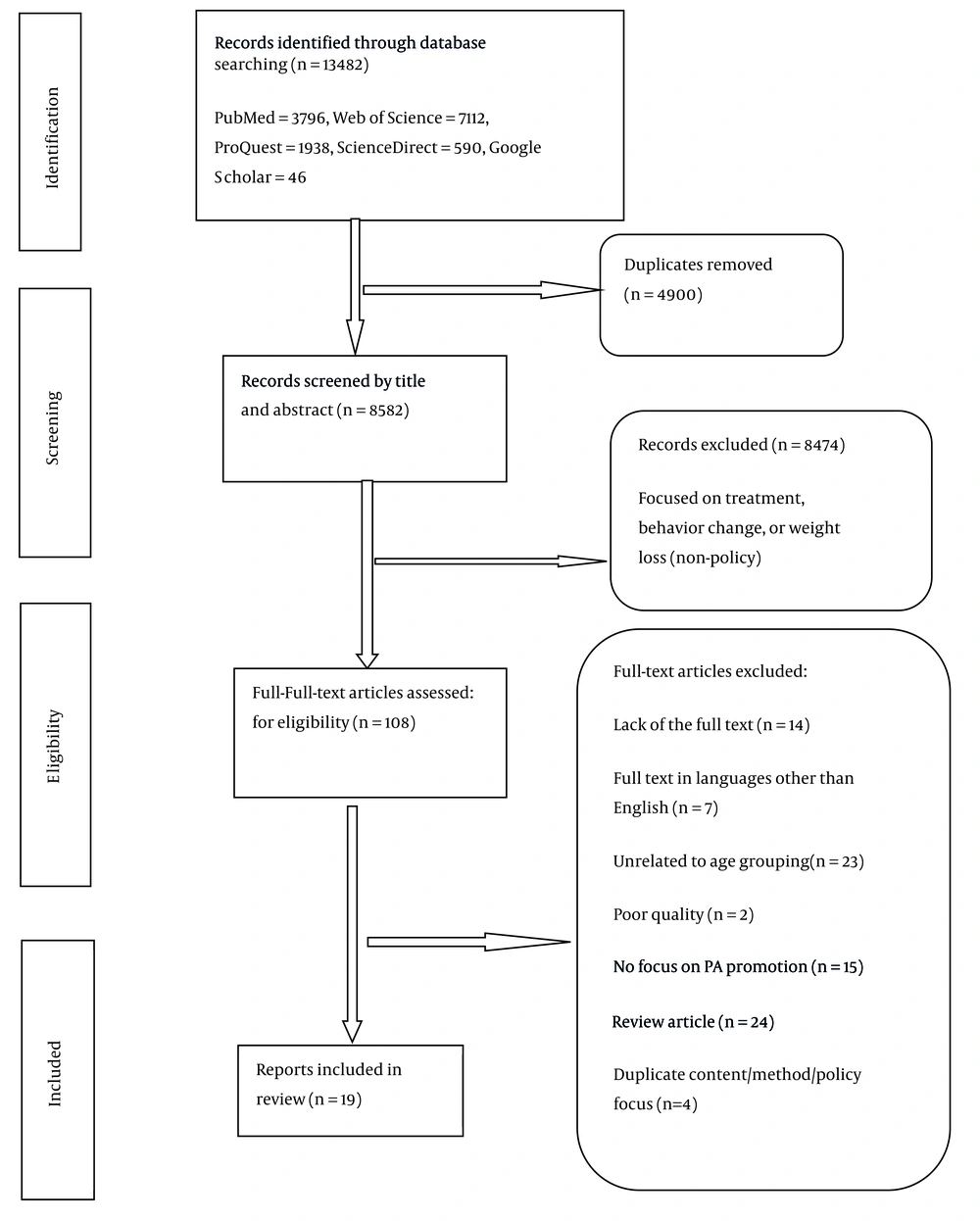
Figure 1.
Study selection process
3.2. Study Characteristics
Table 1 summarizes the characteristics of the included articles. Australia (four studies, 21%), Canada (three studies, 16%), the United States (two studies, 11%), and the Netherlands (three studies, 16%) had the highest number of studies. Estonia, China, Thailand, Denmark, Norway, Chile, and Finland each conducted one study (5% each).
Table 1.
Characteristics of Included Studies
| Categories and First Authors | Program Name | Country | Main Focus |
|---|---|---|---|
| School focus | |||
| Dong, Jiahui (2023) (20) | Physical Education Entrance Examination for Senior High School (PEESHS) | China | Promoting PE through entrance examination for high schools |
| Katewongsa (2023) (21) | Active School Thailand | Thailand | Implementing a whole-school approach to encourage active learning |
| Pedersen (2023) (22) | National School Policy | Denmark | Integrating 45 minutes of daily physical activity into the school schedule |
| Algroy (2022) (23) | Obligatory Physical Activity Scheme | Norway | Providing 76 additional hours of physical activity across the school year |
| Mooses (2021) (24) | Schools in Motion | Estonia | Innovating educational practices to support physical activity among students and teachers |
| Sutherland (2021) (25) | Physical Activity 4 Everyone (PA4E1) | Australia | Applying the WHO Health-Promoting Schools framework |
| Rodriguez (2020) (26) | Integral Sports Schools | Chile | Offering diverse sports workshops as part of the school curriculum |
| Nathan (2020) (27) | Student Health and Wellbeing Policy | Australia | Embedding physical activity within a student well-being framework |
| Bartelink (2019) (28) | Healthy Primary School of the Future (HPSF) | Netherlands | Applying the WHO Health-Promoting Schools framework |
| Weatherson (2019) (29) | Daily Physical Activity Policy | British Columbia | Expanding opportunities for daily physical activity in schools |
| Haapala (2017) (30) | Schools on the Move | Finland | Encouraging physical activity and enhancing teaching quality |
| Sutherland (2016) (31) | WHO’s Health Promoting Schools Framework | New England | Using the WHO Health-Promoting Schools framework |
| Van Kann (2016) (32) | Active Living Project | Netherlands | Promoting active transportation and implementing school-based interventions with evaluation |
| Cradock (2014) (33) | Physical Education and Physical Activity Policy | United States | Enforcing comprehensive state policies supporting PE and activity |
| Allison (2014) (34) | Daily Physical Activity Policy | Canada | Expanding opportunities for daily physical activity in schools |
| Jurg (2006) (35) | JUMP-in Program | Holland | Combining nutrition, physical activity, and structured recess in daily school routines |
| After-school focus | |||
| Reilly (2021) (36) | Active Kids Program | Australia | Providing financial vouchers to support children’s participation in physical activity |
| Beets (2016) (37) | After School Physical Activity Guidelines | California | Guiding the development of structured physical activity programs after school hours |
| Active lifestyle focus | |||
| Rhodes (2019) (38) | Canadian 24-Hour Movement Guidelines | Canada | Balancing sleep, sedentary behavior, and physical activity throughout a 24-hour day |
Abbreviation: PE, physical education.
In terms of study design, eight studies (42%) employed quasi-experimental methods, six (32%) used clinical trial designs, one (5%) was a cohort study, two (11%) were qualitative, two (11%) were survey studies, and one (5%) utilized mixed methods.
Fourteen studies (74%) examined policies related to the school day; one (5%) focused on before- and after-school policies; one (5%) investigated policies integrating physical activity, sleep, and sedentary behavior over a 24-hour period; and one (5%) explored financial incentive plans to increase physical activity. Except for one, the rest of the studies concentrated on in-school and before- and after-school environments. Some of these policies aimed at more than just increasing physical activity, addressing other aspects of health and well-being such as nutrition, sleep, and mental health. The years 2014, 2019, 2021, and 2023 had the highest number of articles.
3.3. Quality
Two articles were excluded from the study due to low quality. The overall quality of the included articles was evaluated as good, with none of the included studies being of low quality (Appendix 1 in Supplementary File).
3.4. Analysis Results
After completing the analysis process, five main domains (governance and policymaking; educational institutions (schools); collaboration and participation of sports organizations; education and awareness; and transportation and urban planning), 15 sub-categories, and 49 actions were extracted, as shown in Table 2.
Table 2.
Dimensions of Physical Activity Policy
| Domains and Subcategories | Actions |
|---|---|
| Governance and policymaking | |
| Supportive policies and national laws | Approving national laws to support physical activity; financial support for organizations involved in physical activity |
| Intersectoral collaboration | Establishing coordinating bodies to facilitate interactions between related organizations; forming joint committees between education, health, sports, and municipal sectors |
| Financial incentives | Providing financial aid to students from low-income families; Tax exemption for organizations active in the physical activity sector; subsidies for sports participation (e.g., bicycle purchase subsidies) |
| Educational centers (schools) | |
| Educational structure | Incorporating physical activity into curricula; Allowing schools’ autonomy in choosing activities; prohibiting the use of physical activity as a punishment; Setting requirements for PE classes (duration, content, objectives); restricting access to mobile phones and the internet during classes |
| Extracurricular school programs | Intra- and inter-school competitions; walking and cycling challenges |
| School facilities and infrastructure | Maintaining and providing necessary equipment; monitoring the quality of school sports equipment and spaces; Improving school environments such as yards, hallways, and classroom sizes |
| Assessment and monitoring | Physical performance evaluation system for students (e.g., physical activity report card); Use of wearable technologies to monitor physical activity; annual reporting and review to improve programs; annually assessing time allocated to physical activity |
| Management of physical activity safety in schools | Management and insurance of sports injuries; development of safety protocols for school sports and physical activities; Standardization of school sports spaces |
| Developing human resources | Recruitment of specialized sports and PE teachers; hiring specialized health experts; Providing training and refresher courses for staff and teachers; Defining competencies and the optimal teacher-student ratio |
| School community engagement (staff, parents, and students) | Strengthening the participation of teachers, staff, and parents in relevant programs; providing opportunities for students to participate in designing and selecting physical activity programs; encouraging parental support for promoting physical activity; Supporting active friendship networks through physical activities (e.g., team challenges) |
| Cooperation and participation of sports organizations | |
| Sports clubs and centers | Designing joint sports activities between clubs and schools; Organizing local sports competitions and events; enhancing the quality of PE teachers through specialized training courses; Provision of sports equipment for educational environments |
| Enhancement of awareness and knowledge | |
| Utilization of traditional and digital media | Launching promotional campaigns on social media; Using mobile applications like fitness apps; Production and distribution of educational content in various formats (brochures, videos, etc.); introducing sports champions through storytelling; Hosting virtual challenges and online competitions |
| Transport and urban planning | |
| Security and safety of routes | Mapping safe walking and cycling routes; Collaboration with police to ensure route safety; ensuring safety in walking and cycling locations |
| Encouraging active transport to school | Providing student transportation cards; creating bicycle parking spaces at schools |
| Urban infrastructure | Developing play spaces in neighborhoods and near schools; designing pedestrian and cycling routes in urban areas; ensuring access to sports and recreational spaces |
Abbreviation: PE, physical education.
4. Discussion
This study was conducted using a systematic review method to identify the common dimensions of policies for promoting physical activity among children and adolescents worldwide. Findings from 19 studies indicated that many opportunities for promoting physical activity were centered on the education sector and developed in collaboration with other sectors. Overall, our review showed that the implemented policy measures could be categorized into five areas: Governance and policymaking, educational institutions (schools), collaboration and participation of sports organizations, education and awareness, and transportation and urban planning.
The findings indicated that school-based policies play a central role in promoting physical activity among children and adolescents. Given that this age group spends a significant portion of its time in the school environment, this setting has great potential for implementing effective policies.
Based on our results, actions such as introducing active recess breaks, integrating physical activity into classroom lessons, improving the quality of physical education (PE) sessions, and promoting active transportation methods are among the strategies that can enhance children’s and adolescents’ physical activity levels. Additionally, providing safe facilities and equipment and organizing intra- and inter-school sports competitions can increase motivation for participation. Previous studies have also shown that increasing access to sports facilities, allocating more time to PE, and implementing extracurricular programs have had a significant impact on increasing physical activity levels among children and adolescents (39, 40).
Moreover, employing qualified and specialized teachers is of particular importance. Algroy et al. identified inadequate investment in teacher training as one of the main barriers to achieving the goals of Norway’s national physical activity promotion policies (23). Furthermore, Finland’s experience indicates that granting schools autonomy in decision-making regarding the implementation of physical activity policies has had a significant impact on increasing children’s and adolescents’ physical activity levels (30). Accordingly, it is recommended that schools be given greater flexibility to design and implement physical activity programs tailored to their available resources and regional climatic conditions.
Beyond the role of schools, families also play a crucial role in supporting physical activity promotion policies. Evidence suggests that parents who actively participate in activities such as family cycling or sports events are more effective in increasing their children’s physical activity levels compared to those who merely provide verbal encouragement (41, 42). Based on this, organizing workshops, training courses, and providing educational packages can be effective strategies for engaging parental support.
Given that strengthening the connection between schools and local communities can provide valuable opportunities for increasing children’s and adolescents’ physical activity, strategies such as outsourcing school sports programs to professional coaches, utilizing the capacities of local sports clubs, organizing sports events and competitions, and allowing access to school yards outside of school hours are recommended. Previous studies have shown that participation in sports clubs, in addition to increasing physical activity levels, has positive effects on children’s and adolescents’ mental health and social skill development (43, 44). Therefore, recognizing the potential of this sector and creating appropriate conditions for utilizing available resources and expertise is essential for developing physical activity promotion policies for children and adolescents.
Another key aspect of successful physical activity promotion policies is the focus on improving urban infrastructure and creating suitable spaces for this purpose. For example, developing safe walking and cycling routes, providing appropriate spaces for sports activities, and ensuring easy access to these facilities naturally encourage individuals to be physically active. Additionally, schools can contribute by offering amenities such as bicycle storage facilities, organizing initiatives like the “Walk to School Challenge”, and providing special active transport cards for students, thus creating a dynamic and engaging environment for children and adolescents. China’s experience has shown that improving local infrastructure and increasing access to sports facilities have had positive effects on children’s and adolescents’ physical activity levels and health (45). In this regard, it is recommended that governments incorporate active design principles into urban planning to create more favorable urban environments and promote physical activity.
In addition to these measures, raising awareness about the benefits of physical activity and informing people about available opportunities and ways to stay active can significantly enhance motivation and participation. For example, actions such as incorporating physical activity content into children’s and adolescents’ television programs, running media campaigns, designating a national “Active Child Day”, and showcasing successful role models in physical activity can play a significant role in fostering a culture of active living. Furthermore, evidence suggests that fitness applications and smartphone-based interventions have positively influenced physical activity levels among children and adolescents (46, 47). Additionally, McKeever et al. confirmed that online interventions incorporating gamification and AI-based personalization have improved students’ attitudes toward PE classes and increased their motivation (48). Therefore, integrating physical activity promotion policies with technology-based interventions can be an effective approach to increasing participation among children and adolescents.
Complementing these efforts, a formal government commitment to improving physical activity levels is necessary, which can be achieved through actions such as passing supportive legislation, developing national programs, allocating financial resources, and evaluating policy effectiveness. Experiences from various countries have shown that government initiatives have had positive impacts on increasing physical activity levels. Examples of such initiatives include subsidizing sports classes in Australia (36), implementing mandatory PE exams for high school entrance in China (20), providing financial support to sports clubs in Finland (49), and extending school hours to encourage more physical activity in Denmark (22).
In addition, it is important to consider equity issues when designing and implementing physical activity promotion policies. Socioeconomic disparities can significantly affect children’s access to sports facilities, equipment, and extracurricular programs. Financial incentives, while beneficial, may inadvertently favor higher-income families unless mechanisms are in place to support disadvantaged groups. Therefore, targeted policies — such as providing subsidies for low-income families, prioritizing resource allocation to underserved schools, and ensuring equitable access to programs — are essential to avoid exacerbating existing inequalities.
Ultimately, given the multidimensional nature of physical activity promotion policies, cross-sectoral collaboration among educational, sports, urban, and media organizations is essential. Experiences from countries such as Finland and the United States have shown that initiatives such as establishing inter-ministerial coordination bodies, signing cooperation agreements with municipalities, and formulating comprehensive policies with the participation of various sectors can facilitate the effective implementation of these policies (33, 49).
Despite the potential of these strategies, several challenges may hinder their effective implementation. Limited financial and human resources, particularly in low-income regions, can restrict the ability of schools and communities to develop and sustain physical activity programs. Cultural barriers and lack of awareness may also reduce participation. Additionally, the absence of coordinated action between different governmental and non-governmental sectors can lead to fragmented efforts. Overcoming these barriers requires sustained political commitment, cross-sectoral collaboration, continuous capacity building, and context-specific adaptation of policies.
Overall, the findings of this study indicate that school-based interventions, family and community engagement, urban infrastructure development, the utilization of modern technologies, and government commitment to policymaking and financial resource allocation play significant roles in promoting physical activity levels. Furthermore, the evidence suggests that a multisectoral approach and inter-organizational collaboration can facilitate the policy implementation process. Therefore, to achieve sustainable and effective policies, it is essential for countries to tailor their strategies to their specific economic, cultural, and geographical contexts.
4.1. Conclusions
The findings of this study suggest that targeted policy interventions — including financial incentives, infrastructure improvements, mandatory school-based physical activity policies, active city planning strategies, family participation, and smartphone-based interventions — have the potential to increase children’s and adolescents’ engagement in physical activity. For the future of physical activity promotion policies, shifting from fragmented approaches to comprehensive and structured strategies is essential to sustainably embed a culture of physical activity within society. Additionally, localizing policies based on the climatic, cultural, and economic conditions of each region is particularly important. Therefore, future research should focus on identifying implementation barriers, analyzing the challenges of policy execution, and examining the role of cross-sectoral collaborations in the success of physical activity promotion policies.
4.2. Limitations
This study has some limitations. First, most of the reviewed studies were conducted in high-income countries, which limits the generalizability of the findings to low- and middle-income countries. Second, cultural and climatic conditions, which can influence policy formulation and implementation, were not sufficiently considered. Third, our analysis was restricted to English-language studies, and access to medical databases such as CINAHL and Embase was not available, which may have resulted in missing some relevant studies.