
1. Background
Welding is a crucial process in manufacturing, particularly in developing countries where rapid urbanization and industrialization have increased its significance (1). Over one million workers worldwide are full-time welders, with an additional three million performing welding tasks as part of their jobs. Welding plays an essential role in metal production, utilizing methods such as shielded metal arc welding (SMAW), gas metal arc welding (GMAW), tungsten inert gas welding (TIG), and submerged arc welding (SAW) (2-4). However, welding poses numerous risks, including exposure to heat, fumes, gases, noise, vibration, and ergonomic stressors (5-7). Short-term hazards include burns, eye and respiratory irritation, and fatigue, while long-term consequences may involve chronic respiratory illnesses, cataracts, or noise-induced hearing loss (8). According to the U.S. Bureau of Labor Statistics, welders experience one of the highest rates of occupational injuries among industrial workers, with over 10,000 nonfatal injuries reported annually, many of which are preventable. In Iran, welding-related incidents account for a significant proportion of injuries in the metal industries, underscoring the urgency of effective preventive strategies (9).
Following safety protocols significantly reduces these risks. Welders must adhere to occupational health and safety (OHS) standards, which cover welding and cutting procedures, personal protective equipment (PPE) usage, gas cylinder safety, working at heights, and the 5S system of workplace organization. Despite these standards, compliance remains inadequate, contributing to higher accident rates, increased medical expenses, compensation claims, and reduced productivity (7, 10-13). Training is a key factor in improving safety outcomes. Research shows that well-structured and context-specific training can significantly reduce unsafe behaviors and accident rates (14-18). However, many workers find existing programs ineffective or disconnected from their actual workplace challenges. A critical step in effective training design is conducting a thorough needs assessment to identify and prioritize the most relevant topics. When training fails to address real employee needs, it often becomes a wasteful expenditure and diminishes the potential for future retraining, especially in environments with constrained budgets (19-22).
2. Objectives
The present study aimed to identify all the educational topics required to enhance OHS training and reduce unsafe behaviors among welders in the metal equipment manufacturing industry. To achieve this, we adopted a comprehensive approach that includes occupational examinations, accident analysis, and safe behavior sampling (SBS).
3. Methods
The present study is a cross-sectional research conducted in 2024 within the metal equipment manufacturing industry in Isfahan. This industry specializes in producing heavy structures used across various sectors, including power plants, refineries, petrochemicals, steel production, and mining. Figure 1 shows the cooling system, one of the products manufactured in this industry. The assembled cooling system is used in the metal structure manufacturing process. This system plays a critical role in controlling thermal stress during welding operations by dissipating excess heat from welded joints and surrounding components. Proper cooling reduces the risk of thermal deformation and contributes to workplace safety by minimizing the likelihood of burns and fire hazards. The presence of this system underscores the importance of engineering controls as part of a comprehensive OHS strategy.
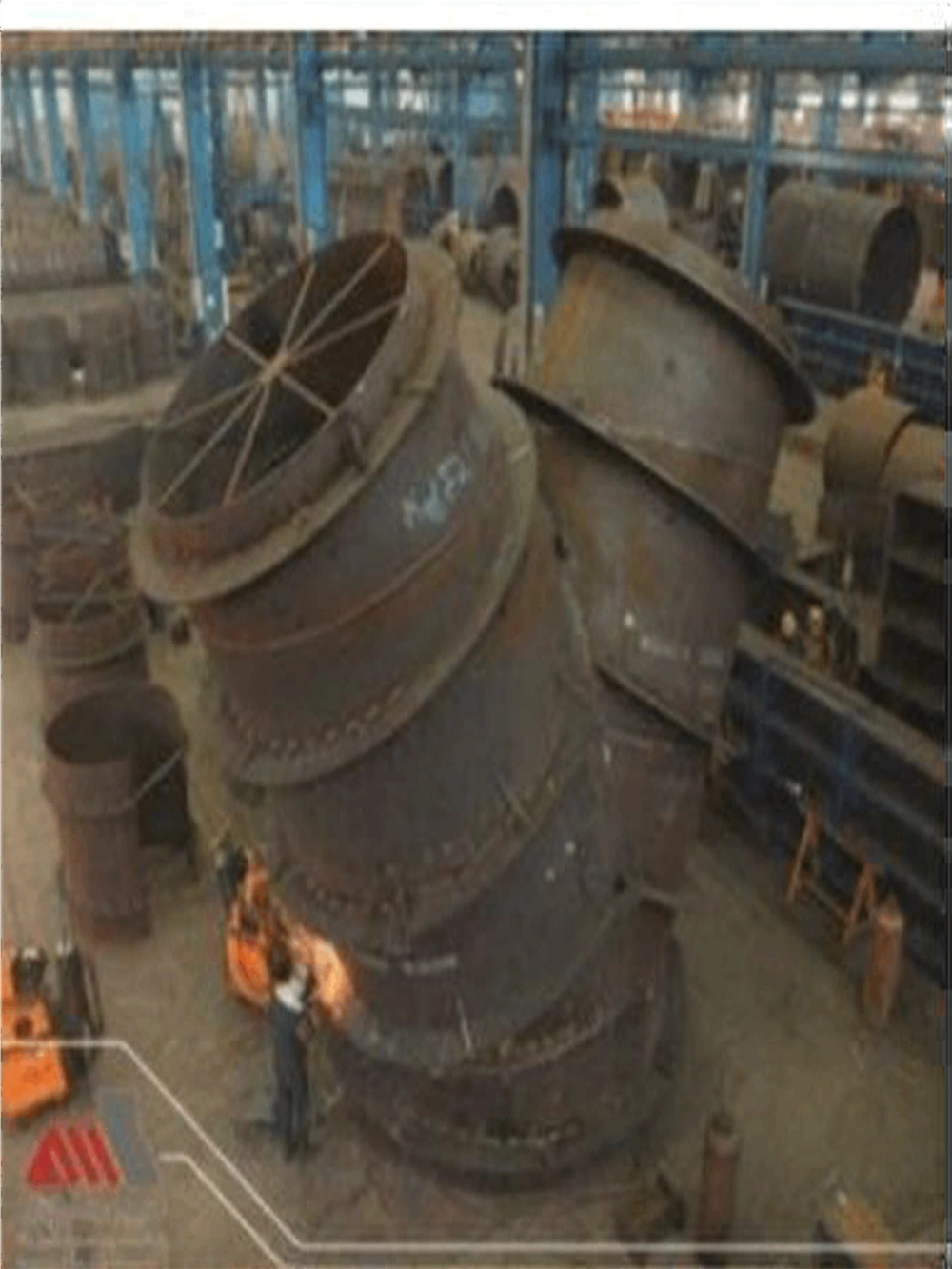
Figure 1.
Welding of an assembled cooling system structure
The demographic data collected on the welders included their age, education, work experience, gender, and marital status. Periodic occupational health evaluations, including optometry, audiometry, and spirometry, were conducted. Welders who underwent periodic evaluations in 2024 were selected for the study. An accident is an unexpected event that can harm individuals, equipment, or the environment. Workplace accidents fall into four categories: Minor, serious, fatal, and near-miss. In this study, recorded accident reports of welders from the past five years were analyzed to assess safety violations and determine how many incidents were due to a lack of awareness. In this industry, any welding accident is initially reported by the injured worker or their supervisor to the First Aid Unit. This unit records details such as the worker’s name, location, type, and cause of the accident and provides medical assistance. If the accident is serious or fatal, the Health, Safety & Environment (HSE) unit is notified, and an accident report is completed to identify the root cause.
In this study, the SBS data for 2024, collected by the industry’s safety team for welders, was analyzed. This data facilitated the identification of behavioral violations. The SBS method is a structured observational technique used to systematically record and quantify safe and unsafe behaviors in the workplace. Observations were conducted over a four-week period during routine operations in various departments of the metal equipment manufacturing facility. A trained safety officer conducted the observations randomly during both morning and afternoon shifts, totaling 80 hours of observation time. A standardized checklist was developed based on key OHS guidelines relevant to welding tasks. This checklist included behaviors such as proper use of PPE, safe handling of welding tools and materials, gas cylinder safety, housekeeping, and adherence to hot work permit protocols. Each behavior was classified as either “safe” or “unsafe” based on predefined criteria. Observers were trained in advance to ensure inter-rater reliability and reduce subjective bias (23).
4. Results
The demographic and occupational characteristics of participants are reported in Table 1. The 2024 occupational health evaluations of 50 welders assessed their vision, hearing, and lung function. Occupational optometry evaluations showed that 66% had 10/10 vision in their left eye, while 34% had visual impairments. For the right eye, 64% had 10/10 vision, while 36% had visual impairments. Occupational audiometry evaluations revealed that 54% of right ears and 48% of left ears had normal hearing, while 46% and 52%, respectively, showed hearing impairments. Spirometry evaluations indicated that 60% of welders had normal lung function, while an obstructive lung pattern was found in 34% of welders, as shown in Table 1.
Table 1.
Demographic Characteristics and Occupational Health Evaluations of Welders
| Variables and Levels | No. (%) |
|---|---|
| Age (y) | |
| 20 - 30 | 1 (2) |
| 30 - 40 | 27 (54) |
| 40 - 50 | 22 (44) |
| Education | |
| Less than high school diploma | 0 (0) |
| High school diploma | 49 (98) |
| Associate degree | 1 (2) |
| Bachelor’s degree | 0 (0) |
| Work experience (y) | |
| 1 - 5 | 2 (4) |
| 6 - 10 | 17 (34) |
| 10 - 15 | 15 (30) |
| 15 - 20 | 16 (32) |
| Gender | |
| Male | 50 (100) |
| Female | 0 (0) |
| Marital status | |
| Married | 50 (100) |
| Single | 0 (0) |
| Optometry (right eye) | |
| 10/10 | 32 (64.0) |
| 10/10 < | 18 (36.0) |
| Optometry (left eye) | |
| 10/10 | 33 (66.0) |
| 10/10 < | 17 (34.0) |
| Audiometry (right ear) | |
| Normal | 27 (54.0) |
| Abnormal | 23 (46.0) |
| Audiometry (left ear) | |
| Normal | 24 (48.0) |
| Abnormal | 26 (52.0) |
| Spirometry | |
| Normal | 30 (60.0) |
| RP | 1 (2.0) |
| OP | 17 (34.0) |
| Lung volumes in LLN range | 1 (2.0) |
| NSP | 1 (2.0) |
Abbreviations: RP, restrictive pattern; OP, obstructive pattern; NSP, no spirometry performed.
Welders involved in work-related accidents first receive treatment at the First Aid Unit. Minor injuries are treated on-site, allowing workers to return to their tasks, while more severe cases are referred to healthcare centers. Table 2 summarizes the types, frequencies, and causes of injuries reported in the First Aid Unit between 2020 and 2024. The most common cause of accidents was grinding particle projection, accounting for 78 cases, followed by exposure to welding radiation (16 cases), collisions with objects (11 cases), and contact with sharp objects (7 cases). Falls from height resulted in 6 cases, while contact with hot surfaces and exposure to dust or foreign objects each contributed to 5 cases. Less frequent causes included entrapment under objects, explosions, and falling objects, with 2 cases each. Additionally, isolated incidents such as sudden exertion and slipping were documented. Statistical analysis using the chi-square test revealed a significant association between injury types and their respective causes each year (P = 0.000).
Table 2.
Recorded Injury Types and Their Causes in the First Aid Unit for Welders (2020 - 2024)
| Variables | 2020 | 2021 | 2022 | 2023 | 2024 | Total |
|---|---|---|---|---|---|---|
| Incidents type | ||||||
| 1. Welding arc eye | 3 | 0 | 4 | 0 | 7 | 14 |
| 2. Grinding particles in the eye | 8 | 6 | 23 | 27 | 14 | 78 |
| 3. Cuts/scratch | 6 | 4 | 3 | 5 | 2 | 20 |
| 4. Ankle sprain | 1 | 0 | 0 | 1 | 0 | 2 |
| 5. Bruising, swelling, and pain | 1 | 1 | 3 | 4 | 2 | 11 |
| 6. Burning, stinging, and pain | 4 | 2 | 0 | 3 | 2 | 11 |
| 7. Unspecified | 0 | 0 | 1 | 0 | 0 | 1 |
| 8. Foreign objects in eye | 2 | 0 | 0 | 1 | 2 | 5 |
| 9. Hot metal spatter in the eye | 0 | 0 | 0 | 1 | 0 | 1 |
| 10. Muscle spasms | 0 | 0 | 1 | 0 | 1 | 2 |
| Cause of incidents | ||||||
| 1. Grinding particle projection | 8 | 6 | 23 | 27 | 14 | 78 |
| 2. Exposure to welding radiation | 3 | 1 | 4 | 1 | 7 | 16 |
| 3. Fall from height | 2 | 0 | 1 | 3 | 0 | 6 |
| 4. Welding spatter projection | 0 | 0 | 0 | 2 | 0 | 2 |
| 5. Contact with sharp objects | 1 | 1 | 3 | 2 | 0 | 7 |
| 6. Contact with hot surfaces | 3 | 1 | 0 | 1 | 0 | 5 |
| 7. Contact with rotating/moving objects (grinding) | 0 | 2 | 0 | 0 | 0 | 2 |
| 8. Other (boiling water spill, neck pain due to exercise) | 0 | 0 | 0 | 0 | 2 | 2 |
| 9. Collision/impact | 4 | 1 | 1 | 3 | 2 | 11 |
| 10. Contact with dust and foreign objects due to (grinder and cutting disc debris), object impact/falling objects on the work surface | 2 | 0 | 0 | 1 | 2 | 5 |
| 11. Sudden strain/exertion | 0 | 0 | 1 | 0 | 0 | 1 |
| 12. Falling objects striking the welder | 0 | 0 | 0 | 0 | 2 | 2 |
| 13. Explosion/fire (anti-spatter spray) | 1 | 0 | 0 | 0 | 1 | 2 |
| 14. Being trapped between/under objects | 1 | 1 | 1 | 1 | 0 | 4 |
| 15. Slipping | 0 | 0 | 0 | 1 | 0 | 1 |
| 16. Unspecified | 0 | 0 | 1 | 0 | 0 | 1 |
A review of accident records in the First Aid Unit revealed that the primary causes of these incidents were not documented in detail, with only general causes being noted. According to company regulations, in cases of severe accidents, the HSE unit conducts further investigations to determine the causes and completes an accident report form. This form includes detailed information on the incident’s occurrence, root causes, and severity. Between 2020 and 2024, 145 incidents were recorded in the First Aid Unit, but detailed reports were completed for only six cases. Four incidents (2.6%) were due to individual carelessness, including two falls from height, a burn from an anti-spatter spray fire, and a collision with a structure. Another fall (0.6%) resulted from failing to use a lifeline, while one case (0.6%) involved a worker’s foot being trapped under a gas cylinder due to both carelessness and lack of proper tools, making it an organizational issue.
In the final phase of the study, unsafe behaviors were assessed using the SBS checklist. The HSE department conducts annual SBS evaluations, analyzing data to identify safe and unsafe behaviors across 61 job categories. In 2024, a total of 2,204 observations were recorded, with 1,832 classified as safe and 372 (16.88%) as unsafe. Among the 483 welding-related observations, 413 were safe, while 70 (14.50%) were unsafe. These unsafe behaviors were categorized into 12 groups, with the most frequent violations being failure to use PPE (32.86%), unsafe work at height (27.14%), and poor body posture (11.43%) (Table 3).
Table 3.
Unsafe Behaviors Observed in Welders (2024)
| No. | Description of Unsafe Behavior | Unsafe Behavior Code | No. (%) |
|---|---|---|---|
| 1 | Failure to use PPE | 1-1 | 23 (32.86) |
| 2 | Improper use of PPE | 1-2 | 2 (2.86) |
| 3 | Wearing a neck scarf during grinding operations | 1-3 | 1 (1.43) |
| 4 | Improper use of tools | 2-1 | 2 (2.86) |
| 5 | Using inappropriate or defective tools | 2-3 | 7 (10.00) |
| 6 | Unsafe work at height | 3-1 | 19 (27.14) |
| 7 | Leaving machines running unattended | 7-1 | 1 (1.43) |
| 8 | Leaving gas hoses and electrical cables unprotected on the ground | 7-2 | 2 (2.86) |
| 9 | Failure to secure gas cylinders | 7-4 | 3 (4.29 |
| 10 | Smoking in prohibited areas | 7-5 | 1 (1.43 |
| 11 | Poor posture | 9-1 | 8 (11.43) |
| 12 | Working under suspended loads | 9-4 | 1 (1.43) |
| Total | 70 | 100 | - |
Abbreviation: PPE, personal protective equipment.
5. Discussion
Our findings reveal that many welders may be at risk for respiratory issues, often linked to exposure to fumes and particles in welding environments. Obstructive lung patterns could indicate early signs of conditions like chronic obstructive pulmonary disease (COPD). Additionally, 2% of welders showed restrictive lung patterns, and another 2% had reduced lung volumes, suggesting early lung damage. Regular monitoring and protection are essential. Zamanian et al. showed that welding processes emit ultraviolet and infrared radiation, which can damage the eyes and skin. Therefore, using protective equipment like shields and appropriate clothing is recommended (24). Murugan and Sathiya stated that welding hazards include heat, electricity, UV and IR radiation, smoke, fire, and gases. Improper welding can cause eye and throat burns, hearing damage, and negatively impact the welder’s health, performance, and industrial productivity (5). Immaculate Atukunda et al. mentioned that welding is common in developing countries and is a major source of both visible and invisible radiation that can affect vision. Prolonged exposure to ultraviolet radiation can cause conditions like pterygia, pinguecula, and band keratopathy (25).
In metal structure industries, alongside welding operations, tasks like assembly and grinding are carried out, leading to increased pollution in the production workshop. Murugan and Sathiya noted that grinding tools and pneumatic equipment are significant contributors to noise pollution and hearing damage. If a welder is exposed to 90 dBA of noise for eight hours during a work shift, it can result in hearing impairment (5). First Aid Unit reports lacked detail on incident causes, often noting only general reasons, making it unclear whether accidents resulted from welders’ actions or those of nearby workers. For example, eye injuries from grinding particles may have occurred while passing by another worker. This ambiguity complicates the identification of specific training needs. Over five years, only six detailed HSE reports were completed, with just one (0.6%) directly attributing fault to the welder. Behavioral sampling further indicated that failure to use PPE was the most common unsafe behavior.
The integration of the three data streams — occupational health examinations, incident reports, and behavioral sampling — offers a more comprehensive understanding of occupational risks in welding. Health examinations identified the types of illnesses welders are prone to, while incident reports revealed the nature and frequency of workplace accidents. Behavioral observations highlighted common unsafe practices such as the failure to use PPE, which often precede such incidents. By analyzing these sources together, we uncover a critical linkage: Unsafe behaviors increase the likelihood of accidents, which in turn elevate the risk of occupational injuries and illnesses. This triangulated approach enables more targeted safety interventions and provides deeper insight than any single data stream alone.
This study highlights the necessity of systematic safety training programs to reduce violations among welders. Regular PPE training is essential to prevent injuries such as burns, radiation exposure, hearing loss, and lung damage, while hazard prevention training should address common risks and promote safe practices. Behavioral safety training plays a crucial role in ensuring compliance with safety standards. However, the study faces limitations due to incomplete and inconsistent First Aid Unit data, making it difficult to distinguish between individual negligence, inadequate safety measures, and organizational issues. Future research should focus on standardizing injury reporting systems and evaluating the effectiveness of safety training programs in reducing workplace incidents.
5.1. Conclusions
In conclusion, relying on just one factor, whether health evaluations, accident analysis, or behavioral observations, can limit our understanding of welders’ challenges and lead to misguided educational priorities. To address this, a combined approach using all three factors is crucial. This helps identify training needs more accurately and enables the creation of targeted programs. By doing so, organizations can improve welders’ safety and health and foster a culture of proactive safety compliance across the industry.