
1. Background
Living healthily in an increasingly industrialized world driven by science and technology is of paramount importance (1). Consequently, promoting health has become a focal point in healthcare. The rising costs of healthcare services have necessitated a shift from treatment to disease prevention (2). Scientific research indicates that many chronic diseases are strongly linked to health-promoting behaviors (3). In this context, new health systems have created evolving needs for their audiences, compelling individuals to adopt new roles in making informed decisions for themselves and their families. One of the most significant factors in this regard is health literacy (4), which has emerged as a critical issue in global discussions (5). Health literacy is a crucial factor that influences health outcomes. Low health literacy is associated with an increased risk of emergency care and hospital admissions, higher mortality rates, and poor adherence to medication regimens (6). The U.S. Ministry of Health and Human Services and the National Academy of Medicine define health literacy as "the degree to which individuals can obtain, process, and understand their basic health information and services to make health decisions" (7). In essence, health literacy encompasses a set of complex and interconnected skills necessary for individuals to navigate the healthcare environment effectively (6, 8-11). These skills impact various aspects of communication, including print literacy — the ability to read, understand, and act upon written materials — locating and interpreting health information in documents, and oral literacy, which involves effectively speaking and listening about health information, such as understanding the needs of healthcare professionals and receiving their guidance (12). Only 12 percent of the adult population in the United States possesses "excellent" health literacy, while the majority (53%) have "adequate" health literacy (13). This disparity has been termed the "health literacy epidemic" (14). Importantly, low health literacy is linked to challenges in communicating about health, including a diminished ability to understand and follow medical advice, increased healthcare costs, and difficulties in interpreting written information in medical and surgical contexts (12, 15). Nowadays, there is a growing interest in using health literacy systems like mobile health applications to improve the effectiveness of healthcare delivery (16). Since computing technologies are implemented on mobile devices that cater to the special needs of individuals, mobile health apps are designed to be convenient and efficient, allowing people to access them anytime and anywhere at relatively low costs (17). According to the Pew Internet and American Life Project, more than half of American adults who own a mobile phone have smartphones, and about 20% of them have downloaded at least one mobile health application (18). Currently, assessing and evaluating scientific output is one of the most prominent research topics in scientometrics (19). Citation analysis is one method used to measure research impact in scientometric and bibliometric studies (20). However, traditional indicators such as the number of citations, journal impact factors, and average citations per article are often inadequate for determining the factors that influence an article's impact (21). While pioneering works may accelerate citation rates, increases in citations can also stem from controversial or erroneous findings, self-citations, or critiques of the work. Moreover, citation rates do not consider an article's impact on online social networks (22, 23). The rise of new technologies and social media has rendered traditional bibliometric indicators less effective in reflecting research impact, prompting the adoption of complementary methods like altmetrics (24, 25). Altmetrics, introduced by Priem et al., utilize social media-based indicators to quantify the social impact of scientific information. This approach has evolved into a research frontier that leverages contributions from the research community (26). Altmetrics measure the number of times a paper is "mentioned" across various online platforms, including digital news media, blogs, and social media channels like Twitter, Facebook, and YouTube (27-31). Compared to traditional bibliometric indicators, such as impact factors and citation, altmetrics provide a more comprehensive assessment of a paper's overall impact (32). The complexity of modern health systems, the abundance of health-related information, and the increasing burden of chronic diseases demand that individuals take an active role in managing their own health (33). The integration of ChatGPT and e-health literacy, as an innovative approach to improving access and quality of healthcare services, has the potential to enhance access to health information and health-related decision-making (34). This shift necessitates a deeper understanding of health information, making health literacy a vital component of public health. The ability to access, comprehend, and use health information effectively is now essential not only for individual well-being but also for the sustainability of healthcare systems (35). As digital technologies become integral to everyday life, tools like mobile health applications offer innovative pathways to support health literacy. Additionally, assessing the reach and impact of scientific research in this area is key to shaping effective public health strategies and informing policy. Understanding how health literacy initiatives perform — both in scientific discourse and public engagement — has become increasingly important in an era where information is widespread but not always accessible or actionable (36). In general, analyzing the altmetrics of scientific outputs health literacy promotion systems helps policymakers, research organizations, investors, and academic employers recognize the preliminary evidence of the impact of scientific products on clinical practices, education, and health (37, 38). A review of the literature shows a lack of altmetric research in this area. Consequently, there is a need to evaluate the productivity and social impact of scientific outputs related to health literacy systems.
2. Objectives
This research aims to conduct an altmetric analysis of scientific outputs pertaining to health literacy systems in this context and to examine the role of social media in disseminating such scientific contributions, thereby addressing a gap in the literature.
3. Methods
This quantitative study was conducted in 2024 to examine research in health literacy systems using the altmetric method. To achieve this, all scientific publications related to health literacy systems indexed in Scopus from 1992 to 2023 were included. The search strategy employed in the Scopus database is outlined as follows: TITLE-ABS-KEY(“Health literacy” OR HLQ OR “health literacy questionnaire*”) AND TITLE-ABS-KEY((Application* AND Mobile) OR “Mobile Application*” OR “Mobile App*” OR (App* AND Mobile) OR “Portable Software App*” OR (App* AND “Portable Software”) OR (“Software App*” AND Portable) OR “Portable Software Application*” OR (Application* AND “Portable Software”) OR (“Software Application*” AND Portable) OR “Smartphone App*” OR (App* AND Smartphone) OR “Portable Electronic App*” OR (App* AND “Portable Electronic”) OR (“Electronic App*” AND Portable) OR “Portable Electronic Application*” OR (Application* AND “Portable Electronic”) OR (“Electronic Application*” AND Portable) OR “Computer Software” OR “Computer Program*” OR “Software Tool*” OR “Computer Applications Software*” OR system). No other restrictions were applied, including the document type limit, etc. To extract the altmetric scores and indices, Altmetric Explorer was used as one of the services of the Altmetric Institute. For this purpose, the DOI of all the documents retrieved from Scopus were exported in the form of an Excel file. In the next step, the Altmetric Explorer was searched with the extracted DOIs. The search output was data related to altmetric scores, indicators, demographic information, etc., regarding documents related to health literacy systems, which were downloaded and stored in CSV format. Then, for the top articles in terms of altmetric score, the number of citations was extracted from Web of Science, Scopus, Google Scholar, and Dimensions to provide a more comprehensive view. In the last step, the relationship between the altmetric scores of the articles and the citations they received from Scopus was investigated. After data collection, according to the research objectives, descriptive statistics (frequency, percentage, mean) were used in Excel software in the form of tables, graphs, etc., and SPSS V.26 was utilized to analyze the data. The statistical tests used in this study, after determining the normality of the data, were Pearson or Spearman correlation tests.
4. Results
As a result of the keyword search conducted in Scopus from 1992 to the end of 2023, a total of 6,137 articles related to health literacy systems were retrieved. Among these, 5,769 articles had a DOI. Since altmetric scores are calculated only for articles with DOIs, the DOIs of these articles were entered into Altmetric Explorer to extract their scores and indicators. A total of 2,034 papers were excluded from the study due to the absence of a DOI. The results from the Altmetric Explorer search indicated that out of the 6,137 articles, only 4,144 (67.52%) were cited on online social media and thus had an altmetric score. Consequently, 1,993 articles (32.48%) did not have an altmetric score.
Figure 1 illustrates the range of altmetric scores for articles in the field of health literacy systems. As shown in Figure 1, the majority of articles (n = 3,148) had altmetric scores between one and ten. There were 516 articles that fell within the score range of 11 to 20, 163 articles with scores from 21 to 30, 72 articles with scores from 31 to 40, and 47 articles with scores from 41 to 50, among other score rankings.
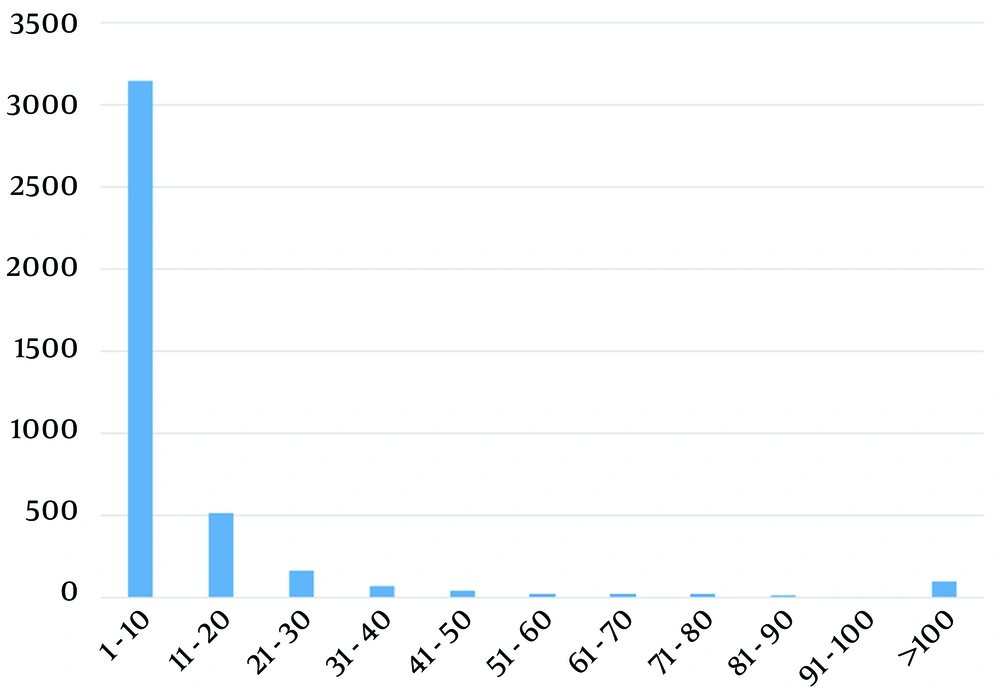
Figure 1.
Distribution of altmetric attention scores
Figure 2 illustrates the presence of articles in the field of health literacy promotion systems across various online social media platforms. According to the data, 4,578 articles (59.37%) were shared on social media via Mendeley, making it the primary platform for sharing articles in this field. Twitter ranked second, with 3,806 articles (62.01%) shared through its network. Following Twitter, Facebook and News occupied the third and fourth positions, with 1,405 and 624 articles shared, respectively. Notably, Syllabi did not play any role in disseminating articles in the field of health literacy systems on social media. To obtain more accurate results, the total number of mentions across each social media platform was also analyzed to provide a comprehensive overview. Table 1 presents the specifications regarding the total number of online mentions from each source, including the average, the highest, and the lowest mentions per article.
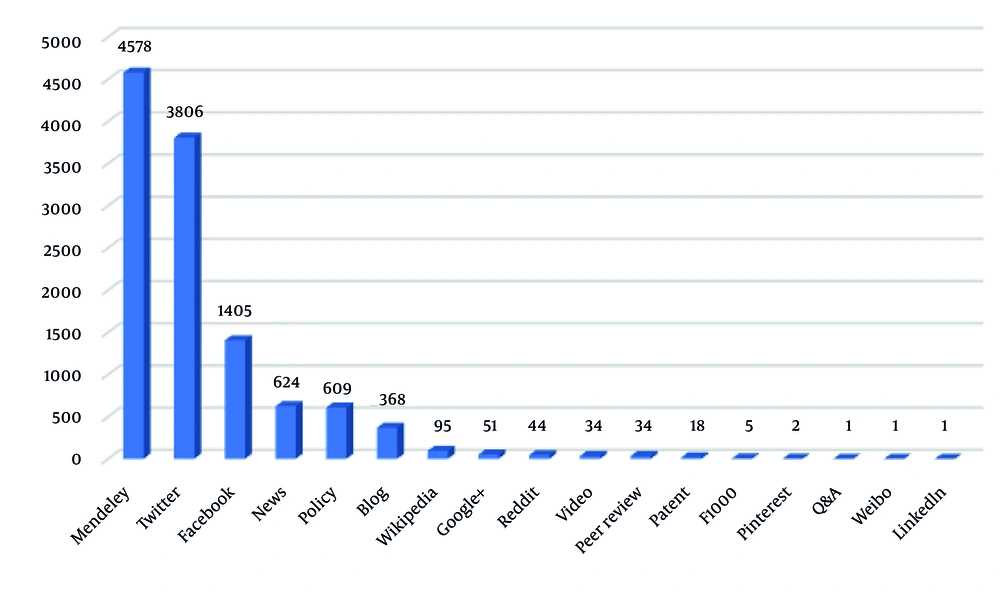
Figure 2.
Extent of various social media usage in sharing articles on health literacy systems
As shown in Table 1, Mendeley ranks first with a total of 439,115 mentions. The average number of mentions per article on Mendeley is 95.91, making it the leading altmetric source. The article titled "Social Determinants of Health," authored by Ferrer, R.L. and published in 2023 in Chronic Illness Care: Principles and Practice, has the highest Mendeley score of 6,341, though it does not offer access to the full text. Twitter follows in second place with a total of 49,035 mentions. The average number of mentions per article on Twitter is 12.88, ranking it third among altmetric sources. The highest score on Twitter, 2,077, corresponds to the article "Science Denial and COVID Conspiracy Theories," published by Miller, B.L. in JAMA in 2020, which is available as a hybrid access article.
Table 1.
Most Frequently Used Altmetric Sources for Health Literacy Systems Outputs
| Rank | Sources of Attention | Number of Publication | Total Altmetric Events | Mean Events per Article (Rank) | Max | Min |
|---|---|---|---|---|---|---|
| 1 | Mendeley | 6137 | 439115 | 95.91 (1) | 6341 | 1 |
| 2 | 6137 | 49035 | 12.88 (3) | 2077 | 1 | |
| 3 | News | 6137 | 5053 | 8.09 (4) | 370 | 1 |
| 4 | 6137 | 2798 | 1.99 (9) | 648 | 1 | |
| 5 | Policy | 6137 | 1554 | 2.55 (6) | 79 | 1 |
| 6 | Blog | 6137 | 601 | 1.63 (11) | 24 | 1 |
| 7 | Wikipedia | 6137 | 173 | 1.82 (10) | 8 | 1 |
| 8 | Google+ | 6137 | 105 | 2.05 (8) | 24 | 1 |
| 9 | Peer review | 6137 | 72 | 2.11 (7) | 6 | 1 |
| 10 | 6137 | 71 | 1.61 (12) | 8 | 1 | |
| 11 | Patent | 6137 | 67 | 3.72 (5) | 36 | 1 |
| 12 | Video | 6137 | 39 | 1.14 (13) | 4 | 1 |
| 13 | 6137 | 27 | 27 (2) | 27 | 1 | |
| 14 | F1000 | 6137 | 5 | 1 (14) | 1 | 1 |
| 15 | 6137 | 2 | 1 (14) | 1 | 1 | |
| 15 | 6137 | 1 | 1 (14) | 1 | 1 | |
| 15 | Q&A | 6137 | 1 | 1 (14) | 1 | 1 |
| 16 | Syllab | 6137 | 0 | 0 (15) | 0 | 0 |
| Total | Sum | - | 344,859 | - | - | - |
4.1. Top Journals in Health Literacy Systems by Social Media Presence and Total Mentions
Top journals in health literacy systems by social media presence and total mentions were also analyzed. A total of 6,137 journals related to health literacy systems were retrieved from Altmetric Explorer. Table 2 provides a list of the top ten journals based on total mentions.
Table 2.
Characteristics of the Top 10 Journals in the Field of Health Literacy Systems
| Rank | Journal Title | ISSNs | Number of Mentioned Outputs | Total Mentions | Country | Scientific Journal Rankings | H-Index (Rank) |
|---|---|---|---|---|---|---|---|
| 1 | JAMA: Journal of the American Medical Association | 0098-7484, 1538-3598 | 14 | 5042 | USA | 5.928 | 768 (2) |
| 2 | Journal of Medical Internet Research | 1438-8871, 1439-4456 | 133 | 2788 | Canada | 2.02 | 197 (7) |
| 3 | British Medical Journal | 0959-535X, 0959-8146, 1756-1833 | 12 | 1791 | UK | 2.803 | 497 (3) |
| 4 | New England Journal of Medicine | 0028-4793, 1533-4406 | 3 | 1359 | USA | 20.544 | 1,184 (1) |
| 5 | PLOS ONE | 1932-6203 | 88 | 1293 | USA | 0.839 | 435 (4) |
| 6 | International Journal of Environmental Research and Public Health | 1661-7827, 1660-4601 | 166 | 1200 | Switzerland | 0.808 | 198 (6) |
| 7 | BMC Public Health | 1471-2458 | 55 | 1056 | UK | 1.253 | 197 (7) |
| 8 | JACC | 0735-1097, 1558-3597 | 6 | 979 | USA | 4.636 | 155 (9) |
| 9 | JAMA Internal Medicine | 2168-6106, 2168-6114 | 6 | 948 | USA | 4.363 | 390 (5) |
| 10 | Patient Education & Counseling | 0738-3991, 1873-5134 | 100 | 887 | Ireland | 1.037 | 161 (8) |
According to Table 2, JAMA, from the USA, ranks first in total mentions, with 14 articles in the field of health literacy systems having been cited 5,042 times across various social media platforms. The journal has an H-Index of 768, making it second in this regard. Overall, the top ten journals in health literacy systems are from the United States, the United Kingdom, Canada, Ireland, and Switzerland, with seven of them being from the U.S. and the U.K. Notably, the New England Journal of Medicine boasts the highest H-Index among the top ten journals, standing at 1,184.
4.2. Top Countries in Terms of Total Mentions
Top countries in terms of total mentions are shown in Table 3. In sum, there were 49,034 tweets from 162 countries, 2,798 Facebook posts from 37 countries, 5,053 news stories from 63 countries, and 1,553 policy documents from 22 countries discussing articles related to health literacy systems. Analyzing Twitter data reveals that the United States had 8,739 tweets from 4,578 Twitter profiles, securing first place. The United Kingdom and Australia follow with 2,753 and 1,571 tweets, respectively. Additionally, there were 28,402 tweets from 13,650 unknown Twitter accounts. On Facebook, the United States also leads with 269 posts from 170 unique profiles. The analysis of news stories indicates that the United States again takes the lead with 3,436 news stories from 738 unique news outlets. Lastly, when examining policy documents, Switzerland tops the list with 677 documents derived from three unique policy sources. Other altmetric sources are shown in Table 3.
Table 3.
Distribution of Top 10 Countries for Twitter, Facebook, News, and Policy Users Based on the Number of Posts
| R (Twitter) | Country | No. of Posts | No. of Profiles | R (Facebook) | Country | No. of Posts | No. of Profiles | R (News) | Country | No. of Posts | No. of Profiles | R (Policy) | Country | No. of Posts | No. of Profiles |
|---|---|---|---|---|---|---|---|---|---|---|---|---|---|---|---|
| 1 | US | 8739 | 4578 | 1 | US | 269 | 170 | 1 | US | 3436 | 738 | 1 | Switzerland | 677 | 3 |
| 2 | UK | 2753 | 1820 | 2 | UK | 55 | 30 | 2 | UK | 500 | 158 | 2 | US | 437 | 28 |
| 3 | Australia | 1571 | 865 | 3 | Australia | 19 | 13 | 3 | Australia | 461 | 126 | 3 | UK | 126 | 9 |
| 4 | Canada | 1282 | 863 | 4 | Canada | 12 | 11 | 4 | India | 173 | 53 | 4 | Canada | 105 | 6 |
| 5 | Spain | 814 | 585 | 5 | Mexico | 10 | 9 | 5 | New Zealand | 62 | 6 | 5 | Australia | 34 | 7 |
| 6 | France | 437 | 252 | 6 | Spain | 9 | 4 | 6 | Canada | 51 | 30 | 6 | Netherlands | 33 | 5 |
| 7 | Germany | 374 | 156 | 7 | Switzerland | 8 | 7 | 7 | Turkey | 42 | 1 | 7 | Denmark | 28 | 3 |
| 8 | Mexico | 314 | 283 | 8 | Argentina | 6 | 3 | 8 | Germany | 36 | 14 | 8 | Sweden | 22 | 6 |
| 9 | Switzerland | 289 | 148 | 9 | Belgium | 5 | 5 | 9 | Spain | 34 | 23 | 9 | Luxembourg | 22 | 1 |
| 10 | India | 262 | 172 | 9 | Costa Rica | 4 | 3 | 9 | Japan | 30 | 9 | 10 | Germany | 12 | 5 |
4.3. Top Affiliations in Health Literacy Systems Based on Total Mentions on Social Media
Top affiliations in health literacy systems based on total mentions on social media are illustrated in Figure 3. The University of California, San Francisco, leads with 4,790 mentions and a total of 141 articles. Harvard University follows in second place, with 136 articles mentioned 4,429 times across various social media platforms.
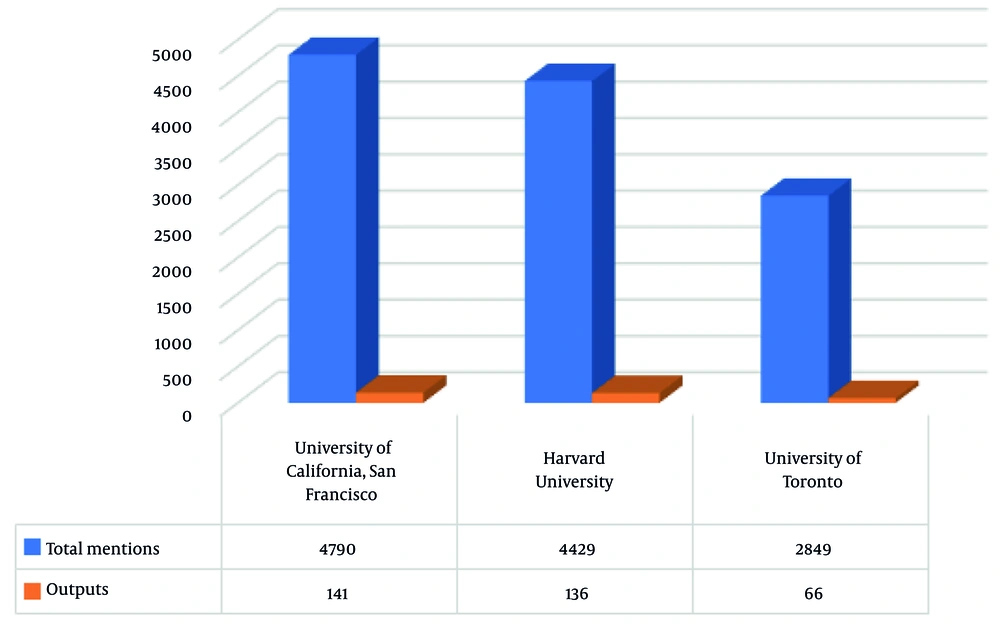
Figure 3.
Top three affiliations of health literacy systems outputs based on total mentions
4.4. Top Articles in Health Literacy Systems Based on Altmetric Scores and Citation Performance
Top articles in health literacy systems based on altmetric scores and citation performance are detailed in Table 4. The article titled "Medication Adherence: WHO Cares," authored by Brown, M.T. and Bussell, J.K. and published in 2011 in Mayo Clinic Proceedings, holds the top position in health literacy systems with an impressive Altmetric score of 2,121. Its Altmetric indicators include 65 mentions on Twitter, 370 in news, 20 in blogs, 6 on Facebook, 2 on Wikipedia, 0 on Reddit, 1 in video, and 2,817 on Mendeley. Notably, this article's News score surpasses that of the other top ten articles. A review of the top ten articles in health literacy systems reveals that two articles were published in the British Medical Journal and two in JAMA. Further details regarding these articles can be found in Table 4.
Table 4.
Top 10 Highly-Mentioned Articles in Health Literacy Systems Outputs
| Rank | Article Title (First Author/Year) | Source Title | AAS | TC | NC | BC | FBC | WC | RC | VC | PS | MC |
|---|---|---|---|---|---|---|---|---|---|---|---|---|
| #1 | Medication adherence: WHO cares? | Mayo Clinic Proceedings | 2121 | 65 | 370 | 20 | 6 | 2 | 0 | 1 | 4 | 2817 |
| #2 | Science denial and COVID conspiracy theories | JAMA: Journal of the American Medical Association | 1429 | 2077 | 11 | 8 | 3 | 0 | 8 | 1 | 0 | 212 |
| #3 | Patient and public involvement in covid-19 policy making | British Medical Journal | 1171 | 591 | 103 | 6 | 1 | 0 | 0 | 0 | 6 | 175 |
| #4 | Evaluation of symptom checkers for self-diagnosis and triage: Audit study | British Medical Journal | 1103 | 303 | 170 | 24 | 31 | 2 | 0 | 4 | 1 | 609 |
| #5 | 2023 Alzheimer's disease facts and figures | Alzheimer's & Dementia: The Journal of the Alzheimer's Association | 1078 | 37 | 206 | 7 | 0 | 0 | 0 | 0 | 7 | 1768 |
| #6 | 2017 ACC/AHA/AAPA/ABC/ACPM/AGS/APhA/ASH/ASPC/NMA/PCNA Guideline for the Prevention, Detection, Evaluation, and Management of High Blood Pressure in Adults A Report of the American College of Cardiology/American Heart Association Task Force on Clinical Practice Guidelines | JACC | 1032 | 276 | 155 | 13 | 22 | 8 | 0 | 1 | 11 | 2851 |
| #7 | American Cancer Society nutrition and physical activity guideline for cancer survivors | CA: A Cancer Journal for Clinicians | 978 | 539 | 107 | 2 | 4 | 0 | 0 | 0 | 1 | 386 |
| #8 | Counteracting health misinformation | JAMA: Journal of the American Medical Association | 890 | 1753 | 6 | 3 | 14 | 0 | 2 | 0 | 0 | 80 |
| #9 | On entering Australia’s third year with COVID-19 | Medical Journal of Australia | 835 | 122 | 180 | 4 | 1 | 0 | 0 | 0 | 1 | 20 |
| #10 | Social media use and health and well-being of lesbian, gay, bisexual, transgender, and queer youth: Systematic review | Journal of Medical Internet Research | 764 | 25 | 143 | 4 | 2 | 0 | 0 | 0 | 1 | 201 |
Table 5 outlines the citation performance of the top ten articles in health literacy systems. The leading article, "Medication Adherence: WHO Cares," has garnered 2,831 citations on Google Scholar, 1,371 citations on Scopus, and 1,497 citations on Dimensions, marking the highest citation count among the top ten articles. Additional citation performance data for the other top articles can be viewed in Table 5.
Table 5.
Citations of Top 10 Highly-Mentioned Articles in Health Literacy Systems
| S.N | Article Title (First Author/Year) | Type of Document | Google Scholar | Scopus | Dimensions |
|---|---|---|---|---|---|
| #1 | Medication adherence: WHO cares? | Article | 2831 | 1371 | 1497 |
| #2 | Science denial and COVID conspiracy theories | Article | 101 | 54 | 61 |
| #3 | Patient and public involvement in covid-19 policy making | Article | 6 | 61 | 75 |
| #4 | Evaluation of symptom checkers for self-diagnosis and triage: Audit study | Article | 479 | 314 | 361 |
| #5 | 2023 Alzheimer's disease facts and figures | Article | 11 | 780 | 935 |
| #6 | 2017 ACC/AHA/AAPA/ABC/ACPM/AGS/APhA/ASH/ASPC/NMA/PCNA guideline for the prevention, detection, evaluation, and management of high blood pressure in adults: A report of the American College of Cardiology/American Heart Association Task Force on Clinical Practice Guidelines | Article | 10298 | 3507 | 3942 |
| #7 | American cancer society nutrition and physical activity guideline for cancer survivors | Article | 398 | 276 | 304 |
| #8 | Counteracting health misinformation | Article | 76 | 51 | 57 |
| #9 | On entering Australia’s third year with COVID-19 | Article | 12 | 8 | 11 |
| #10 | Social media use and health and well-being of lesbian, gay, bisexual, transgender, and queer youth: Systematic review | Article | 62 | 36 | 40 |
5. Discussion
This study focused on exploring research related to health literacy systems through an altmetric method. By searching Scopus from 1992 to 2023, a total of 6,137 articles in the area of health literacy systems were identified. Out of these, only 4,144 articles (67.52%) were discussed on online social media and had corresponding altmetric scores. The majority of these articles (n = 3,148) received altmetric scores ranging from one to ten, with only a small number exceeding 100. The platforms where most studies in health literacy systems were shared included Mendeley, Twitter, Facebook, News outlets, Policy platforms, and Blogs. Mendeley, Twitter, and News articles were the top three platforms in terms of mentions, whereas in terms of average occurrences, Mendeley, Weibo, and Twitter led the rankings. These findings suggest that a social media platform’s popularity does not necessarily correlate with its impact on Altmetric scores. The general popularity or widespread use of a social media platform alone cannot guarantee its impact on the Altmetric score. Rather, it is the type, quality, and context of scientific engagement on these platforms that play the most significant role in determining the score. This explains why platforms such as Mendeley and Twitter, despite being less popular than mainstream social networks, have a greater influence on Altmetric scores.
Interestingly, Facebook ranked third in terms of usage, but fourth in total altmetric score. Conversely, while News outlets ranked fourth for usage, they came in third for total altmetric scores after Mendeley. Subsequently, Shirazi and Goltaji conducted research on health literacy studies using altmetrics, finding that Mendeley and Twitter were the most utilized social media platforms, with 492 and 487 articles cited, respectively, making them the first and second most popular platforms (39). The key distinction between their research and the current study lies in the source of the articles, as the former utilized Web of Science for data extraction. Other studies have recognized Mendeley as a critical tool for offering article-level data and altmetrics. Unlike other social media platforms, Mendeley provides detailed user information, including country of origin, field of study, and job position, which facilitates collaboration and enhances the sharing of research among scholars (40, 41).
The results of this study show that the highest mentions in the field of health literacy systems on social media came from users in the United States, the United Kingdom, and Australia. Additionally, Switzerland, the United States, and the United Kingdom had the most mentions on policy-focused social media. Among academic institutions, the universities of California, Harvard, and Toronto received the highest mentions related to health literacy systems on social media. Furthermore, the research conducted by Shirazi and Goltaji revealed that the United States, the United Kingdom, and Spain were the most significant contributors to the mentions of health literacy papers (39), this finding aligns with the results of the current research. Karamali et al. similarly observed that the most active countries in the field of health literacy are the United States and Canada, which have made substantial contributions to health literacy studies (42). The study by Yang et al. also found that the United States and the University of California had the highest scientific output in the area of digital health literacy, which is consistent with the findings of the current study (43).
An analysis of the altmetric scores of articles in the field of health literacy systems revealed that these articles have been published in prestigious journals, including BMJ, JAMA, JACC, and CA, which are highly ranked in the medical sciences based on various indicators such as impact factor (IF) and SCImago Journal Rank (SJR). Additionally, Yang noted that the Journal of Medical Internet Research publishes the most studies in the area of digital health literacy (43), this aligns with the findings of the current study. The findings indicated that the articles with the highest mentions also demonstrated a notable citation performance in Scopus, Google Scholar, and Dimensions. Similarly, the study by Shirazi and Goltaji revealed a significant positive relationship between most altmetric indicators and the number of citations received in citation databases (39). They noted that social media has a positive impact on the number of citations for articles, which is consistent with the results of the current study as well as previous research. Furthermore, the correlation observed between citations and the storage metric in Mendeley was stronger than that seen with other alternative metrics. The platform's subject coverage, large user base, and popularity are significant factors that contribute to this trend (41, 44-46).
In a distinctive study employing a co-word analysis approach to health literacy research, Baji et al. found that the fields of healthcare, psychiatry and psychology, public health, social sciences, communications, health services, and health education had the highest degree of centrality within the entire network of this discipline. Overall, the conceptual structure of health literacy presents a continuous framework with meaningful connections among its constituent concepts and topics, reflecting the nature and core consistency of this field. As a branch of medical sciences, health literacy has successfully established coherent and sustainable connections with the social and human sciences. This integration enables health literacy researchers to articulate future research trends based on the identified influential domains (47). Karamali et al. also noted that health literacy is inherently interdisciplinary, intersecting with fields such as education, health, information and communication technology (ICT), and mental health. This highlights the need for collaboration among researchers in this area (42).
Coşkun et al. pointed out that new health literacy systems based on ChatGPT helps people better understand, analyze, and interpret health information while building a comprehensive health profile. However, there's a risk that ChatGPT might misdiagnose conditions or provide inaccurate information, which could lead to misleading advice and prevent users from accessing reliable data. Additionally, a ChatGPT-based system could restrict individuals’ ability to monitor and interpret their own health records (34). Saadatifar et al. proved that mHealth training significantly improves treatment adherence in dialysis patients. So, alongside regular training, mHealth education can be incorporated into treatment programs for hemodialysis patients to enhance their compliance (48).
One of the strengths of this study is its comprehensive consideration of all informational channels related to health literacy system applications, without imposing any linguistic restrictions. In this study, the data extraction was limited to the Scopus database, so it is recommended that future studies also utilize the Web of Science database to extract research in this area and compare the results with those obtained from Scopus. Another limitation of this study is the lack of similar research to compare against the findings, highlighting the need for further investigation using altmetric and scientometric approaches. Additionally, conducting systematic reviews to identify health literacy systems and their dimensions could be beneficial for designing more precise systems in this field.
5.1. Conclusions
This study provides a comprehensive analysis of health literacy systems using altmetric indicators, revealing valuable insights into how scholarly communication unfolds across various social media platforms. The findings demonstrate that the popularity of a platform does not necessarily equate to greater altmetric influence. Instead, platforms such as Mendeley and Twitter, despite being less popular among general users, play a more significant role due to the scientific nature and context of user engagement. The results also highlight the dominant role of countries like the United States, the United Kingdom, and Australia in generating altmetric attention, particularly from academic institutions and policy-related platforms. Furthermore, articles with higher altmetric scores were often published in high-impact journals and showed a strong positive correlation with traditional citation metrics. The study reinforces the interdisciplinary nature of health literacy, underscoring its integration with fields such as education, mental health, public health, and ICT. It also emphasizes the importance of combining altmetric data with scientometric analysis to gain a more holistic understanding of research impact. Despite some limitations — such as reliance on a single database (Scopus) and the scarcity of similar studies for comparison — this research contributes meaningful evidence supporting the strategic role of alternative metrics in assessing the visibility and influence of scholarly outputs. Future studies are encouraged to include other databases like Web of Science and to conduct systematic reviews to further explore the evolving landscape of health literacy systems.