1. Background
Computer literacy is commonly defined as basic computer knowledge, skills, and a positive attitude toward using and learning with computers. Like reading and writing, it has been considered a requirement for all students in the current century and commonly refers to the abilities required for all modern citizens to use computers to explore, create, and communicate effectively for everyday life, learning, and work (1-3). However, the scope and definition of computer literacy may change due to the rapid advancement of computer technology. For example, the impact of AI technology on human society has led educational policymakers in many countries to emphasize learning computer programming in university curricula. Therefore, computational thinking has gradually been considered a new dimension of computer literacy and has been included in curriculum standards as new knowledge and attitude (4, 5).
One of the most important application areas of information technology is the field of medical sciences. In recent years, along with the rapid growth of information and communication technology, we have witnessed the use of various computer information systems, electronic health records, telemedicine, artificial intelligence, and the Internet of Things in healthcare and treatment centers, which make timely, accurate, and convenient care services available to care providers and clients at any time and place (6, 7). Advanced technologies enable medical professionals to improve the timeliness of healthcare delivery and make it more accessible to more people, make preventive treatment easier for people, and contribute to their long-term health, and have the potential to make healthcare more effective, organized, and accessible (7, 8).
The rapid development of information technology has presented medical education with numerous new choices, challenges, and opportunities. A variety of technologies, including mannequins, models, simulators, digital systems, and applications, are now widely used in medical education, enabling students to learn about technology with greater motivation (9, 10). Medical science is based on research, and one of the essential tools for research is literature review and the use of sources in databases. Therefore, with the stunning expansion of information technology and the possibility of accessing international networks, a huge transformation has occurred in the storage and retrieval of medical information, and accessing these resources has become one of the most important educational and research tools (11, 12).
Information technology has gradually been introduced in medical education to facilitate learning and improve medical outcomes. The role of technology has expanded from a mere tool for study and research to an integrated approach and use in education. Its use in medical education is constantly advancing. In fact, one of the achievements of information and communication technology is the Internet-based teaching and learning process, which makes its necessity more evident due to issues such as lack of educational space, large amount of available information, and time conflicts of professors (13, 14).
2. Objectives
Therefore, this study was conducted with the aim of investigating the computer literacy and technology of students at the University of Medical Sciences in the year 2024.
3. Methods
The present study is a cross-sectional descriptive-analytical study conducted in 2024. The research population consisted of students studying at Abadan University of Medical Sciences during the 2023 - 2024 academic year. A total of 300 students from Abadan University of Medical Sciences were selected using a stratified random sampling method, proportional to the number of students in each field. After receiving the code of ethics and permission from the university's research council, students were given explanations about the objectives of the study and the confidentiality of their responses and opinions. The criteria for entering the study included voluntary and informed consent and completing at least three academic semesters at the university, while the criteria for exiting the study were non-cooperation in the study and incomplete completion of the questionnaire.
The data collection tool was a researcher-made questionnaire. The validity of the questionnaire was assessed by four health information management and biostatistics experts. Test-retest reliability (with a 10-day interval) was performed to determine the reliability of the questionnaire. Thus, 30 students from different fields [Medicine (MD degree), nursing, operating room, information technology Bachelor's degree] were asked to answer the questionnaire again after ten days, and finally, the reliability of the questionnaire was confirmed using a correlation coefficient of 86%. The questionnaire was designed in three parts: The first part included four main questions related to knowledge and skills in working with computers; the second part related to the Internet and searching the Internet and databases; and the third part consisted of four main questions related to new technology skills. In the section of questions related to knowledge and skills in using information technology, the desired criteria were presented before each question to guide the respondents.
To measure the answers to the questions, a five-point Likert scale was used, ranging from zero to four, with zero for no skill and four for excellent skill, or zero for very little use and four for very much use. The average score obtained in each section is expressed as a percentage for ease of comparison. To give meaning to the data that were collected, descriptive statistical tools were employed, namely: Frequency count, percentage, arithmetic mean, standard deviation, weighted mean, one-way ANOVA, Tukey’s test, Pearson’s product-moment coefficient of correlation, and the Fisher’s t-test. In testing the hypotheses, the decision on whether the null hypothesis was accepted or rejected was guided by the following decision rule: Accept the null hypothesis if and when the computed value was less than the critical or tabular value or the P-value was greater than α; on the other hand, reject the null hypothesis if and when the computed value was equal to or greater than the critical or tabular value or the P-value was equal to or less than α. The hypotheses testing assumed that the level of significance would equal α = 0.05 in a two-tailed test. Available statistical software or packages were utilized for accuracy and precision in data processing. The collected data were analyzed using descriptive statistics in the form of frequency, frequency percentage, and mean in SPSS 26 software.
4. Results
In this study, 350 questionnaires were distributed among paramedical, nursing, medical, and health students. After collection, 50 questionnaires that were not completely filled out were eliminated, resulting in 300 questionnaires being analyzed. The largest number of students were undergraduates and were related to the nursing field. The results of the study showed that the level of familiarity of students with computers was 55%. In comparing the basic knowledge of students about computers, the highest level of familiarity (63%) was related to the ability to use computers and manage files, while the lowest level of familiarity (46%) was related to the ability to manage the Windows operating system. In comparing the basic knowledge of students about computers, the highest level of familiarity (65%) was related to paramedical fields, and the lowest level of familiarity (49%) was related to nursing students (Table 1).
Table 1.
Determining the Knowledge of Students at Abadan University of Medical Sciences About Computers
| Faculties; Computer Skills | Medical Fields | Nursing Fields | Paramedical Fields | Health Fields | Sum | |||||
|---|---|---|---|---|---|---|---|---|---|---|
| Average Score Out of 4 | Average Score % | Average Score Out of 4 | Average Score % | Average Score Out of 4 | Average Score % | Average Score Out of 4 | Average Score % | Average Score Out of 4 | Average Score % | |
| Familiarity with basic concepts of information technology | 2 | 50 | 2.2 | 55 | 2.3 | 58 | 2.2 | 55 | 2.17 | 54 |
| Ability to use a computer and manage files | 2.1 | 52 | 2 | 50 | 3.2 | 80 | 3 | 75 | 2.5 | 63 |
| Ability to manage the Windows operating system | 1.7 | 42 | 1.6 | 40 | 2.3 | 57 | 1.9 | 47 | 1.8 | 46 |
| Ability to work with Microsoft Office software packages (Word, PowerPoint, Access, and Excel) | 2.3 | 57 | 2.1 | 52 | 2.6 | 65 | 2.4 | 60 | 2.3 | 58 |
| Overall average | 2 | 50 | 1.9 | 49 | 2.6 | 65 | 2.3 | 59 | 2.2 | 55 |
In terms of the ability to use the Microsoft Office software package, the highest skill was related to PowerPoint (70%), while the lowest skill was related to Access (6%). The level of familiarity of students with the Internet and the Web was 53%. In comparing students' basic knowledge about the Internet, the highest level of familiarity (55%) was related to the skill of being able to use the Internet, and the lowest level of familiarity (46%) was related to the skill of using the Outlook program. In comparing students' skills and familiarity with the Internet, the highest level of familiarity (60%) was related to paramedical students, and the lowest level of familiarity (48%) was related to health students (Table 2).
Table 2.
Determining the Knowledge of Abadan University of Medical Sciences Students About the Internet
| Faculties; Internet Skills | Medical Fields | Nursing Fields | Paramedical Fields | Health Fields | Sum | |||||
|---|---|---|---|---|---|---|---|---|---|---|
| Average Score Out of 4 | Average Score % | Average Score Out of 4 | Average Score % | Average Score Out of 4 | Average Score % | Average Score Out of 4 | Average Score % | Average Score Out of 4 | Average Score % | |
| Familiarity with basic concepts of the Internet and the World Wide Web | 2.2 | 55 | 1.9 | 47 | 2.3 | 57 | 1.9 | 47 | 2 | 51 |
| Ability to use the Internet | 2.3 | 57 | 2.3 | 57 | 2.4 | 60 | 1.9 | 47 | 2.2 | 55 |
| Ability to use e-mail | 2.6 | 65 | 2.4 | 60 | 2.8 | 70 | 2.3 | 57 | 2.5 | 63 |
| Basic knowledge and skills in using Outlook | 2.1 | 52 | 2 | 50 | 2.1 | 52 | 1.3 | 32 | 1.8 | 46 |
| Total average | 2.3 | 57 | 2.15 | 53 | 2.4 | 60 | 1.8 | 48 | 2.1 | 53 |
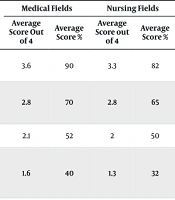
The comparison of students' skills and familiarity with the Internet also showed that male students had a higher level of skill and knowledge than female students, with 59% compared to 41%. In the case of e-mail, 80% of the students had an e-mail address. The level of familiarity of students with different approaches to searching for information on the Internet was 54%. Most students (84%) used the usual and simple search method to search for information by typing the desired phrase in the search box of a search engine such as Google and Yahoo. In comparison, paramedical students used more diverse search methods (60%, Table 3).
Table 3.
Study of the Status of Students of the University of Medical Sciences Using different Approaches to Search for Information on the Internet
| Faculties; Methods Used to Search for Information on the Internet | Medical Fields | Nursing Fields | Paramedical Fields | Health Fields | Sum | |||||
|---|---|---|---|---|---|---|---|---|---|---|
| Average Score Out of 4 | Average Score % | Average Score out of 4 | Average Score % | Average Score Out of 4 | Average Score % | Average Score Out of 4 | Average Score % | Average Score Out of 4 | Average Score % | |
| Simple and common search such as: Typing the desired phrase in the search box of a search engine | 3.6 | 90 | 3.3 | 82 | 3.6 | 90 | 3.1 | 77 | 2.7 | 84 |
| Advanced search such as: Using the advanced search facilities of the search engine using Boolean operators, OR, AND, NOT for searching | 2.8 | 70 | 2.8 | 65 | 3.2 | 80 | 3.3 | 82 | 3 | 74 |
| Using Boolean operators, OR, AND, NOT for searching | 2.1 | 52 | 2 | 50 | 2.1 | 52 | 2.8 | 65 | 2.25 | 54 |
| Restricting the search for more precise retrieval such as: Using quotation marks, parentheses, plus and minus operators (- and +) shortening phrases in the search (truncation), etc. | 1.6 | 40 | 1.3 | 32 | 1.8 | 45 | 1.6 | 25 | 1.5 | 35 |
| Using a topic guide such as the list of menus available in the topic search engine | 1.3 | 25 | 1.2 | 35 | 1.4 | 35 | 1.1 | 27 | 1.25 | 25 |
| Average total | 2.8 | 55 | 2.12 | 52 | 2.42 | 60 | 2.38 | 55 | 2.14 | 54 |
Also, the comparison of the two genders showed that boys had more skills in searching for information, with 54% compared to 46%. The level of familiarity of students with new technology skills was 19%. Students were most likely to use online discussion groups (chat rooms, text chat, voice chat, and online conferences) at 30%. The lowest level of familiarity, at 14%, was related to the skill of using programming languages. In comparison, paramedical students used online discussion group methods (chat rooms, text chat, voice chat, and online conferences) at 25% (Table 4).
Table 4.
Determining the Knowledge of Abadan University of Medical Sciences Students About New Technology Skills
| Faculties; Methods Used for New Technologies | Medical Fields | Nursing Fields | Paramedical Fields | Health Fields | Sum | |||||
|---|---|---|---|---|---|---|---|---|---|---|
| Average Score Out of 4 | Average Score % | Average Score Out of 4 | Average Score % | Average Score Out of 4 | Average Score % | Average Score Out of 4 | Average Score % | Average Score Out of 4 | Average Score % | |
| Skill in using programming errors | 0.6 | 15 | 0.3 | 7 | 1 | 25 | 0.4 | 10 | 0.57 | 14 |
| Skill in using artificial intelligence and its tools | 0.3 | 7 | 0.2 | 5 | 1.1 | 27 | 0.9 | 22 | 0.6 | 15 |
| Skill in using online discussion groups (chat rooms, text chat, voice chat, and online conferences) | 9 | 22 | 1.3 | 32 | 1.4 | 35 | 1.3 | 32 | 1.2 | 30 |
| Skill in using ChatGpt | 0.6 | 25 | 7 | 17 | 0.6 | 15 | 0.4 | 10 | 2.3 | 16 |
| Total average | 0.6 | 17 | 0.6 | 15 | 1 | 25 | 0.7 | 18 | 1.1 | 19 |
Also, the comparison of the two genders showed that boys had more skills in using artificial intelligence and its tools (65% to 35%).
5. Discussion
The present study was conducted to investigate the computer literacy of students at Abadan University of Medical Sciences. Although most students had a good knowledge of basic skills such as the ability to use a computer and tasks like file management, using toolbars, desktop settings, setting time and date, printer settings, burning CDs, and managing hard disks, their level of familiarity with skills such as installing Windows, installing various drives like graphics cards and motherboards, restoring the system to previous settings, and installing hardware equipment such as scanners and printers was at an average level. Additionally, their familiarity with new technologies such as ChatGPT and artificial intelligence tools in the field of education and research was very low.
In a study by Sarbaz and Vehedian on students at the Faculty of Paramedical and Health Sciences of Mashhad University of Medical Sciences, most students had an average level of familiarity with computers and their equipment (54%), and only 9% of students had an advanced level of familiarity with computers and their equipment (15). This was somewhat consistent with our study and showed good growth in computer literacy. The results of the study also showed that students' attitudes towards basic computer concepts were good, which was consistent with the studies of Son et al. (16), Atay et al. (17), Maag (18), and Robabi and Arabisarjou (19).
In a study by Kong et al. aimed at designing, implementing, and evaluating an AI literacy course for university students in 2021, the findings showed that participants with diverse study backgrounds and of both genders could understand the concepts of machine learning, supervised learning, regression, classification, unsupervised learning, and clustering (20). This was not consistent with the present study. Of course, the field of new technologies is somewhat underdeveloped and requires more training and the inclusion of more units and workshops for students. Artificial intelligence is profoundly impacting our daily lives and workplaces. To face the challenges and seize the opportunities associated with AI, university students need to gain a basic understanding of AI. Assessing students’ AI literacy status is essential for implementing effective programs that enhance AI capabilities.
A 2023 study by Hornberger aimed to develop and validate an AI literacy test and provide initial insights into the current state of AI literacy among German university students. The results showed that there are significant differences in AI literacy among students, with AI literacy being higher among students with a background in technical education or previous experience in AI. The results showed that there is a need for effective AI courses for a broader audience of students who use AI in their daily lives and will use AI tools in their future careers. Furthermore, university professors should consider students’ prior knowledge and experience when designing and teaching AI courses (21).
In a study by Zhang et al. in 2024 titled "College Students’ Literacy, ChatGPT Activities, Educational Outcomes, and Trust from a Digital Divide Perspective", the findings indicated that US college students have a greater relationship with AI literacy than with general digital literacy. This is not consistent with the findings of our study (22).
In examining the relationship between the dimensions of computer literacy, demographic variables between semester and grade point average, there was a relationship with the dimensions of computer literacy, which can be attributed to taking more courses related to technology and computers. It should be noted that the field of study is related to computer literacy, and health information technology and library science students in the medical field had the highest computer and technology literacy due to the relevance of the course content.
The findings of the present study showed that overall, students had a good familiarity with the basic concepts of computers and the Internet, but they had low literacy with the concepts of new technological tools, including programming and AI tools. Therefore, planning to teach new skills in medical universities is essential.
5.1. Conclusions
Since students' computer literacy is an introduction to learning healthcare technologies, it is recommended that measures be taken to increase the computer literacy of medical students so that they can effectively and efficiently play an active role in the clinical environment and provide patient care. Therefore, it is recommended to relevant decision-makers and planners to take an important step towards increasing computer literacy and learning new age technology tools by holding workshops or changing curricula and adding rich course units.
5.2. Limitations
Among the limitations of this study are the failure to complete some questionnaires by students, and another limitation is the failure to examine all variables on students' computer literacy, such as the economic, social, and cultural conditions of families that can have a positive effect on computer literacy.