


1. Background
Cervical cancer ranks as the fourth most common cancer in terms of both incidence and mortality among women worldwide. According to the "Global Cancer Statistics 2022" published in February 2024 in CA: A Cancer Journal for Clinicians, approximately 662,000 new cervical cancer cases and 349,000 deaths occurred globally in 2022, accounting for 6.8% and 8.1% of total female cancer incidence and mortality, respectively. In China specifically, an estimated 151,000 new cases and 56,000 deaths were recorded in 2022, representing 22.8% and 16.0% of the global totals. Furthermore, both incidence and mortality rates in China have been rising over the past two decades, reaching age-standardized incidence and mortality rates of 13.83 and 4.54 per 100,000 women in 2022, indicating a significant disease burden (1).
Cervical cancer is currently the only malignant tumor with a clearly identified etiology that is both preventable and treatable. It has a well-established three-tiered prevention strategy, including HPV vaccination, cervical cancer screening, and early diagnosis and treatment, making it a candidate for the first cancer type to be eliminated (1, 2). Human papillomavirus (HPV), primarily transmitted through sexual contact, has over 200 identified subtypes (3). Of these, 25 types possess carcinogenic potential in humans, with at least 14 genotypes — namely HPV-16, -18, -31, -33, -35, -39, -45, -51, -52, -56, -58, -59, -66, and -68 — classified as high-risk human papillomavirus (hrHPV) genotypes (4). Persistent hrHPV infection has been confirmed as the primary causative factor for cervical cancer (5).
China initiated the free "Two-Cancer" Screening Project (breast cancer and cervical cancer) for rural women in 2009, and since 2019, this screening has been integrated into the essential public health services program (6). Data from China’s rural cervical cancer screening project between 2009 and 2018 indicate that the detection rate of cervical cancer and precancerous lesions using the HPV testing method was higher than that using cytology (7). The HPV nucleic acid testing, which detects HPV infection status and offers higher sensitivity, is the primary screening method for cervical cancer recommended by the World Health Organization (WHO) (8) and is also the preferred screening method endorsed by the "Chinese Guidelines for Cervical Cancer Screening (I)" (9).
Since its initiation in 2009, Guizhou province has annually conducted the free "Two-Cancers" Screening Program for rural women in accordance with project protocols, achieving full coverage across all 88 counties (districts) in its 9 prefecture-level cities (autonomous prefectures) by 2020. To promote early diagnosis and treatment of cervical cancer, a primary screening strategy of "hrHPV DNA testing combined with TCT triage" every five years has been adopted since 2023 for large-scale cervical cancer screening among eligible women. This initiative holds significant importance for understanding the hrHPV infection status and regional distribution patterns in Guizhou province, as well as optimizing localized cervical cancer prevention and screening strategies.
To investigate the spatial distribution of hrHPV infection rates across 88 counties/districts in Guizhou province, this study utilized spatial autocorrelation and space-time scan statistics to analyze hrHPV infection data from the 2023 - 2024 free cervical cancer screening program in the region.
2. Objectives
Given the limited prior research examining hrHPV infection distribution from a spatial perspective and the absence of relevant reports in Guizhou province, the present study aims to determine the overall prevalence and spatial clustering characteristics of hrHPV infections in different areas of Guizhou, China. The findings will facilitate optimized resource allocation, targeted prevention strategies, and rational distribution of public health resources to reduce HPV infections among women and mitigate cervical cancer incidence.
3. Methods
3.1. Screening Program
In accordance with the Guizhou Provincial Health Commission’s Guizhou Health Letter (2022) No.36 document, "Guizhou Province cervical cancer and breast cancer screening work program", the technical process requirements for screening are as follows: The initial screening uses gynecological examination and reverse polymerase chain reaction (PCR) typing of hrHPV DNA qualitative testing. This method can detect 14 high-risk types required by the National Cervical Cancer Screening Program, specifically identifying HPV16 and HPV18 subtypes, and mixed identification of HPV31, 33, 35, 39, 45, 51, 52, 56, 58, 59, 66, 68. The report results are divided into four categories: Negative, HPV16, HPV18, and other 12 high-risk subtypes. In this study, hrHPV-positive reporters were those who reported positive results for HPV16, HPV18, and the other 12 high-risk subtypes.
3.2. High-Risk Human Papilloma Virus Testing
This process comprises specimen collection, preservation, laboratory testing, reporting, and data verification/submission. Specimen collection is conducted at designated township or county-level medical institutions across the province. Preservation adheres to the standards specified by high-risk HPV testing institutions. Designated testing institutions (selected through open bidding) regularly collect specimens from the assigned medical facilities and complete testing within stipulated timeframes. All test data undergo hierarchical review and feedback through township-county-municipal maternal and child health hospitals, ultimately submitted to the provincial maternal and child health hospital for province-wide data consolidation and verification. Women aged 35 - 64 eligible for free cervical cancer screening across the province are eligible for one free screening every five years, following high-risk HPV testing protocols. Annually, staff in project areas conduct duplicate checks for negative cases according to screening cycles and follow up on abnormal cases as required. Specifically, those with negative screening results may only participate in the next free screening round after five years, while those with positive results are no longer eligible for subsequent free screenings.
3.3. Study Subjects and Data Sources
The data for this study came from the "two cancers" screening program in Guizhou province, exported from the information system of each city (state) and then summarized at the provincial level. The exported data included the screening time of each case, the screening institution, the address of the screener, the basic gynecological examination, and whether the hrHPV screening was positive. Inclusion criteria included eligibility for free cervical cancer screening (i.e., women aged 35 - 64 across the province, with priority given to rural women and urban women receiving subsistence allowances as part of rural revitalization efforts); comprehension of the screening procedures and voluntary participation by signing informed consent forms; and accurate recording of initial screening (hrHPV DNA testing) results in the multi-tiered systems. Exclusion criteria included those who did not have their initial screening (hrHPV DNA test) results entered in the system. The map information was derived from the 1:250,000 geographic data of the county-level administrative division map of Guizhou province provided by the Guizhou Provincial Center for Disease Control and Prevention.
3.4. Spatial Analysis
3.4.1. Establishment of a Spatial Database
We used Excel 2010 to establish a database of hrHPV infection rates with variables such as year, number of hrHPV-positive infections, number of hrHPV tests, hrHPV-positive infection rate, and county and district codes. We used vector maps of Guizhou province as the spatial structure database in ArcGIS 10.2 and associated the infection rate database with administrative maps of Guizhou province counties and districts through the variable “county and district code” to construct a GIS spatial database of hrHPV infection. In ArcGIS 10.2, we used the vector map of Guizhou province as the spatial structure database and associated the infection rate database with the administrative map of counties and districts in Guizhou province through the variable “county code”.
3.4.2. Spatial Autocorrelation Analysis
Spatial autocorrelation analysis examines whether spatial units and their neighboring units exhibit clustered distribution patterns of specific attributes. Global and local spatial autocorrelation analyses were conducted using ArcGIS 10.2. Global spatial autocorrelation evaluates whether an attribute exhibits spatial clustering across the entire study area, while local spatial autocorrelation identifies specific locations and degrees of clustering. A spatial weight matrix was generated based on the "inverse distance" conceptualization of geographical adjacency among county-level administrative units in Guizhou province. The global spatial autocorrelation results are represented by Moran’s I coefficient, Z-score, and P-value. Moran’s I ranges from (-1, 1), where I > 0 indicates positive spatial autocorrelation (clustered distribution), I < 0 indicates negative spatial autocorrelation (dispersed distribution), and I = 0 suggests spatial randomness. The closer the absolute value of I is to 1, the stronger the spatial autocorrelation. Local spatial autocorrelation results are visualized using Local Indicators of Spatial Association (LISA) cluster maps, categorized into four types: High-high (H-H) or low-low (L-L) clusters (I > 0): Areas where hrHPV infection rates are similarly high or low compared to neighboring regions. High-low (H-L) or low-high (L-H) outliers (I < 0): Areas where hrHPV infection rates are significantly higher or lower than adjacent regions (10). Here, |Z| ≥ 1.96 and P < 0.05 indicate that the spatial autocorrelation is statistically significant.
3.4.3. Spatio-Temporal Scanning Analysis
Spatio-temporal scanning statistics were calculated to determine whether the specified attributes were spatio-temporally clustered within a certain study area. SaTScan 9.1 software was applied to perform the analysis, and the Kulldorff method of spatio-temporal scanning statistic of the discrete Poisson model was used to dynamically scan the range of the study area through the circular scanning window, calculate the theoretical incidence number of each scanning window, and derive the likelihood statistic Log Likelihood Ratio (LLR) based on the theoretical incidence number and the actual incidence number. The RR value was calculated, and temporal clustering was considered to exist when P < 0.05 for the LLR test (11).
3.5. Statistical Analysis
Excel 2010 software was used for data organization and descriptive analysis, and ArcGIS 10.5 software was applied to draw maps, visualize spatial analysis data, and complete spatial autocorrelation analysis. Spatio-temporal scanning analysis was performed with SaTScan 9.1 software, with the test level α = 0.05.
4. Results
4.1. Descriptive Analysis
The cumulative number of hrHPV-positive cases reported in Guizhou province from 2023 to 2024 was 177,466, and the cumulative number of people tested was 1,355,148, with an overall hrHPV infection rate of 13.10%. Among them, the hrHPV infection rate in 2023 was 12.78% (93,473/731,464). Analyzing the infection rate in 88 counties and districts in 2023, the infection rate in Xueheng county was the highest at 20.39%; there were 12 districts and counties with an infection rate of > 15%. The number of hrHPV-positive cases was 83,993, and the cumulative number of tested people was 623,684 in 2024, with an hrHPV infection rate of 13.47%, of which Kaiyang county had the highest infection rate of 18.59%, and there were 18 districts and counties with an hrHPV infection rate > 15% in 2024 (Table 1 and Figure 1).
Table 1.Districts with > 15% High-Risk Human Papillomavirus Prevalence (2023 - 2024)
| Years | Number (pcs) | District and County Names |
|---|---|---|
| 2023 | 12 | Buchuan Gelao-Miao autonomous county, Xixiu district, Sinan County, Dejiang county, Wangmu county, Ceheng county, Sanxiu county, Tianzhu county, Pintang county, Luodian county, Changshun county, Sandu Shui autonomous county |
| 2024 | 18 | Nanming district, Huaxi district, Qingzhen city, Kaiyang county, Renhuai city, Chishui city, Xishui county, Wuchuan Gelao-Miao autonomous county, Zheng’an county, Daozhen Gelao-Miao autonomous county, Ziyun Miao-Buyi autonomous county, Wangmu county, Xunxian county, Zhenyuan county, Kaili city, Luodian county, Changshun county, Sandusui autonomous county |
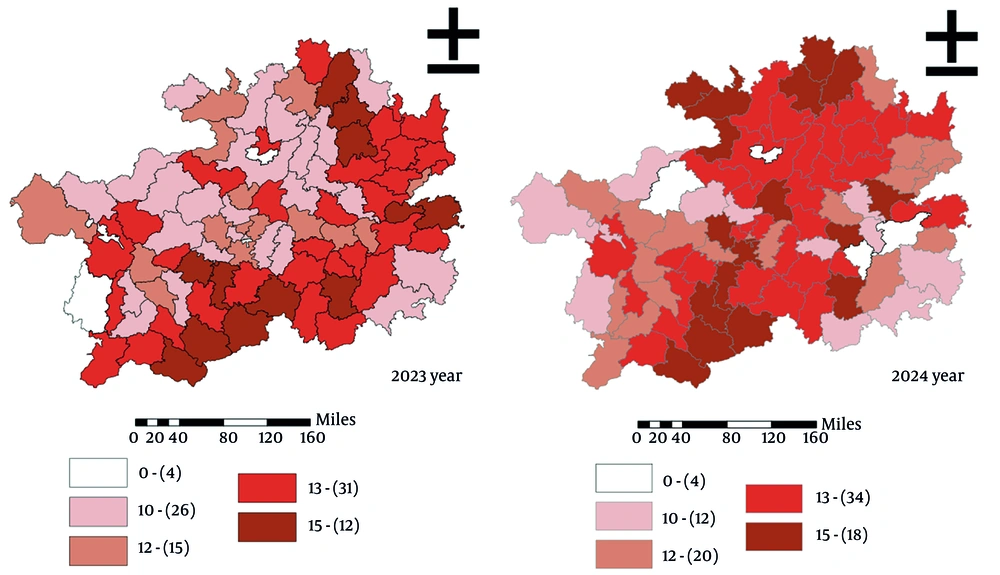
Figure 1.
Spatial distribution of high-risk human papillomavirus infection (%) in 88 counties (districts) in Guizhou province (2023 - 2024)
4.2. Global Spatial Autocorrelation Analysis
The global autocorrelation test results showed that the global value of hrHPV infection in 2023 was 0.334, with a Z-value of 5.24 and a P-value < 0.001. This difference was statistically significant, suggesting that hrHPV infection in 2023 was spatially clustered. In contrast, the global value of hrHPV infection in 2024 was 0.080, with a Z-value of 1.39 and a P-value of 0.166, indicating no spatial aggregation of hrHPV infection in 2024, and it was randomly distributed (Figure 2).
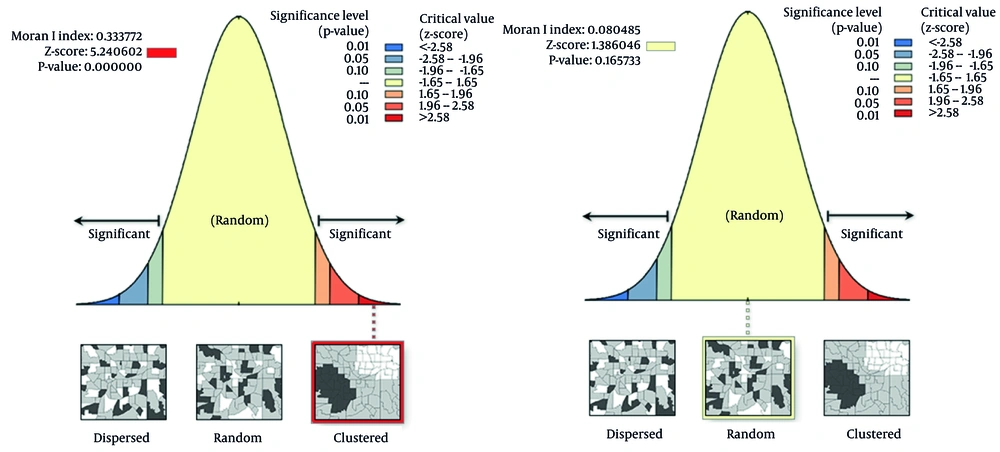
Figure 2.
Global spatial autocorrelation analysis of high-risk human papillomavirus infection rates in Guizhou province (2023 - 2024)
4.3. Local Spatial Autocorrelation Analysis
Results from the local autocorrelation test revealed two types of local spatial autocorrelation patterns in 2023, with nine counties exhibiting statistically significant patterns (P < 0.05). Among these, five counties — Ceheng and Wangmo in Qianxinan Buyi and Miao autonomous prefecture (hereinafter "Qianxinan Prefecture"), Sansui in Qiandongnan Miao and Dong autonomous prefecture (hereinafter "Qiandongnan Prefecture"), Luodian and Pingtang in Qiannan Buyi and Miao autonomous prefecture (hereinafter "Qiannan Prefecture") — formed H-H clusters, with an average infection rate of 17.54%. The L-L aggregation was observed in three counties and districts under the jurisdiction of Zunyi municipality (Honghuagang district, Meitan county, Suiyang county) and one county under the jurisdiction of Qiannan prefecture (Longli county), with an average infection rate of 10.01%.
In 2024, four types of localized spatial autocorrelation patterns (P < 0.05) were identified: The H-H aggregation, L-L aggregation, H-L aggregation, and L-H aggregation. The H-H aggregation was observed in two counties under the jurisdiction of Qianxinan prefecture (Ceheng county and Wangmo county), with an average infection rate of 17.32%. The L-L aggregation was observed in two counties under the jurisdiction of Bijie municipality (Qixingguan district and Dafang county), with an average infection rate of 10.13%. The H-L aggregation was observed in two counties under the jurisdiction of Qiandongnan prefecture (Kaili city and Zhenyuan county), with an average infection rate of 15.63%. The L-H aggregation was observed in one county under the jurisdiction of Guiyang municipality (Xiuwen county), with an average infection rate of 10.52% (Figure 3).
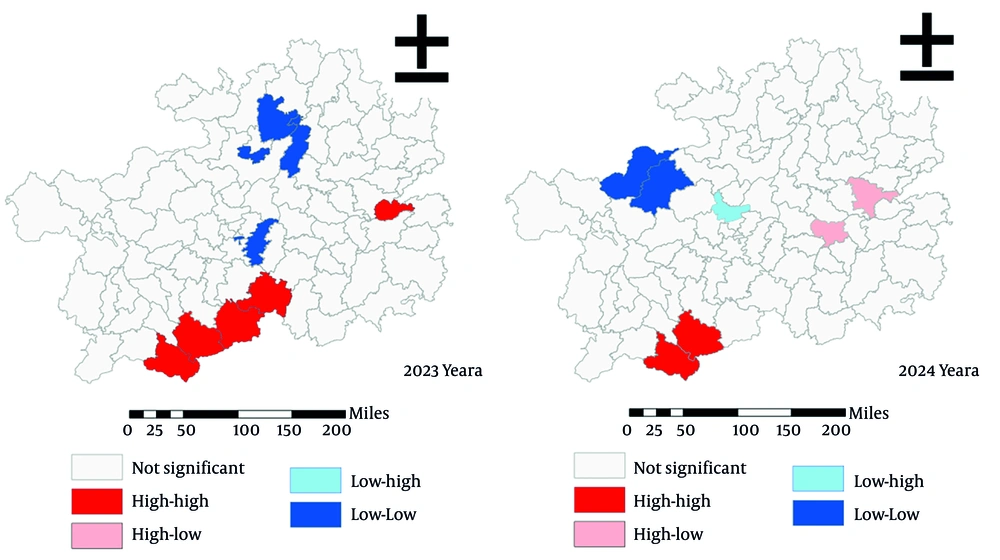
Figure 3.
Spatial distribution of clusters of high-risk human papillomavirus infection rates in Guizhou province (2023 - 2024)
4.4. Spatio-Temporal Scanning Analysis
Spatio-temporal scanning statistical analysis of hrHPV infection rates in 88 counties and districts from 2023 to 2024 was conducted on a yearly basis. The results showed that the hrHPV infection rate during this period exhibited spatiotemporal aggregation, with three spatiotemporal aggregation ranges covering 29 counties, accounting for 32.95% of the total number of incidence counties.
The largest possible aggregation range is located in the south-central region of Guizhou province, covering 11 districts and counties in 2023, with a LLR value of 198.06 and an aggregation radius of 108.20 km. The first-class aggregation region is located in the central part of Guizhou province, covering 6 districts and counties in 2024, with an LLR value of 99.13 and an aggregation radius of 29.77 km. The second-class aggregation region is located in northeastern Guizhou province, covering 12 districts and counties in 2023, with an LLR value of 95.37 and an aggregation radius of 89.70 km (Table 2 and Figure 4).
Table 2.Spatio-Temporal Scanning Analysis of High-Risk Human Papillomavirus Infection in Guizhou Province, 2023 - 2024
| Gathering Time (y) | Type of Aggregation | Aggregation Radius (km) | Position | Number of Counties (Districts) Involved | Agglomeration Area | RR-Value | LLR-Value | P-Value |
|---|---|---|---|---|---|---|---|---|
| 2023 | Primary | 108.20 | South central region | 11 | Luodian county, Wangmu county, Pintang county, Ziyun Miao and Buyei autonomous county, Huishui county, Changshun county, Dushan county, Zhenning Buyi and Miao autonomous county, Zhenfeng county, Ceheng county, Xixiu district | 1.19 | 198.06 | <0.001 |
| 2024 | Secondary | 29.77 | Central section | 6 | Guanshanhu district, Yunyan district, Baiyun district, Nanming district, Qingzhen city, Huaxi district | 1.20 | 99.13 | <0.001 |
| 2023 | Tertiary | 89.70 | North-eastern | 12 | Jiangkou county, Yinjiang Tujia and Miao autonomous county, Bijiang district, Cengong county, Yuping Dong Autonomous county, Songtao Miao autonomous county, Wanshan district, Sinan county, Shiqian county, Zhenyuan county, Sansui county, Dejiang county | 1.14 | 95.37 | <0.001 |
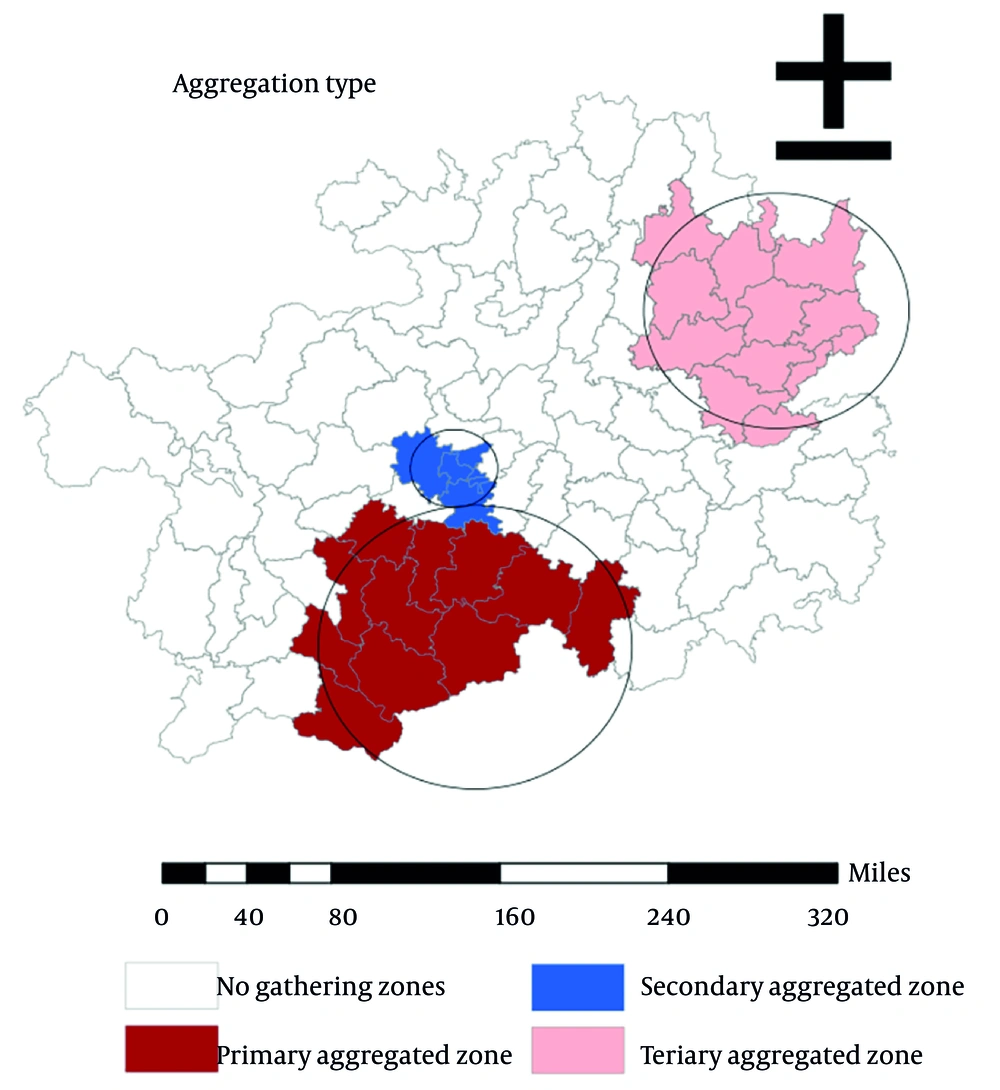
Figure 4.
Spatio-temporal scanning analysis of the number of high-risk human papillomavirus-positive detected cases in Guizhou province (2023 - 2024)
5. Discussion
The overall hrHPV infection rate in Guizhou province showed an upward trend from 2023 to 2024, with a 5.40% increase in 2024 compared to 2023. The average infection rate over these two years (13.10%) was higher than rates reported in Chengdu and Hainan province (12, 13). Current studies on hrHPV infection in China primarily focus on descriptive epidemiological analyses of its temporal, spatial, and demographic distributions, while research on spatiotemporal trends remains limited. Furthermore, province-wide distribution data on hrHPV infection in Guizhou are currently unavailable, hindering healthcare planning.
This study employs spatial analysis tools to correlate hrHPV infection rates across both spatial and temporal dimensions, enabling clear visualization of spatial distribution patterns, hotspot regions, and trends in regional interconnections. These findings hold significant implications for developing precise and effective cervical cancer prevention and control strategies tailored to different regions. Spatial autocorrelation analysis quantitatively describes and tests the geographic variation of aggregated outbreaks (10), which helps to understand the spatial distribution characteristics of hrHPV infection.
The results of global spatial autocorrelation analysis in this study showed that hrHPV infections in Guizhou province in 2023 were not randomly distributed at the county level, and there was a spatial positive autocorrelation, i.e., spatial aggregation; hrHPV infections in 2024 were not aggregated and had a discrete distribution. The results of local spatial autocorrelation showed that the high-value-high-value aggregation area was shortened from five districts and counties in 2023 to two districts and counties in 2024, of which two counties, including Ceheng and Wangmu counties, which are under the jurisdiction of Qianxinan prefecture, were the persistent high-value-high-value aggregation area for two years; moreover, in 2024, the high-value-high-value aggregation area is reduced, but Kaili city and Zhenyuan county under the jurisdiction of Qiandongnan prefecture become the new high-value-low-value aggregation area.
The above results suggest that the coverage of high-value-high-value clusters of hrHPV infections is decreasing in 2023 - 2024, but the emergence of high-value-low-value clusters is expanding, and the spread of high-incidence areas to low-influence areas should be prevented. In addition, the high-value-high-value clustering area persisted in Zuheng county and Wangmu county in Qiandongnan prefecture, which should be highly emphasized by the relevant departments. Relevant studies have shown that the hrHPV infection rate is higher among people with low literacy, early age of sexual contact, high number of abortions, high number of sexual partners, and high degree of cervical erosion. Targeted enhancement of women’s sexual health education, standardized use of condoms, and selection of appropriate HPV vaccination can effectively prevent hrHPV infection, thereby reducing the incidence of cervical cancer. It is suggested that in this study, Qiandongnan county and Wangmu county should develop targeted interventions to effectively reduce the hrHPV infection rate among women in this region.
The space-time scan statistic incorporates temporal dynamics into spatial clustering analysis, providing a dual-dimensional assessment of both time and space (14). Results from the space-time scan analysis in this study demonstrated statistically significant spatiotemporal clusters of hrHPV infections during 2023 - 2024. The primary cluster (class I) encompassed 11 counties/districts, largely overlapping with the H-H clusters identified in local spatial autocorrelation analysis, primarily located in Qianxinan, Qiandongnan, and Qiannan prefectures. These regions should be prioritized for intensified surveillance. In contrast, the secondary (class II) and tertiary (class III) clusters revealed by the space-time scan analysis did not align with high-incidence clusters detected through local spatial autocorrelation. This may be related to seasonal variations in HPV infection rates or interventions of prevention and control measures in Guizhou (15).
Relevant studies indicate that disparities in HPV infection rates are primarily attributed to geographic location, economic levels, and cultural diversity (16, 17). This study identified H-H clusters of hrHPV infection primarily in Qiandongnan, Qianxinan, and Qiannan prefectures. Compared to other regions in Guizhou, these three autonomous prefectures exhibit distinct demographic characteristics: Qiandongnan prefecture, located in southeastern Guizhou, is home to 46 ethnic groups including Miao, Dong, and Han, with ethnic minorities comprising 82.1% of its population; Qianxinan prefecture, situated in southwestern Guizhou at the junction of Yunnan, Guangxi, and Guizhou, hosts 46 ethnic groups including Han, Buyi, and Miao, with minorities accounting for 39.09% of its population; Qiannan prefecture, in south-central Guizhou, has a minority population proportion of 60.43% (18). Ethnic minority regions often face challenges such as poorer economic development, lower educational attainment, harsh working conditions, and inadequate health expenditure (19). Studies demonstrate higher HPV positivity rates among individuals with lower education levels (20), and HPV vaccination has proven effective in preventing infections (16). However, vaccination uptake is influenced by ethnicity, affordability of HPV vaccines, and awareness (21, 22).
Current initiatives, including China’s "Healthy China 2030" plan and the WHO’s "Global Strategy to Accelerate the Elimination of Cervical Cancer" (23), are advancing HPV vaccination and cervical cancer screening efforts. Therefore, future work should involve targeted policy support from Guizhou authorities for these regions, including increased funding to reduce the financial burden of HPV vaccination. Concurrently, multi-channel health education campaigns should be implemented to enhance women’s health awareness, improve understanding of HPV infections, and ultimately increase vaccination coverage. These measures would reduce HPV positivity rates and contribute to the global acceleration of cervical cancer elimination.
5.1. Limitations
The data for this study were derived from Guizhou province’s free cervical cancer screening program, which targeted women aged 35 - 64 years, excluding those under 35. This introduces potential selection bias that may affect the generalizability of the findings. However, the dataset comprehensively covers all 88 counties in Guizhou, providing an objective reflection of the current hrHPV infection status and its spatial distribution characteristics across regions. These insights offer valuable references for optimizing future screening strategies, health education priorities, and comprehensive prevention measures within Guizhou’s cervical cancer control program.

