
Dear Editor,
Dengue, an arboviral disease, is among the fastest-growing mosquito-borne illnesses worldwide, with Aedes aegypti and A. albopictus recognized as confirmed vectors (1, 2). The recent expansion of invasive Aedes species into new regions underscores the necessity for vigilant surveillance at transport hubs and other points of entry. In Iran, the national protocol for dengue vector surveillance, issued by the Ministry of Health, classifies regions into three scenarios: (1) Areas without established A. aegypti or A. albopictus but at risk of introduction; (2) areas with limited local establishment; and (3) areas with widespread establishment over more than 25 km2. A transition from scenario I to scenario II marks the first confirmed establishment of the vector in a new location and necessitates intensified surveillance and control measures.
In Iran, the dengue surveillance system employs ovitraps placed at various locations, depending on the designated scenario. An ovitrap is typically a black plastic container containing water and an attractant, with a light-colored paper affixed to the inner wall, creating an optimal oviposition site for dengue vectors. Surveillance teams may also utilize additional detection methods to closely monitor the spread of dengue vectors. This system has been implemented continuously across the country for several years and plays a crucial role in detecting invasive species
For years, concerns and warnings have been raised regarding the potential entry and establishment of dengue fever vectors in southeastern Iran (4). The first report of A. aegypti in southeastern Iran occurred on 30 August 2023 in Chabahar, Sistan and Baluchestan province. Within one year, its spread was confirmed across multiple sites in Chabahar and neighboring counties, including Konarak and Negur. Notably, the initial detection in Chabahar followed public complaints of daytime mosquito biting and nuisance, suggesting that the species may have been established for some time prior to its official confirmation (5).
Approximately 17 months later, and nearly 500 km away, A. aegypti was detected in Zahedan, the provincial capital, which is located in a desert climate markedly different from the humid coastal areas in the south. Zahedan covers an estimated 110 km2 and has a population of approximately 587,000, with the metropolitan area projected to reach about 644,000 in 2025. Unlike in Chabahar, the detections in Zahedan were not prompted by community complaints but instead were identified through the active entomological surveillance system, which systematically detected and confirmed the presence of the invasive species.
Under active surveillance for scenario I, between 50 and 100 ovitraps are deployed with appropriate spatial distribution to ensure comprehensive coverage of each entry point (e.g., airports or other sites under investigation). In scenario III, however, a greater number of ovitraps is necessary to obtain statistically reliable estimates of mosquito populations. Ovitraps are inspected every 15 days throughout the mosquito activity season. In addition to ovitrap deployment, entomology technicians may conduct indoor inspections using spray sheet collection (total catch) and/or traditional mouth aspirator (hand catch) methods.
The chronological detections of A. aegypti in Zahedan, including the life stages and GPS coordinates, are as follows:
- January 27, 2025: One adult was detected in a warehouse chamber near the runway of Zahedan International Airport (29.479180°N, 60.899585°E; Figure 1A).
- February 5, 2025: One adult was found in a booth of an under-construction airport building (29.476904°N, 60.893838°E; Figure 1B).
- May 6, 2025: One adult was collected from a water meter pit at the intercity bus terminal (29.502617°N, 60.822157°E; Figure 1C).
- May 7, 2025: Three larvae were collected from a side-road gutter at the intercity bus terminal (29.502432°N, 60.820528°E; Figure 1D).
- May 20, 2025: Three larvae were found in a discarded plastic cup near the warehouse chamber at Zahedan International Airport (29.479071°N, 60.899464°E; Figure 1E).
- June 11, 2025: One adult was detected on the external window glass of the airport waiting hall (29.475070°N, 60.900550°E; Figure 1F).
- June 17, 2025: Three larvae were collected from a side-road gutter along a boulevard near residential areas (29.471798°N, 60.875759°E; Figure 1G).
- July 14, 2025: One adult was detected at Zahedan customs (29.460533°N, 60.890053°E; Figure 1H).
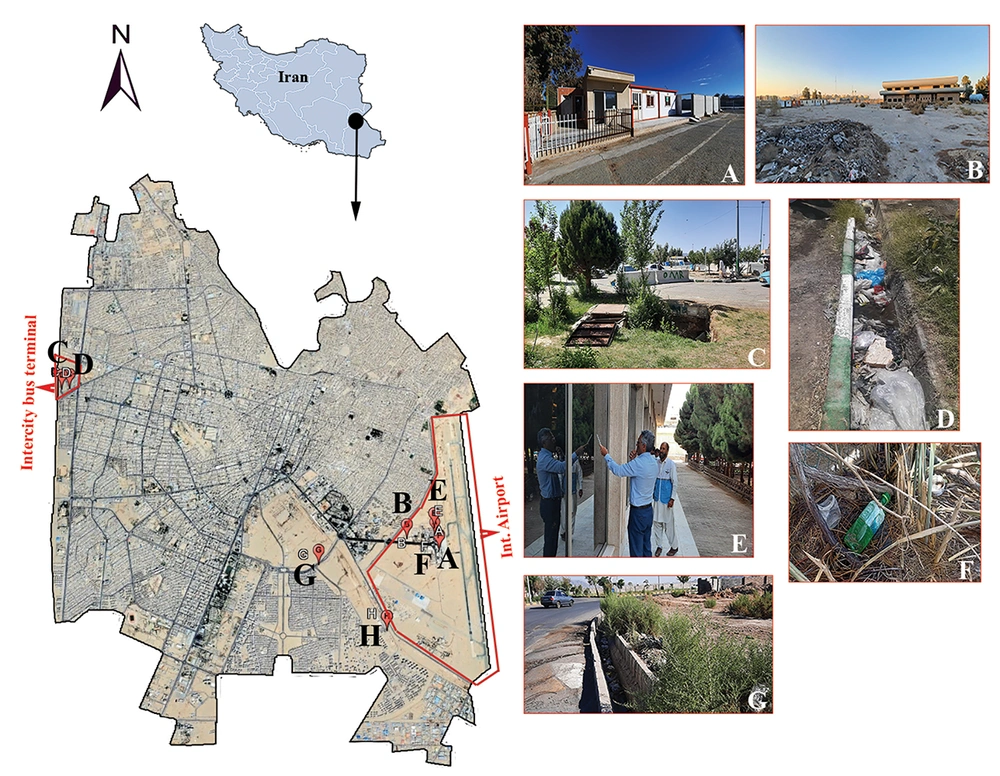
Figure 1.
Spatial distribution of invasive Aedes aegypti adults and larvae detected in Zahedan, Southeastern Iran (January - July 2025): A, warehouse chamber near the runway of Zahedan International Airport; B, booth of an under-construction airport building; C, water meter pit at the intercity bus terminal; D, side-road gutter at the intercity bus terminal; E, discarded plastic cup near the airport warehouse chamber; F, external window glass of the airport waiting hall; G, side-road gutter along a boulevard near residential areas; H, Zahedan customs.
Except for the bus terminal (approximately 8 km from the airport), all positive sites are located within approximately 2 km of the airport, and most are formal entry points (airport, intercity terminal, customs). Over these roughly 7 months, surveillance teams collected 5 adults and 8 larvae; adults were collected using spray sheet and mouth aspirator collection methods, while larvae were sampled by dipping or from small artificial containers. All collected specimens were identified based on morphological characteristics and valid identification keys using a microscope or stereomicroscope. Final confirmation of the samples was carried out by the scientific focal point of the dengue vector control program in the southeast of the country at the Health Promotion Research Center, Zahedan University of Medical Sciences. The spatial clustering near transport nodes and the recovery of immature stages indicate not only repeated introductions but also early local establishment and limited spread of this invasive vector within the city.
From a public health and policy perspective, these findings represent a paradigm shift for southeastern Iran. Until recently, Zahedan was classified as scenario I; however, with the confirmed presence of A. aegypti, it must now be reclassified as scenario II, necessitating urgent adaptation of surveillance and control strategies. This transition is particularly concerning given the documented dengue seropositivity in the province and the high level of cross-border human movement with Pakistan.
Recommended priorities include: (1) Intensified environmental management and larval source reduction at entry points; (2) targeted indoor residual spraying and focal larviciding where appropriate; (3) expansion of year-round entomological monitoring, including ovitrap networks radiating from gateways; (4) enhanced cross-sector coordination among health authorities, airport and customs officials, and municipal services; and (5) community engagement campaigns addressing daytime biting and container management. Notably, the first detections in Zahedan occurred during winter, when many ovitraps were frozen, highlighting A. aegypti’s capacity to persist and reproduce under suboptimal semi-arid conditions. This seasonal persistence has operational implications: Surveillance limited to warm months may overlook early establishment windows (4, 6).
In conclusion, the recent emergence of A. aegypti in Zahedan marks the first report of invasive dengue vector establishment in this inland city and signifies a shift from scenario I to scenario II. This development should serve as an urgent call for strengthening surveillance, preparedness, and vector control measures in southeastern Iran. Proactive interventions may prevent widespread establishment and reduce the risk of dengue outbreaks, which would otherwise impose a heavy burden on a region already struggling with malaria control. Given the reported presence of this species during the winter months, both surveillance and interventions should not be confined to the warmer seasons but instead be conducted year-round.