
1. Background
Multiple sclerosis (MS) is an inflammatory disease in which myelinated axons in the central nervous system (CNS) are damaged (1), leading to neurological disability. It is more common among adults aged 20 - 40 years (2). Multiple sclerosis is a global health problem, and the number of patients with MS increased to 2.8 million in 2020 (3). Epidemiological studies have shown that the number of patients with MS has also increased in Iran over the past two decades (4). The prevalence of MS in Kerman, Iran, was 57.3 per 100,000 people in 2011 (5).
Studies have shown that air pollutants may affect the CNS and lead to hospital admissions for neurological diseases (6-8). Although the main etiology of MS has not yet been identified (9), several environmental risk factors for MS have been reported, including seasonal changes, weather conditions, and air pollutants (10-12). Other studies have suggested that MS relapse varies by season (13); for example, in Kerman, Iran, most cases occur in winter and spring (14).
Oikonen et al. reported an association between MS and particulate matter in Finland (15). In a systematic review, the authors concluded that air pollutants such as NO2 and PM may be associated with MS (4). In addition, Heydarpour et al. showed that exposure to SO2, PM10, NO2, and NOx might be related to MS relapses in Tehran (12).
Despite these findings, evidence regarding the effects of air pollution on CNS diseases such as MS remains limited. Kerman is a city in southeastern Iran with both air pollution and variable rates of MS incidence (14).
2. Objectives
This study aimed to determine whether short-term associations exist between air pollutants (CO, O3, NO2, SO2, PM10, and PM2.5) and hospital admissions for MS in Kerman, Iran.
3. Methods
3.1. Study Design and Setting
This ecological study was conducted in Kerman, Iran. Hourly ambient city-wide air pollutant measurements for CO, O3, NO2, SO2, PM10, and PM2.5 in Kerman were obtained from the Kerman Environmental Protection Agency from September 2008 to March 2020. Daily averages were calculated from the hourly data. In Kerman, air pollution is monitored by a single station located at Shohada Square. Measurements were performed using standard monitoring instruments in accordance with relevant guidelines. In this study, when hourly data were unavailable, missing values were imputed using the expectation-maximization (EM) algorithm.
Meteorological variables, including daily temperature and relative humidity, were obtained from the Kerman Meteorology Organization.
3.2. Multiple Sclerosis Hospitalization Data
Multiple sclerosis incidence and relapse data, as daily counts, were obtained from Kerman's Shafa Hospital MS Registry under ICD-10 code G35. Shafa Hospital is the main referral center for neurological patients in Kerman, and the MS data center is located at this hospital.
Incidence data were obtained anonymously by sex and age group. Most MS hospitalizations were due to MS attacks, relapse, or complications; however, the exact reason for admission was not recorded.
3.3. Statistical Analysis
Generalized additive models (GAMs), as shown in the equations below, were used to estimate the RRs of air pollutants and MS hospitalization for a 1-unit increase in CO and a 10-unit increase in all other pollutants. The models were adjusted for temperature, relative humidity, seasonality, weekdays, and long-term trends, with lags of up to 7 days. This study evaluated only short-term effects; therefore, effects only up to 7 days were examined. The time unit was day. Analyses were performed using R 4.5.2 software.
In this model, Yt denotes the daily number of MS hospitalizations in the total population and by sex and age group. βi is the coefficient for air pollutants and denotes the log of the RR, and Sj (Xj) represents the smoothing functions of meteorological variables, including temperature and relative humidity.
4. Results
During the 12-year study period, 4,913 hospitalizations for MS were recorded at Shafa Medical Center, of which 3,739 (76%) were in females and 1,174 (26%) were in males. Most admissions (59%) occurred in the 30 - 50-year age group. MS hospitalization counts are presented in Table 1. Table 2 shows the mean±standard deviation of air pollutants in Kerman, during the years under study.
Table 1.
Counts of Multiple Sclerosis Hospitalization From 2008 to 2020 in Different Population Subgroups
| Variables | 2008 | 2009 | 2010 | 2011 | 2012 | 2013 | 2014 | 2015 | 2016 | 2017 | 2018 | 2019 | 2020 | Total |
|---|---|---|---|---|---|---|---|---|---|---|---|---|---|---|
| Female | 36 | 178 | 199 | 234 | 201 | 197 | 269 | 333 | 370 | 452 | 497 | 671 | 102 | 3739 |
| Male | 14 | 62 | 67 | 57 | 58 | 76 | 87 | 121 | 128 | 143 | 152 | 180 | 29 | 1174 |
| < 30 years | 22 | 105 | 102 | 92 | 95 | 97 | 127 | 163 | 166 | 198 | 189 | 256 | 55 | 1667 |
| 30 - 50 years | 23 | 123 | 149 | 183 | 152 | 164 | 211 | 274 | 302 | 347 | 391 | 508 | 62 | 2889 |
| > 50 years | 5 | 12 | 15 | 16 | 12 | 12 | 18 | 17 | 30 | 50 | 69 | 87 | 14 | 357 |
| Sex Ratio (F/M) | 2.57 | 2.87 | 2.97 | 4.10 | 3.46 | 2.59 | 3.09 | 2.75 | 2.89 | 3.16 | 3.26 | 3.72 | 3.51 | 3.18 |
Table 2.
| Variables | O3 (ppb) | CO (ppm) | NO2 (ppb) | SO2 (ppb) | PM10 (μg/m3) | PM2.5 (μg/m3) |
|---|---|---|---|---|---|---|
| 2009 | 20.03 ± 1.06 | 0.91 ± 0.36 | 18.79 ± 4.57 | 8.03 ± 3.58 | 130.10 ± 41.57 | 42.82 ± 18.88 |
| 2010 | 26.47 ± 17.18 | 1.03 ± 0.54 | 20.81 ± 9.21 | 9.98 ± 6.37 | 118.32 ± 51.29 | 45.25 ± 26.88 |
| 2011 | 29.99 ± 6.61 | 0.94 ± 0.43 | 16.24 ± 4.49 | 12.87 ± 4.22 | 101.63 ± 26.56 | 26.24 ± 9.77 |
| 2012 | 34.42 ± 13.53 | 0.78 ± 0.38 | 12.68 ± 4.84 | 7.93 ± 5.14 | 67.32 ± 40.33 | 20.53 ± 15.61 |
| 2013 | 33.66 ± 11.89 | 0.92 ± 0.39 | 12.77 ± 5.10 | 16.73 ± 9.01 | 67.4 ± 24.21 | 25.35 ± 12.70 |
| 2014 | 30.51 ± 7.35 | 1.13 ± 0.38 | 15.35 ± 2.99 | 25.04 ± 6.19 | 68.94 ± 17.55 | 24.34 ± 8.32 |
| 2015 | 32.83 ± 11.94 | 0.91 ± 0.56 | 7.62 ± 6.89 | 24.21 ± 10.33 | 60.88 ± 29.37 | 28.21 ± 13.52 |
| 2016 | 30.08 ± 11.49 | 0.97 ± 0.52 | 16.56 ± 14.24 | 52.04 ± 22.80 | 66.92 ± 43.60 | 24.62 ± 10.65 |
| 2017 | 32.67 ± 11.22 | 1.02 ± 0.49 | 23.01 ± 7.56 | 49.99 ± 19.96 | 48.85 ± 21.03 | 21.52 ± 9.38 |
| 2018 | 30.72 ± 11.84 | 1.48 ± 1.39 | 14.75 ± 6.39 | 35.43 ± 18.13 | 26.45 ± 21.03 | 23.37 ± 11.72 |
| 2019 | 33.66 ± 8.36 | 1.62 ± 0.78 | 14.93 ± 4.07 | 46.66 ± 11.62 | 27.44 ± 24.64 | 22.20 ± 9.45 |
a Values are expressed as mean ± SD.
b Data was not available for all months of 2008 and 2020 and thus these years were not listed in the table.
Descriptive statistics for the air pollutants and meteorological variables are presented in Table 3. Correlations among air pollutants in Kerman are shown in Table 4. Many air pollutants were significantly correlated; therefore, only single-pollutant models were constructed.
Table 3.
Descriptive Statistics of Daily Air Pollution and Meteorological Variables in Kerman (2008 - 2020)
| Mean | SD | Min | Median | 25th Percentile | 75th percentile | 98th percentile | Max | |
|---|---|---|---|---|---|---|---|---|
| O3 (ppb) | 30.21 | 11.91 | 1.92 | 29.72 | 22.24 | 37.42 | 58.70 | 79 |
| CO (ppm) | 1.07 | 0.69 | 0.03 | 0.92 | 0.66 | 1.34 | 2.54 | 12.27 |
| NO2 (ppb) | 15.82 | 7.96 | 0 | 15.41 | 11.71 | 19.29 | 36.69 | 78.45 |
| SO2 (ppb) | 26.12 | 20.64 | 0 | 21 | 9.12 | 41.64 | 82.76 | 128.46 |
| PM10 (μg/m3) | 71.11 | 47.45 | 0 | 63.48 | 36.71 | 97.94 | 194.61 | 382.76 |
| PM2.5 (μg/m3) | 27.47 | 16.18 | 0 | 24.20 | 17.57 | 32.91 | 78.55 | 112 |
| Temperature(°C) | 16.75 | 8.10 | -12.1 | 17.2 | 9.7 | 23.80 | 30.20 | 41 |
| Humidity (%) | 31.15 | 17.30 | 1 | 27 | 18 | 41 | 75 | 100 |
Table 4.
Spearman Correlation Coefficients Between Air Pollutants in Kerman (2008 - 2020)
| CO | NO2 | SO2 | PM10 | PM2.5 | ||
|---|---|---|---|---|---|---|
| O3 | 1 | |||||
| CO | -0.548 a | 1 | ||||
| NO2 | -0.454 a | 0.399 a | 1 | |||
| SO2 | 0.205 a | 0.233 a | 0.181 | 1 | ||
| PM10 | -0.107 a | -0.231 a | 0.158 a | -0.399 a | 1 | |
| PM2.5 | -0.1 a | -0.079 a | 0.051 a | -0.141 a | 0.486 a | 1 |
a P < 0.001.
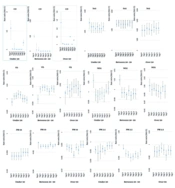
Table S1 in the supplementary file and Figure 1 present the GAM results for evaluating the impact of air pollutants on MS hospitalizations.
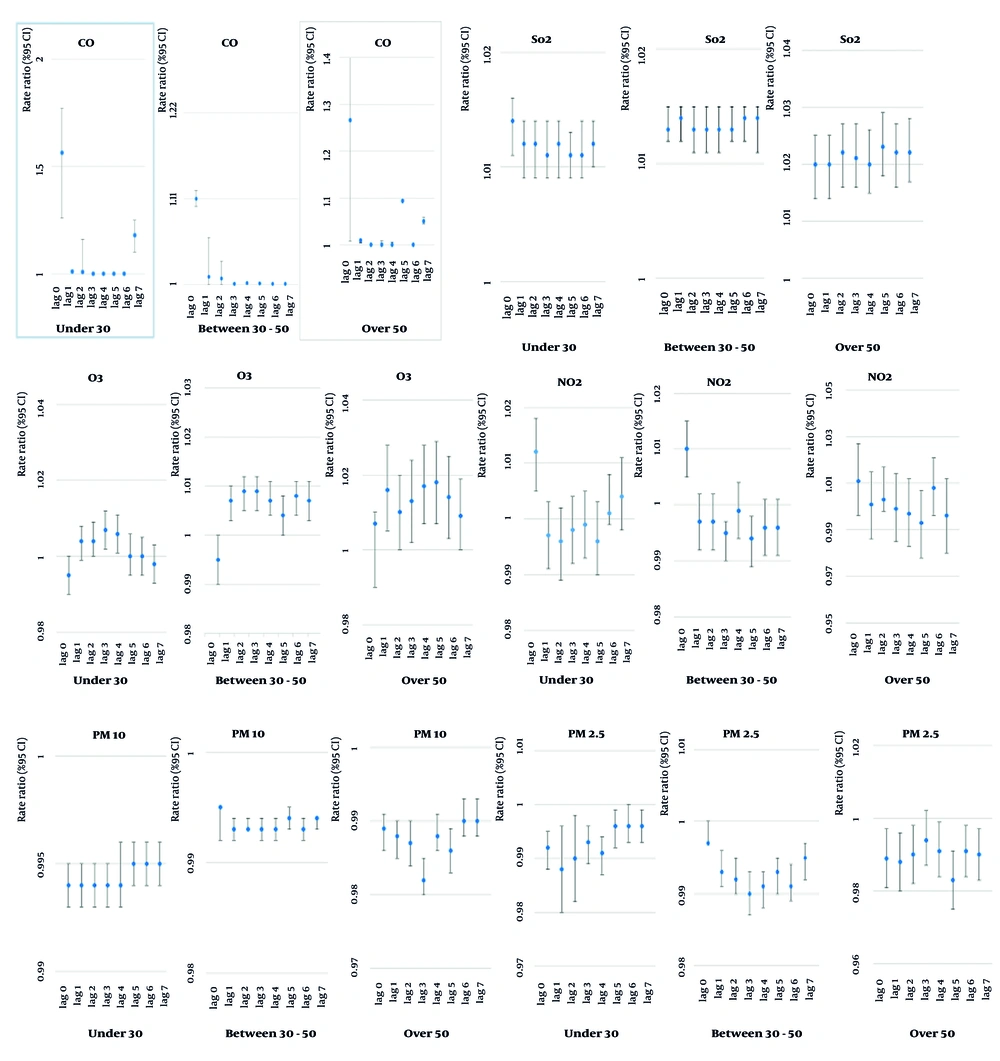
Figure 1.
Association between air pollutants (CO, O3, NO2, SO2, PM10, PM2.5) and multiple sclerosis hospitalization in age groups with up to 7-day lags in Kerman, Iran, September 2008 - March 2020.
Carbon monoxide, O3, and SO2 were directly associated with MS hospitalizations at certain lags in males. Significant associations were observed at lag 1 for CO (RR = 1.0113, 95% CI: 1.0099 - 1.0123), lag 3 for O3 (RR = 1.0110, 95% CI: 1.0051 - 1.0171), and lag 5 for SO2 (RR = 1.0135, 95% CI: 1.0106 - 1.0163).
Carbon monoxide, O3, SO2, and NO2 were also directly associated with MS hospitalization rates at certain lags in females. Associations were observed at lag 0 for CO (RR = 1.4784, 95% CI: 1.1884 - 1.8401), lag 3 for O3 (RR = 1.0101, 95% CI: 1.0061 - 1.0122), lag 1 for SO2 (RR = 1.0135, 95% CI: 1.0124 - 1.0160), and lag 0 for NO2 (RR = 1.0121, 95% CI: 1.0050 - 1.7080).
Across many age groups, CO, O3, and SO2 showed direct associations with MS hospitalizations. The strongest association was observed in individuals aged < 30 years at lag 0 for CO (RR = 1.5647, 95% CI: 1.2610 - 1.3711).
Among all pollutants listed in Table S1 in the supplementary file, CO and SO2 were more consistently associated with increased MS hospitalizations than the other pollutants.
In this study, PM10 and PM2.5 were inversely associated with MS hospitalizations in several subgroups. The strongest significant associations were observed for PM10 in individuals aged > 50 years at lag 3 (RR = 0.9828) and for PM2.5 in individuals aged > 50 years at lag 5 (RR = 0.9832).
5. Discussion
Few studies worldwide have examined the relation between air pollution and MS (15-21). In this study, significant associations were observed between short-term exposure to some air pollutants and MS hospitalization in Kerman, Iran. Watad et al. also suggested that MS recurrence may be associated with environmental factors such as climate variables and air pollution (22).
In this study, increased CO was associated with a higher number of MS hospitalizations across different subgroups. A case-control study in the United States also reported a significant relation between ambient CO and MS in children (OR = 3.85, 95% CI: 1.34 - 11.1) (20). However, in Tehran, Iran, CO was not related to MS recurrence, which may have been due to the short study period (2011 - 2012) and small sample size (21).
In this study, O3 was significantly associated with MS hospitalizations across many subgroups and lags. Consistent with these findings, Jeanjean et al. showed that O3 was related to MS relapse during the hot season in France after adjustment for meteorological variables (OR = 1.16, 95% CI: 1.07 - 1.25) (19). However, these results differ from a study conducted in Tehran, which found no significant relation between O3 and MS attacks (21). One possible reason is that, in the current study, the average concentration of O3 was 30.21 ± 11.91 ppb, which was higher than that reported in the Tehran study (25.79 ± 16.11 ppb) (21). Meanwhile, ozone levels in the hot season in France were even higher than those in Kerman (86.85 ± 30.89 ppb), which might explain the association observed between O3 and MS in the French study (19). However, in a study conducted in Spain with O3 levels similar to those in Kerman (35.7 ± 18.11 ppb), no association was found between O3 and MS admissions (17).
In this study, significant associations between SO2 and MS hospitalizations were observed in many subgroups. Other researchers have also reported relations between sulfur dioxide and MS (12, 15, 20). In Tehran, Iran, researchers observed that MS cases were more exposed to SO2 than controls (12). Lavery et al. also showed that SO2 was associated with increased pediatric MS recurrence in the United States (OR = 3.14, 95% CI: 1.13 - 8.72) (20). In this study, the average concentration of SO2 was 26.12 ± 20.64 ppb, which is higher than the WHO-recommended level (23), but lower than the level reported in the Tehran study (58 ppb), which also found a significant association (12).
In the current study, NO2 was significantly related to MS hospitalizations in several subgroups. Similarly, other studies have reported that nitrogen dioxide may be related to the recurrence of MS attacks (12, 15, 16, 19, 21). A systematic review conducted by Farahmandfard et al. (4) also concluded that NO2 and NOx may be related to MS prevalence or relapse. In France, increased NO2 after a 0 - 3-day lag was related to MS relapse in winter (OR = 1.08, 95% CI: 1.03 - 1.14) (19), and in Tehran, NO2 was related to MS relapse (r = 0.27) (21). However, Gregory et al. did not find a significant relation between NO2 and MS relapse in the United States (18). In Spain, Carmona et al. also showed no association between traffic-related air pollutants, including nitrogen oxides, and MS hospitalizations (17).
In this study, PM10 and PM2.5 were inversely related to MS hospitalizations in all subgroups. This finding may have several explanations. Similar counterintuitive findings have been reported in studies conducted in regions with substantial dust storms or non-combustion particulate sources (19, 24, 25). In cities such as Kerman, the chemical composition of particulate matter in arid environments is often dominated by crustal or mineral dust rather than traffic- or industry-related particles, and these components may have different inflammatory potentials. In addition, extreme dust events can lead to substantial changes in population mobility, school and workplace closures, or altered health-care-seeking behavior at the population level, none of which can be fully accounted for in ecological models. However, other studies have shown relation between PM10 and MS (12, 15, 16, 18, 19, 24-26). In Finland, increased PM10 concentrations after a 1-month lag increased the risk of MS relapse (OR = 4.14, 95% CI: 1.61 - 10.63) (15). In the study by Gregory et al., PM10 was directly related to MS prevalence rates in the total population in the United States (β = 0.276) (18). In Italy, MS relapse was directly related to PM10 exposure in two studies (24, 25). Roux et al. showed a significant direct association between PM10 and the risk of MS relapse after a 1 - 3-day lag in the cold season in Strasbourg, France (OR = 1.40, 95% CI: 1.08 - 1.81) (26). In Jeanjean et al.'s study, PM10 after a 0 - 3-day lag was associated with increased MS relapse in winter in Paris, France (OR = 1.06, 95% CI: 1.01 - 1.11) (19). However, other studies found no association (17, 27).
In this study, the average concentration of PM10 was 71.11 ± 47.45 μg/m3, which was higher than the levels measured in Italy (42.48 ± 28.6 μg/m3) (24) and France (23.70 ± 12.69 μg/m3) (19), but lower than the level measured in Tehran, Iran (99.1 μg/m3) (12). Therefore, it is not reasonable to attribute these conflicting results to ambient dust concentrations alone.
One study showed that PM2.5 was associated with increased recurrence of MS among children in the United States (OR = 3.96, 95% CI: 1.42 - 11.1) (20), and another study observed that MS prevalence was directly related to PM2.5 exposure in Italy (28). However, in Canada, PM2.5 exposure did not increase the risk of MS (HR = 0.96, 95% CI: 0.86 - 1.07) (29). In Italy, people with lower PM2.5 exposure were less likely to develop MS (30).
Some studies have reported that patients with MS have lower vitamin D levels during relapses. This may be related to the role of vitamin D in immune system balance (31, 32). Sunlight exposure can increase vitamin D production in the human body, but air pollutants reduce exposure to ultraviolet radiation and decrease vitamin D production (33, 34). Nevertheless, vitamin D is discussed here only to suggest a biological rationale, as air pollution has been shown to reduce solar radiation and may affect vitamin D synthesis. This might help explain how industrialization, urbanization, and lifestyle changes are related to MS (35-37).
5.1. Study Limitations
Important limitations of this study include the use of aggregated data and the possibility that hospital admissions may not reflect all MS relapses. Diagnostic variability and changes in health-care access may also have occurred during the 12-year period. Because of multicollinearity concerns, single-pollutant models were used; however, pollutant effects may have been confounded by other pollutants. In addition, not all meteorological factors were adjusted for in the analysis. Another limitation is that only short-term effects, with lags of up to 7 days, were evaluated.
Many studies have examined associations between ambient pollutants, environmental risk factors, and health outcomes (38-42), but these studies cannot demonstrate causation. More research is needed to draw causal inferences.
There are limited studies on the effects of air pollutants on MS. This study was innovative because it included approximately 12 years of air pollution and MS hospital admission data and used GAMs to adjust for nonlinear confounder variables.
5.2. Conclusions
Ambient O3, NO2, and, more consistently, CO and SO2 were associated with increased MS hospitalization in Kerman. However, potential confounders, the aggregated nature of the data, collinearity between pollutants, and the limited generalizability of the results should be considered. This evidence emphasizes the need to control and reduce air pollutants.