
1. Background
Food safety is a major concern in modern societies, particularly in the context of population growth and limited natural resources (1). Honey is among the most valuable natural foods and has long been recognized for its nutritional and medicinal benefits (2). Honey is produced by bees from floral nectar through enzymatic transformation and concentration. Its chemical composition is dominated by carbohydrates, including glucose, fructose, and sucrose, as well as water and minor constituents (3, 4). Owing to its pleasant taste, high nutritional value, and numerous therapeutic properties, honey is widely consumed as a natural health-promoting food (4, 5).
The composition of honey can vary markedly depending on its botanical origin, climatic conditions, geographical location, environmental characteristics, and beekeeping practices (6). Because honey reflects the quality of the environment in which it is produced, it is considered a useful bioindicator for monitoring contamination (7). However, honey may be contaminated by several environmental pollutants, including pesticides, radionuclides, and heavy metals such as cadmium, lead, chromium, arsenic, mercury, tin, and nickel. Heavy metals are of particular concern because of their toxicity and tendency to bioaccumulate in food chains, creating serious public health risks (8, 9). Metal compounds, including metal-based nanomaterials, have also been shown to exert dose-dependent cytotoxic effects relevant to food safety (10). Lead, cadmium, and tin may enter honey through contaminated soil, water, and air, as well as during processing and storage (11). Important anthropogenic sources include emissions from fuel combustion; the use of fertilizers containing cadmium and mercury; arsenic-containing pesticides; metallurgical industries; and mining activities (8). Elevated lead exposure can impair hemoglobin synthesis and cause anemia, hypertension, and kidney damage, whereas prolonged exposure to tin may lead to anemia, growth retardation, and impaired liver function (12). Furthermore, studies in animal models have confirmed that lead exposure causes hepatotoxic and cardiovascular effects and that natural chelators can mitigate lead-induced organ damage (13, 14).
In general, exposure to heavy metals may result in a wide range of adverse health effects, including neurological disorders, various cancers, respiratory and cardiovascular diseases, liver, kidney, and brain damage, endocrine disruption, immune suppression, nutritional and metabolic disorders, and, in severe cases, death (15). The presence of heavy metals in honey, arising from both environmental pollution and handling practices, has been investigated in numerous studies (3, 16, 17). Other studies have further emphasized the influence of regional environmental conditions on honey composition (4, 18, 19). Geological factors can also be decisive (9, 12, 15).
Sistan and Baluchistan is the largest province in Iran and is located in the southeast of the country, bordering Afghanistan and Pakistan. The province encompasses a range of environmental conditions, from the arid, dust-prone Sistan basin in the north to the relatively humid coastal areas near Chabahar in the south. The region includes both industrial and non-industrial zones. Zahedan, the provincial capital, and Zabol in the north experience considerable anthropogenic pressure from traffic emissions and the 120-Day Winds (Levar), which carry dust from the dried Hamoun Lake bed. In contrast, the central and southern cities of Khash, Iranshahr, Saravan, Sarbaz, Nikshahr, and Chabahar are predominantly agricultural and semi-industrial.
2. Objectives
Although honey quality has been investigated in various regions of Iran, comprehensive data on heavy metal concentrations in honey produced in Sistan and Baluchistan Province remain limited. Given the importance of food safety and the potential risks associated with heavy metal exposure, this study evaluated Pb, Cd, and Sn levels in honey samples collected from three distinct regions of this southeastern province. Using GF-AAS, the study aimed to assess the safety of regional honey for human consumption, identify potential environmental drivers of contamination, and provide baseline data to support the development of regulatory standards.
3. Methods
3.1. Reagents and Chemicals
All reagents used in this study were of analytical grade. Hydrochloric acid (37%, HCl), nitric acid (65%, HNO_3), and ammonium dihydrogen phosphate (NH_4H_2PO_4) were purchased from Merck (Darmstadt, Germany). Deionized water with a resistivity of 18.2 MΩ·cm, obtained from a Milli-Q purification system (Millipore, USA), was used for all dilutions and for rinsing glassware. Stock standard solutions of Pb, Cd, and Sn at 1000 mg L-1 were prepared from Merck Titrisol ampoules. All glassware and polyethylene storage bottles were soaked overnight in 10% (v/v) HNO_3, thoroughly rinsed with deionized water, and dried before use.
3.2. Study Area and Sample Collection
A total of 33 honey samples were collected from beekeepers operating in three geographical regions of Sistan and Baluchistan Province, southeastern Iran: Region 1 (North), Zahedan and Zabol, which are predominantly urban/industrial areas with high traffic density and dust storm activity; Region 2 (Center), Khash, Iranshahr, and Saravan, which are semi-industrial and agricultural areas; and Region 3 (South), Sarbaz, Nikshahr, and Chabahar, which are coastal/rural and non-industrial areas. Samples were collected directly from beekeepers using sterile polyethylene containers (100 mL), labeled, sealed, and transported to the laboratory in a cooler at 4°C. All samples were stored at room temperature in the dark until analysis. Sampling was conducted after informed consent was obtained from the beekeepers and in accordance with the General Guide for Ethics in Biomedical Research Involving Human Subjects in the Islamic Republic of Iran cod no: Nine.
3.3. Sample Preparation
A total of 10 g of each honey sample was accurately weighed into quartz crucibles that had been previously soaked in 5% (v/v) hydrochloric acid for 24 hours and rinsed with deionized water. A few drops of olive oil were added as an antifoaming agent, and the crucibles were heated gradually on a hot plate until complete carbonization was achieved. The carbonized samples were then ashed in a muffle furnace at 550°C for 24 hours. After cooling, the residue was dissolved in 10 mL of 2 M hydrochloric acid, quantitatively transferred to a 50 mL volumetric flask, and brought to volume with deionized water. The solution was filtered through a 0.45 μm membrane filter before analysis.
3.4. Instrumentation and Analytical Conditions
Pb, Cd, and Sn were determined using a PerkinElmer AAnalyst 700 atomic absorption spectrometer equipped with a transversely heated graphite furnace and an AS900 autosampler. Argon (99.999%) was used as the purge gas. The temperature program consisted of a drying step at 90 - 150°C for 50 seconds, followed by pyrolysis at 500°C for Pb, 400°C for Cd, and 700°C for Sn. Atomization was performed at 1500°C for Pb, 900°C for Cd, and 2400°C for Sn under gas-stop conditions. The limits of detection (LOD) and quantification (LOQ) were calculated as 3σ and 10σ of the blank signal, respectively.
3.5. Ethical Approval
This study was approved by the Ethics Committee of Zahedan University of Medical Sciences under the ethical code IR.ZAUMS.REC.1399.109. All beekeeping collaborators provided informed consent before sample collection.
3.6. Regulatory Standards for Permissible Heavy Metal Levels
To evaluate the safety of the analyzed honey samples, the measured Pb, Cd, and Sn concentrations were compared with the maximum permissible limits established by national and international regulatory standards. At the national level, the Institute of Standards and Industrial Research of Iran (ISIRI 12968) specifies maximum permissible limits of 200 ppb for Pb and 250,000 ppb for Sn in honey (20). At the international level, European Union Commission Regulation (EU) 2023/915 establishes maximum levels of 100 ppb for Pb and 50 ppb for Cd in honey; no specific Sn limit is currently defined under this regulation (21). These national and international thresholds served as reference benchmarks for evaluating honey safety in the present study.
4. Results
A total of 33 honey samples from three geographical regions of Sistan and Baluchistan Province were analyzed for Pb, Cd, and Sn by GF-AAS after dry-ashing sample preparation. The analytical performance of the method is summarized in Table 1. The calibration curves showed excellent linearity (R2 ≥ 0.9987) for all three metals across the working concentration ranges (Pb: 5 - 80 μg L-1; Cd: 1 - 50 μg L-1; Sn: 10 - 100 μg L-1). Repeatability (RSD%, n = 6) was ≤ 4.1% for all analytes, and recoveries ranged from 94% to 106%, confirming the suitability of the method.
Table 1.
Analytical Figures of Merit for the Determination of Pb, Cd, and Sn by GF-AAS
| Parameters | Pb | Cd | Sn |
|---|---|---|---|
| Wavelength (nm) | 283.3 | 228.8 | 286.3 |
| Linear range (ppb) | 5 - 80 | 1 - 50 | 10 - 100 |
| Correlation coefficient (R2) | 0.9991 | 0.9995 | 0.9987 |
| LOD (ppb) | 0.8 | 0.2 | 2.5 |
| LOQ (ppb) | 2.6 | 0.7 | 8.3 |
| Repeatability (RSD%, n = 6) | 3.2 | 2.8 | 4.1 |
| Recovery (%) | 96 - 104 | 95 - 103 | 94 - 106 |
| Parameters | Pb | Cd | Sn |
| Wavelength (nm) | 283.3 | 228.8 | 286.3 |
| Linear range (ppb) | 5 - 80 | 1 - 50 | 10 - 100 |
Table 2 presents the concentrations of Pb, Cd, and Sn in all analyzed honey samples, categorized by region. Lead was the most prevalent contaminant and was detected in all 33 honey samples (100%). Tin was detected in 32 of 33 samples (97%); the single non-detect was sample 33 (Region 2), which showed no measurable Sn (see the footnote in Table 2). Cadmium had the lowest detection frequency and was quantifiable in only 16 of 33 samples (48.5%), with the remaining 17 samples (51.5%) below the LOD of 0.2 μg L-1.
Table 2.
Concentrations of Pb, Cd, and Sn (Ppb) in Honey Samples from Three Regions of Sistan and Baluchistan a
| No. | Region | Pb | Cd | Sn |
|---|---|---|---|---|
| 1 | 1 | 21.03 | 0.21 | 24.90 |
| 2 | 2 | 8.77 | nd | 23.26 |
| 3 | 3 | 7.74 | 0.02 | 25.16 |
| 4 | 3 | 11.69 | 0.16 | 32.11 |
| 5 | 2 | 10.30 | nd | 56.10 |
| 6 | 1 | 17.44 | 0.28 | 21.65 |
| 7 | 2 | 5.25 | nd | 22.15 |
| 8 | 1 | 7.82 | nd | 23.22 |
| 9 | 3 | 13.96 | 0.34 | 35.11 |
| 10 | 2 | 8.22 | nd | 32.14 |
| 11 | 1 | 28.13 | 0.25 | 28.76 |
| 12 | 2 | 9.68 | nd | 23.86 |
| 13 | 2 | 6.73 | 0.02 | 25.85 |
| 14 | 3 | 13.60 | 0.26 | 32.41 |
| 15 | 1 | 11.42 | nd | 56.71 |
| 16 | 3 | 19.24 | 0.32 | 21.63 |
| 17 | 2 | 4.36 | nd | 22.11 |
| 18 | 1 | 6.25 | nd | 23.92 |
| 19 | 3 | 14.65 | 0.29 | 35.71 |
| 20 | 2 | 9.21 | nd | 32.16 |
| 21 | 1 | 22.16 | 0.23 | 66.10 |
| 22 | 1 | 6.18 | nd | 71.65 |
| 23 | 3 | 5.79 | nd | 52.15 |
| 24 | 1 | 15.54 | 0.14 | 24.22 |
| 25 | 3 | 13.44 | nd | 34.11 |
| 26 | 1 | 17.22 | 0.15 | 30.15 |
| 27 | 2 | 5.38 | nd | 25.76 |
| 28 | 1 | 8.22 | 0.09 | 24.83 |
| 29 | 1 | 15.12 | 0.16 | 22.19 |
| 30 | 3 | 7.25 | nd | 34.41 |
| 31 | 2 | 11.34 | 0.22 | 36.17 |
| 32 | 3 | 12.48 | nd | 24.46 |
| 33 | 2 | 10.26 | nd | nd* |
a Region 1 = North (Zahedan, Zabol); Region 2 = Center (Khash, Iranshahr, Saravan); Region 3 = South (Sarbaz, Nikshahr, Chabahar). Sample 33 showed no detectable levels for Pb, Cd, or Sn. The statement that “Sn was detected in 32 of 33 samples” is therefore consistent with the data in this table; sample 33 represents the single nondetect for Sn. Abbreviation: nd, not detected (below LOD).
Lead concentrations ranged from 4.36 to 28.13 ppb, with a mean of 11.6 ± 5.5 ppb. A statistically significant regional gradient was observed (P < 0.05): Region 1 (North; Zahedan/Zabol) had the highest mean Pb level (14.42 ppb), followed by Region 3 (South; 11.97 ppb) and Region 2 (Center; 8.15 ppb). Sn concentrations ranged from 21.63 to 71.65 ppb (mean: 33.2 ± 13.5 ppb), with mean values of 34.17 ppb in Region 1, 33.70 ppb in Region 3, and 29.18 ppb in Region 2. Cd levels in the 16 positive samples ranged from 0.02 to 0.34 ppb, with the highest value recorded in sample 9 (Region 3, South).
The distribution of Pb concentrations showed a right-skewed pattern (Figure 1A), with most samples clustered between 5 and 15 ppb and a few outliers approaching 30 ppb. Cd concentrations among detectable samples (N = 16) were approximately normally distributed (Figure 1B); 17 samples (51.5%) were below the LOD and are excluded from this histogram. The Sn distribution (Figure 1C) was also right-skewed, reflecting a small number of elevated values, notably sample 22 at 71.65 ppb, against a background of 21 - 40 ppb. These distributional patterns suggest heterogeneous, site-specific contamination of Sn, whereas Pb contamination is more widespread but regionally variable.
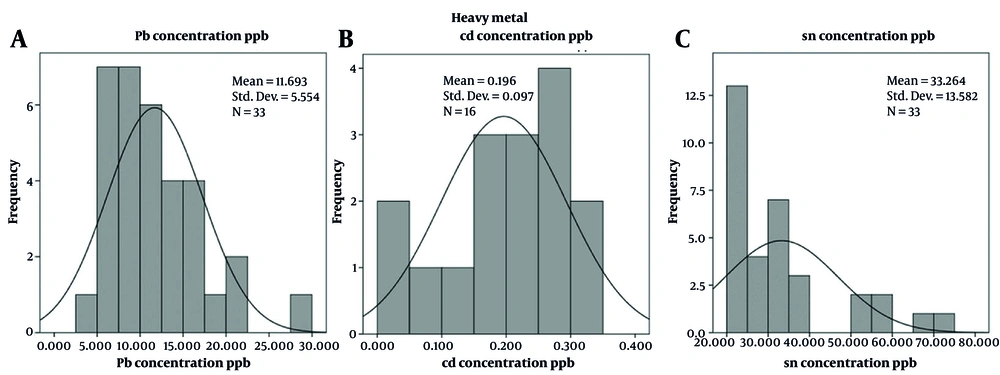
Figure 1.
Histograms showing the distribution of heavy metal concentrations in honey samples from Sistan and Baluchistan Province. A, Pb concentrations (n = 33, all detected; mean = 11.6 ppb, SD = 5.5 ppb). B, Cd concentrations for samples with detectable Cd only (n = 16 of 33; 51.5% of samples were below the LOD of 0.2 ppb and are excluded). C, Sn concentrations (n = 32; 1 sample was below the LOD and excluded). Overlaid normal curves are for visual reference only and do not imply normality.
To contextualize these findings, Table 3 compares the concentrations of Pb, Cd, and Sn measured in the present study with values reported in previous studies from Iran and other countries. Overall, the concentrations observed in the present samples were within or below the ranges reported in earlier investigations.
Table 3.
Comparison of Pb, Cd, and Sn Concentrations (Ppb) in Honey from the Present Study and Published Literature a
| Study / Region | Pb (ppb) | Cd (ppb) | Sn (ppb) | Reference |
|---|---|---|---|---|
| Present study (SE Iran) | 4.36 - 28.13 | nd - 0.34 | nd - 71.65 | This study |
| Urmia, Iran | nd - 15.2 | nd - 0.12 | NR | — |
| Zanjan, Iran | nd - 116 b | NR | nd - 221,270 c | (19) |
| Chahar-Mahal-Bakhtiari, Iran | < 200 | < 0.5 | < 250,000 | (18) |
| Zhejiang, SE China | nd - 43.8 (mean: 34.0) | 0.20 - 3.41 (mean: 1.34) d | NR | (22) |
| Lithuania | 100 - 500 | 50 - 300 | NR | (23) |
| Morocco | nd - > 100 e | nd | NR | (24) |
| Abruzzo, Italy | 1.5 - 62.5 | nd - 0.27 | NR | (9) |
| EU Maximum Limit | 100 | 50 | — | (21) |
| ISIRI 12968 (Iran) | 200 | — | 250,000 | (20) |
a Abbreviations: NR, not reported; nd, not detected (below LOD).
b Maximum Pb in beeswax honey; refined honey showed lower concentrations. All values were below the ISIRI limit of 200 ppb.
c Sn concentrations are reported in ppb (μg/kg); the highest values were recorded in beeswax honey. The ISIRI standard limit is 250,000 ppb.
d Mean Cd was reported as 1.34 μg/kg (ppb) by Ru et al. The range reflects variation among honey types in that study.
e Massous et al. reported Pb exceeding the EU maximum level (100 ppb) in sweet orange, PGI Euphorbia, and Globularia alypum honey from Morocco; nd = not detected for Cd.
5. Discussion
The present study investigated the concentrations of Pb, Cd, and Sn in 33 honey samples collected from three geographically distinct regions of Sistan and Baluchistan Province in southeastern Iran. Pb was detected in all samples (100%), with concentrations ranging from 4.36 to 28.13 ppb (mean: 11.6 ± 5.5 ppb). Sn was present in 32 of 33 samples (97%), with concentrations ranging from 21.63 to 71.65 ppb (mean: 33.2 ± 13.5 ppb). Cd was quantifiable in only 16 samples (48.5%), with concentrations among detectable samples ranging from 0.02 to 0.34 ppb. Importantly, all measured concentrations were well below the maximum permissible limits established by both ISIRI 12968 (200 ppb for Pb and 250,000 ppb for Sn) (20) and European Union Commission Regulation (EU) 2023/915 (100 ppb for Pb and 50 ppb for Cd) (21), indicating that the analyzed honey samples do not pose an immediate public health risk with respect to these metals under current regulatory thresholds.
A statistically significant north-to-south gradient in Pb concentrations was observed (P < 0.05), with Region 1 (Zahedan/Zabol, North) showing the highest mean Pb level (14.42 ppb), followed by Region 3 (South; 11.97 ppb) and Region 2 (Center; 8.15 ppb). This spatial pattern is consistent with the elevated anthropogenic burden in northern Sistan and Baluchistan, where dense urban traffic, industrial activity, and the 120-Day Winds (Levar) generate substantial aeolian dust from the dried bed of Hamoun Lake, a recognized pathway for heavy metal redistribution (4, 6). These findings reinforce the role of honeybees and their products as sensitive bioindicators of local environmental contamination (7). Previous studies have also reported that honey extracted directly from the comb may contain lower concentrations of heavy metals than wax-containing honey, suggesting that beeswax can act as an additional reservoir for metal deposition (19).
The sporadic detection of Cd, which was quantifiable in only 48.5% of samples while 51.5% were below the LOD of 0.2 ppb, indicates that cadmium contamination is localized rather than province-wide. The highest Cd value (0.34 ppb; sample 9, Region 3/South) may reflect site-specific geological or agricultural inputs rather than industrial sources because Cd is frequently associated with phosphate fertilizer use and natural soil mineralogy (8). The heterogeneous distribution of Sn, which was right-skewed and included 1 outlier at 71.65 ppb, similarly suggests discrete contamination events, potentially linked to tin-containing equipment or metallic storage containers at individual apiaries. Beekeepers operating in high-traffic or semi-industrial areas are therefore advised to use non-metallic, food-grade extraction and storage equipment to minimize Sn migration into honey.
Comparison with published data from other Iranian provinces (Table 3) shows that the Pb concentrations measured in the present study are broadly consistent with those reported elsewhere in Iran, while remaining substantially below regulatory limits. Values reported from Urmia ranged from non-detectable to 15.2 ppb for Pb and from non-detectable to 0.12 ppb for Cd; these values are closely comparable to the present findings and may reflect similarly low anthropogenic pressure in that region. Nabilou et al. reported Pb concentrations in Zanjan Province reaching up to 116 ppb in beeswax honey, which is notably higher than in the present study, although still within ISIRI limits. Sn levels in refined honey from the same province reached up to 221,270 ppb in beeswax samples, underscoring the role of wax as a metal sink (19). Moshtaghi Boroujeni et al. reported Pb below 200 ppb and Cd below 0.5 ppb in Chahar-Mahal-Bakhtiari Province (18), further supporting the observation that honey across most Iranian regions remains below national maximum limits, although Pb levels in areas near industrial activity warrant ongoing surveillance.
International comparisons emphasize the considerable global variability in honey metal concentrations and show that the levels observed in southeastern Iran are comparatively low (Table 3). In Zhejiang Province, southeastern China, Ru et al. reported Pb concentrations up to 43.8 ppb (mean: 34.0 ppb) and a Cd mean of 1.34 ppb (22), with the Cd mean approximately 4 times higher than the maximum detectable Cd level in the present study. In Lithuania, Šerevičienė et al. documented Pb in the range of 100 - 500 ppb and Cd in the range of 50 - 300 ppb in honey collected from contaminated locations, values that substantially exceeded both the levels observed here and EU maximum limits, reflecting the proximity of sampling sites to industrial pollution sources in that study (23). In Abruzzo, Italy, Flamminii et al. reported Pb concentrations of 1.5 - 62.5 ppb and Cd concentrations from non-detectable to 0.27 ppb across apiaries with varying degrees of anthropogenic influence (9). This range overlaps closely with the present findings and supports the view that honey from areas with moderate anthropogenic pressure typically contains Pb in the low-to-mid ppb range. In Morocco, Massous et al. found that several monofloral honey varieties, including sweet orange, PGI Euphorbia, and Globularia alypum, contained Pb levels that exceeded the EU maximum level of 100 ppb (24), in contrast to the substantially lower concentrations recorded in the present study. These differences likely reflect the influence of specific botanical origins and regional agricultural practices, including pesticide and fertilizer use, on metal accumulation in honey (25).
Taken together, this cross-regional comparison suggests that although Pb is a near-ubiquitous contaminant of honey worldwide, reflecting its broad dissemination through the historical combustion of leaded fuels, industrial emissions, and atmospheric deposition (8), its concentrations in southeastern Iran are at the lower end of the globally reported spectrum and do not approach levels of regulatory concern. Cd contamination appears to be driven primarily by localized geological and agricultural factors in this province, consistent with observations from other semi-arid, non-industrial regions. The elevated Sn levels detected in a subset of samples merit attention from a monitoring perspective, given the absence of a specific Sn limit in EU regulation and the relatively high ISIRI threshold of 250,000 ppb, which may not fully reflect contemporary toxicological evidence.
5.1. Limitations
Several limitations of the present study should be acknowledged. First, the sample size of 33 is relatively small and may not fully capture the heterogeneity of honey produced across the entire province; future studies should target larger, geographically stratified samples. Second, all samples were collected within a single season, precluding assessment of temporal variation, which is potentially important given that dust storm intensity and associated Pb deposition in the north are strongly seasonal. Third, the analyte panel was restricted to Pb, Cd, and Sn; other metals of public health relevance, including arsenic, mercury, chromium, and nickel, were not assessed. Health risk assessment methods, such as Monte Carlo simulation, which have previously been applied to chromium in drinking water in northeastern Iran (26), would provide a more comprehensive characterization of exposure risk and should be incorporated into future studies of honey from this region.
5.2. Conclusions
This study provides baseline data on Pb, Cd, and Sn contamination in honey produced in southeastern Iran, specifically Sistan and Baluchistan Province. The overarching finding is that all three metals were present at levels well below both Iranian (ISIRI 12968) and international (EU Regulation 2023/915) maximum permissible limits, indicating that regional honey is safe for human consumption under current regulatory standards. A clear north-to-south gradient in Pb contamination was identified, most plausibly driven by the combined effects of urbanization, traffic emissions, and aeolian dust in the northern cities of Zahedan and Zabol. The sporadic presence of Cd, detected in only 48.5% of samples, suggests that Cd contamination is a localized phenomenon rather than a province-wide concern.
From a regulatory perspective, these findings underscore the need for periodic monitoring programs targeting honey from northern Sistan and Baluchistan, where anthropogenic Pb sources are most active. Authorities are recommended to establish specific, stringent maximum permissible limits for heavy metals in honey, beyond the general ISIRI 12968 standard, to strengthen consumer protection. Beekeepers in industrial or high-traffic areas should also be advised to use non-metallic, food-grade storage containers to minimize Sn migration. Future research should include larger seasonal samples, broader metal panels, and risk assessment calculations to further characterize human exposure.