
1. Introduction
The compact fluorescent lamps (CFLs) are used widespread in the offices, industrial buildings, hospitals, universities, and similar premises (1). The replacement of incandescent light converting 10 % of the electricity consumed into light has benefits to the community and environment. CFLs consume 4-5 times less energy for the same light output (2). Engineering data suggested 20 Watt CFL that can be replaced by 100 Watt in candescent bulbs (3). Using less energy reduces the amount of green house gas emissions and has the potential to lower the cost of electricity which benefits both individual and industry whilst helping the environment (4). Another great advantage to CFLs compared to traditional incandescent bulbs includes: 1) CFLs which have a life span of between 6,000 and 15,000 hours and last six to twenty times longer than incandescent bulbs, 2) CFLs produce about 75 percent less heat, so they’re safer to operate and can cut energy costs associated with home cooling (5). CFLs relative to incandescent lamp have some disadvantages such as greater use of materials, use of toxic mercury in the tube gases, their poor power factor and high harmonic current demand plus the potential, electromagnetic interference effectdue to nature of their electronic ballast, there are also lingering concerns in the community about dimness and colorand ultra violet (UV) irradiance (6). In CFLs, UV light is produced by electric discharge in mercury vapor, which excites the phosphor material coated inside the glass envelop of the lamp and finally produces visible light. CFLs radiate a different light spectrum from those incandescent lamps. Ideally, conversion of UV to visible light should be 100%; however, due to the defect in phosphor coating, output light contains trace amount of UV radiation (7-10). The feature that characterizes the properties of any particular region of the spectrum is the wave length of the radiation. UV Radiation spans are the wave length region from 400 to 100 nm (11), that is further subdivided into three regions: UVA (315 nm-400 nm), UVB (280 nm-315 nm), and UVC (100 nm-280 nm) (12). Because of their mercury content, CFLs, emitted significant quantities of UVA, epically at 365 nm. Many of the CFLs had sizeable outputs at 313 nm (UVB) and in some cases, at 254 nm (UVC) (3). Information provided by different manufacturers shows the emissions spectra of ‘‘typical’’ bulbs, which are adjusted for different colors in the visible light, without any emission in the UV range (13). However, a recent study performed a general survey of the emissions from commercially available bulbs and found significant amounts of UVA and C light (14). In a study by Eadie et al.results revealed that irradiance of UV in three 11 W of CFLs with the same brand was different (15). In study by Klein et al. 26 CFLs in five brands including: general electric (GE), lights of America, N.vision, Philips and Sylvania the measurement of UV irradiance showed that brand of Philips was the safest. They emitted the lowest levels of UVA, UVB and UVC (16). The cost of electricity has increased in recent years and people use compact fluorescent lamps that consume 4-5 times less energy relative to incandescent lamps and because of nature of produced light in CFLs, ultra violet radiation is generated and UV irradiance is different regarding the value of different brand of CFLs, the present study aimed to evaluate UV emissions radiated from compact fluorescent lamps of Iranian current brands.
3. Material and Methods
This experimental study was conducted on 16 CFLs that were manufactured by four manufacturers including branded names and retailer owned brands. The CFLs were marked as 11, 18, 40 and 60 Watt and all of the lamps contained integral electronic ballasts. All the CFLs are used for one hundred hours (12) in the laboratory conditions using a stabilized 220 V DC power supply. The UV irradiance of various types of CFLs is measured on a three-meter long optical bench, and measurement was done in 10, 25, 50, 100, 150 and 200 cm using a calibrated UV-meter. Measurement of UV irradiance was performed in three angles including 0°, 45° and 90° (Figure 1). In the angle 0°, the lamps were orientated horizontally so that the tip of the lamp faces the input diffuser of the spectroradiometer. This was used to measure the radiation as expectedin case of standing directly under a lamp suspended from the ceiling. In the angles 45° and 90°, UV lamps are used at desk or task lamps.
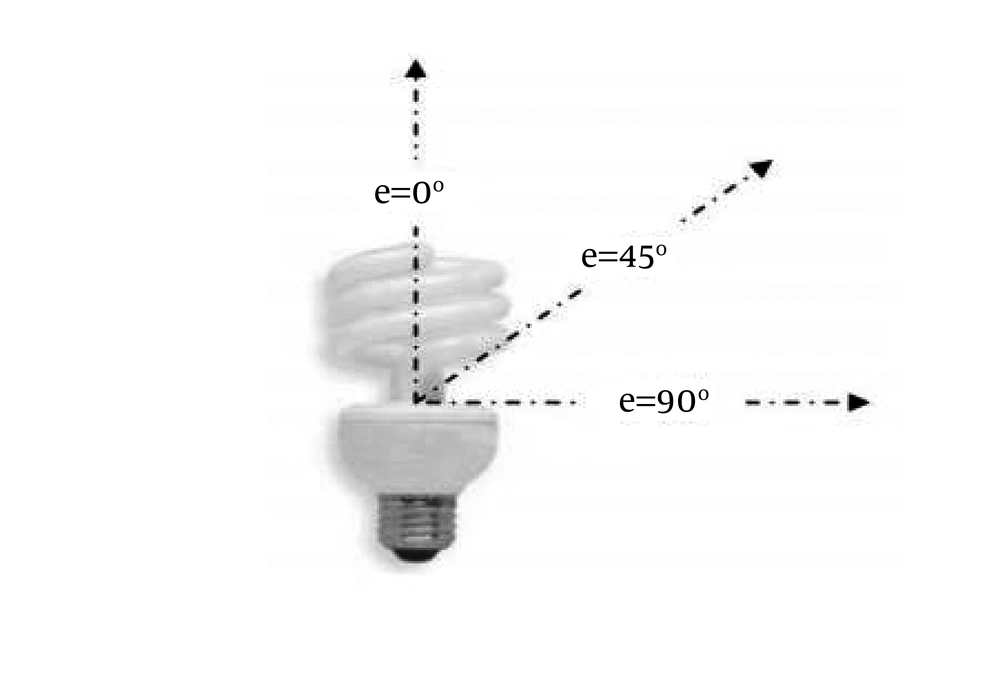
Figure 1.
Angle of Measuring UV Irradiance
A type-666230 photometer-radiometer equipped with UVA, UVB and UVC detectors were used to measure UV irradiance in all the three ranges. Measurements were performed in a dark room maintaining the temperature at (26 ± 2)°C and the relative humidity (45%). Following a 10 min warm-up period, the emission spectrum of each lamp was measured. Measurement were repeated for each type of CFLs and finally averaged out. Finally, the information was analyzed using SPSS-20. In order to compare UVA and UVB irradiance and the value of irradiance in angles of four brands, we used of one way ANOVA. A P value less than 0.05 were considered to be statistically significant.
4. Result
Ultra violet irradiance was measured at the distance of 10, 25, 50, 100, 150 and 200 cm, for sixteen types of CFLs in four different Watt. At distance of more than 50 cm, UVB irradiance could not be detected in all the cases (Table 1), on the other hand, UVC at 10 cm was considered to be the closest distance that people would be exposed to the lamps, even in desk top applications, irradiance could not be detected in all cases. One way ANOVA indicated that differences between UVB irradiance in three angles, and UVB irradiance in the same wattage of four brands of lamps was not significant statistically (P > 0.05). Table 2 showes the UVA irradiance (W.m-2) values in 10, 25, 50, 100, 150 and 200 cm and three angles for four brand CFLs in Iranian brands. As is obvious, UVA irradiance increases with increase in lamp electrical wattage. Unlike Table 2, that UVA irradiance increases with increase in lamp electrical wattage, and emissions decreased rapidly, for UVB irradiance (Table 1), such cases were not detected, and may not detect the limit of device that was used for measurement of UV irradiance, the lowest value of UVB irradiance recorded in Pars Khazar lamp, while the highest value was recorded in Etehad lamps. One way ANOVA indicated that differences between UVA irradiance in three angles, was not significant statistically (P > 0.05). The lowest UVA irradiance recorded in 45°, while the highest was recorded in 90°. In order to compare UVA irradiance in the same wattage of four brands of lamps, one way ANOVA showed that comparison between different brands was not significant (P > 0.05). Pars khazar with the highest UVA irradiance placed in the first group and other groups were Nama Noor, Parmis and Etehad, respectively.
Table 1.
UVB Irradiance (W.m-2) Values in One Hundred Hour for Four Brand CFLs in Iranian Brands
| Brand of CFLs | Distance | 10 cm | 25 cm | 50 cm | ||||||
|---|---|---|---|---|---|---|---|---|---|---|
| Angle | 0° | 45° | 90° | 0° | 45° | 90° | 0° | 45° | 90° | |
| Pars khazar | 11 W | 0 | 0 | 0 | 0 | 0 | 0 | 0 | 0 | 0 |
| 18 W | 0 | 0.02 | 0.02 | 0 | 0 | 0 | 0 | 0 | 0 | |
| 40 W | 0.02 | 0 | 0.02 | 0 | 0 | 0 | 0 | 0 | 0 | |
| 60 W | 0 | 0 | 0 | 0 | 0 | 0 | 0 | 0 | 0 | |
| Parmis | 11 W | 0.01 | 0.01 | 0.01 | 0.01 | 0.01 | 0.01 | 0 | 0 | 0 |
| 18 W | 0.01 | 0.01 | 0.01 | 0.01 | 0 | 0 | 0 | 0 | 0 | |
| 40 W | 0 | 0 | 0.02 | 0 | 0 | 0 | 0 | 0 | 0 | |
| 60 W | 0 | 0 | 0 | 0 | 0 | 0 | 0 | 0 | 0 | |
| Etehad | 11 W | 0 | 0.01 | 0.01 | 0 | 0 | 0 | 0 | 0 | 0 |
| 18 W | 0.01 | 0.01 | 0.01 | 0.01 | 0.01 | 0.01 | 0 | 0 | 0 | |
| 40 W | 0.02 | 0.02 | 0.01 | 0.01 | 0 | 0 | 0 | 0 | 0 | |
| 60 W | 0.02 | 0.03 | 0.03 | 0 | 0.02 | 0.02 | 0 | 0 | 0 | |
| Nama Noor | 11 W | 0.01 | 0.01 | 0.01 | 0 | 0.01 | 0 | 0 | 0 | 0 |
| 18 W | 0.01 | 0.01 | 0.01 | 0.01 | 0.01 | 0.01 | 0 | 0 | 0 | |
| 40 W | 0.02 | 0.02 | 0.02 | 0 | 0 | 0 | 0 | 0 | 0 | |
| 60 W | 0.02 | 0.02 | 0.02 | 0 | 0 | 0 | 0 | 0 | 0 | |
Table 2.
UVA Irradiance (W.m-2) Values in One Hundred Hour for Four CFLs in Iranian Brands
| Brand of CFLs | Distance | 10 cm | 25 cm | 50 cm | 100 cm | 150 cm | 200 cm | ||||||||||||
|---|---|---|---|---|---|---|---|---|---|---|---|---|---|---|---|---|---|---|---|
| Angle | 0° | 45° | 90° | 0° | 45° | 90° | 0° | 45° | 90° | 0° | 45° | 90° | 0° | 45° | 90° | 0° | 45° | 90° | |
| Pars khazar | 11 W | 0.33 | 0.2 | 0.16 | 0.05 | 0.04 | 0.04 | 0.02 | 0 | 0 | 0 | 0 | 0 | 0 | 0 | 0 | 0 | 0 | 0 |
| 18 W | 0.92 | 0.67 | 0.65 | 0.13 | 0.16 | 0.13 | 0.04 | 0.06 | 0.04 | 0 | 0.02 | 0.02 | 0 | 0 | 0 | 0 | 0 | 0 | |
| 40 W | 1.24 | 1.17 | 1.61 | 0.3 | 0.38 | 0.37 | 0.07 | 0.1 | 0.09 | 0.02 | 0.03 | 0.03 | 0 | 0 | 0.02 | 0 | 0 | 0 | |
| 60 W | 1.51 | 1.42 | 1.78 | 0.48 | 0.49 | 0.51 | .02 | .02 | .03 | 0 | 0 | 0 | 0 | 0 | 0 | 0 | 0 | 0 | |
| Parmis | 11 W | 0.13 | 0.12 | 0.19 | 0.04 | 0.04 | 0.05 | 0.02 | 0.02 | 0.03 | 0.02 | 0.02 | 0.03 | 0 | 0.01 | 0.02 | 0 | 0 | 0 |
| 18 W | 0.34 | 0.28 | 0.3 | 0.08 | 0.09 | 0.09 | 0.04 | 0.04 | 0.03 | 0.02 | 0.02 | 0.02 | 0.01 | 0.01 | 0.02 | 0.01 | 0.02 | 0.01 | |
| 40 W | 0.87 | 0.66 | 0.66 | 0.26 | 0.17 | 0.15 | 0.05 | 0.06 | 0.04 | 0 | 0.02 | 0.02 | 0 | 0 | 0 | 0 | 0 | 0 | |
| 60 W | 0.95 | 0.89 | 0.98 | 0.3 | 0.24 | 0.38 | 0.09 | 0.06 | 0.1 | 0 | 0 | 0 | 0 | 0 | 0 | 0 | 0 | 0 | |
| Etehad | 11 W | 0.07 | 0.05 | 0.06 | 0.02 | 0.03 | 0.03 | 0.01 | 0.02 | 0.01 | 0 | 0 | 0 | 0 | 0 | 0 | 0 | 0 | 0 |
| 18 W | 0.24 | 0.26 | 0.26 | 0.07 | 0.07 | 0.08 | 0.03 | 0.03 | 0.02 | 0.01 | 0.01 | 0.01 | 0.01 | 0.01 | 0.01 | 0 | 0 | 0 | |
| 40 W | 0.38 | 0.43 | 0.54 | 0.12 | 0.15 | 0.12 | 0.04 | 0.05 | 0.04 | 0.02 | 0.02 | 0 | 0 | 0 | 0.02 | 0 | 0 | 0 | |
| 60 W | 0.89 | 0.66 | 0.96 | 0.2 | 0.25 | 0.33 | 0.05 | 0.08 | 0.1 | 0 | 0.04 | 0.04 | 0 | 0 | 0.02 | 0 | 0 | 0 | |
| Nama Noor | 11 W | 0.21 | 0.28 | 0.3 | 0.05 | 0.08 | 0.07 | 0.03 | 0.03 | 0.03 | 0.02 | 0.02 | 0.02 | 0.02 | 0.02 | 0.02 | 0 | 0 | 0 |
| 18 W | 0.22 | 0.19 | 0.24 | 0.05 | 0.07 | 0.06 | 0.03 | 0.03 | 0.02 | 0.02 | 0.02 | 0.02 | 0 | 0 | 0 | 0 | 0 | 0 | |
| 40 W | 0.7 | 0.67 | 0.72 | 0.14 | 0.18 | 0.16 | 0.04 | 0.05 | 0.04 | 0 | 0 | 0.02 | 0 | 0 | 0 | 0 | 0 | 0 | |
| 60 W | 1.07 | 0.88 | 1.27 | 0.25 | 0.24 | 0.33 | 0.05 | 0.08 | 0.09 | 0.03 | 0.03 | 0.03 | 0.02 | 0.02 | 0.02 | 0.02 | 0.02 | 0.02 | |
5. Discussion
Measurements of the emissions from the lights were made in the UV part of the spectrum (100 nm to 400 nm) at distances of 10, 25, 50, 100, 150 and 200 cm. Measurable values of the UVC irradiance (100 nm-280 nm) were not observed using UVC detectors at the distance of 10 cm in all of lamps. The International Commission on Non-Ionizing Radiation Protection (ICNIRP) declares which part of UVC spectrum with wave lengths below 180 nm (vacuum UV) are readily absorbed in air (17). That was consistent with study by Klein et al. in which the results revealed using more sensitive spectroradiometer and UV irradiance was discernible at 300 nm, and in less values, wave length of the UV irradiance was not detected, while all of bulbs emit UV in the UVA and UVB range (16) and was inconsistence with the study by Khazova et al. in 2008 on 73 CFLs (20 single envelopes and 53 double envelope CFLs) at 2 cm and 20 cm, in which the results of measurement showed that double envelope CFLs had very low UVB irradiance while single envelope lamps emitted UVB and UVC and they concluded that the UVC irradiance were probably due to defects in the phosphor coating of the glass envelope (18). According to OEL, occupational UVB exposure should be limited to an effective irradiance of 0.000003 W.m-2 in an 8 hours period (19). At 10 cm distance, measurement of UVB irradiance from most of CFLs was more than OEL. The highest value was recorded in Etehad lamp with 0.03 W.m-2 that was 10000 times more than OEL. In a study by Eadie et al. (15) that was conductedon 5 CFLs wattage from 11, 15 and 20 Watt and at 5 and 20 cm distance, results showed one of 11 Watt and 15 and 20 Watt CFLs emitted UVB more than the artificial optical radiation directive (20). The highest UVA irradiance was recorded in 90°, for UVA radiation, occupational exposure limited should be limited to 1.04166 W.m-2, of all of the bulbs tested, the Etehad appear to be the safest. They emitted the lowest levels of UVA and the highest levels of UVB, among sixteen CFLs which were measured at a distance of 10 cm. The UVA output for Pars Khazar 40 and 60 W was 1.61 W.m-2 and 1.78 W.m-2, respectively, and for Nama Noor, 60 W was 1.07 W.m-2, this shows that three CFLs would exceed the UVA exposure limit in 8 hours at a distance of 10 cm.
Ultra violet emission was measured of various types, size and electrical powers of CFLs. Measurements were performed in controlled environmental conditions and under good regulation of electrical parameters. Measurement of three field of UV (UVA, UVB and UVC) showed that UVC emission was not observed at the distance of 10 cm in all of lamps. UVB irradiance in most of lamps in 10 and 25 cm was more than OEL, but in 50 cm was less than OEL. UVA irradiance in all of CFLs lamps in 25 cm was less than OEL. Therefore, based on the results of this study, authors recommended that CFLs lamps, due to UV radiation, especially in UVB span, be used at distances greater than 25 cm.