1. Background
Pneumatic tires have been produced since the late 1800s in Great Britain. More than 20 components and approximately 60 natural and synthetic raw materials are used in the production of a typical tire (1). A mixture of organic solvents including benzene, toluene, and xylene has wide applications in industries including printing as well as the production of paint, rubber, adhesives, and many other chemicals (2, 3). Volatile organic compounds are used to improve the mixing, flexibility, adhesion, and expansion of rubber hydrocarbons. An estimated 97% of volatile organic compound emissions from tire manufacturing are organic solvents (4).
Exposure to solvents such as benzene and toluene is common in the tire manufacturing industry. This can subsequently result in health problems in workers, such as disorders of the nervous system, liver, kidneys, and skin (5) as well as increased risks of leukemia, bladder, gastrointestinal, and lung cancer (6, 7). Benzene has been used as a thinner or degreasing agent in tire manufacturing. Nowadays, despite its prohibition in industrial usage, it occurs as an impurity of toluene and styrene (8). Exposure to benzene incurs genetic, neurologic, and hematologic toxicity and can lead to acute non-lymphoid leukemia as well as several other effects in humans (9-11). Meanwhile, toluene has a wide range of industrial applications as an aromatic solvent. It can cause impairment of electrolyte and pH balance, gastrointestinal and neuropsychological disorders, and acute respiratory and reproductive defects (12-14).
Biological monitoring of exposure, a complementary method to personal monitoring, evaluates the internal absorbed dose and takes into consideration individual differences, workload, work practices, the adequacy of control measures, genetic and acquired metabolic characteristics, and all routes of exposure other than inhalation (15-17).
Different specimens are used for biological monitoring; blood and urine samples are most commonly used (18). However, significant amounts of volatile compounds are excreted in unmetabolized forms in exhaled air (19-21). Benzene is initially rapidly cleared from breathing (half-life: 2.6 hours) and then more slowly (half-life: 24 hours); furthermore, this appears to be slower in cases of long-term occupational exposure (22). Besides the sensitivity analysis of exhaled air, some researchers report the successful detection of benzene in exhaled air 20 - 45 hours after the last exposure (23). Because of the difficulties and disadvantages of blood and urine sampling, recent approaches for assessing occupational and environmental exposure to several chemicals as well as biological monitoring have focused on exhaled air (24, 25). Therefore, because of a lack of scientific data on worker exposure in Iran, this study evaluated organic solvents with some chemical impurities such as benzene and toluene in the tire manufacturing process.
2. Objectives
This study evaluated the external doses of benzene and toluene through personal monitoring of breathing zone air as well as the feasibility of measuring these parent compounds in workers’ exhaled air as biological markers of internal doses.
3. Materials and Methods
Two tire factories A and B located in a suburb of Tehran, Iran were investigated. The factories’ characteristics as well as worker demographics, health conditions, smoking habits, and the use of personal protective equipment were investigated by questionnaires. All workers provided written informed consent to participate in this study.
Personal monitoring of 50 non-smoking male workers was performed in the morning shift (8:00 - 16:00) according to the national institute for occupational safety and health (NIOSH) 1501 method in both factories. Thus, a total of 100 personal samples of workers’ breathing zone air were collected. In addition, biological monitoring for all 100 workers was conducted by collecting exhaled air in SKC Tedlar® bags at the end of their shift after lung washing as described previously by Azari et al. (26). Thus, a total of 100 biological samples including 50 from each factory were collected. Then, 5 L exhaled air was passed through an SKC charcoal adsorbent tube (100 + 50 mg, 20 – 40 μm mesh size) at 0.08 L/min.
The contents of each of the charcoal tubes in personal and biological samples were extracted with 1 mL carbon disulfide containing cumene as the internal standard. Finally, 1 µL extracted sample was injected into a gas chromatograph (GC-17A, Shimadzu, Japan) equipped with a flame ionization detector. The oven temperature program was 40°C for 4 minutes, increasing to 90°C at 30°C/min for 4 minutes, and finally increasing to 125°C at 60°C/min for 8 minutes. The flame ionization detector temperature was set at 140°C, and the flow rate of carrier gas was 1.02 mL/min. An HP-1 capillary column ((length: 30 m, internal diameter: 0.25 mm, inner layer thickness: 0.25 µm; SGE analytical science Company Melbourne Australia) was used to separate the abovementioned compounds. Analytical-grade nitrogen, hydrogen, and oxygen gases purchased from an Iranian supplier were used as the carrier, combustible, and combustion gases, respectively.
The data were analyzed by statistical analyses of data were conducted in SPSS software version 16 using independent sample t-tests and correlation analysis coefficients. Quantitative data are presented as values reported as mean ± standard deviation and the level of significance was set at P < 0.05 (M ± SD).
4. Results
Both factories are among the largest tire manufacturing companies in Iran. Tire production and solvent use were higher in factory B, but most processes and amounts of raw materials were similar between factories. All subjects were physically healthy; however, almost none of them did not used suitable respirators.
In factory A, the mean worker age and work history were 33.2 ± 3.52 and 10.2 ± 4.22 years, respectively; those in factory B were 34.6 ± 4.56 and 11.9 ± 5.54 years, respectively. There were no significant differences between factories with respect to age or work history (P > 0.05). The results of personal monitoring are summarized in Table 1. The personal exposure of workers to benzene and toluene was significantly higher in factory B than factory A.
Table 1.
Concentrations of Benzene And Toluene in Workers’ Breathing Zones
| Compound | Factory A (n = 50)a | Factory B (n = 50) | P Valueb |
|---|---|---|---|
| Benzene, ppm | 1.09 ± 1.24 | 1.88 ± 1.37 | 0.003 |
| Toluene, ppm | 2.07 ± 2.10 | 3.20 ± 2.79 | 0.024 |
a Data are presented as mean ± SD.
b Independent sample t-test.
Analysis of biological samples by gas chromatography showed the mean benzene concentrations in workers’ exhaled air were 0.29 ± 0.18 and 1.29 ± 1.17 ppm in factories A and B, respectively; there was a significant difference in the concentrations of benzene in exhaled air between factories. Meanwhile, the mean toluene concentrations in the workers’ exhaled air were 0.83 ± 0.91 and 1.53 ± 1.41 ppm in factories A and B, respectively; toluene exposure was significantly higher in factory B than factory A (Table 2).
Table 2.
Concentrations of Benzene and Toluene in Workers’ Exhaled Air
| Compound | Factory A (n = 50) a | Factory B (n = 50) | P Valueb |
|---|---|---|---|
| Benzene, ppm | 0.29 ± 0.18 | 1.29 ± 1.17 | < 0.001 |
| Toluene, ppm | 0.83 ± 0.91 | 1.53 ± 1.41 | 0.004 |
a Data are presented as mean ± SD.
b Independent sample t-test.
Pearson correlation analysis showed personal exposure to benzene and its concentration in exhaled air were significantly correlated in all tire manufacturing workers (P < 0.001; Figure 1). The biological exposure index (BEI) is the value of the parent compound or its metabolites in the biological samples of healthy subjects who have been exposed to chemicals at the threshold limit value (TLV) via inhalation. Therefore, on the basis of the equation obtained from regression curves y = 0.5087x + 0.03682 and benzene’s TLV set by the American conference governmental industrial health (ACGIH) at 0.5 ppm (27), the BEI for benzene exposure in exhaled air was 0.29 ppm. Personal exposure to benzene exceeded the current TLV in 68% of workers, and its levels in exhaled air were higher than the estimated BEI in 62% of workers.
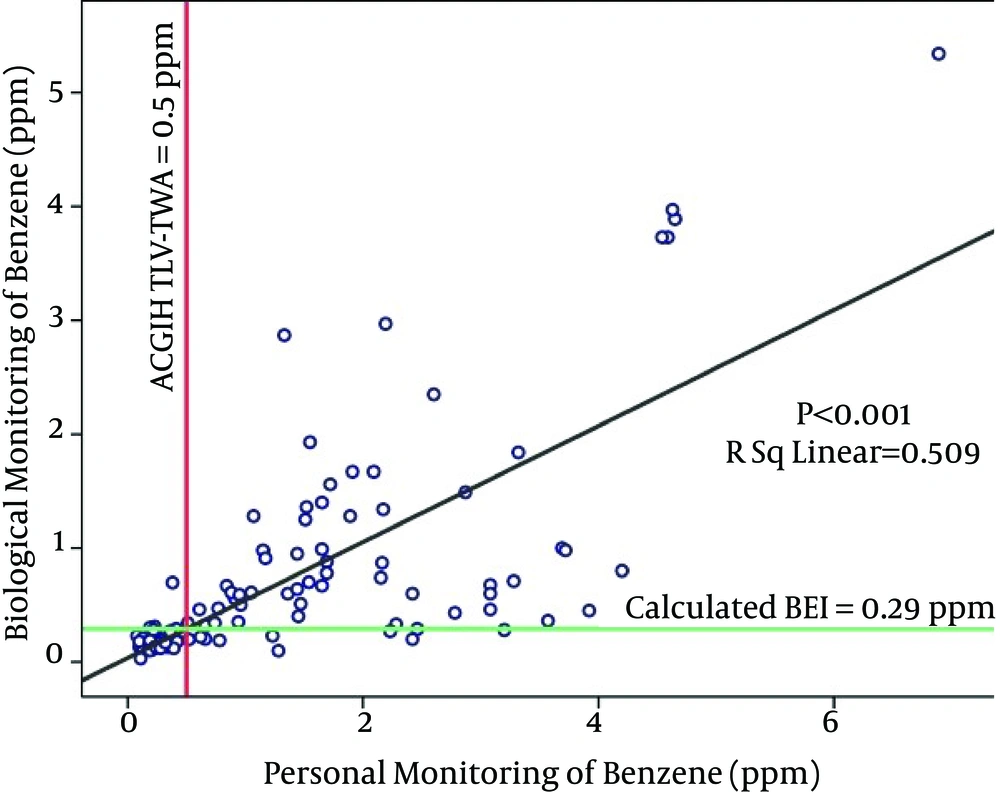
Figure 1.
Correlation Between External and Internal Doses of Benzene
In addition, Pearson correlation analysis showed a significant correlation between the concentrations of toluene in the breathing zone air and workers’ exhaled air (P < 0.001; Figure 2). The BEI of toluene according to the equation from regression curves y = 0.3089x + 0.3642 and its TLV set by the ACGIH of 20 ppm (27) was 6.54 ppm. Thus, the toluene concentrations of personal exposure and exhaled air were below the corresponding TLV and calculated BEI, respectively.
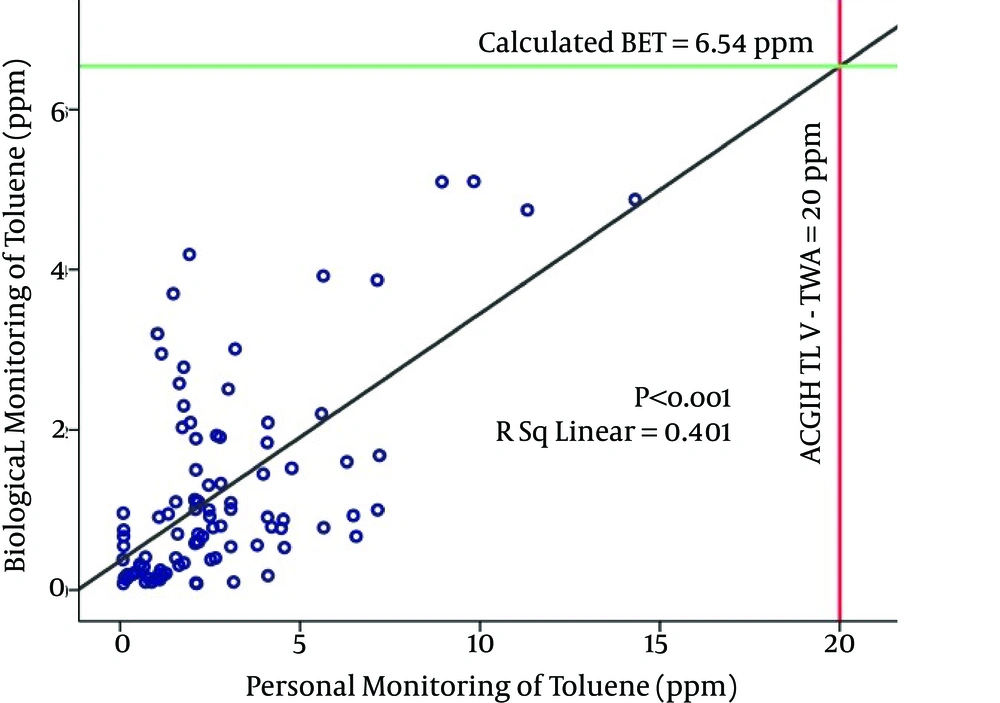
Figure 2.
Correlation Between External and Internal Doses of Toluene
5. Discussion
In present study, personal exposures to benzene and toluene were significantly higher in factory B than factory A. This can be attributed to the higher tire production; amount, type, and purity of solvents used in the preparation of special cement; and use of gasoline in open containers for ease of access by assembly workers in factory B.
Overall, 68% of workers had personal exposure to benzene that exceeded the current TLV (0.5 ppm); on the other hand, all personal exposure to toluene was below the current TLV (20 ppm) (27). Personal exposure to benzene in the present study is less than that reported in tire manufacturing in other developing countries such as Turkey (28, 29), similar to that in South Korea (30), and higher than that reported in developed countries (31, 32). In this study, the mean toluene concentration from personal monitoring was similar to that reported in Brazil (33) and lower than that reported in China (34).
In addition, the results of biological monitoring results of exposed workers by through measuring thethrough measuring concentrations of unchanged parent compounds (benzene and toluene) in the exhaled breathexhaled airbreath showed a the statistical significant correlation trend as with their personal exposure. While 68% of workers had personal exposure exceeding the TLV, 62% percent showed higher benzene concentrations in their exhaled air than the estimated BEI. The personal exposure levels and exhaled air concentrations of toluene were lower than the corresponding TLV and estimated BEI, respectively.
The present study found a significant correlation between personal exposure to benzene and biological monitoring of benzene in exhaled air; these results corroborate the findings of other studies (35-37). In addition, the concentrations of toluene in the workers’ breathing zone and exhaled air were significantly correlated. Such a correlation between exhaled and ambient air has been reported in other studies (38).
Given the positive correlation between the findings of personal and biological monitoring of a relatively large number the tire manufacturing workers as the study subjects, the data presented could be a basis for recommending a new BEIs for benzene and toluene exposure. This can be implemented by measuring the unchanged benzene and toluene compounds in workers’ exhaled air at the end of their work shifts. Such monitoring could be used as a safe alternative method for assessing the risks of such exposures, especially in cases in which the personal monitoring of workers is unfeasible.
Occupational exposure to benzene exceeded the current TLV in the majority of tire manufacturing workers in the present study; was also reflected by the measured exhaled breath concentration of benzene. Thus, the results of personal and biological monitoring of exposed workers in this study demonstrated the need for improving the working conditions of tire factories. Determining the levels of unchanged benzene and toluene in exhaled breath, offer an alternative method of biological monitoring of exposed workers and has some advantages over comparable methods, through non-invasive sampling and rapid analysis.