1. Background
Coronary artery disease (CAD) is a kind of cardiovascular disease (CVD) (1). Also, it is the most common cause of death and disability around the world (2). According to the available statistics, CVD is the cause of ten percent of all deaths in 1990, 50% in 2000 and 75% of deaths in 2020 in the world. Many studies show that CVD is increasing in the world especially in developing countries. Iran’s latest statistics indicate that the incidence of CVD mortality is 167 per 100,000 people (3). Previously, known physical factors had been associated with CVD incidence. These factors include unchangeable factors such as genetics, changeable factors such as activity pattern, overweight, etc., and non-atherosclerotic cardiovascular disease risk factors (1, 4). Generally, that is clear that these factors can predict only 50% of coronary heart disease (CHD) incidence (5). New developments in behavioral medicine shift the health psychologists’ attention to the key role of nonbiological factors in CHD (6). They found that CAD is a type of disease with psychosomatic causes and the role of psychological factors (especially personality) is clear. In fact, these psychological factors increased the risk of heart disease directly or indirectly (7), so that some sudden cardiac deaths, after the emotional turmoil, were founded throughout history and cultures (8).
Personality variables and illness perceptions are two determinant factors of stress and emotion. Among the personality variables, character of D personality is a new personality structure that has been expressed by Denollet (6). The traumatic role of this personality type in psychological and physiological aspects based on two general and constant characteristics: negative affectivity and social inhibition. Negative affectivity means the Individual’s tendency to experience negative emotions in different times and situations, whereas social inhibition refers to a tendency of individual to avoid expressing negative emotions in social interaction (9). Autonomic nervous system has a significant effect on cardiovascular activity and this system is sensitive to the personal and acute emotional stress factors such as sadness, fear or extreme anger (10).
These personality characters have been identified as an independent risk factor for prognostic and mortality rate in patients with myocardial infarction, cardiac surgery and a predictor of treatment in patients with heart disease (11). In the recent studies such as Whitehead study (12) and Martin et al. study (13), the relationship between CAD and type D personality was reported.
Furthermore, the patient with CAD made the disease perception influenced by the environment, history of heart disease and personality factors (14). The cognitive representation and visualization of patients about the meaning of their problems enable them to create their own coping strategies and effect on the result of their disease (15). In addition, heart disease can disrupt the quality of life. According to the world health organization definition (1998), quality of life is the perception of each person about his/ her life according to the culture, value systems, goals, experiences and their standards (16).
Quality of life is the connection point between medicine and psychology (17) and today is widely used in the field of health indices and outcomes (16). The quality of life in CAD patients are low and the reverse relation was between quality of life and the severity of disease (18). In the Beyranvand et al. study, quality of life, in all subscales of short-form (SF)-36 health survey, was lower than the normal society (19). Recent studies showed the relation between type D personality and impaired quality of life. These studies showed that type D personality is related to low quality of life (11), intense psychological distress (20) and damaged health status (21). On the other hand, Stafford showed that the CAD patients with the positive disease perception have a better quality of life (22). Williams et al. showed that disease perception is a mediator variable in relation between type D personality and CAD outcomes (23). Jerram and Coleman study (24) and Monirpour study (25) showed that there is a significant relation between personality and disease perception in the CAD patient.
Consequently, high rate of mortality and incidence of CAD showed that understanding the nature of the disease and underlying causes and factors is important to prevent, treat and control CAD. In fact, despite the increasing prevalence of CAD in Iran, sufficient researches have not been done in this area and few studies have showed that the socio-psychological factors, especially personality factors and perceptions, are risk factors for the patient’s quality of life (14).
2. Objectives
Therefore, the aim of this study was to survey the direct and indirect relation between type D personality and quality of life in patients with CAD and illness perception as a mediated factor by creating a conceptual model.
3. Patients and Methods
In this cross- sectional study, patients with CHD referred to the angiography unit of Mostafa- Khomeini hospital in Tehran, Iran, were selected using random sampling from April to June 2012. The inclusion criteria were no psychiatric disorders, no use of psychiatric drugs, definite diagnosis of CAD by a cardiologist, having a good general medical condition. According to the medical records, consultation with a cardiologist and a short interview with the patients were evaluated before implementation. Ninety-nine patients with CAD were finally selected. For data collection we used the type D personality scale, summarized version of the illness perceptions questionnaire (IPQ) and SF-36 questionnaire.
3.1. Statistical Analysis
The structural equation model (SEM) was selected as the statistical technique to investigate the direct and indirect relation between type D personality and quality of life in patients with CAD. The structural equation model is a family of statistical methods designed to test a conceptual or theoretical model. Some common SEM methods include confirmatory factor analysis, path analysis, and latent growth modeling. The term “structural equation model” most commonly refers to a combination of two things: a measurement model that defines latent variables using one or more observed variables, and a structural model that links latent variables together.
The AMOS version 20 (IBM SPSS Amos, USA) with maximum likelihood estimation was used to estimate the confirmatory and structural equation models in this study. Also, the Wald test was used to evaluate hypothesis.
3.2. Study Questionnaire
3.2.1. Type D Personality Scale
Type D personality scale used in this study has been made By Ahmadpour et al. (26). This questionnaire is made in order to modify the Bug of Denollet type D personality scale about the effect of anger on CAD. This scale was standardized for Iranian population. Denollet type D personality scale (14 questions) as the main source, Ahvaz aggression scale and depression and anxiety subscales of the SCL-90 were used to make it. This scale consists of 22 items with two subscales: negative emotions and social inhibition. Depression- anxiety (seven questions), anger (three questions), and irritability (four questions) are three factors of the negative emotion subscale. In social inhibition subscale, two factors including social limitation (six questions), and inhibition of verbal communication (two questions) are located. Ahmadpour reported the reliability of this scale with Cronbach’s alpha = 0.85, the test-retest and split half coefficients equal to 0.92, and 0.74, respectively. Also, correlation of this scale with Denollet type D personality scale was 0.95, with GHQ was 0.55 and with Glass social interaction (negative thoughts subscale) was 0.52 that indicated the validity of this scale was good (26).
3.2.2. Quality of Life Scale
The SF-36 questionnaire built in 1992 in order to assess quality of Life. This questionnaire was one of the useful tests for screening and applicable for all age, disease and various treatment methods. The SF-36 contains 36 questions and eight subscales (vitality, physical functioning, bodily pain, general health perceptions, physical role functioning, emotional role functioning, social role functioning, mental). Asghari Moghaddam et al. (27) study conducted on 404 students at the Shahed University, reported Cronbach’s alpha coefficients for all subscales in the range of 0.70 to 0.85. Then to verify test- retest reliability of SF-36, the test was run after a week on 120 person of the people who formerly completed the questionnaires and the result for subscales was 0.43 to 0.79 (27). The validity of this questionnaire was evaluated by Asghari Moghaddam et al. and they reported there was a significant difference between all subscale in two groups of healthy people and patients (27).
3.2.3. The Illness Perception Scale
We used short form of IPQ that covers all proposed aspects of the cognitive Leventhal’s self-regulation theory. This scale had nine questions, the first eight questions were answered in a range of zero to ten, and question nine was about the causes of disease presented by the patient. From eight questions, five questions measured cognitive visualization consist of outcome, duration, personal control, treatment control, and essence. Two questions measured emotional visualization which is made up of fear and excitement, and the last measured the patient perception about his/ her disease. Reliability and validity of this scale was confirmed in Monirpour study (25). Monirpour reported Cronbach’s alpha coefficients from 0.71 to 0.84 (25). In the Broadbent et al. study, predictive validity was established by examining the relationship between brief IPQ scores and outcomes in a sample of 103 Myocardial Infarction (MI) patients. Discriminant validity was examined by comparing scores on the brief IPQ between five different illness groups (28).
4. Results
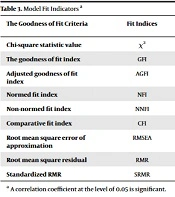
A total of 99 CAD patients, with the mean age of 59.7 (age range, 20 - 86) were entered and 58 cases (58.8%) were males. Cronbach’s alpha for quality of Life and type D personality questionnaires were calculated 0.93 and 0.81, respectively which are acceptable values. Prevalence of diabetes, hypertension and high cholesterol in these patients were 25.3%, 47.5% and 17.2%, respectively. The regression weights for the final model are in Table 1. We checked the relationship between type D personality and quality of life with the proposed model (Figure 1) in CAD patients by the illness perception as a mediator variable directly or indirectly. Some nonsignificant relationships had been deleted using the Back Ward method. Finally, 48 significant parameters were estimated in the model. This model was fitted with the chi-square = 67.905, degrees of freedom= 57 and P-value = 0.153. In addition, other fit indices such as goodness of fit index (GFI), root-mean-square error of approximation (RMSEA) and Tucker-Lewis index (TLI) were 0.91, 0.044 and 0.978, respectively that indicated a good fit of the suggested model with 48 parameters. The meaningful levels for RMSE, GFI and TLI were < 0.08, > 0.95 and > 0.95, respectively (29). The χ2 /df was 1.19 (Figure 2).
Table 1.
Regression Weights for the Final Model
| Scale and subscale | Direction of Relationships | Scale and subscale | Estimate | S.E. | P-Value |
|---|---|---|---|---|---|
| Illness perception | ← | D personality | 0.902 | .207 | < .0001 |
| Quality of life | ← | Illness perception | -0.236 | .045 | < .0001 |
| Quality of life | ← | D personality | -0.375 | .097 | < .0001 |
| Mental health | ← | Quality of life | 2.060 | .401 | < .0001 |
| Emotional rolling | ← | Quality of life | 4.460 | .750 | < .0001 |
| Social function | ← | Quality of life | 4.563 | .574 | < .0001 |
| Vitality | ← | Quality of life | 2.866 | .414 | < .0001 |
| General health | ← | Quality of life | 2.400 | .314 | < .0001 |
| Bodily pain | ← | Quality of life | 3.959 | .461 | < .0001 |
| Physical rolling | ← | Quality of life | 4.990 | .850 | < .0001 |
| Physical function | ← | Quality of life | 1.000 | NA | NA |
| Inhibition of verbal communication | ← | D personality | 0.090 | .040 | .024 |
| Anger | ← | D personality | 0.317 | .075 | < .0001 |
| Irritability | ← | D personality | 0.526 | .080 | < .0001 |
| Anxiety | ← | D personality | 1.000 | NA | NA |
| Social constraints | ← | D personality | 0.283 | .076 | < .0001 |
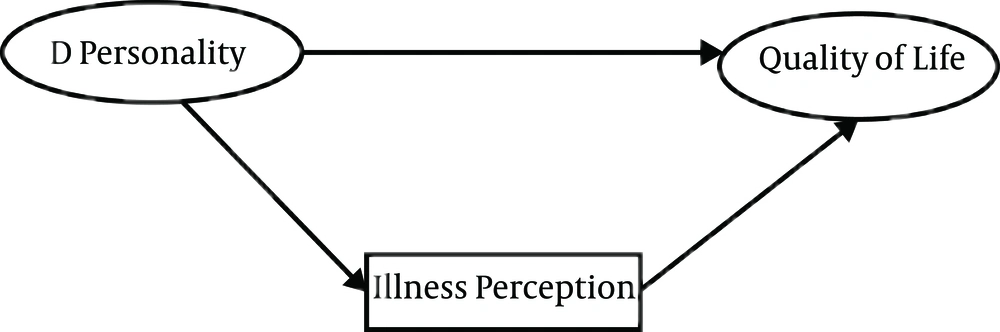
Figure 1.
The Proposed Model

Figure 2.
The Final Model
According to this model (Figure 2), the type D personality was related to quality of life in patients with CAD directly or indirectly by the mediator of the perception of illness. Personality variable significantly predicted illness perception with positive correlation. In addition, personality variable and illness perception inversely predicted quality of life. The anxiety subscale of the personality variables had a significant reverse correlation with general health perception, vitality and mental health of quality of life. Irritability significantly had an inverse relationship with mental health and physical functioning of quality of life. Social limitations had an inverse correlation with general health. Anger and vitality inversely correlated with themselves. Verbal inhibition had a significant Inverse relationship with general health and social functioning. Another finding of this research was some relationships between subscales of each component that improved the fit of the model. In personality variables, social limitations had a positive relationship with verbal inhibition but an inverse relationship with anger. About quality of life, we found an inverse relationship between physical functioning and bodily pain. There were direct relationships between physical functioning and emotional functioning, bodily pain and emotional functioning, vitality and mental health. Also, a significant inverse relationship was found between the vitality with social functioning and mental health with physical functioning.
5. Discussion
The present study investigated the relationship between illness perception, type D personality and quality of life with CHD and created a conceptual model. Except the special signs and symptoms of CAD, changing of physical conditions, severe mental protests, loss of job security, decrease in recreation time and social relation, stressful future and disruption of individuals and family relationships were done (30).
The results of this study showed that type D personality was directly a significant predictor of illness Perception. Williams and colleagues (31) found that all aspects of illness perception were significantly different in coronary patients in two groups of type D personality and the other type which confirms our results. Also, Monirpour (25), concluded that type D personality significantly predicted illness perception in coronary patients. Pane Baker (1983, quoted by Ogden, 2004) suggested that the individual and personality differences were influenced by the individuals attention to the inner state and their symptoms. Some people may be very sensitive to symptoms; the others encountered with low sensitivity (15).
As a result, personality variables and illness perception were inversely predicted quality of life. In fact personality variables can predict quality of life directly or through the illness perception as a mediator variable. In relation to the personality and quality of life consistent with the results of this study, Moreno-Jimenez (32) showed that personality variables predicted quality of life in cardiac patients. In addition, there is a significant relation between difficult emotion describing and social inhibition with low quality of life. Julkunen and Ahlstrom (33) found a negative correlation between anger (type D personality subscale) and quality of life. Consistent with these findings, Pedersen et al. (9), Gul et al. (34), Denollet and colleagues (6) and Whitehead (12) and Martin (13) reported a significant relationship between type D personality and quality of life in patients with CHD.
According to the model, anxiety as a subscale of personality variables had a significant inverse correlation with general health, vitality, and mental health. Irritability had a significant inverse relationship with mental health and physical function. As a result, irritability, depression and anxiety can reduce people stimulation threshold and create tension and sadness. These persons are prone to pessimism, their self-esteem was lower than the normal population and their social relationship was very fragile. The other finding of this study was the inverse relationship between social limitations and general health. Also, verbal inhibition had a significant negative relationship with general health and social functioning.
As we know, the CVD was in the category of psychosomatic disease and emotional and affective factors play a critical role in their etiology. In other words, despite the symptoms of CAD appear with physical damage, but emotional factors were the main factors causing them. Furthermore, type D personality through reducing positive emotions, social inhibition and lack of emotional support from family and friends in the stress position, can cause decreased life satisfaction, increased psychological disorders such as social isolation and depression, anger, anxiety and loss performance of the activity. Health-related behaviors were less preferred by people with type D personality. These individuals In comparison with the other normal people did not have an enjoyable activities, nutritional deficiency, noncompliant health care and did not perform regular checkup and totally noncompliance criteria for general health will be reduced their health. Also, the oldest people with this type of personality have more traumatic lifestyle and noncompliance public health standards, more prone to physical and mental disorders, reduced well-being in different aspects of psychological-social and totally reduced general health (35, 36). However, contrary to expectations, anger in type D personality had a direct correlation with the vitality variable of quality of life. Maybe because of elderly patients with coronary disease and social constraints, possibly express anger causing assertiveness of these people and it is a spirit and vitality.
In relation to the illness perception, consistent with the study results, van Ittersum et al. (37) and Bazzazian et al. (38) showed that illness perception variables can explain part of the quality of life variance. Also, Yaraghchi et al. (39) showed that the nature, worry of disease, awareness about severity of disease and emotional components of illness perception can predict quality of life in patients with CAD. However, Williams (31) showed that disease perception can play a mediating role in the relationship between type D personality and the effects of CHD. So, it seems that, illness perceptions play a mediating role in the relationship between personality variable and quality of life in CAD patients. On the other hand, a significant relationship between subscales of the present study variables indicates that type D personality and illness perceptions had a synergistic effect on incidence and prognosis of CAD.
These results suggested that diagnosing type D personality and their specific perceptions and knowing about how these perceptions can affect the CAD, help medical team to identify patient with prone personality and prevent them from the disease by changing their life style. Modifying patients’ lifestyle can also reduce the severity and the impacts of illness and the effects of medical intervention are more stable.