1. Background
Noise propagated from road vehicles (including motorcycles, cars and heavy machinery) has a major contribution to noise pollution of cities. At present, noise pollution is amongst most important problems of industrialized societies and developing countries. Noise pollution can be caused by many sources. However, the impacts of the remaining factors are lower compared with traffic noise, in terms of noise levels and amount of annoyance for individuals. On the basis of the conducted studies, noise pollution can have various effects on health, including hypertension, risk of heart disease, impact on sleep, psychological effects, annoyance and disruption of daily activities, fatigue, decreased performance in school children, interference with daily life and other effects (1-7). The impacts of noise pollution on peoples’ sleep and health have been confirmed by various laboratory, field, epidemiology and review studies (8-14). The World Health Organization (WHO) announced that there is various evidence that exposure to noise at night is a cause of self-reported sleep disturbance, which is a major cause of health problems (15). The previous studies have led to the introduction of equations, by which the size of populations affected by environment noise can be estimated. This is done by using the dose-response curve. Thus, the level of people annoyance or sleep disturbance from environmental noise can be estimated (16).
Dose-response curve, along with noise regional map data can be used to estimate actual number of people exposed to noise in a society. To determine society’s exposure to environmental noise, regional scale noise maps have been a popular method during the last ten years. Constructing such maps has turned into an obligation for some parts of the world. Percentage of annoyed people as a function of exposure to noise in residential areas is provided by WHO (17) and the European Commission (18). Based on these functions and also dose-response curves, the percentage of annoyed people by certain values of day-evening-night noise level (Lden) and vice versa can be estimated.
Health and welfare impacts caused by environmental noise have heavy costs for the society (19). One of the reasons behind this is because health costs are not reflected in the market price of transportation and the financial are not accounted for the external costs (20-22). Reported annoyance due to traffic noise is variable, with respect to different modes of transportation. Noise caused by aircrafts in comparison to the same noise level from road traffic noise is more annoying. Various modes of traffic have different disruption in sleep mode (20). Therefore, studies have recommended that the difference between modes of transportation should be considered in cost calculation.
2. Objectives
Since awareness of health costs due to traffic noise can have a great impact on decision-making for control measures, this study attempted to estimate costs of traffic noise in the city of Tabriz, Iran. Our purpose was to measure and evaluate traffic noise pollution by the top-down method in Tabriz city.
3. Materials and Methods
Generally, two different approaches are used to estimate the costs of traffic noise:
1. The bottom-up approach
2. The top-down approach
The bottom-up approach is generally called the ‘impact pathway approach’. The starting point of this approach is at the micro level, i.e. the traffic flow on a particular route.
The starting point of the top-down approach is at the macro level, i.e. the estimated cost for a country. The top-down approach uses the Willingness to Pay (WTP) or the willingness to accept compensation for more silence, and the associated health effects, and multiplies these unit values with the data on noise exposure for different noise classes.
The top-down approach calculates the average value of transportation costs. It uses the total noise exposure (differentiated for noise classes) and divides it by total mileage driven on that road. In addition, different methods can be applied to value the effects of transport noise. In some cases market prices can be used to value the effects of transport noise (e.g. cost of illness). However, for annoyance effects no market prices exist, and the Willingness to Pay (WTP) approach should be used. Generally, there are two valuation methods including the hedonic valuation method (HVM) and the contingent valuation method (CVM). The HVM examines differences in housing prices due to traffic noise, whilst, HVM is based on “WTP” calculations (23, 24). In other words, CVM evaluates the Willingness to Pay (WTP) or the Willingness to Accept (WTA) changes in environmental goods and services, through questioning people directly. To determine peoples’ reaction in specific situations, this direct questioning approach is used. This is performed by deduction of individuals’ behavior in terms of their responses to the questions. In fact, since there is no market for environmental quality of air, water, soil, and other environmental goods, the economic evaluation of these environmental goods is done by, estimation of WTP. On the other hand, when environmental damage occurs, injuries and damages are engendered. Therefore, one can point directly that, the benefits of improving environmental quality is made by reduction in loss (25). The contingent valuation method was presented to estimate the WTP for five levels of annoyance in Europe during 2006. Finally, the mean WTP per person per year to eliminate road noise annoyance at the five levels was presented (WTP per person per year for not annoyed, slightly annoyed, moderately annoyed, very annoyed and extremely annoyed was 8.12, 37.08, 84.93, 84.30, 80.51€, respectively (€ 2005)) for six European countries (26).
The present study was carried out in Tabriz city during year 2011 (1390 in Iranian calendar). To obtain the 24-hour noise exposure level (Lden), the level of noise was measured in 35 stations of the ten districts (based on civic divisions, covering all the areas particularly busy squares, intersections and highways) of Tabriz city during the morning, afternoon, evening and night. This was done by considering overcrowding, exposure level and people’s daily travels and freight. To do so, noise pollution was measured during the following hours, 6 to 8 in the morning 12.5 to 14.5 at noon, 17 to 19 in the afternoon and 22 to 24 at night, and during these hours, the one hour average noise level (L1h(i)) was obtained for each station. Next, to find the effects of noise at different distances, and to obtain the number of people exposed to a certain level of noise, the annoyance levels due to traffic noise were assessed for 300 Tabriz residents, using a questionnaire. Samples included one individual between 18 and 80 years old in each family who had lived for at least one year at his/her current location. The questionnaire consisted of two parts. The first part consisted of demographic information and individual’s residential information, as well as people annoyance and disruption in everyday function. The second part of the questionnaire consisted of the mental and physical effects of noise, such as sleep disturbances, depression, headaches, etc.
Questionnaire content validity was then reviewed and approved by a panel of experts including three experts in the field of occupational health and ergonomics. Its reliability was calculated by a pilot study of 30 patients with Cronbach’s alpha and internal consistency. Cronbach’s alpha value was equal to 0.75. When applying a questionnaire as part of a research method, the number of samples should be a multiple of at least five, of the number of questions. In this study, the questionnaire consisted of 41 questions. Hence, 300 Tabriz residents around the squares, intersections and highways, and at different distances from these locations were selected. Finally, the amount of traffic noise cost was calculated. To calculate the cost, three steps were taken, as follows:
1) Defining the threshold value (a value below which there is no considerable annoyance). Based on the recommendations of the European commission (18) and WHO, the threshold value is 55 dB.
2) Determining the number of people exposed to a certain level of noise (Lden).
3) Evaluation in terms of money in each region: at this stage, the following equation (Essen H, 2004, equation 1 (21)) was used to calculate the costs. Based on the recommended value by the European commission, 10 Euros per (decibel) person per year was used (2004 Euros).
Equation 2 was used to obtain one hour average noise level (L1h (i)), for 15 hours during the day, whilst Equation 3 and Equation 4 were applied to obtain one hour average noise level (L1h (i)) during the evening and night, respectively. By using Equation 5, 24 hours noise level was then calculated. In order to apply the impact of time of the day into account; uses a weighted noise measure to take evening noise carries a penalty of 5 dB (A) and night noise carries a penalty of 10 dB (A) (Equation 5). When Lden was obtained, its value was corrected based on various distances from the stations. This was done by using the results of people annoyance, which was categorized in five groups including; not annoyed, slightly annoyed, moderately annoyed, very annoyed and extremely annoyed. For this purpose, the link between annoyance and Lden that was provided by the European commission and WHO was used. On this basis, for extremely annoyed individuals, Lden value was calculated from the noise measurement at 35 stations in 10 regions of the city, and for moderately annoyed and very annoyed groups, Lden 24 hours noise level was calculated (without correction). For not annoyed and slightly annoyed individuals, as the obtained Lden value was less than the cut-off value, Lden was not calculated.
4. Results
Based on the questionnaire results, the levels of resident’s annoyance due to traffic noise were 15% for not annoyed, 22% for slightly annoyed, 39% for moderately annoyed, 17.7% for much annoyed, and 6% for extremely annoyed individuals. The population sizes for each of the mentioned levels of annoyance were 224 249, 328 899, 583 050, 264 614 and 94 185, respectively. The population sizes of the ten regions of the city, based on annoyance level, are presented in Table 1. As indicated, the first, third and fourth districts of the city (based on civil divisions) were more crowded.
Table 1.
| Region of City | Total Population | Not Annoyed | Slightly Annoyed | Moderately Annoyed | Very Annoyed | Extremely Annoyed |
|---|---|---|---|---|---|---|
| Region 1 | 212,206 | 31,830 | 46,685 | 82,760 | 37,560 | 13,368 |
| Region 2 | 169,047 | 25,357 | 37,190 | 65,928 | 29,921 | 10,649 |
| Region 3 | 243,400 | 36,510 | 53,548 | 94,926 | 43,081 | 15,334 |
| Region 4 | 316,124 | 47,418 | 69,547 | 123,288 | 55,953 | 19,915 |
| Region 5 | 92,274 | 13,841 | 20,300 | 35,986 | 16,332 | 5,813 |
| Region 6 | 94,897 | 14,234 | 20,877 | 37,009 | 16,796 | 5,978 |
| Region 7 | 143,460 | 21,519 | 31,561 | 55,949 | 25,392 | 9,037 |
| Region 8 | 28,700 | 4,305 | 6,314 | 11,193 | 5,079 | 1,808 |
| Region 9 | 324 | 48 | 71 | 126 | 57 | 20 |
| Region 10 | 194,564 | 29184 | 42,804 | 75,879 | 34,437 | 12,257 |
a All the parameters are individual.
b Source: Research findings.
The obtained Lden values for the different districts of the city are presented in Table 2. According to the results, and based on the municipal divisions of Tabriz, the eighth, ninth and second district of the city had the highest level of noise with 74.5, 73.5, and 71 dB, respectively. However, in these regions, population density was lower compared to the other areas such as the fourth district of the city. For moderately and very annoyed individuals, day-evening-night day-evening-night noise Level (Lden) are shown are corrected based on figure 1. The corrected value are presented in Table 2. Since Lden value for not annoyed individual and slightly annoyed individual was lower than threshold (55 dB) value, had not been mentioned in Table 2. Table 2 presents the number of individuals exposed to different levels of Lden. Furthermore, the costs for the specified level (using Equation 1) and also for different regions are presented in Table 2.
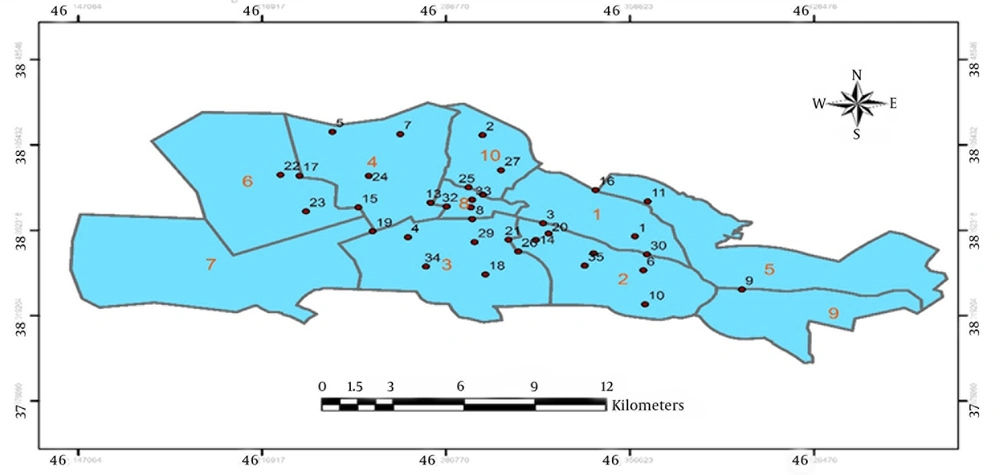
Figure 1.
Traffic Noise Level of Different Stations in Various Regions of Tabriz City
Table 2.
Cost Calculated Based on Day-Evening-Night Noise Level (Lden) a
| Annoyance Levels | Lden (dB) | Individual Frequency | Cost, € | The Cost for Each Region |
|---|---|---|---|---|
| Region 1 | 16546716 | |||
| Moderately | 65 | 82760 | 9310500 | |
| Very annoyed | 67 | 37560 | 5070600 | |
| Extremely annoyed | 69.4 | 13368 | 2165616 | |
| Region 2 | 13373055 | |||
| Moderately | 65 | 65928 | 7416900 | |
| Very annoyed | 67 | 29921 | 4039335 | |
| Extremely annoyed | 71 | 10649 | 1916820 | |
| Region 3 | 24727290 | |||
| Moderately | 65 | 94926 | 10679175 | |
| Very annoyed | 67 | 55953 | 7553655 | |
| Extremely annoyed | 68.4 | 43081 | 6494460 | |
| Region 4 | 24201697 | |||
| Moderately | 65 | 123288 | 13869900 | |
| Very annoyed | 67 | 55953 | 7553655 | |
| Extremely annoyed | 68.4 | 19915 | 2778142 | |
| Region 5 | 7064158 | |||
| Moderately | 65 | 35986 | 4048425 | |
| Very annoyed | 67 | 16332 | 2204820 | |
| Extremely annoyed | 67.2 | 5813 | 810913 | |
| Region 6 | 3517742 | |||
| Moderately | 65 | 37009 | 416351 | |
| Very annoyed | 67 | 16796 | 2267460 | |
| Extremely annoyed | 69.1 | 5978 | 833931 | |
| Region 7 | 16492894 | |||
| Moderately | 65 | 55949 | 9294262 | |
| Very annoyed | 67 | 25392 | 3427920 | |
| Extremely annoyed | 69.9 | 9037 | 3770712 | |
| Region 8 | 2353123 | |||
| Moderately | 65 | 11193 | 1270828 | |
| Very annoyed | 67 | 5079 | 685665 | |
| Extremely annoyed | 74.5 | 1808 | 396630 | |
| Region 9 | 27211 | |||
| Moderately | 65 | 126 | 17010 | |
| Very annoyed | 67 | 57 | 7951 | |
| Extremely annoyed | 73.5 | 20 | 2250 | |
| Region 10 | 16349055 | |||
| Moderately | 65 | 75879 | 10243665 | |
| Very annoyed | 67 | 34437 | 4726478 | |
| Extremely annoyed | 69.4 | 12257 | 1378912 | |
| Total cost | 119926467 | 119926467 | ||
a Source: Research findings.
The costs were estimated for the second time, directly through multiplying the average of WTP for each person per year with the total number of individuals with certain annoyance levels (see Table 3). Based on these results, the total estimated cost was equal to 104 290 507 €. The cost due to noise was somewhat different for the two methods. This might be due to differences in individual’s willingness to pay for comfort in different countries.
Table 3.
Cost for Groups With Different Levels of Exposure to Traffic Noise (Computed by Willingness to Pay Based on Heatco for Six European Countries, 2006) a
| Annoyance Levels | Population Frequency | Willingness to Pay Per Person Per Year, 2012, € | Cost, € |
|---|---|---|---|
| Not annoyed | 224249 | 9 | 2018241 |
| Slightly annoyed | 328899 | 40.5 | 13320409 |
| Moderately annoyed | 583050 | 95 | 55389750 |
| Very annoyed | 264614 | 94.8 | 25085468.4 |
| Extremely annoyed | 94185 | 90 | 8476638.6 |
| Total cost | 104290507 | ||
a Source: research findings.
5. Discussion
Based on the findings of this study, the health effects of traffic noise in terms of money on Tabriz residents are very significant. Therefore, in order to reduce adverse effects of noise pollution in the long-term, preventive measures have to be taken by local authorities. A comprehensive traffic system, further improvement of urban public transportation system, placing sound barriers, setting high prices for parking in central parts of the city, concentrating commercial centers outside the city, and increasing green space are suggested preventive measures and control actions. The measures have to be taken by urban managers and decision-makers to reduce the health impact of traffic noise on Tabriz residents.
Traffic noise imposes heavy costs for the health and welfare of the residents in different countries, whilst the costs are dissimilar. Considering the increasing costs due to traffic noise, this study aimed at measuring traffic noise pollution in Tabriz city and its associated costs by applying the top-down method. Due to differences in input values, such as the threshold limit value and the method used to calculate the costs, the calculated costs can vary to some extent. In general, the average costs that are calculated by a top-down approach, are higher than the marginal costs that are calculated by a bottom-up approach. The average cost can be up to six to eight times the marginal costs (27). Moreover, various studies have used different threshold limits for health effects and annoyance caused by traffic noise. For example, Unite in 2003 considered 70 dB as the threshold of health effects other than sleep. The cut-off for sleep disturbance was considered as 43.2 and 40 dB, for road and rail noise, respectively.
The results of a study in the Netherlands showed that the health costs due to traffic noise are half of the cost of road accidents. In addition, based on the Dolly index between 1980 to 2020, the index for noise is rising while, it is falling for accidents, in this way they will be same by 2020 (28). A dose-response study with a cut-off of 55 dB was conducted in Germany, which showed that 31 million people were exposed to noise above 55 decibels and health costs due to noise was 2.5 billion euros each year. The costs caused by noise pollution are increasing in cities around the world. Dassen stated that in the Netherlands, 3% - 4% of the population is exposed to noise levels exceeding 65 decibels. Without additional policy measures, more people (5% - 6%) would be exposed to higher noise levels. This is caused by factors like high population density, increasing urbanization and mobility of people and increasing goods transport. Other factors are the increase in recreational activities and elevated possession, and the use of sound equipment (29).
It is worth noting that, the above-mentioned factors such as high population density and increasing urbanization, can be even more important and expose more people to noise in the cities of developing countries. In this regard, the results of the present research in Tabriz city indicated that, 23.7% of people are exposed to higher noise levels than 67 decibels and amount of calculated total costs (including direct costs only) was equal to 119,926,467 € in year 2012. These high costs can be avoided by preventive measures. In other words, the difference between the high costs imposed by traffic noise in Tabriz city and preventive costs, which can be spend to reduce traffic noise health impacts, is too large. This can indicate the necessity of planning and investment for control measures to secure the health of the society. In the study of Naish et al. (30), which estimated health-related costs of an acoustic balcony, it was shown that the use of an acoustic balcony has great impact on reducing the expenses of health due to traffic noise.
Willemijn carried out another study in which, he used the hedonic method to analyze monetary valuation of aircraft noise around Amsterdam airport in Netherland. The findings of his study indicated that a marginal benefit of 1 dB noise reduction leading to a total benefit of 1 dB noise reduction of 574 million Euros (31). In another study that was conducted by Watts et al. (32) and Li et al. (33), it was shown that the presence of green spaces such as grasslands, gardens etc. can also have a large impact on reducing traffic noise. Therefore , control measures with smaller costs can really reduce the received noise by people with its adverse consequences.