
1. Background
The increase in urbanization and population cause more solid wastes. The basic policy for prevention of water, soil and air pollution, is preventing natural resources destruction and disease transmission (1, 2). Integrated management of municipal solid wastes comprised of eight required elements, including waste minimization, storage, collection, transportation, processing and recycling, final disposal and surveillance after disposal of solid wastes (3, 4). All these elements are interconnected like a chain of rings. To achieve such an important matter, planners must also monitor all stages of the chain (4, 5). However, the reality is that the element of solid waste production is more important in the process of solid waste management. The amount of solid waste with respect to time, season and geographical location is different (5). One of the most important types of municipal solid wastes in terms of both quantity and quality is medical wastes. Medical solid wastes are usually produced from diagnosis, treatment and immunization of diseases in health care centers (6, 7). Hospital solid wastes as a significant portion of medical solid wastes in health care centers, both in terms of quantity and quality are the most important. Approximately 1% of the total municipal solid wastes in each community is generated by the hospitals (6, 8). Various factors influence amount of generated hospital solid wastes such as the hospital size, variety of activities and type of hospital ownership (public or private) (9, 10). Generally, hospital solid wastes are divided into general solid wastes and hazardous solid wastes (11). Hazardous solid wastes form 10 to 25 percent of solid wastes generated in health care centers and hospitals (6). This type of waste is divided into three sub-groups such as infectious and chemical wastes and sharps (6, 8). Hospital solid wastes were categorized by the World Health Organization (WHO) in eight groups including general, chemical, infectious, radioactive, pathological and pharmaceutical wastes, pressurized containers and sharp objects (6).
Babolsar is a coastal town in the North of Iran and is the closest town to the Caspian sea. The city is one of the most important tourist regions in the country. It is located on the southern coast of the Caspian Sea. Since the Babol River passes through the city, both the bank of the river and the beach of the sea potentially attract many tourists. Also the existence of many central organizations and Mazandaran University challenged the integrated solid wastes management of Babolsar. Babolsar city has an area of 345.7 square kilometers and a population over 124323 people. The construction of new tourist towns often increases the population of the city up to a hundred thousand in some seasons of a year. The latitude and longitude of Babolsar are 36, 41, 44 N and 52, 38, 44 E, respectively (Figure 1).
2. Objectives
Review of the quality and quantity of household and hospital solid wastes in Babolsar city was the purpose of this study.
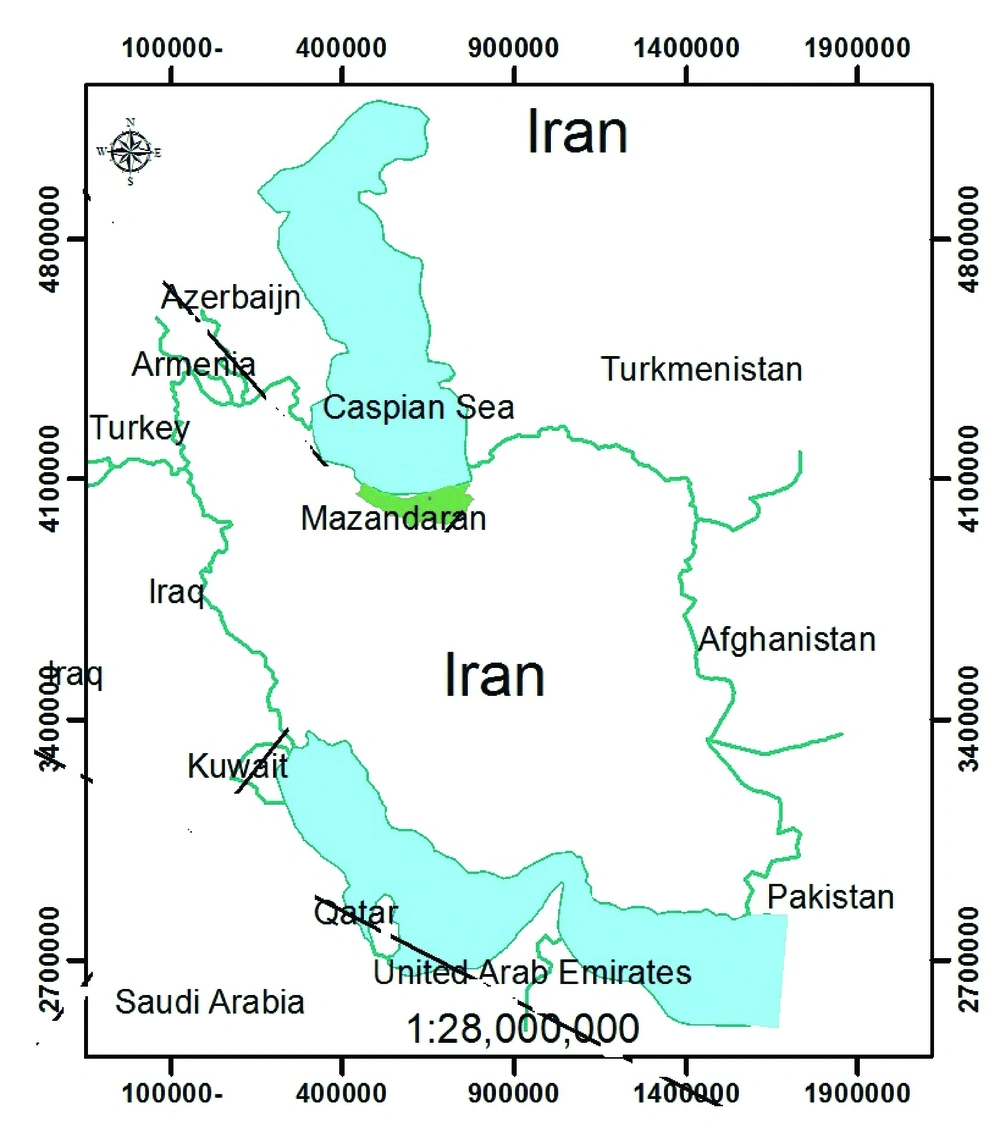
Figure 1.
Location of Investigated Area
3. Materials and Methods
This study was descriptive and cross- sectional and was performed in a landfill site and three hospitals of Babolsar.
3.1. Sampling and Sorting Operations
Sampling was carried out at a disposal site (Landfill site) according to international standards ASTM D 5231-92 (12). The determination of the mean composition of MSW was based on the collection and manual sorting of wastes during one week. Vehicle loads of wastes were designated for sampling, and a sorting sample was collected from the discharged vehicle load. Each sorting sample was weighed to 120 kg and prepared properly (mixed, coned and quartered) from each discharged MSW vehicle load by using a front end loader with at least a 0.5 m3 bucket. Samples were then classified into seven categories (food waste, plastic, paper, glass, metal, textile and other materials) manually (5, 11). Each material category was then weighed and registered in the data sheet. Weighing of the solid wastes generated by three hospitals (Shafa hospital, Shahid Rajaei and Hazrat Zeinab hospitals) was performed on 3 consecutive days (Monday, Tuesday and Wednesday) in the mid-weeks of the second month of spring and autumn of 2012. A Mettler digital scale with an accuracy of 0.1 grams was used for household and hospital solid wastes weighing. Physical analysis of hospital solid wastes was performed after selecting 120 kg samples and separating them into food waste, plastic, paper, glass, metal, textile and other materials (8, 10). In this study, general and infectious solid wastes were collected in black and orange containers and sharp objects in plastic containers (Safety box). The statistical analysis of the results was done through ANOVA and T-test at a significance level of P < 0.05 on the SPSS software.
4. Results
4.1. Generation Rate of Household Solid Wastes
Daily average of solid waste production in Babolsar city was 73608 ± 7483 kg. These amounts in spring and autumn were 67184 ± 2202.5 and 80033 ± 3365 kg per day respectively. On the basis of population census in 2012 by statistical center of Iran, Babolsar city had a population of 61984, and average generation rate of solid waste in this city was 1.2 kg per person in a day. The average generation waste (in spring and autumn) was 1.1 kg and 1.3 kg per person in a day respectively. In this study, total generation of food, paper and plastic wastes were more than 85 percent of total municipal solid wastes (Figure 2).
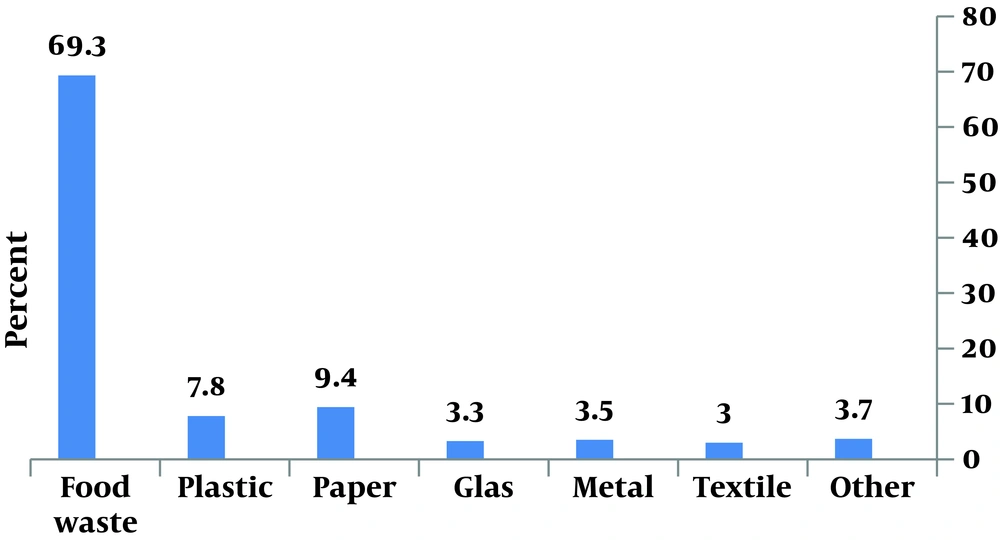
Figure 2.
Percent by Weight of Municipal Solid Waste Components in Babolsar
4.2. Determination of Generation Rate of Hospital Solid Wastes
Table 1, shows the average amount of total solid wastes including general and infectious solid wastes, and sharp objects generated in the studied hospitals. In this review, the amount of total solid wastes produced in Shafa hospital was more than other hospitals.
A general solid waste generated by any hospital was more than other solid waste types. An average generation rate of hospital solid wastes per bed in Babolsar was determined to be 2.33 kg per day. In the present study, the average percentage of general and infectious solid wastes, and sharp objects were 50.6%, and 48.1% and 1.3% respectively (Table 1).
Table1.
Generation Rates of Solid Wastes in the Investigated Hospitals
| Hospital | The Number of Occupied Beds | Total Solid Waste, Generation Rate (kg/day) | General Solid Waste, Generation Rate (kg/day) | Infectious Solid Waste, Generation Rate (kg/day) | Sharps, Generation Rate (kg/day) |
|---|---|---|---|---|---|
| Shafa | 120 | 285 | 144.2 | 137.1 | 3.7 |
| Shahid Rajaei | 46 | 82.5 | 41.7 | 39.7 | 1.1 |
| Hazrate Zeinab | 32 | 92 | 46.6 | 44.3 | 1.2 |
| Mean | 66 | 153.2 | 77.5 | 73.7 | 2 |
4.3. Determination of Various Components of General Solid Wastes in the Investigated Hospitals
Table 2 shows the average percentage of different components of general solid wastes in the health care centers. According to this table, the amount of food wastes, paper and plastic components formed more than 70 percent of hospital wastes.
Table 2.
Average Percentages of Available Components of General Solid Wastes in the Hospitals
| Hospital | Food Wastes | Plastic | Paper | Glass | Metal | Textile | Other |
|---|---|---|---|---|---|---|---|
| Shafa | 46.5 | 13.8 | 15.4 | 6.2 | 4.5 | 5.3 | 5.3 |
| Shahid Rajaei | 46.2 | 11.5 | 12.6 | 7.4 | 6.8 | 5.2 | 10.3 |
| Hazrate Zeinab | 44.3 | 9.5 | 12.8 | 7.2 | 7.4 | 9.5 | 9.4 |
| Mean | 45.3 | 11.6 | 13.6 | 6.9 | 6.2 | 6.7 | 8.3 |
The Figure 3, shows the components of plastic, textiles and paper in infectious wastes were more than other components (Glass, Metal and sharps) in all hospitals. According to this figure, plastic component percentage (37%) was more than other components of infectious solid wastes in the investigated hospitals.
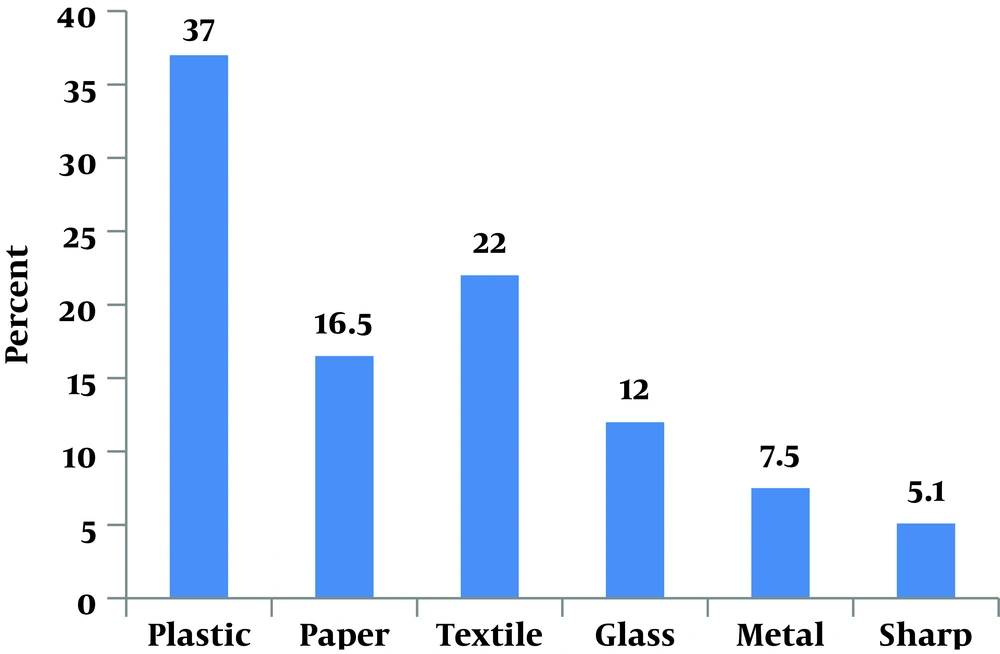
Figure 3.
Average Percentages of Available Components in Infectious Solid Wastes of the Hospitals
5. Discussion
Based on the present study, the amount of solid waste generation rate of municipal solid wastes in Babolsar was 1.2 kg per person per day, so it is more than the average generation rate of municipal solid wastes of each person per day (791 gram) in Iran (2). This outcome is due to the coastal and touristic region of Babolsar. It is necessary to allocate sufficient funds and facilities to collect and transport municipal solid wastes of this beautiful and attractive city. In a study by Jafari and colleagues conducted in the city of Khorramabad, generation rate of municipal solid wastes was 800 g per capita in a day (3). According to the other studies from different countries such as India, Nepal, Pakistan, Bangladesh and SriLanka, the generation rate of municipal solid wastes was 790, 350, 440, 730 and 590 gram per person per day (4). In this research, the mean percentages of food wastes, paper, plastic, metals, glass, textiles and other materials were 69.3%, 9.4%, 7.8%, 3.5%, 3.3%, 3 and 3.7% respectively. Based on Samadi and colleagues investigation, the average percentage of putrescible materials, plastic, paper and textiles, metals, glass and other items in Hamedan municipal solid wastes were 77.7%, 5.4%, 5.6%, 3.2%, 2.1%, 1.1% and 4.9%, respectively (5). Considering the results of this research and its comparison with other investigations, it has been identified that the percentages of putrecible items, paper and plastic in the municipal solid wastes of Babolsar (86.5%) are appropriate for recycle programs. In this study, mean generation rate of total, general, and infectious solid wastes and sharp materials in Babolsar hospitals were 2.33, 1.2 and 1.1 and 0.03 kg per bed per day respectively; thus, 50.6 % were general wastes, and 48.1% and 1.3 % were infectious wastes and sharp materials, respectively. In the research of Bazrafshan and et al., mean generation rate of general solid wastes, infectious wastes and sharps were 1.4, 1.3 and 0.04 kg per bed/day respectively (13), which were similar to that found in this study. Based on the research of Taghipour and colleagues, total generation rate of hospital wastes, general wastes and infectious wastes were 3.48, 2.43 and 1.04 kg per bed/day respectively (14). Amouei et al. found that the average generation rate of total solid wastes of each bed was 2.3 kg per day in hospitals affiliated to the Babol University of Medical Sciences, which was similar to that found in by our study. Askarian and colleagues determined that the generation rate of total solid wastes for a bed was 4.45 kg per day, by investigating 15 private hospitals of Fars province. They explained that the quantity of general and infectious solid wastes and sharp objects were 71.4%, 27.8% and 0.76% respectively (15). In this research, the percentages of food wastes, paper and cardboard, plastics, glass, textiles, metals and other materials were 45.3%, 13.6%, 11.6%, 6.9%, 6.7%, 6.2% and 8.3% respectively. Mean of weight percentages of plastics, textiles, paper, glass, metals and sharps in the infectious wastes were 37 %, 22 %, 16.5%, 4.48%, 12%, 7.5% and 5.1% respectively. Zazouli et al. recognized that percentages of food wastes, paper, plastic, glass, metal, textiles and other material were 68%, 13.2%, 6.3%, 2.8%, 3.6%, 2.4% and 2.7% respectively (16). Household and hospital solid wastes are appropriate for recycling and conversion in to compost fertilizers by considering the high percentage of food wastes and other organic materials. Also, because of high levels of recyclable components (plastic, paper, metal and glass) in the municipal solid wastes of Babolsar, separation and recycling of these materials reduce the cost of solid waste management. Furthermore, considering the high levels of infectious waste generation in the investigated hospitals, application of sterilization systems such as hydroclave for making these hazardous wastes harmless is recommended.