
1. Background
1.1. Human Factors in Process Safety
There are obviously a wide variety of factors such as process hazards, natural hazards, or human errors, as well as their interactions affecting safety in process industries; ensuring safety in the chemical and process industries can be very complex task (1). The accident frequency and severity have increased significantly in the chemical process industries. Some accidents are associated with catastrophic consequences (2). Process industries had a high number of accidents with serious consequences, such as the explosion and fire on the Piper Alpha platform with 167 deaths in the North Sea in 1988 (3), the explosion and fire at the Esso gas processing facility at Longford with 2 deaths in Australia in 1998 (4), and the BP Refinery explosion and fire with 15 deaths and 170 injuries in Texas City in 2005 (5).
Human factors are one of the major causes of accidents (6). The UK Health and Safety Executive (HSE) defined human factors as “human factors refer to environmental, organizational and job factors, and human and individual characteristics, which influence behavior at work in a way which can affect health and safety” (7). Human factors, as a relatively new area, play an important role in process safety that can reduce the frequency of accidents by using scientific knowledge and principles (6, 8). The likelihood of human error, the prevention of work-related musculoskeletal disorders, and improving productivity and quality can be achieved through the application of human factors. Job, individual, and organizational factors have been shown to affect the safety-related behavior of workers (6). It has been demonstrated that organizational factors such as worker-management relationship, control on sub-contract’s safety behavior, management-worker co-operation on safety, and talk by management on safety have important effects on safety performance (9). Safety culture, as an aspect of the organizational culture, affects safety behavior and safety performance in organizations (10, 11). Workers with limited training may be at increased risk of injuries in their workplaces (12, 13). The main causes of 21% of the accidents in process/storage plants and in the transportation of hazardous materials were human error in the study conducted by Darbra et al. (14). Individual factors including stress, fatigue, and workers’ competence affect performance (6, 15). Physical working conditions such as physical workload, design of work place, noise, vibration, and workplace temperature (16, 17), as well as the human computer interface (HCI), communications, procedures, shiftwork issues, and alarm systems (8) may result in the loss of control and major incidents.
1.2. Analytical Hierarchy Process (AHP)
AHP was introduced in 1980 by Saaty (18). AHP approach, as a multi-criteria decision making method, is one of the more practical ways for integrating experts’ opinions and evaluating the scores as well as devises the complex decision-making system through decomposing the complex problem from higher hierarchies into important components (19). The AHP is used for evaluating the relative importance or weight of each of the factors (criterion) using the pairwise comparison matrix in terms of a ratio scale (19, 20). In AHP, the weighting of each criterion is basically determined by expert judgment using the pairwise comparisons (21).
1.3. Fuzzy Set Theory
According to Zadeh (22), the classification of objects in the real physical world fails to have precisely defined the criteria of membership. The application of decision-making method in fuzzy environments has been reported in a number of studies in an uncertain and fuzzy environment (18-20, 23). A fuzzy number is described as a fuzzy subset of real number (24). Triangular fuzzy numbers (TFNs) as well as trapezoidal fuzzy numbers are commonly used in some previous studies as a form of fuzzy numbers to treat the vagueness and ambiguity of variables associated with defined topics (25).
The approach for handling fuzzy analytic hierarchy process (fuzzy AHP) was developed by Chang in 1996 with the use of triangular fuzzy numbers for pairwise comparison scale of fuzzy AHP (26). Several attempts have been made to use fuzzy AHP in ergonomic and safety-related literatures. Dağdeviren and Yüksel used fuzzy AHP method to determine the degree of importance of the factors affecting faulty behavior risk (FBR) in work systems. The factors included organizational, personal, job related factors, and environmental factors. It has been demonstrated that the factor with a higher relative importance was an organizational factor (0.31) (27). González Dan et al. (1), employed fuzzy AHP to weight and prioritized the human factors variables. The job, the individuals, and the organization factors were considered as criteria. Their findings revealed that all criteria had the same importance (0.33) (1). Although many studies have noted the association between human factors and accidents, however, human factors, as a key aspect of process safety management, are not explicitly detailed (1, 8).
2. Objectives
In the present work, fuzzy AHP approach was used to determine the importance weights of human factors variables in the management of major accident hazards in process industries.
3. Methods
This qualitative research was conducted in 2017. As shown in Figure 1, the procedure was comprised of the following steps:
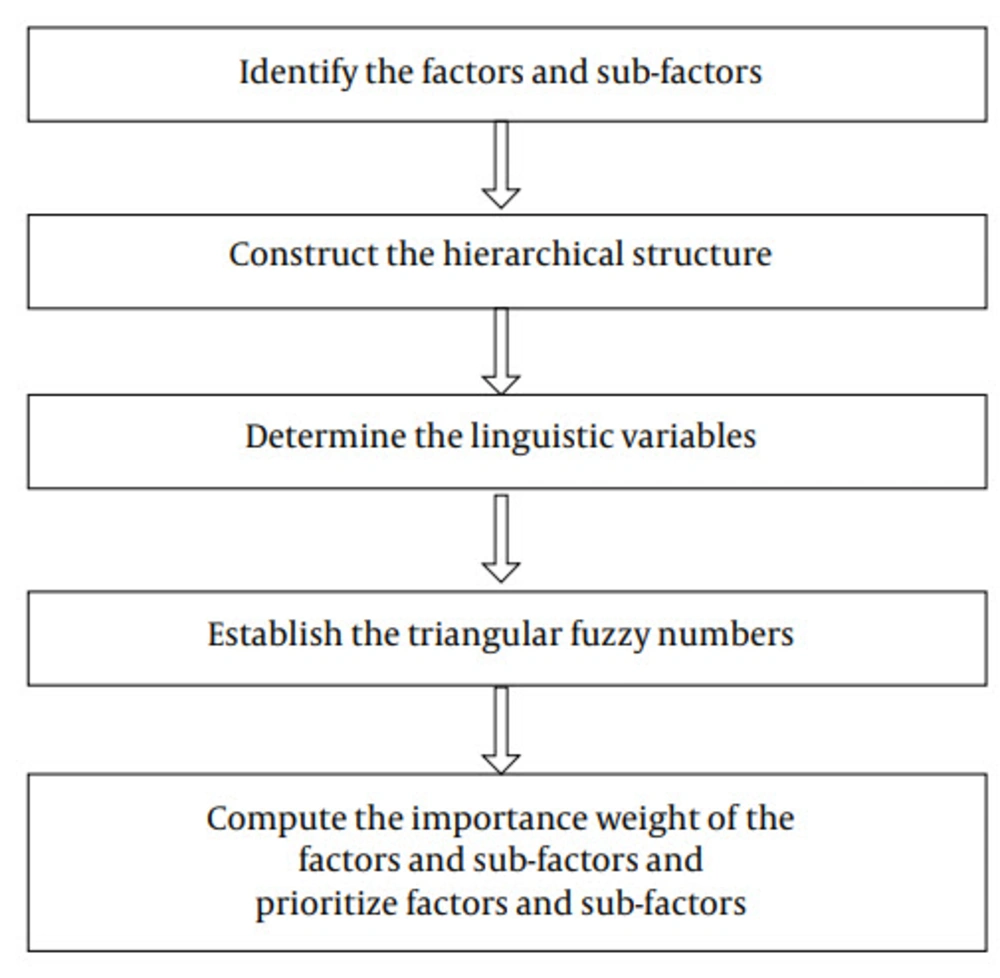
Figure 1.
Flowchart of the fuzzy AHP used for determining the importance weights of human factors variables
3.1. Identifying Human Factors Variables
According to the guidelines for human factors in the management of major accident hazards set by the HSE (6) and human factors methods for improving performance in the process industries (8), the job, the individual (personal), and the organization factors were selected as factors. The sub-factors for the job factor included communications, ergonomic design, workload, alarm systems, human-computer interface, shift pattern, environmental factors, and procedures. The sub-factors for the individual factor included fatigue, stress, and competence, and the organization factor was comprised of four sub-factors including managing human failures, training, safety culture, and management of change.
3.2. Constructing Hierarchical Structure
The hierarchical structure of AHP model was constructed based on the identified factors and sub-factors (Figure 2).
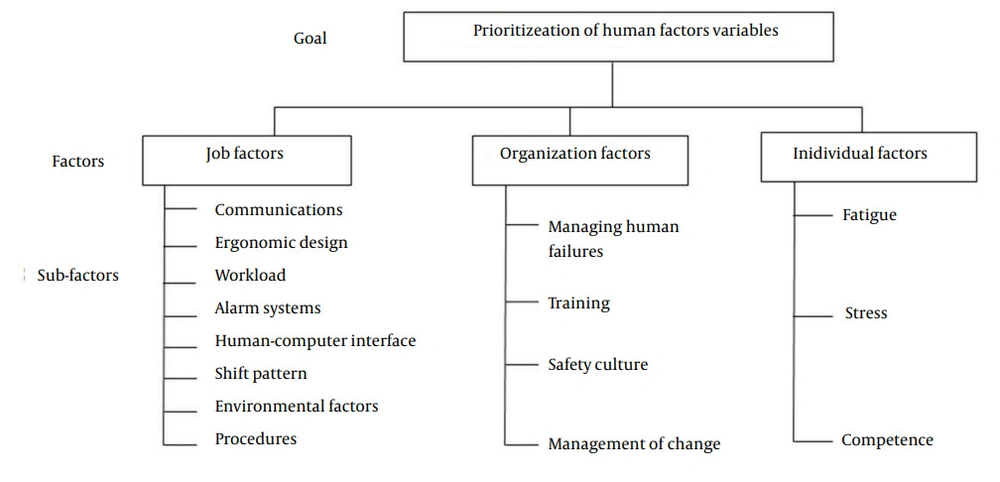
Figure 2.
Hierarchical structure of human factors variables
3.3. Preparing AHP Questionnaire and Selecting Expert Group for Pairwise Comparison Judgements
Sixteen experts (decision makers) from occupational health, safety, and ergonomic professionals from Tehran University of Medical Sciences (14 experts) and a process plant working in safety office (2 experts) were selected for pairwise comparisons. AHP questionnaire was designed for pairwise comparisons and determining the important weights and priorities of each factor and related sub-factors. Table 1 presents pairwise comparison questions for factors.
Table 1.
The Questions for the Establishment of Weights of Factorsa
| Which Factor is More Important in The Management of Major Accident Hazards? | |||||||||||||||||||
|---|---|---|---|---|---|---|---|---|---|---|---|---|---|---|---|---|---|---|---|
| 1 | Job factors | 9 | 8 | 7 | 6 | 5 | 4 | 3 | 2 | 1 | 2 | 3 | 4 | 5 | 6 | 7 | 8 | 9 | Organization factors |
| 2 | Job factors | 9 | 8 | 7 | 6 | 5 | 4 | 3 | 2 | 1 | 2 | 3 | 4 | 5 | 6 | 7 | 8 | 9 | Personal factors |
| 3 | Organization factors | 9 | 8 | 7 | 6 | 5 | 4 | 3 | 2 | 1 | 2 | 3 | 4 | 5 | 6 | 7 | 8 | 9 | Personal factors |
a Circle one number per row below using the scale: 1 = equal, 3 = moderate, 5 = strong, 7 = very strong, 9 = extreme.
3.4. Fuzzy AHP
The primary drawback of AHP method is that the method does not consider the uncertainty caused by imprecision or ambiguity embedded in the paired comparison. To overcome this drawback, pairwise comparisons in fuzzy AHP were done by membership values using the linguistic terms (28). In the present study, triangular membership functions of fuzzy numbers were used to reduce vagueness, ambiguity, and uncertainty for pairwise comparisons. As can be seen from Figure 3, TFNs are often denoted using three real numbers in the interval (0,1) Ã = (l, m, u) (19, 28-30). Where m is the mid-value of membership function, l and u are the lower and upper grades of membership function.
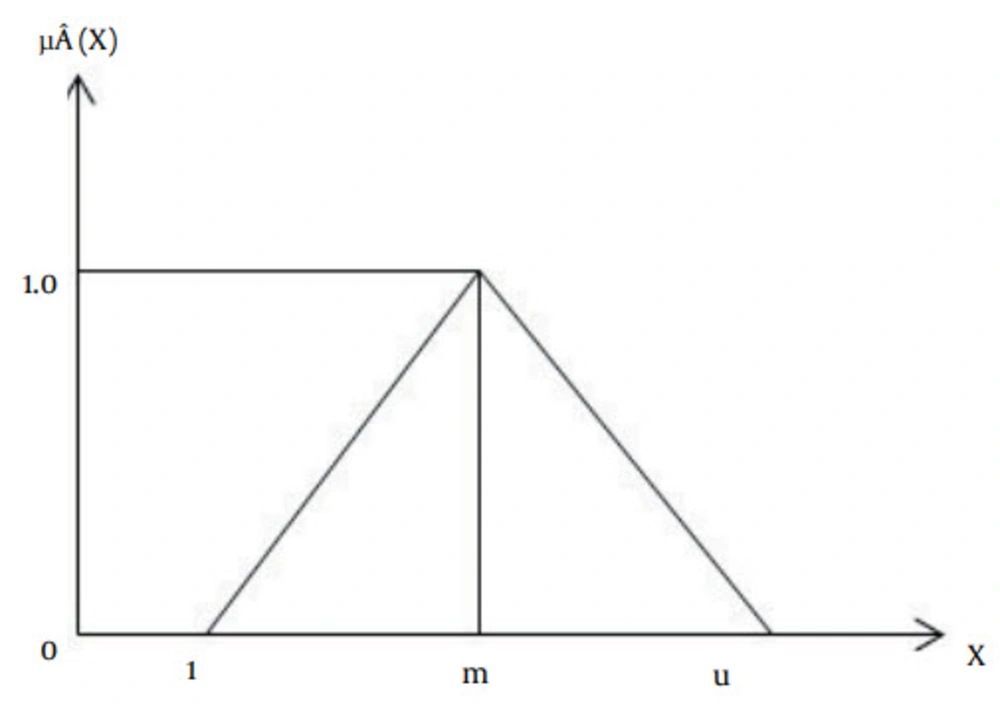
Figure 3.
The membership functions of the triangular numbers
Equation 1 represents à and its membership function:
In this paper, 9 point scale is used for pairwise comparisons and the related triangular fuzzy sets are shown in Table 2 and Figure 4.
Table 2.
Membership Function of Linguistic Terms
| Intensity of Importance | Definition | Scale of Fuzzy Number |
|---|---|---|
| 1 | Equally important | (1, 1, 1) |
| 2 | Slightly/weak advantage | (1, 2, 3) |
| 3 | Not bad | (2, 3, 4) |
| 4 | Preferable | (3, 4, 5) |
| 5 | Good | (4, 5, 6) |
| 6 | Fairly good | (5, 6, 7) |
| 7 | Very good | (6, 7, 8) |
| 8 | Absolute | (7, 8, 9) |
| 9 | Perfect | (8, 9, 10) |
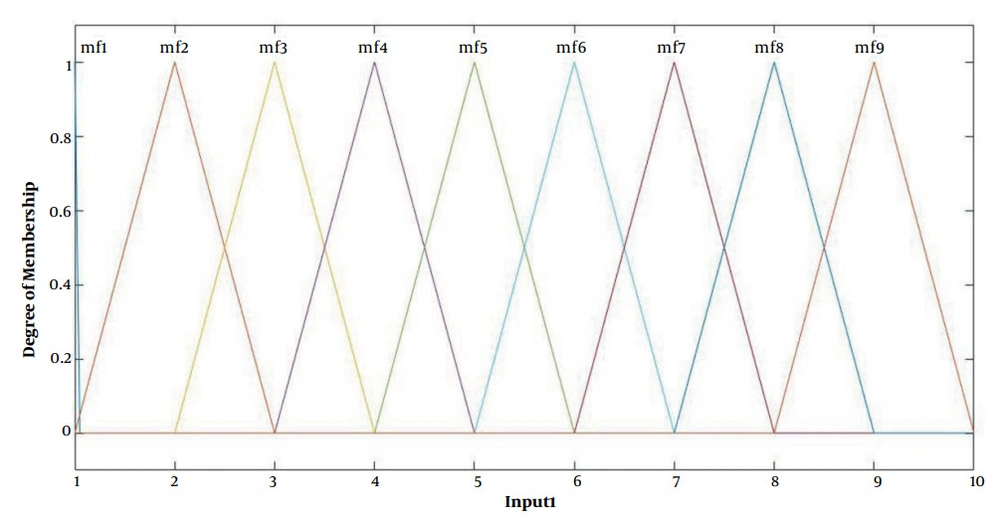
Figure 4.
Membership functions of linguistic values
Fuzzy reciprocal judgement matrix, based on pairwise comparison approach of factors and sub-factors, is illustrated in Figure 5 (28).
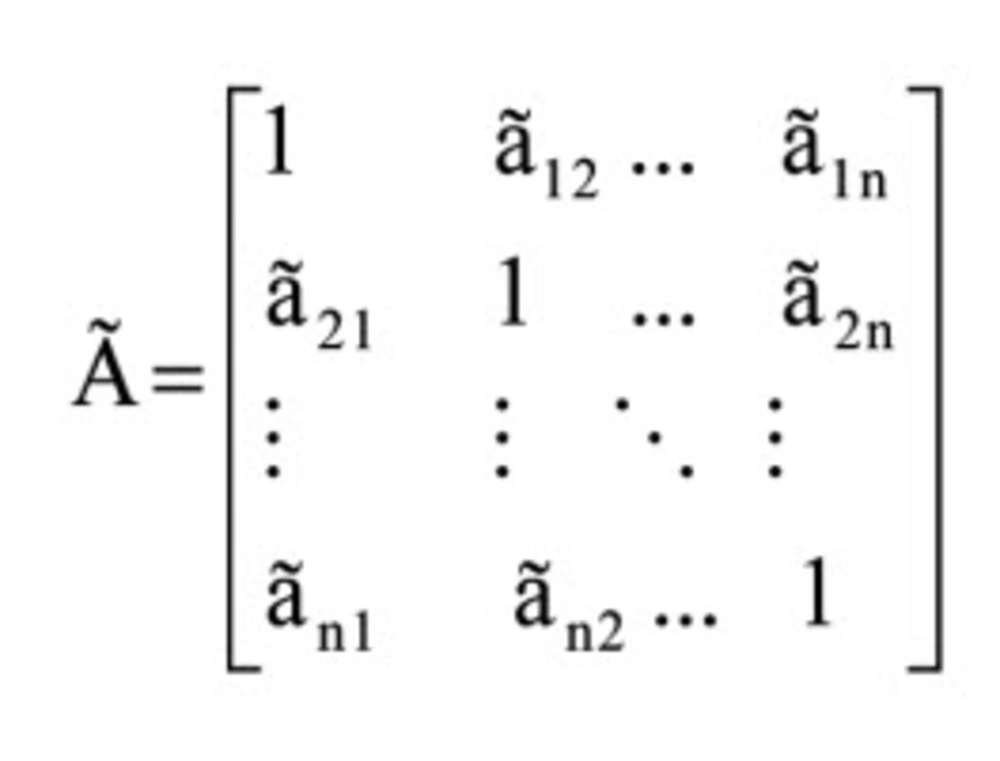
Figure 5.
Fuzzy reciprocal judgement matrix
Buckley (31) has suggested an equation to use the fuzzy geometric mean and fuzzy weights of each factor (Figure 6).

Figure 6.
Fuzzy geometric mean and fuzzy weights
Defuzzification technique is employed for converting the fuzzy number into crisp real numbers; the procedure of defuzzification is to locate the best nonfuzzy performance (BNP) value (19). Several methods are available, eg mean of maximum, center of area, and a cut method (32). In the present study, center-of-area method is used. Equation 2 is employed to obtain the defuzzified value of fuzzy number (19).
The consistency index (CI) for measuring any inconsistency of pairwise comparison matrices and the consistency ration (CR) (8) are also computed by the following equations (29, 33).
Where λmax is the largest eigenvalue of the comparison matrix, n is the dimension of matrix, and RI is a random index whose value depends on n. If the calculated CR of a comparison matrix is less than 0.1 the consistency of the judgment in the pairwise comparison matrices is acceptable (33).
4. Results
In this paper, the fuzzy AHP was used to determine the importance weight of each factor and sub-factors of human factor variables in the management of major accident hazards. In this study, fuzzy evaluations were provided in the pairwise comparisons by 16 experts. The consistency rate of this study was 0.079. The values less than 0.1 were considered acceptable. Table 3 shows the coefficients of evaluation matrices and the weighted vector of factors. According to this table, organization factors had the highest relative weight (0.381).
Table 3.
Relative Weights of a Comparison Matrix of Factors
| Factors | Relative Weights |
|---|---|
| Organization factors | 0.381 |
| Individual (personal) factors | 0.366 |
| Job related factors | 0.253 |
The relative weights of organization sub-factors are illustrated in Table 4. Safety culture had the highest relative weight (0.33) among other organization sub-factors.
Table 4.
Relative Weights of a Comparison Matrix of Organization Sub-Factors
| Organization Sub-Factors | Smallest Expected Value (l) | Most Probable Expected Value (m) | Largest Expected Value (u) | Relative Weights |
|---|---|---|---|---|
| Training | 0.247 | 0.271 | 0.297 | 0.27 |
| Safety culture | 0.322 | 0.334 | 0.345 | 0.33 |
| Human failure | 0.125 | 0.136 | 0.149 | 0.14 |
| Management of change | 0.25 | 0.259 | 0.267 | 0.26 |
The relative weights of individual (personal) sub-factors are shown in Table 5. Fatigue got the lowest weight (0.27) among all core items of individual (personal) sub-factors.
Table 5.
Relative Weights of a Comparison Matrix of Individual (Personal) Sub-Factors
| Individual Sub-Factors | Smallest Expected Value (l) | Most Probable Expected Value (m) | Largest Expected Value (u) | Relative Weights |
|---|---|---|---|---|
| Fatigue | 0.239 | 0.273 | 0.311 | 0.27 |
| Stress | 0.34 | 0.362 | 0.386 | 0.36 |
| Competence | 0.344 | 0.365 | 0.39 | 0.37 |
Ergonomic design and environmental factors with relative weights of 0.17 had the highest relative weight among job sub-factors. The relative weights of job sub-factors are given in Table 6.
Table 6.
Relative Weights of a Comparison Matrix of Job Sub-Factors
| Job Sub-Factors | Smallest Expected Value (l) | Most Probable Expected Value (m) | Largest Expected Value (u) | Relative Weight |
|---|---|---|---|---|
| Communications | 0.101 | 0.108 | 0.117 | 0.11 |
| Ergonomic design | 0.143 | 0.17 | 0.21 | 0.17 |
| Workload | 0.125 | 0.136 | 0.148 | 0.14 |
| Alarm systems | 0.068 | 0.079 | 0.097 | 0.08 |
| Human-computer interface | 0.131 | 0.138 | 0.148 | 0.14 |
| Shift pattern | 0.097 | 0.104 | 0.114 | 0.11 |
| Environmental factors | 0.144 | 0.164 | 0.188 | 0.17 |
| Procedures | 0.097 | 0.101 | 0.11 | 0.10 |
5. Discussion
Process industries have many hazards and risks. The past decades have seen increases in the rates of major incidents in these industries (34). It is widely recognized that human factor issues play important roles in accident causation in process industries. The present study was designed to determine the importance weights of human factors variables in the management of major accident hazards in process industries using the fuzzy AHP approach.
This study has found that organization factors are the most important variables in the management of major accident hazards in process industries. According to the experts’ opinions, organization factors got the highest relative weights in comparison with other studied factors including job factors and individual factors. The results of developing a fuzzy AHP for behavior-based safety management conducted by Dağdeviren and Yüksel (27) indicated that organizational factors with local weights of 0.31 had the highest weight among other factors such as personal factors (local weights: 0.24) and job-related factors (local weights: 0.25). Previous research findings have found that organizational factors affect safety performance and accidents in industries (35). The second important variable was individual (personal) factors. The relationship between personal factors and occupational accidents and behavior-based safety has been investigated in some studies. Personal factors are related to workplace accidents and faulty behavior risk (27, 36, 37). Personal factors such as awareness, personal attitude, and personal competency are important for the successful implementation of a safety management system in workplace settings (38). Individual factors such as competence of the individual, knowledge, perceptual judgements, stress, and motivation were seen as the underlying causes of accidents in the offshore oil industry (39). Job characteristic factors such as work environments has effects on the behavior of workers (6). Among organization sub-factors, safety culture had the highest importance in comparison with other sub-factors. These results are consistent with the view that safety culture, as a key organizational factor and a sub-facet of organizational culture, affect safety behavior and can influence safety performance (10, 35). The second important sub-factor was training. The findings of the current study are consistent with those of Kinateder et al. (40), who found that training can improve safety behavior. Although human failure is less important than other organization sub-factors in the current study, analyses of major accidents indicated that human error has been implicated in the occurrence of many accidents (6, 41).
Among individual sub-factors, competence of personnel was the most important sub-factor (0.37). Competence of personnel is recognized as a contributor to major accident causation and safe behavior (42). Stress and fatigue are less important than competence as sub-factors of individual (personal) factors. Stress and fatigue are presumed to affect the risk of accident involvement in offshore studies (15, 16). Sneddon et al., in the study conducted in the drilling industry suggested that higher levels of stress and fatigue can decrease work situational awareness, increase unsafe behavior, and also lead to higher accident risk (15).
Among job sub-factors, the highest weights were obtained for ergonomic design and environmental factors (0.17). Human-computer interface, workload, communications, shift patterns, procedures, and alarm systems are less important than ergonomic design and environmental factors. The weight of environmental conditions and workload management in the study conducted by González Dan et al. (1), was 0.33. Analysis of 100 accidents at sea showed that improvement of ergonomic design may result in a 34% decrease of accidents (43). Environmental factors at workplaces and physical stressors (noise, heat, light) are recognized as risk factors for occupational accidents (44, 45). Physical work environment characteristics such as noise level, lighting, and harsh physical work conditions found to be associated with accidents (46). Human–machine interaction issues led to some undesirable results in some industries (47, 48). The human-machine interaction failure is identified as the underlying causes of accidents in complex systems (49). Stress and physical workload may impair the ability of the staff members and can lead to high-risk behavior and accidents (16). Heavy physical work and exposure to workloads may lead to occupational accidents (50). Inadequate training, non-adherence to safety procedures, and permit to work systems, poor communication, inadequate procedures, and arrangements for securing evacuation and escape were the major causes of Piper Alpha disaster (51). Inadequate designs and equipment, supervisory and maintenance failures, inadequate training, and procedures, as known as latent conditions, were identified as contributing factors of unsafe acts (52). Poor work activity scheduled or shift-work schedule can lead to fatigue and operator errors, and may be the major cause of accidents (8). Alarms are very important, however, too many alarms in a new control system or lack of alarms may lead to human errors and problems in process industries (6, 8).
Human factors are involved in 80% - 90% of work related accidents (53) and the lack of effective management of human factors limits successful human performance and leads to many major accidents such as Piper Alpha, Esso Longford, Chernobyl, Bhopal, and Grangemouth. Human failure is not the sole cause of major accidents, however, many major accidents are largely attributable to the human factor (6, 8). Human factors in the management of major accident hazards are therefore important for process safety management. It is important to pay attention to human factor variables in the management of major accident hazards in process industries.
5.1. Conclusions
In this study, fuzzy AHP approach was used to determine the degree of importance of the human factors variables in the management of major accident hazards in the process industries. The present study demonstrates that organization factors are the most important variables in the management of major accident hazards in process industries with the application of fuzzy AHP for determining the factors weights. Safety culture, staff competence, ergonomic design, and environmental factors are the most important organization, individual, and job sub-factors. Fuzzy AHP is a useful tool for prioritizing and weighting human factors variables by collecting the experts’ opinions. The application of fuzzy AHP allows introducing the most important human factors variables for the management of major accident hazards in process industries.