
1. Background
Previous researches underline the negative consequences of risk-taking behaviors associated with health in youths (1-3). The transition from high school to college is an important developmental milestone that holds the potential for personal growth and behavioral change. Fromme et al. (4) followed a cohort of students on their participation in a variety of behavioral risks during the last 3 months of high school and throughout the first year of college. Alcohol use, marijuana use, and sex with multiple partners increased during the transition from high school to college.
Studies revealed an increase in the prevalence of high-risk behaviors among college students in Iran (5-8). Haghdoost and Moosazadeh in 2013, in a meta-analysis study, (9) revealed that smoking frequency among male and female students in Iran's universities was 19.8% (17.7 - 21.9) and 2.2% (1.4 - 3.02), respectively. The prevalence of occasionally and regular hookah smoking among university students in Iran was about 14% and 6%, respectively (10, 11). Studies revealed that 2.6% to 7.6% and 8% to 17% of university students in Iran abused drugs and used alcohol at least once in the past 30 days (5, 7, 8, 12, 13).
2. Objectives
This study was conducted to estimate the prevalence of risk- taking behaviors and some of the related factors among students of Lorestan universities in west of Iran to encourage and inform interventions and the future research agenda regarding college students. Due to lack of data in Lorestan province, the results of this study (To our knowledge, this was the first study in this region.) can also provide the basis for comparison in future epidemiological studies.
3. Methods
In this cross-sectional analytical study, 1181 students were selected proportionally and randomly from 3 universities in city of Khorramabad (Lorestan University of Medical Sciences, Lorestan University, and Lorestan Islamic Azad University). They were assessed in January and February 2015. A self-administrated questionnaire, including questions about cigarette smoking, hookah use, drug abuse, alcohol consumption, as well as demographic information was distributed to the students. A total of 1131 students completed the study questionnaire, and response rate was 95.8%.
To enhance the validity of students’ self-reports, they were assured about the strict confidentiality of their responses and were further informed that they could not be recognized by their answers. They were also informed about the voluntary nature of their participation in the study and their right to refuse or skip any questions.
In this study, cigarette smoking was measured as never smoker, experimenter (less than100 cigarettes in lifetime), occasional user, regular smoker, and ex-smoker. The prevalence of cigarette smoking was calculated based on these answers. However, to consider the factors related to cigarette smoking, the respondents were classified into 2 categories of cigarette smoking: never smoker and ever smoker.
In this study, hookah smoking was measured using a multiple choice question including the following answers: never use, only tried, occasional use, at least once per month, and at least once per week. The prevalence of hookah smoking was calculated according to these answers. However, to consider the factors related to hookah smoking, the respondents were classified into 2 categories of hookah smoking: never smoker and ever smoker.
Alcohol use was defined as consuming alcohol in the past 30 days and ever or never alcohol use. Ever use of any illicit drugs, such as Ritalin, methamphetamine, ecstasy, cannabis, opium, and heroin, were regarded as drug abuse. In a pilot study, the questionnaire was completed by 37 students 2 times in a 3-week interval. The reliability of the questionnaire was approved with test retest correlation coefficient equal to 0.77. This study and the related questionnaire have been approved by the ethics committee of Lorestan University of Medical Sciences.
Logistic regression model, exact logistic regression model (due to the small number of cases in this study), chi square test, and t test were used for statistical analysis, which was performed using SPSS-22. Final logistic regression model was selected using likelihood ratio test. Also, the Shapiro-Wilk test was used to check the normality of quantitative data. Significance level was set at P < 0.05.
4. Results
Out of 1181 freshmen students, 1131 students completed the study questionnaire (response rate: 95.8%). The mean age of the participants was 19.64 ± 2.21 years (min: 17 and max: 45). Of participants, 430 (38.0%) and 701 (62.0%) were male and female, respectively.
Table 1 demonstrates the frequency distribution of cigarette smoking and hookah smoking by gender. As demonstrated in Table 1, 96.3% of the students were never cigarette smoker and 78.3% never hookah smoker. Higher stages of cigarette smoking and hookah smoking were more prevalent among the males than females.
Table 1.
Prevalence of Tobacco Use in First Year College Students by Gender
| Tobacco Use | Males, n (%) | Females, n (%) | Total, n (%) | CI95% |
|---|---|---|---|---|
| Cigarette smoking | ||||
| Never smoker | 395 (92.7) | 688 (98.4) | 1083 (96.3) | 95.0 - 97.2 |
| Experimenter | 12 (2.8) | 6 (0.9) | 18 (1.6) | 1.0 - 2.5 |
| Occasionally user | 10 (2.3) | 3 (0.4) | 13 (1.2) | 0.7 - 2.0 |
| Regular smoker | 7 (1.6) | 2 (0.3) | 9 (0.8) | 0.4 - 1.5 |
| Ex-smoker | 2 (0.5) | 0 (0.0) | 2 (0.2) | 0.1 - 0.6 |
| Hookah smoking | ||||
| Never smoker | 302 (71.7) | 571 (82.3) | 873 (78.3) | 75.8 - 80.6 |
| Experimenter | 63 (15.0) | 93 (13.4) | 156 (14.0) | 12.1 - 16.2 |
| Occasionally user | 38 (9.0) | 22 (3.2) | 60 (5.4) | 4.2 - 6.9 |
| At least once at month | 7 (1.7) | 3 (0.4) | 10 (0.9) | 0.5 - 1.6 |
| At least once at week | 11 (2.6) | 5 (0.7) | 16 (1.4) | 0.9 - 2.4 |
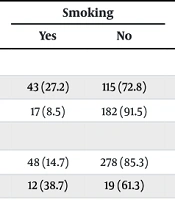
Only 62 (5.5%) students had ever used alcohol and 27 (2.4%) consumed alcohol in the past 30 days, and 26 (2.4%) abused drugs. Table 2 presents the demographic and key characteristics of the sample, as well as the conditional distribution of cigarette smoking and hookah smoking at each level of the variables. As seen in this table, gender, marital status, living status, having a job, alcohol consumption, history of drug abuse, and having a smoker friend had a significant relationship with cigarette smoking. Gender, having a job, alcohol consumption, history of drug abuse, having a smoker friend, and presence of smoker in the family had a significant relationship with hookah smoking. The results also revealed that hookah smoking and cigarette smoking co-occurred.
Table 2.
Demographic and Key Characteristics of the Students by Cigarette Smoking and Hookah Smoking
| Variable | Cigarette Smoking | Hookah Smoking | ||||
|---|---|---|---|---|---|---|
| No, n (%) | Yes, n (%) | P | No, n (%) | Yes, n (%) | P | |
| Gender | ||||||
| Male | 395 (92.7) | 31 (7.3) | < 0.001 | 302 (71.7) | 119 (28.3) | < 0.001 |
| Female | 688 (98.4) | 11 (1.6) | 571 (82.3) | 123 (17.7) | ||
| Marital status | ||||||
| Single | 1028 (96.9) | 33 (3.1) | < 0.001 | 825 (78.5) | 226 (21.5) | 0.617 |
| Married | 53 (85.5) | 9 (14.5) | 47 (75.8) | 15 (24.2) | ||
| Living in | ||||||
| Parental house | 498 (95.4) | 24 (4.6) | 0.009 | 404 (78.3) | 112 (21.7) | 0.093 |
| Dormitory | 275 (99.3) | 2 (0.7) | 227 (82.2) | 49 (17.8) | ||
| Single houseor other | 301 (95.0) | 16 (5.0) | 235 (74.8) | 79 (25.2) | ||
| Having job | ||||||
| Yes | 53 (81.5) | 12 (18.5) | < 0.001 | 41 (65.1) | 22 (34.9) | 0.009 |
| No | 1021 (97.2) | 29 (2.8) | 823 (79.1) | 218 (20.9) | ||
| Ever alcohol use | ||||||
| No | 1044 (98.2) | 19 (1.8) | < 0.001 | 858 (81.5) | 195 (18.5) | < 0.001 |
| Yes | 39 (62.9) | 23 (37.1) | 15 (24.2) | 47 (75.8) | ||
| Hookah smoking | ||||||
| No | 861 (98.9) | 10 (1.1) | < 0.001 | - | - | - |
| Yes | 210 (86.8) | 32 (13.2) | - | - | ||
| Cigarette smoking | ||||||
| No | - | - | - | 861 (80.4) | 210 (19.6) | < 0.001 |
| Yes | - | - | 10 (23.8) | 32 (76.2) | ||
| Ever drug abuse | ||||||
| No | 1033 (97.5) | 26 (2.5) | <0.001 | 845 (79.9) | 213 (20.1) | < 0.001 |
| Yes | 15 (57.7) | 11 (42.3) | 6 (24.0) | 19 (76.0) | ||
| Having smoker friend | ||||||
| No | 974 (98.6) | 14 (1.4) | < 0.001 | 813 (82.5) | 172 (17.5) | < 0.001 |
| Yes | 95 (77.2) | 28 (22.8) | 56 (45.5) | 67 (54.5) | ||
| Smoker in the family | ||||||
| No | 884 (96.6) | 31 (3.4) | 0.254 | 746 (81.7) | 167 (18.3) | < 0.001 |
| Yes | 187 (94.9) | 10 (5.1) | 122 (62.2) | 74 (37.8) | ||
| Age (mean ± SD) | 19.5 ± 1.8 | 21.1 ± 4.5 | 0.035 | 19.6 ± 2.0 | 19.6 ± 1.9 | 0.851 |
Two logistic models were used to evaluate the relationship of all variables listed in Table 2, which was significant in 0.2 levels with cigarette smoking and hookah smoking. The results of these analyses (Table 3) indicated that being male (OR = 5.89), married (OR = 8.09), alcohol use (OR = 9.17), hookah smoking (OR = 5.37), ever drug abuse (OR = 12.84), and having a smoker friend (OR = 2.69) increased the risk of cigarette smoking. The results indicated that having a smoker friend (OR = 3.25), presence of smoker in the family (OR = 2.87), alcohol use (OR = 5.31), cigarette smoking (OR = 4.75), and drug abuse (OR = 3.40) were factors associated with student’s hookah smoking (Table 4).
Table 3.
Logistic Regression Analysis of the Relationship Between Cigarette Smoking and Risk Variables in First Year College Students
| Variables | OR (95%CI) | P Value |
|---|---|---|
| Gender | ||
| Female | 1 | |
| Male | 5.89 (2.53 - 13.62) | < 0.001 |
| Marital status | ||
| Single | 1 | |
| Married | 8.09 (2.29 - 28.61) | 0.001 |
| Alcohol use | ||
| No | 1 | |
| Yes | 9.17 (3.29 - 25.56) | < 0.001 |
| Hookah smoking | ||
| No | 1 | |
| Yes | 5.37 (1.99 - 14.49) | 0.001 |
| Ever drug abuse | ||
| No | 1 | |
| Yes | 12.84 (3.52 - 46.81) | < 0.001 |
| Having smoker friend | ||
| No | 1 | |
| Yes | 2.69 (1.02 - 7.45) | 0.047 |
Table 4.
Logistic Regression Analysis of the Relationship Between Hookah Smoking and Risk Variables in First Year College Students
| Variables | OR (95%CI) | P Value |
|---|---|---|
| Having smoker friend | ||
| No | 1 | |
| Yes | 3.25 (2.0 - 5.29) | < 0.001 |
| Smoker in the family | ||
| No | 1 | |
| Yes | 2.87 (1.98 - 4.16) | < 0.001 |
| Alcohol use | ||
| No | 1 | |
| Yes | 5.31 (2.59 - 10.88) | < 0.001 |
| Cigarette smoking | ||
| No | 1 | |
| Yes | 4.75 (1.76 - 12.88) | 0.002 |
| Ever drug abuse | ||
| No | 1 | |
| Yes | 3.40 (1.10 - 10.56) | 0.034 |
5. Discussion
In the present study, 3.7% of the students (7.3% of the males and 1.6% of the females) have experienced cigarette smoking and only 0.8% (1.6% of the males and 0.3% females) were regular smokers. Also, 1.2% of the students were occasional cigarette smokers. These findings are not consistent with national studies and studies in neighboring countries on university students and are not even similar to smoking status of Iranian high school students. Results of a meta-analysis (16) revealed that 7% of Iranian high school students are regular smokers and 27% are experimenters; and a study with large and representative sample revealed that about 22.3% of the high school students (31.6% of the males and 12.4% of the females) have experienced cigarette smoking and only 5.0% (6.1% of the males and 0.4% females) have been regular smokers (17). In a meta-analysis study entitled, “the prevalence of cigarette smoking among students of Iran’s Universities” by Haghdoost and Moosazadeh in 2013 (9), 22 valid articles were selected. The lowest and highest prevalence of smoking among male students was 13.4% and 39.9%, respectively, while it was 0.7 and 25.5%, respectively, among female students. Meta-analysis results revealed that smoking frequency among male and female students in Iran's universities was 19.8% (17.7 - 21.9) and 2.2% (1.4 - 3.02), respectively. The prevalence of cigarette smoking in university students was 18.5 % in Turkey (18), 24% in Pakistan (19), and 14.5% in Saudi Arabia (20).
The prevalence of hookah smoking (at least once per month) in this study was 2.3% (4.3% for males and 1.1% for females). We also realized that 21.7% of the samples had at least tried hookah smoking in some occasions. In Mohammadpoorasl et al.’s study (11, 17) in Tabriz, these values were 8.5% and 39.4%, respectively. These results were relatively low compared with studies conducted on whole students in Iranian universities and in Western countries. Primack et al. (21) found that the prevalence of hookah smoking among United States college students in lifetime, over the past year, and over the past 30 days was 40.5%, 30.6%, and 9.5%, respectively. In Poland, 38% of high school and college students had smoked water pipe at least once in their life time and 22% had smoked hookah during the last 30 days (22). It seems that hookah smoking status of first year students is similar to that of high school students. A study with large and representative sample revealed that the prevalence of hookah smoking (at least once per month) in high school students was 5.2% (10.4% for males and 1.4% for females) and 48.9% had at least tried hookah smoking in some occasions (23).
Alcohol use and drug abuse found more in Iranian students than in students of other countries due to the following factors: legal prohibition of drug abuse; religious and legal prohibition of alcohol use; cultural stigma against alcohol use and drug abuse; and disapproval of alcohol use and drug abuse by parents. Data from United States revealed that more than 60% of American college students reported past month alcohol use and 14.5% of the students reported past 30-day use of marijuana (24, 25). Studies revealed that 2.6% to 7.6% and 8% to 17% of university students in Iran abused drugs and used alcohol at least once in the past 30 days (5, 7, 8, 12, 13). In the present study, 5.5% of the students had ever used alcohol and 2.4% had alcohol consumption in the past 30 days, and only 2.4% had an experience of drug abuse. These findings indicated that alcohol consumption and drug abuse are generally lower among the freshmen university students in Iran than in those of other countries and lower than whole Iranian students.
Our findings showed that cigarette smoking, hookah smoking, alcohol use, and drug abuse are much more prevalent in males than in females. These results are similar to those of previous studies performed in Iran (11, 16, 26-28).
Similar to numerous studies, our findings emphasized the co-occurrence of risky behaviors (7, 11, 23, 29, 30). Considering co-occurrence, co-changing is one of the most effective approaches in prevention of high- risk behaviors. Co-occurrence of risky behaviors in the present study highlights the importance of implementing comorbid substance use prevention programs in students.
The first limitation of the present study was its reliance on self-report data. Although we went to great lengths to ensure confidentiality and anonymity, we had no way of assessing underreporting of risk- taking behaviors. Therefore, the estimated prevalence of tobacco smoking and substance abuse reported above may, thus, represent lower estimates of the actual prevalence. Finally, the cross-sectional nature of the study limits the conclusions about associations between the correlates and risk- taking behaviors.
5.1. Conclusions
The prevalence of risk- taking behaviors in freshmen students compared to other studies done in all students was considerably low. It seems that incidence of risk- taking behaviors during university years was high. Longitudinal studies are needed to evaluate changing the risk- taking behaviors during university years. Our study demonstrated the co-occurrence of risky behaviors, which emphasizes the importance of interventions aimed at reducing or preventing different high- risk behaviors simultaneously.