1. Background
A serious threat is the increasing trend in some risky behaviors, which are health concerns at thenational and international levels (1). Among these behaviors, drug use and unsafe sex are at thetop of the list, particularly among young age groups (2). High-risk behaviors among young people, such as having unsafe sex with multiple partners, consuming alcohol and taking hallucinogenic drugs, and being tattooed, increase the risk of HIV infection (3).
In recent years, alcohol consumption and methamphetamine use as well as different illegal drugs have become one of the most important concerns in Iran (1-3). Likewise, Iran has a young population, with approximately one-third of the total population aged between 15 and 29 years old. However, only a few studies have been implemented to estimate the high-risk behaviors among Iranian students (4, 5). It is known that people usually do not provide precise answers about sensitive questions, and studying high-risk behaviors such as sexual practices, especially where these acts are not legally permitted and are highly stigmatized, would be prone to bias using direct methods. Consequently, answers would usually be distorted towards the social norms, which would then introduce social desirability bias when estimating the sensitive behavior (6).
Besides the direct methods, indirect methods have been recently introduced to estimate sensitive behaviors; one of these methods is network scale-up (NSU) (7). The NSU method has already been applied to estimate the prevalence of HIV and other related hard-to-reach groups (8, 9). Another indirect method is the crosswise model which has also been used to estimate the prevalence of sensitive matters, such as plagiarism in student papers (10) and illicit drug use among students (11).
The information about high-risk and sensitive behaviors among young groups is limited, especially for college students, albeit these risky behaviors are religiously and legally restricted and prohibited in Iran.
2. Objectives
Thus, this study was done to estimate the prevalence of six risky behaviors among college students in one of the main medical Universities of Iran through two indirect methods.
3. Patients and Methods
3.1. Setting and Sample
This cross-sectional study was conducted on students from the Kerman University of Medical Sciences, one of the main universities in southeastern Iran, in 2012 - 2013. This university consists of seven schools with approximately 5,200 students. A proportional to size stratified sampling was used to recruit 563 students. Students were selected in the classes and a trained interviewer elaborated on the purposes of the research. All information was anonymously obtained from the students, and they were fully assured that the data would not be used anywhere. Informed verbal consent was obtained from all participants. The study protocol was approved by the ethics research committee of Kerman University of Medical Sciences.
3.2. Data Collection
In the current study, the prevalence of opium use, alcohol consumption, amphetamine use, taking tramadol without medical indications, having RWOS, and EPMS in the previous year, even for one episode, was estimated using a questionnaire.
3.3. Reliability Assessment of the Questionnaire
The reliability of the questionnaire was assessed by a test-retest examination. In this step, we gave the questionnaire to 30 participants before the main research. After 10 days, the same participants were again provided with the questionnaire. Kappa statistics and a paired t test were applied to evaluate the reliability of the questionnaire. The mean kappa was 79%, which is considered substantial agreement (12), (ranged from 0.42% [for having RWOS] to 100% [for the question of amphetamine use and opium use]). For the second section related to the reliability of the NSU questions, based on a paired t-test, we analyzed each question one by one, and those with p values higher than 0.05 were considered reliable questions. We found only one question significant with a p value less than 0.05. Since we realized this question’s reliability via the kappa statistics in the CM method, we did not eliminate this question.
3.4. Crosswise Model (CM)
This method is based on a simple idea; that is, respondents are asked two questions: one sensitive question along with one non-sensitive question (6, 10). They are asked to answer both questions at the same time. The non-sensitive question must be independent of the sensitive item. Suppose that X is the sensitive question, and Y is a non-sensitive question. In this model, it is always assumed that p = Pr (Y = 1) (the probability of a positive response to the non-sensitive question). In this case, the respondents were asked to choose option “A” if their answers to both questions are the same (both either yes or no) and choose “B” if their answers are different (one yes and the other no). According to the frequency of option “A” (λ = pπ + (1 - p) (1 - π)), we estimated the ratio of Pr (x = 1) = π (prevalence of sensitive trait) based on the following formula (Equation 1):
Where n/N is the frequency of the same answers, and p is the relative frequency of non-sensitive “yes.”
3.5. Network Scale-Up (NSU)
Performing NSU requires estimating the size of the students’ networks. After this, the subjects are asked about a number of their close friends with high-risk behaviors in their networks. Finally, assuming that the subjects are selected randomly, and also randomly distributed during sampling, the frequency presented in the student’s social network is an estimation of the frequency in the target population. So, estimations are obtained as follows (8):
Where c is the size of the participant’s network, m is the number of people who are introduced as those with high-risk behaviors by the participant, and t is the total number of target populations: the students. Based on these three elements, e as the total number of people with high-risk behaviors is estimated.
3.6. Statistical Analyses
All statistical analyses were conducted using Microsoft Office Excel 2007 and SPSS version 20. The data are reported as absolute and relative frequencies and 95% confidence intervals (CI). As already explained, in the CM method, respondents replied to the questions on their own behalf, while in the NSU, they answered on behalf of their network; thus, generally speaking, when respondents are not aware of students in their network belonging to a specific population, information transmission bias/effect may occur. Therefore, we calculated the ratio of the prevalence estimated in the NSU method to the CM method, which was considered a correction coefficient to define the visibility of the behaviors for the NSU method.
4. Results
Participants were 18 to 33 years old (mean ± SD: 21.9 ± 2.1) of whom about 44% (n = 247) were male and only about one-tenth of the participants were married (n = 54). The network size of the students was estimated at 16.1, which means that every student in the university knew about 16 students (as defined in the method). The network size of the male and female students was 19.4 and 14.3, respectively.
4.1. Drug-Related Behaviors
Based on the results of the NSU method, the prevalence of opium use among students was estimated at 2.2%, which was similar to the CM estimation (VC = 1) (Table 1). This behavior was higher among male students than female students (Figures 1 and 2). The visibility coefficients of opium use in males and females were 2.3 and 0.25, respectively.
Table 1.
The Estimation of the Prevalence of High-Risk Behaviors Using the CM and NSU and its Proportion (to Obtain the Correction Coefficient) (N = 563)
| High-Risk Behaviors | Crosswise Model (CM) | Network Scale-Up (NSU)a | Correction Coefficient (NSU/CM) |
|---|---|---|---|
| Opium use | 2.2 (0.0, 9.4)b | 2.2c | 1 |
| Alcohol consumption | 16.8 (8.9, 24.6) | 8.1 | 0.48 |
| Methamphetamine use | 7.2 (1.2, 13.1) | 1.2 | 0.17 |
| Taking tramadol without medical indications | 14.8 (9.4, 20.1) | 4.8 | 0.32 |
| Friendship and close relations with the opposite sex | 42.8 (34.1, 50.5) | 31.9 | 0.75 |
| Extra/pre-marital sexual contact | 12.4 (6.2, 18.5) | 7.1 | 0.57 |
aThe overall personal network was estimated at 16.1.
bPercent (95% CI).
cPercent.
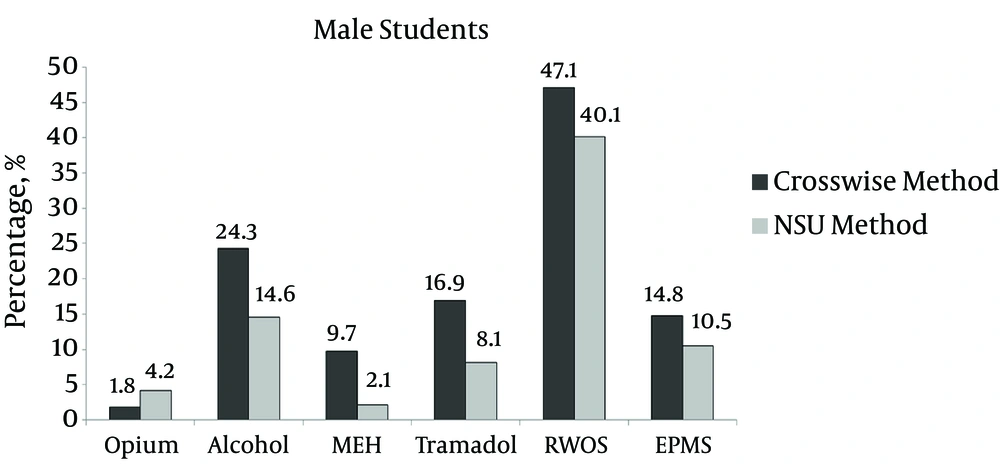
Figure 1.
METH, methamphetamine; RWOS, relationships with the opposite sex; EPMS, extra/pre-marital sex.
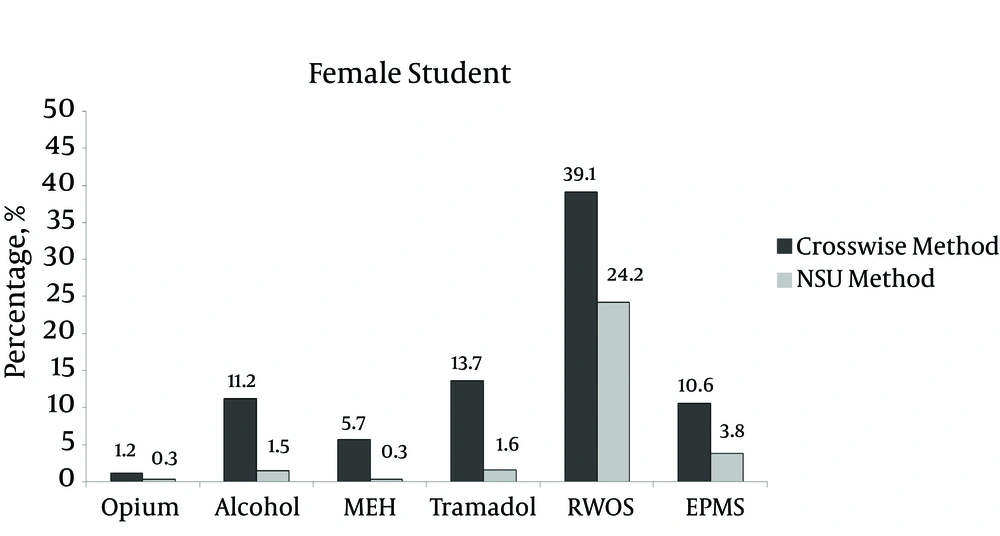
Figure 2.
METH, methamphetamine; RWOS, relationships with the opposite sex; EPMS, extra/pre-marital sex.
The prevalence of methamphetamine use based on CM and NSU methods was 7.2% and 1.2%, respectively, giving a visibility coefficient of 0.17. By gender, the frequency of methamphetamine use among male students was higher (Figure 1, 2).
According to the results of the CM and NSU methods, using tramadol without medical indications was estimated at 14.8% and 4.8%, respectively. The NSU estimation was around one-third of the CM method. Among males, the estimation of the CM model was around two times higher than the NSU method (16.9% vs. 8.1%), while among females, they were 13.1% and 1.6% based on these two methods, respectively.
The estimate of alcohol consumption derived from the CM was about two times higher than the NSU (16.8% VS. 8.1%). This gave a visibility coefficient of about 0.5. The frequency of this behavior was also higher in male students compared to female students. The visibility of this behavior was much lower among females.
4.2. Sexual-Related Behaviors
Both methods revealed that more than 30% of students have RWOS (42.3% in the CM versus 31.9% in the NSU). The visibility coefficient was 0.75. The corresponding figures among male and female students were CM: 47.1% vs. NSU: 40.1%, and CM: 39.1% vs. NSU: 24.2%, respectively.
Around one-tenth of the students had had extra/pre-marital sexual contact in the last year (CM: 12.4% vs. NSU: 7.1%). The ratio of the NSU to the CM was 0.57. EPMS was more prevalent among males (CM: 14.8% and NSU: 10.5%) than female students (CM: 10.6% and NSU: 3.8%).
5. Discussion
Based on our findings, some practices such as alcohol consumption were relatively common among college students; however, the frequency of opium use was seemingly low. In addition, we found a lower frequency with lower visibility of these practices among female students. Our findings showed that the visibility of these practices ranged from around 100% for opium use to 17% for methamphetamine use.
In the present study, the frequency of substance use in the last year varied between 2.2% for opium and 14% for taking tramadol without medical indications. In a study by Taramian et al. (2008), the self-reporting of opium, tramadol, and ecstasy were reported as 1.2%, 2.3%, and 0.3%, respectively among students in Tehran (13), the capital of Iran. Shamsipour et al. in 2014 (11) showed that the overall prevalence of lifetime use of any illicit drugs among medical students of Tehran using crosswise model was around 20%, while via direct questions this figure was 3%. Additionally, the overall prevalence of lifetime use of opium by the crosswise model was 13.6%, with a substantial underreporting of opium use via the direct method which was 1%. Sheikhzadeh et al. (14) in a university setting in Iran (2014) estimated the prevalence of opium use at 3.02% using the NSU method and 5.13% through direct questioning in male students; however, based on the proxy respondent method (PRM), it was higher at 9.36%. These same estimations for female students based on these three methods were 0.07%, 1.64%, and 1.16%, respectively.
However, there was a considerable difference between boys and girls in terms of drug use. The proportion of illegal drug use, such as opium and methamphetamines, among boys was remarkably higher than girls. In other studies, lifetime use of illegal substances, tobacco, marijuana, cocaine powder, ecstasy, and anabolic androgenic steroids as well as hallucinogens (15) was reported significantly more frequently among male students. Warner et al. (16) indicated that one of the main reasons for these differences between male and female substance use can be negative pressures and the strong stigma against females for these behaviors. Gender is also considered a predictive contributor for substance use (17).
According to the findings of our study, about 16% of students consumed alcohol in the last year. In a recent study (2014) in a medical University in Iran based on the three methods of PRM, NSU, and direct questioning, the prevalence of alcohol was estimated at 2.32%, 0.44%, and 2.23% for females, while such estimations were 18.12%, 8.68%, and 13.4% for males, respectively (14). In the present study, the estimates for alcohol consumption among male students was much higher than for females. Similarly, a higher prevalence of alcohol consumption among males in comparison to females is reported in other studies (18). Among college students in Brazil (15), recent (in the last 12 months) alcohol consumption among male students was at a significantly higher rate. Like substance use, there was a considerable gender difference in terms of alcohol consumption in the present study, which was remarkably higher among male students (24.3% vs. 11.2%). It is generally believed that the leading reason women drink less than men is because the social pressures against this behavior are much greater for women than for men (19). The social sanctions against females seem to be much greater in Iran.
Regarding the EPMS issue, our findings showed that 12.4% of college students had extra/pre-marital sexual contact in the last year. In a study in Iran among medical students, the frequency of extra-marital sex based on the PRM, NSU, and direct questioning methods was estimated at 13.4%, 7.4%, and 10.3% for males, and 3.47%, 0.95%, and 1.4% for females, respectively (14). The findings of a study in Canada (2009) showed that 12% of undergraduate students had risky sexual behavior (20).The results of a study in the United States (US) among university students showed that 80% of boys and 73% of girls had intercourse = with the opposite sex, and about 75% of university students in Scotland had heterosexual penetrative sex (21, 22).
Another part of our findings showed that the visibility of some practices such as sexual contact was relatively low even in the network of close friends, particularly among female students. Explaining this finding is not difficult since most of these practices, particularly extra/pre-marital sexual contact, are not acceptable culturally, legally, and by the Islamic laws. Therefore, students might hide their practices even from their friends. This barrier is stronger for ladies in Iran; therefore, lower visibility would be expected among female students even before exploring the findings of this study. Of those risky behaviors, the most obvious gender differences in the present study were shown in having close RWOS (females: 24.2/39.1 = 0.62 vs. males: 40.1/47.1 = 0.85) and EPMS (females: 3.8/10.6 = 0.36 vs. males: 10.5/14.8 = 0.71). Studies in developed nations have also implied that boys are more prone to commence sexual relationships, and have a higher frequency of sexual contacts and more risky practices than girls (23, 24).
In Iran, unlike girls, male youths receive more permissions and liberties from society for extra/pre-marital sexual activities, although for both genders, it is considered taboo. Then, because of these restrictions, these behaviors may occur in a hidden environment. Within this context, however, in comparison with Western nations, the frequency of extra/pre-marital sexual contact in Iran was remarkably low. However, sexual behaviors along with the early initiation of sexual practices (24) can endanger young individuals, afflicting them with dangerous infections such as sexually transmitted diseases (STI) and HIV, and somehow immerse them in unwanted pregnancies and subsequent consequences, such as unsafe abortions (25).
Estimations through the CM technique were higher than those obtained from the NSU. A lower percentage obtained from the NSU method may result from the low visibility of high-risk behaviors within the students’ social networks. Such findings were also achieved in other studies that compared direct size estimations with indirect ones (11, 14). Comparing direct and indirect methods, we can conclude that indirect methods perform better and obtain more exact and closer-to-reality estimations than direct ones.
5.1. Conclusions
We showed the feasibility and applications of two indirect methods in the estimations of risky behaviors among college students. It seems that both the crosswise and network scale-up techniques have their own considerations; however, both may be used to check and monitor risky behaviors. Our findings showed that both illegal drug use and extra/pre-marital sexual contact were relatively common among students in Iran, with a considerable gap between males and females. In addition, it seems that the visibility of most of these practices is low even among male students.