


1. Background
Adolescents and youth are among the most important groups at risk of behavioral problems, which can increase the risk of early mortality, disability, and chronic illnesses among them (1). Risk behaviors such as alcohol use, smoking, and unprotected sexual relations can endanger one’s health, and behaviors such as robbery, aggression, and escape from school and home can threaten others’ health (2). Studies have shown that some social problems such as waterpipe smoking, unsafe sexual behaviors, and street fight are the most common high-risk behaviors among the Iranian youth (3, 4). At the end of adolescence, the tendency to risky behaviors increases because of physical and mental changes and the interest in experiencing new behaviors. Also, due to the higher identity independence in young students, the likelihood of having risky behaviors increases (5). Studies have shown that dormitory life, being away from the family, unemployment, lack of healthy recreation, and failure to meet emotional needs can affect the prevalence of risky behaviors (6). As students choose to avoid health-promoting behaviors, it increases the likelihood of high-risk behaviors (7).
The results of a study showed that African-American teenagers are more likely to experience violence and risky behaviors than Asian teenagers, and in this regard, the most important confounding factor is ethnicity (8). Another important variable in the development of risky behaviors is gender. Studies have shown that men perform more risky behaviors than women (6, 9). The results of a study on the prevalence of high-risk behaviors among medical students in Iran showed that drug abuse and pre-marital sex among students were common, with a significant difference between women and men (10).
As risky behaviors can bring about irreparable consequences and impose time and financial burden on society, identifying and preventing the causes that trigger these behaviors are introduced as a sound approach to reducing the incidence of high-risk and threatening behaviors in the community, especially in the youth (11).
2. Objectives
The present study was conducted to determine the frequency of high-risk behaviors in students of Ardabil University of Medical Sciences to gain an accurate understanding of the frequency of such behaviors to use in future studies and interventions.
3. Methods
3.1. Sample and Procedure
A cross-sectional study was conducted with 215 students of Ardabil University of Medical Sciences, located in the northwest of Iran, in 2018. The sample size was determined to be 234 students using the appropriate formula. After explaining the research objectives and obtaining informed consent from the students, the questionnaires were distributed, and finally, 215 completed questionnaires were received (response rate 92%). The inclusion criteria included being a student at Ardabil University of Medical Sciences. Participants were selected using a stratified sampling method in which a list of students was first prepared from all of the nine faculties of Ardabil University of Medical Sciences. Then, students were randomly selected proportional to the population of each faculty to receive the questionnaires after giving their informed consent. It should be noted that the centers for disease control and prevention (CDC) has declared five categories of risky behaviors, including sexual behavior, mental health and suicide, high-risk substance use, and violence victimization (12). Some other references referred to alcohol consumption, unhealthy dietary behaviors, and physical inactivity as risk-taking behaviors (2). We tried to meet these variables in the current study using the appropriate questionnaire.
3.2. Measurements
The self-administered Iranian Youth Risk-Taking Scale (IYRTS), consisting of 48 items, was used to assess the risk behaviors of participants. The questionnaire has 48 questions based on a four-point Likert scale to measure six categories of high-risk behaviors including risky driving (nine questions), smoking (seven questions), drug use (eight questions), drinking (nine questions), sexual relationship (eight questions), and violence (seven questions). The structural validity of the questionnaire has been confirmed through exploratory and confirmatory factor analysis. Also, Cronbach’s alpha has been reported as 0.93 for the total scale, 0.88 for risky driving, 0.91 for smoking, 0.83 for drug use, 0.93 for drinking, 0.85 for sexual relations, and 0.77 for violence subscales (13).
3.3. Statistical Analysis
The SPSS software (version 16.0) was used for the statistical analysis of study data. The numbers, percentages, means, and standard deviations were used to describe the data. The chi-square test was used to compare high-risk behaviors in two groups of male and female students. P values of less than 0.05 were considered statistically significant in the analyses.
3.4. Ethical Issues
The researchers explained the purpose of the study to the participants and assured them about the confidentiality of information. Also, written informed consent was obtained from the participants. Permissions were received from the Research Committee (No., 1397.008).
4. Results
The results showed that of 215 participants, 125 (58.1%) were male and 90 (41.9%) were female. The mean age of male and female students was 21.4 ± 1.92 and 20.9 ± 1.38 years, respectively. The demographic characteristics of male and female students are presented in Table 1.
Table 1.Demographic Characteristics of Students by Gender
| Variables/Categories | Male, No. (%) | Female, No. (%) | Total, No. (%) |
|---|---|---|---|
| Education | |||
| Bachelor | 86 (68.8) | 70 (77.8) | 156 (72.6) |
| Master | 11 (8.8) | 6 (6.7) | 17 (7.9) |
| Doctoral or Ph.D. | 28 (22.4) | 14 (15.5) | 42 (19.5) |
| Housing | |||
| Dormitory | 69 (55.2) | 40 (44.4) | 109 (50.7) |
| Parental house | 37 (29.6) | 40 (44.4) | 77 (35.8) |
| Rental house | 19 (15.2) | 10 (11.2) | 29 (13.5) |
| Marital status | |||
| Single | 111 (88.8) | 81 (90) | 192 (89.3) |
| Married | 13 (10.4) | 7 (7.8) | 20 (9.3) |
| Other | 1 (0.08) | 2 (2.2) | 3 (1.4) |
| Total | 125 (58.1) | 90 (41.9) | 215 (100) |
Table 2 shows the frequency of personal high-risk, unsafe, and violent behaviors by gender. The history of physical violence during the year before the implementation of the research was 37.7% in all students, which was significantly higher in male students than in female students (P < 0.001).
Table 2.Comparison of Risky Behaviors Between Male and Female Students
| Risky Behaviors | Male, No. (%) | Female, No. (%) | Total, No. (%) | P Valuea |
|---|---|---|---|---|
| History of physical violence in the past year | < 0.001 | |||
| Yes | 60 (48) | 21 (23.3) | 81 (37.7) | |
| No | 65 (52) | 69 (76.7) | 134 (62.3) | |
| Cigarette smoking | 0.031 | |||
| Current smoking | 56 (44.8) | 24 (26.7) | 80 (37.2) | |
| Smoking cessation | 13 (10.4) | 10 (11.1) | 23 (10.7) | |
| Never | 56 (44.8) | 56 (62.2) | 112 (52.1) | |
| Cigarette per day (N = 80) | 0.025 | |||
| 1-4 | 24 (42.9) | 15 (62.5) | 39 (48.75) | |
| 5-9 | 18 (32.1) | 6 (25) | 24 (30) | |
| 10 or above | 14 (25) | 3 (12.5) | 17 (21.25) | |
| Waterpipe smoking | 0.041 | |||
| Current smoking | 65 (52) | 38 (42.2) | 103 (47.9) | |
| Smoking cessation | 10 (8) | 2 (2.2) | 12 (5.6) | |
| Never | 50 (40) | 50 (55.6) | 90 (46.5) | |
| Substance abuse in the past year | 0.037 | |||
| Yes | 38 (30.4) | 17 (18.9) | 55 (25.6) | |
| No | 87 (69.6) | 73 (81.1) | 160 (74.4) | |
| Alcohol use | < 0.001 | |||
| Yes | 48 (38.4) | 23 (25.6) | 71 (33) | |
| No | 77 (61.6) | 67 (74.4) | 144 (67) | |
| Physical activityb | 0.42 | |||
| Never | 30 (24) | 25 (27.8) | 55 (25.6) | |
| Irregular (1 - 2 times a week) | 42 (33.6) | 32 (35.6) | 74 (34.4) | |
| Regular (3 - 5 times a week) | 38 (30.4) | 26 (28.9) | 64 (29.8) | |
| Over 5 time a week | 15 (12) | 7 (7.8) | 22 (10.2) | |
| Suicide attempts in the past year | 0.011 | |||
| Yes | 6 (4.8) | 11 (12.2) | 17 (7.9) | |
| No | 119 (95.2) | 79 (87.8) | 198 (92.1) |
aChi-square test
bIn the past week; 30 min each time
Of the total sample, 47.9% (n = 103) had a history of cigarette smoking, of which 37.2% were current users, and 10.7% had quit smoking. The pattern of smoking was different between males and females, where smoking was higher in males (P = 0.031). Also, the number of cigarettes per day varied among male and female consumers, and males consumed more cigarettes daily. More than 55% of men consumed more than five cigarettes per day, compared to less than 40% in women. On the other hand, more than half of the students had a history of waterpipe smoking, of whom 47.9% (n = 103) were current consumers, and 5.6% (n = 12) had quit waterpipe smoking. The consumption of waterpipe was higher in men (52%) than in women (42.2%). About a quarter of the students had a history of narcotics and psychotropic drug use over the past year, which was higher in men than in women (P = 0.037). Additional information in this regard is provided in Table 2. Methylphenidate (25.6%), ecstasy (13%), and tramadol (8.4%) were the most prevalent drugs used in the students. Also, the history of alcohol consumption in the past year was 33% among the students, which was significantly higher in men than in women (P < 0.001) (Figure 1).
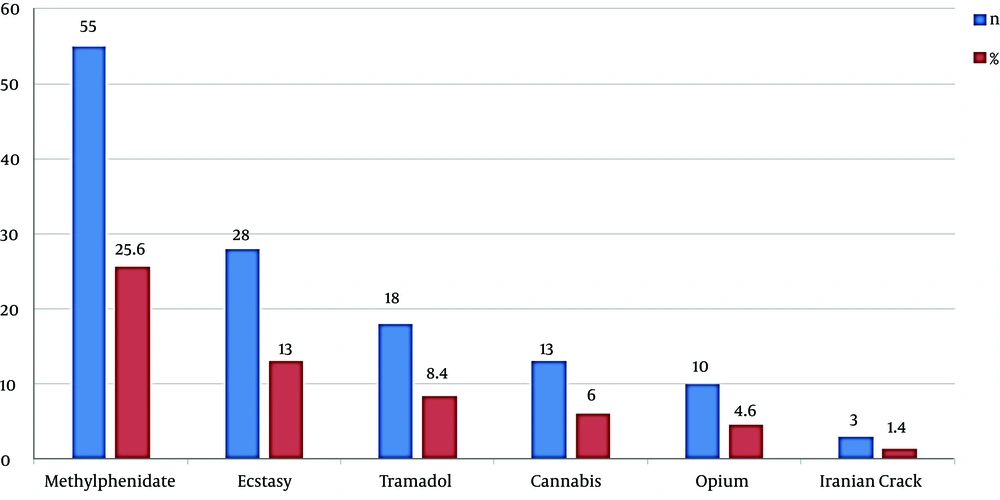
Figure 1.
Types of drug abuse in students (N = 215)
Only 40% of the total students had regular physical activity three times a week (at least 30 min each time). Also, 25.6% had no regular physical activity during the week. The pattern of physical activity in men and women did not have a significant difference.
In this study, we investigated the history of suicide attempts among the students, of whom 7.6% (n = 17) reported at least one suicide attempt during the past year, which was significantly higher in women than in men (P = 0.011).
5. Discussion
In the present study, a significant proportion of the participants had a history of high-risk behaviors such as violence, cigarette smoking, waterpipe smoking, and substance abuse. Risky behaviors are effective in the health, psychological aspect, and social life of adolescents and youth. These behaviors can increase the risk of premature death, disability, and early onset of chronic diseases (6).
More than a third of the students in this study had a history of physical violence in the past year. A previous study showed that more than 40% of the students of Ardabil University of Medical Sciences experienced high and moderate violations (6). A study showed that 14.8% of the students had physical conflicts during the last 12 months (4). In the present study, physical violence in male students was more than twice that of female students. It is suggested that male students tend to use physical and verbal behaviors directly, while female students do aggressive actions indirectly (14). Lei et al. emphasized that culture is the most important determinant of the high prevalence of violence in men (15). Given the patriarchal culture in Iran and the limitations that exist for female students, it is likely that culture may be one of the most important factors influencing the high prevalence of physical violence among male students. Violence in students is important because it may be a predisposing factor to continued violence in adulthood (16), and it can even lead to suicidal ideation in adulthood (17-20). Also, given the special status of the university in Iranian culture, students are expected to have the least amount of violence in society.
Cigarette and waterpipe smoking in the students was higher in the present study that in other studies (21-23). A study in Iran showed that the history of cigarette smoking and waterpipe use during the last year was 27% and 27.6%, respectively, and the men’s consumption was twice that of women (4). Also, another study reported smoking in 21% of the college students of Kyrgyzstan, which was higher in males than females (24). Peer encouragement, pleasure, entertainment, recreation, and a history of smoking in parents or family members are among the reasons for smoking in students (4). Waterpipe smoking is widespread in the Eastern Mediterranean region, where the prevalence of using waterpipe ranges from 20% to 69%, and it is particularly high among university students (25). Probably, one of the reasons for the high prevalence of waterpipe is that college students believe that hookah is less harmful than cigarettes (26).
Alcohol use was another risk behavior assessed in the present study, which was higher compared to the other studies in Iran (27, 28). A study in Iran reported that about 5% of students were drinking alcohol, with no difference between males and females (4). Alcohol use is attractive to the youth, perceived as a sign of adulthood. Alcohol use among adolescents and youth can lead to aggressive or violent behaviors, subsequent police arrests, lethal events, self-injuries, and suicide (29). In the present study, consistent with other studies in Iran, alcohol use was significantly higher in male students than in females (27, 28). One possible reason could be the boys’ easier access to alcohol in Iran. Male students also behave more recklessly in the preparation and consumption of alcoholic drinks because of their greater freedom in society than girls.
In the present study, we found that a quarter of the students had a history of drug use, which was higher in males than in females. Also, Methylphenidate, ecstasy, and tramadol were the most prevalent drugs used by the students. A previous study showed that less than 3% of the students had a history of substance abuse, where Naswar (NAS in Persian) was the most prevalent (4). In another study, the prevalence of opium, methamphetamine, and tramadol use was 2.2%, 7.2%, and 14.8%, respectively. Other studies showed that gender is a predictor of substance use in medical students (30, 31).
In the present study, 25% of college students had no physical activity. Also, more than one-third of the students were irregularly active. In a study, 66.4% of university students were inactive, which was more than in our study. This might be due to the sedentary lifestyle in the Kingdom of Saudi Arabia (32). In a study in Iranian students, the prevalence of physical inactivity was 15.3% (1). The results of another Iranian study showed that 26.5% of students had regular physical activity, 59.5% had irregular physical activity, and others had no physical activity. In the present study, consistent with a similar study (4), there was no significant difference between male and female students in terms of physical activity. Researchers believe that the high prevalence of physical inactivity in medical students might be attributed to the time spent to study, which is more than in other students (28).
College students, as a large part of the youth, start a new life as they enter a college to educate independently from their parents. They experience a new environment at the university, which can potentially expose them to an unhealthy lifestyle (28). Also, as contextual factors, the family’s socioeconomic status, such as poverty, living in an area of violence, and the lack of family or social support, act as predisposing factors to substance addiction (33). Moreover, compliance with social norms and peer influence are among the most important explanations for risk-taking behaviors (34). Effective psychological treatments have been implemented for health promotion in Iran (35-38). Such treatments need to be provided to reduce risk-taking behaviors among university students. Drug treatment for adults in Iran has received professional attention in recent years (39, 40), which also needs to be evaluated and implemented for adolescents with drug use problems.
5.1. Limitation
In the present study, we used a questionnaire with direct questions to collect the data, which could be one of the limitations of this study. One of the important issues in investigating smoking, alcohol use, and substance abuse is that college students are usually reluctant to answer direct questions, and various studies have shown that supplemental analysis and use of indirect questions may bring different results on the prevalence of high-risk behaviors (10).
5.2. Conclusion
In the present study, we found high consumption of cigarettes, hookah, alcohol, and drugs, as well as physical inactivity, among the students. Also, except for physical inactivity, other high-risk behaviors were more prevalent in male students than in females. We propose to pay special attention to factors affecting risky behaviors in future studies. Educational and supportive measures could also be initiated at the school level and completed at the university so that students can cope with the incentives for high-risk behaviors.


