1. Background
An artificial neural network (ANN) as a nonparametric method is applied in the medical field based on input variables to classify individuals as patient or healthy, and predict their situation based on danger factors (1). The history of neural networks (NNs) dates back to the mid-20th century. At first they may seem complicated, but they can be easily merged with a medical environment (2). Today, due to the development of knowledge in the medical field as well as complexity of the decisions related to diagnosis and treatment, specialists pay due attention to smart tools and decision support systems in medical issues. In addition, the use of different kinds of smart systems in medicine is increasing (3, 4). These tools and systems can decrease the potential errors that may arise due to the medical specialist’s tiredness or their inexperience in the diagnosis and treatment of diseases. In addition, using these systems, the medical database can be analyzed in much less time and in more details (3-5). For this purpose, the models with minimum errors and maximum confidence should be used. Ozden et al., in a study entitled “periodontal disease diagnosis using classification algorithms”, found that the decision tree and supporting vector machine with high precision were suitable to classify periodontal diseases (6). A study conducted by Kositbowornhcahi et al., on the NN function to diagnose vertical fracture of tooth root, revealed that the NN designed for their research had high insensitivity, accuracy, and verity in the diagnosis of vertical tooth root (7). In a study entitled “the multi-layer perceptron NN to diagnose proximal plaque”, Devito et al., reported 39.5% improvement in diagnosis (8). Martina et al., showed that NNs can be used as an important tool to improve the medical behaviors and maximize the profit of treatment costs (9). In a study entitled “estimation of dental ceramics chemical resistance using NN”, in another study, reported that ANN had high potential as an additional method to investigate the properties of dental materials (9). The study by Amiri et al., entitled “determining the effect of qualitative and quantitative prediction of survival of patients with gastric cancer using hierarchical NN models” concluded that compared with the Cox model, NNs can accurately anticipate the probability of survival of patients with gastric cancer (10). Shankarapillai et al., showed that NN trained by Levenberg-Marquardet (LM) algorithm can be used effectively to diagnose the risk of periodontal diseases (11). Moghimi et al., conducted a study entitled “designing and using a combination of genetic algorithm and ANN to anticipate the size of hidden canines and premolar size”, and found that the proposed method was an efficient tool to anticipate the size of hidden canines and premolar with high accuracy in comparison with regression analysis (12). According to the mentioned studies, it can be said that the unique capability of ANNs to differentiate, categorize, and diagnose diseases can be efficient and useful (13). Periodontitis is a common inflammatory disease (14) in humans, and its main cause is long-term bacterial infection (15). Research on the pathobiology of periodontal diseases increases the knowledge about this disease (16). Each ANN is made of input, hidden, and output layers. There are some processing elements (neurons and nodes) in each layer. An NN is a set of processors in which each processor is associated with the processor in the next layer. The relationship between the network layers are possible according to the weight coefficients and bias of each processor, as well as the threshold and transfer functions. Finally, the network output can be regarded as the simulated value resulting from the training network. While training the network, it is necessary to minimize the network’s simulation error by choosing a suitable learning algorithm. In the back propagation error method, the main goal is to reduce the network error rate (17). The current study used multilayer feed forward NN with two different train algorithms (LM and scaled conjugate gradient (SCG) algorithms) and three major factors of the disease diagnosis (probing pocket depth, clinical attachment loss, and plaque index) to diagnose the periodontal diseases. Then, the results of the two algorithms were compared in terms of error rate and number of iterations.
2. Objectives
The current study aimed at introducing a model to diagnose periodontal disease using ANNs. Both LM and SCG algorithms were used to choose the best algorithm with lower error rate and number of iterations in order to detect periodontal disease.
3. Methods
In the current study, an NN was designed to diagnose periodontal disease according to the input variables. The system was evaluated using a data set related to patients with periodontal disease in the periodontics department of Zahedan dentistry University from 2014 to 2015. The features and functions available in Matlab software (version 2015) were used to implement the network. According to the specialists, the introduced input variables were age, gender, probing pocket depth, clinical attachment loss, and plaque index. The overall structure of the ANN was inspired by the human biological NN, and was a simplified model of the central neural system. As an information processing system, the brain is composed of structural main elements named neurons. A set of related neurons comprise tissues called nerves, which transfer information and messages from one point to the other in the body. ANNs include a set of connected neurons each of which is called a layer (18). Figure 1 shows a single-input neuron structure in which p and a are the neuron input and output, respectively.
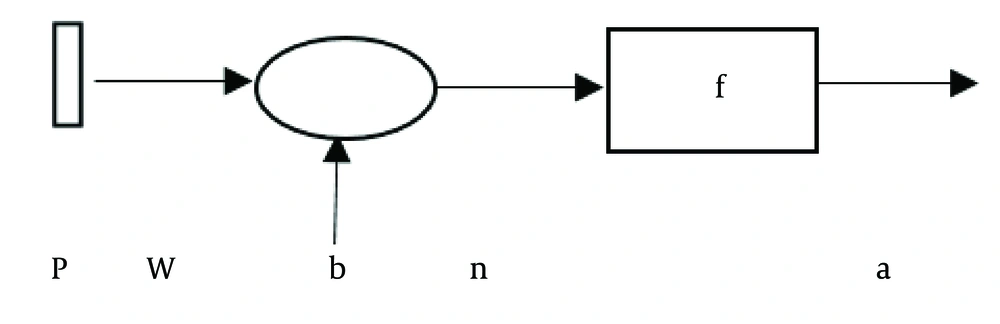
Figure 1.
Single-input neuron model
The effect of p on a is determined by w value. Another input is the constant value of 1 which is multiplied by b sentence and then summed with WP. The sum is the n net input for conversion or activation (motive) function of f. Therefore, the neuron output is defined as follows:
a = f (wp + b)
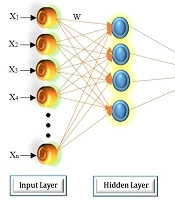
Where, parameters w and b are adjustable, and the motive function of f is determined by the designer. The parameters w and b are set according to the selection of f and the type of learning algorithm. In fact, learning means that w and b change and the relationship of neuron input and output are set with a special goal. Finally, the neurons are attached by the activation (motive) functions to create layers (19). Despite their diversity, ANNs have similar structures (18). An NN is usually composed of three layers: input, hidden, and output (20). The input layer only receives the information and acts as an independent variable; and therefore, the number of neurons in the input layer is determined on the basis of the problem nature. The output layer acts as a dependent variable, and the number of its neurons depends on the number of independent variables; however unlike the input and output layers, the hidden layer shows no meaning and is just an intermediate result in the process of calculating the output value (19). Figure 2 illustrates the overall view of an ANN.

Figure 2.
Overall view of an artificial neural network
Feedforward neural networks (FFNNs) are the most applied type of ANNs (18), due to one hidden layer, logistic activation function in the hidden layer, linear activation function in the output layer, and enough neurons in the hidden layer, they can approximate any functions with arbitrary accuracy (20). For this reason, this kind of NN with the above structure is called comprehensive approximation. It means that with enough hidden units and suitable number of neurons in this layer, the network can almost approximate every linear and nonlinear function with an arbitrary accuracy (19). Accordingly, an FFNN was used in the current study. The data were divided into two different sets of training and testing to design and train an ANN, since it was necessary to use training and testing data for this purpose (21). The train set is a set of network inputs and outputs used to train a special work to the network. After network training and end of the learning procedure, the test sample was used to investigate the network efficiency (19). Most researchers select the train and test samples with either one of the rules of 90% against 10%, 80% against 20%, or 70% against 30%. Naturally, the selection of any rule depends on the type of problem. But, there is a huge burden research indicating that increasing the number of training samples improves the operation of the network in the field of anticipation (21). In the current study, about 80% of the data were used as training sample, and the rest (20%) as testing sample. For training, the validation and NNs test were used during the design phase in the data related to 160 patients (train). The remaining data regarding 30 subjects were used to simulate the NN models for each of the algorithms (test) applied. The input variables (factors) for periodontal disease diagnosis were investigated in all of the 190 patients (Table 1). The data were imported to the Matlab software as input values. Periodontal disease diagnosis on each patient’s record was made in 1 - 4 intervals by one specialist; therefore, target parameter 1 was regarded for the attachment loss index values that were between 1 and 2 intervals; target parameter 2 for the values of attachment loss index in 2 and 3 intervals; target parameter 3 for the values between 3 and 4 intervals, and target parameter 4 for the values between 4 and 5 intervals. Therefore, 40 data sets were considered for the target parameters 1, 2, 3, and 4 in the training phase. The 30 remaining data were considered as follows: seven data sets with target parameter 1; seven data sets with target parameter 2; eight data sets with target parameter 3, and eight data sets with target parameter 4. The mean square error (MSE) and regression parameters with maximal 1000 epoch were considered for the two algorithms. Descending slope with momentum weight and bias learning function and MSE function were used for both the LM and the SCG algorithms. The Sigmoid transfer function was selected for both layers. The LM algorithm was trained with 1000 epochs and minimum tangent of 1e - 010 and infinite time. The SCG algorithm was trained with 1000 epochs, minimum tangent of 1e - 006, sigma value of 5e - 005, and lambda value of 5e - 007. First, 160 samples were trained to design the NN by the LM algorithm. Then, to design the SCG NN, the SCG algorithm was trained with the same number of data. The outputs of both of the trained networks were saved, and the results were compared to determine the most efficient algorithm to diagnose periodontal disease.
Table 1.
Factors of Periodontal Disease Diagnosis and Their Value Ranges as Input Parameters
| Factor | The Range of Value |
|---|---|
| Age | 18 - 55 |
| Gender | Female/male |
| Probing pocket depth | 1 - 4 |
| Clinical attachment loss | 0 - 4 |
| Plaque index, % | 0 - 100 |
4. Results
The Matlab programming environment (version 2015) was used to implement the algorithms. An ANN modeling process was performed by a set of training data. First, 160 samples were used to train the neural network both for the LM and SCG algorithms, and then the 30 remaining samples were used to test the NN. By fitting the different ANNs, a model was designed with two layers and 20 neurons in the hidden layer. Figure 3 shows the number of neurons in the input layer, the first and second hidden layers, and the output layer, which were 5, 20, 4, and 4, respectively. Table 2 shows the designed NN output after the implementation of the multi-layer perceptron NN in the Matlab software by the LM and SCG algorithms. The training phase for the LM algorithm was performed in 6.5870 seconds with six validations in 16 iterations. The rates of regression for training, validation, and testing phases were 0.9649, 0.8687, and 0.7354, respectively. The overall regression for the three mentioned phases was 0.9054. The input array’s training for scaled conjugate gradient (SCG) was 3.7670 seconds with six validations and 27 iterations. The regressions for the three phases were 0.7287, 0.3289, and 0.5315, respectively. Trainings of the LM and SCG algorithms were finished with 0.0012 and 0.0218 slopes, respectively. Comparison of the best performance of error validation in the LM and SCG algorithms in periodontal disease diagnosis indicated that the LM algorithm’s training in 22 performances gained 0.0098 and the SCG algorithm’s training in 33 performances had 0.055 for the MSE; thereby showing that the LM algorithm had a better performance in error management. According to the results obtained both for the NN’s training and testing phases (Table 2), the number of iterations for the LM and SCG algorithms was 16 and 27, respectively; indicating that the LM algorithm achieved the optimal responses with lower iterations compared with the SCG algorithm. These algorithms were performed in 6.5870 and 3.7670 seconds, respectively, indicating that the LM algorithm performed faster than the SCG algorithm, but acted weaker in error management. Among the three factors of error management, number of iterations, and performance duration, the LM algorithm was better in the first two factors compared with the SCG algorithm, but it was weaker in the third factor (i e, time control). Therefore, in a case in which it is impossible to access the periodontics specialist idea, due to negligible time difference, LM algorithm can be used to diagnose periodontal disease.
Table 2.
Comparison of the Results of Training and Testing Phases Both for LM and SCG Algorithms
| Neural Network Algorithms | Levenberg-Marquardt | Scaled Conjugate Gradient |
|---|---|---|
| Time executed, s | 6.6870 | 3.7670 |
| Epochs run | 22 | 33 |
| Convergence iteration | 16 | 27 |
| Best performance (MSE) | 0.0098 | 0.055 |
| Optimal gradient | 0.0012 | 0.0218 |
| R value training | 0.9649 | 0.7287 |
| R value validation | 0.8687 | 0.3289 |
| R value test | 0.7354 | 0.5313 |
| Overall R value | 0.9054 | 0.6444 |
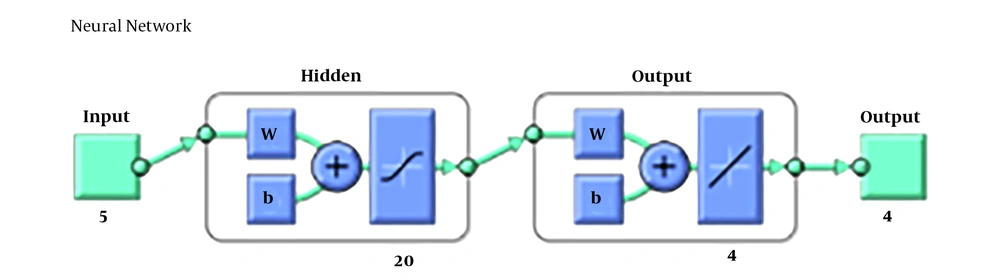
Figure 3.
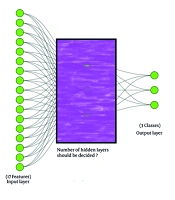
The number of layers and neural network neurons
5. Discussion
The current study aimed at developing a diagnosis system by ANN to diagnose periodontal disease. Age, gender, probing pocket depth, clinical attachment loss, and plaque index were selected as the main variables in NN learning. Use of decision making algorithms is a new area in the field of dentistry, and there is a lacking part for periodontal diseases (6). ANNs are used to help physicians in disease diagnosis for the past five decades. NNs attracted especial attention due to their ability to learn complex issues, along with the ability to maintain accuracy, even in the absence of some information (22, 23). Computational accuracy is an important tool used when applying an NN to ensure the quality of the final results (24). Therefore, this method is used in various fields, including prediction of mortality along with statistical methods. In the current study, the best comparison of validation performance of LM and SCG algorithms for periodontal diagnosis showed that the LM algorithm network training converged with an optimal MSE of 0.0098 at epoch 16; while the SCG algorithm training phase took 27 iterations to reach a much higher best MSE of 0.0555, leaving the LM algorithm better in terms of error management. LM algorithm could perform at least twice better than the SCG algorithm in terms of target approximation with minimal error, which may be due to the fact that the LM algorithm mostly performs better with moderate number of samples with higher accuracy and when the network contains no more than a few hundred weights (11). The obtained results were similar to those of the study by Edavi et al., concluding that ANN application had high accuracy, and those of the study by Jafarnejad and Soleymani, who concluded that ANN model, due to its accuracy measurement index (MSE), had more efficiency (25). The obtained results showed that the SCG algorithm was costly both in terms of error management and iterations needed for fitting and validation in this specific study. It was in contrast with the findings of Moller, who was on the opinion that SCG algorithm required less number of iterations for convergence (15). It revealed that the LM algorithm had a high performance in error management. Previous studies demonstrated that ANN accuracy was an important tool to diagnose the diseases. According to the current study results and comparing them with those of previous studies, high accuracy and efficiency of the ANNs to diagnose periodontal disease were achieved.