
1. Background
Although access to fire has caused extensive changes in daily life and subsequently, development of technology and industrialization, sometimes, insecure use and out of control fire causes accident and destruction, thus the importance of fire safety is clear to everyone (1). Hospitals and health service providers are a great asset for any country, the destruction and damage of which will have a huge economic burden for a country. When a hospital is destroyed and stops working, large costs are imposed on governments, considering that 70% of ministry of health budgets are spent on hospitals, thus, it is necessary that hospitals are protected from any damage and destruction (2). In some countries, up to 80% of the health budget are spent on hospitals and health service providers. Rebuilding a destroyed hospital costs double the initial construction cost. Hospitals provide care during 24 hours and cannot be easily evacuated as it is necessary to rescue patients, especially babies and those needing intensive care, thus, hospitals must continue their work and if activity of hospitals and health care providers are disrupted or hospital buildings are damaged, emergency services will be disrupted (3). This is why the World Health Organization stresses on 2009 messages on protecting hospitals during emergencies (4). National fire protection association of American, announced during year 2005 that on average over 8000 hospital fires occur around the world each year (5). From 2006 to 2010, the US fire department responded to around 1400 cases of fire emergencies (6). On July 26th, 2013, 39 people died in Liaoyuan, Jilin in China due to power failures. On 13 Sept 2013, 37 deaths occurred in Luka, Novgorod in Russia due to fire as a result of cigarette smoking, on April 26th, 2013, in Romanesque near Moscow, 38 people died at a psychiatric hospital due to the electrical short-circuit current and on October 23rd, 2012 at 4:06 in Tainan, Taiwan, 13 people died and 60 people were injured as a result of a fire at a hospital (7). According to the results of research conducted in the field of fire in developed countries, it is clear that nearly 80% of fires are predictable and preventable and it is clear that by predicting appropriate activities, the 25% remaining damage can be managed appropriately. Studies indicate that about 80% of fires occur in buildings and facilities, in which fire has not occurred previously and this clearly shows that lack of fire incidents for a long period, does not indicate that the place is a safe one (1). Examples of such events at hospitals, according to the above, shows that observing safety requirements, is important at hospitals and it is essential for each hospital to evaluate its safety conditions. According to international standards, the amount of safety at hospitals will be reduced after 10 years. Overall, 570 hospitals are working in the country, 486 of which are over ten years old or more. The situation of hospitals in the country indicates that the average age of 570 of the country’s public hospitals, are over 35 years old, which are hospitals with poor structures in terms of safety. If only one of these hospitals will be on fire because of the oxygen canisters, medical supplies, alcohol and fuel sources, the fire will intensify. Now, imagine the extant of a fire disaster at a four-storey hospital with 200 beds, with average of at least 170 patients, 30 physicians, 250 nurses, 600 medical and administrative staff, and 140 million dollars of facilities with light and heavy equipment (8). Johnson et al. performed a risk assessment on the basis of audit methods (9). In a study by Yarahmadi et al., use of designed methods based on risk assessment was recommended in order to achieve fire safety with appropriate performance (10). In a study by Mahdinia et al., in 2012, a software-based approach was introduced for risk assessment in order to optimize buildings for fire safety measures and it was concluded that using quantitative risk assessment in the design and implementation of fire protection in buildings is an appropriate method to boost performance (11). According to the importance and necessity of evaluation and implementation of protective measures to prevent damage, a risk assessment method is required. Unlike building codes that are mostly meant to assure a safe escape or rescue for the occupants, “FRAME” aims at protecting the building, its content, and activities. In one study, the evaluation of fire risk assessment according to FRAME was reported as the most comprehensive, the most transparent, and the most practical method for risk assessment (12). Some of its advantages are risk quantitative assessment, low cost, applicability in a short time, and evaluation of the present condition before making any attempt for correction. Experience has shown that there is a relationship between risk (R) and the amount of damage. This method can easily be used to evaluate fire risks in existing buildings and in order to avoid long statements on the status of fire safety, it can be stated using a number (13). The aim of this study was to evaluate alternative methods for fire risk assessment.
2. Methods
This study was a descriptive analytical study conducted at 15 wards of elected hospitals and on the basis of the standard FRAME method and its purpose was to introduce a systematic fire risk evaluation for buildings, based on the combination of severity, probability, and exposure of fire. “FRAME” is a developed Swiss Gretener method, which was published in 1970. Development and validation were measured by Eric De Smet. FRAME separately measures level of fire risk for buildings and property (R), for the occupants (R1) and activities (R2), based on the calculated potential risk to the building and its contents (P), potential risk for occupants (P1), as well as the potential risk for activity (P2). The acceptable risk level for the building and its contents is indicated by A. The acceptable risk level for occupants is A1, and the acceptable risk level for the activities is A2. Protection level for buildings and contents is D, the Protection Level for occupants is D1, and the protection level for activities is D2. Based on the R = P/(A × D) formula, the final result is expressed as a number.
The aim of a “FRAME” calculation is to determine whether or not there is an appropriate balance between the potential hazard, protection measures, and probability of occurrence. For an adequately protected compartment, the values of the risks are equal to or less than one. For numbers more than one, there is unacceptable risk and this means that the level of safety protection against potential risk is low and the system requires interventions (12).
The data were collected using a prepared checklist by the researcher, according to the required information for the method of measurement of length, width, and height, and observation and interviews. Due to the high volume of complex calculations used in the calculation method and in order to facilitate and increase the speed and accuracy, the Excel software was used for all the calculations. In order to assess the effect of crisis, before creating the management team, the initial risk assessment was carried out. For the team, which includes representatives from all units, training was done regarding fire accidents, evacuation procedures, reporting and communication in emergency situations, and training topics in methods of FRAM. Necessary amendments in the data was made again and the results were compared with the study limitations, and before and after evaluations were done by the researcher. Data were analyzed by SPSS 20 software at a significant level of P < 0.05 with the Wilcoxon test.
3. Results
Fifteen wards of selected hospitals were studied regarding fire risk assessment. Table 1 shows the risk of fire in buildings, occupants, and activities without the creation of a crisis management team and after organizing the team, the risk of fire was reduced. According to the results, a crisis management team will lead to a 34.97% decrease in risk for buildings, 22.77% for occupants and 35.36% for activities, and an average 31.4% reduction in the fire risk. In this study, 13.33% of the risk was for buildings (mean = 0.57, SD = 0.51) 100% risk was for individuals (mean = 4.60, SD = 2.37) and 53.33% risk was for activities (mean = 1.81, SD = 1.56), which were greater than one (unfavorable). Existence of effective crisis management team reduces fire risk by an average of 31.4%.
Figure 1 indicates the risk of fire for buildings, according to which laundry and facilities wards had the highest risk, and lowest risk of fire was for an isolated room. Figure 2 shows the fire risk for occupants; the fire risk for all wards was greater than one. Figure 3 shows the risk of fire for activities; the risk of fire was for the activity of 15 wards, eight of which had a score of greater than one.
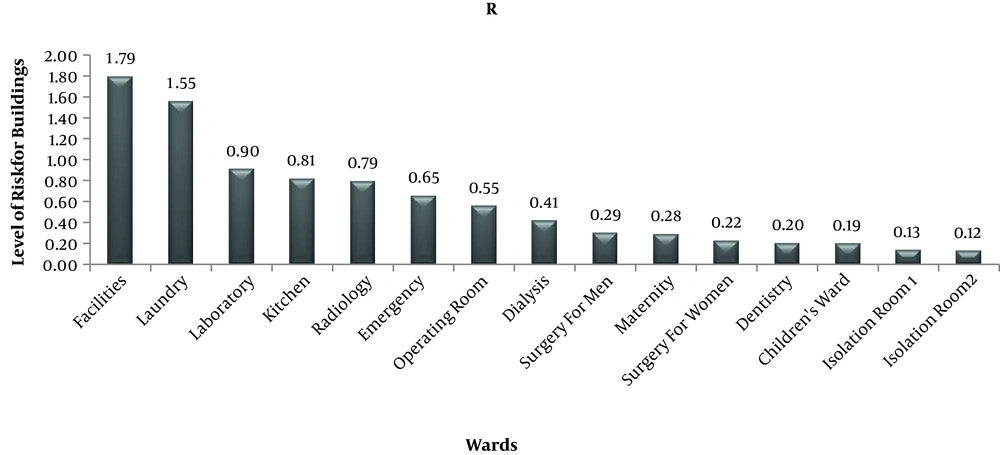
Figure 1.
The level of risk of fire for buildings and contents in the studied wards
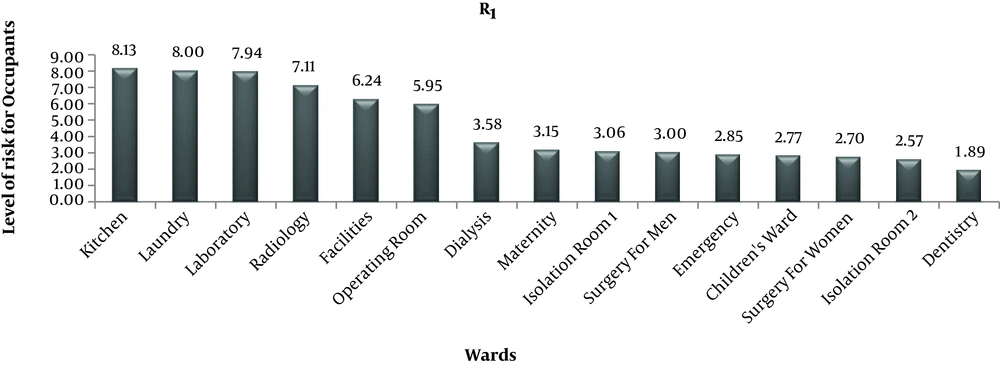
Figure 2.
The level of risk of fire for occupants in the studied wards
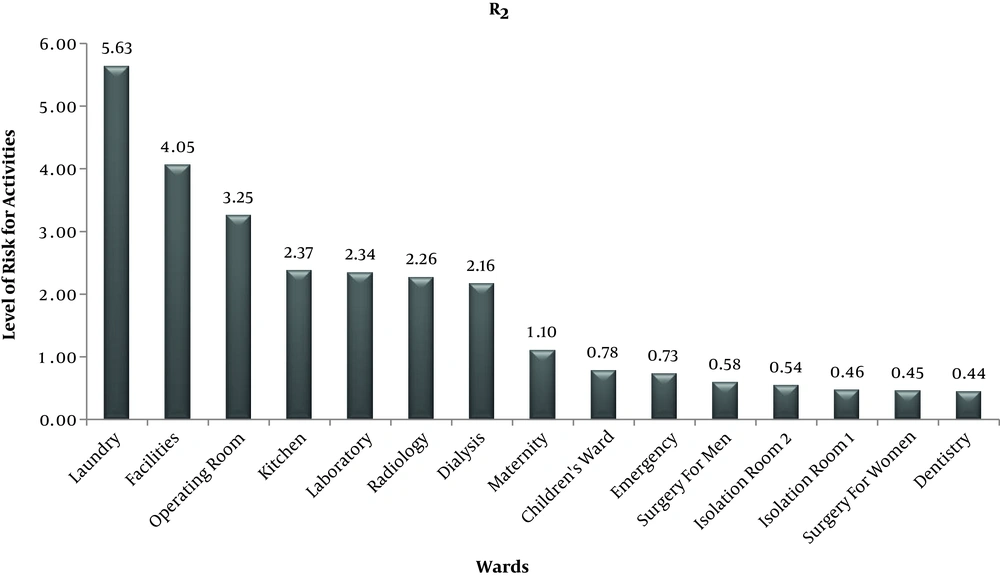
Figure 3.
Level of risk of fire for activities in the studied wards
Table 1.
Risk of Fire for Buildings, Occupants, and Activities without the Creation of a Crisis Management Team and After Organizing the Team
| Ward Name | Risk, Before Creation and Organization of the Team | Risk, After Creation and Organization of the Team | Risk Reduction (Percent) | ||||||
|---|---|---|---|---|---|---|---|---|---|
| Building, R | Occupants, R1 | Activities, R2 | Building, R | Occupants, R1 | Activities, R2 | Building, R | Occupants, R1 | Activities, R2 | |
| Kitchen | 0.81 | 8.13 | 2.37 | 0.60 | 6.62 | 1.75 | 34.97 | 22.77 | 35.36 |
| Laundry | 1.55 | 8.62 | 5.63 | 1.15 | 7.02 | 4.16 | |||
| Facilities | 1.79 | 6.24 | 4.05 | 1.33 | 5.08 | 2.99 | |||
| Dentistry | 0.20 | 1.89 | 0.44 | 0.15 | 1.54 | 0.32 | |||
| Emergency | 0.42 | 2.85 | 0.73 | 0.31 | 2.32 | 0.54 | |||
| Radiology | 0.74 | 7.11 | 2.26 | 0.55 | 5.79 | 1.67 | |||
| Laboratory | 0.90 | 7.94 | 2.34 | 0.67 | 6.47 | 1.73 | |||
| Surgery for men | 0.29 | 3.00 | 0.58 | 0.22 | 2.44 | 0.43 | |||
| Surgery For women | 0.22 | 2.70 | 0.45 | 0.16 | 2.20 | 0.33 | |||
| Children's ward | 0.19 | 2.77 | 0.78 | 0.14 | 2.26 | 0.57 | |||
| Isolation room 1 | 0.13 | 3.06 | 0.46 | 0.10 | 2.49 | 0.34 | |||
| Operating room | 0.48 | 5.38 | 3.25 | 0.36 | 4.38 | 2.40 | |||
| Maternity | 0.28 | 3.15 | 1.10 | 0.21 | 2.56 | 0.81 | |||
| Dialysis | 0.41 | 3.58 | 2.16 | 0.30 | 2.91 | 1.59 | |||
| Isolation room 2 | 0.12 | 2.57 | 0.54 | 0.09 | 2.09 | 0.40 | |||
| Average | 0.57 | 4.60 | 1.81 | 0.42 | 3.75 | 1.34 | |||
| Standard deviation | 0.51 | 2.37 | 1.56 | 0.38 | 1.93 | 1.15 | |||
4. Discussion
According to Zaboli (14), formation and training of a crisis management team in hospitals will, on average, reduce the risk of fire by 34%, and this effect was statistically significant (P < 5).
Regarding fire safety, facility and laundry wards had the highest risk and isolated units had the lowest risk for buildings, some reasons for low risk in the building compared to the risk of fire for occupants and activities can be the following, relative resistance of buildings against fire, shorting of theoretical length and area of units, and access to water for firefighters. In both studies, by Sarsangi et al. (15) and Mahdinia et al. (11), 100% of occupants’ risk was obtained greater than one, which was equal to the results of this study. Some reasons for high risk of fire for occupants and activities can be the lack of a coherent plan for the evacuation of staff, lack of adequate access to emergency exits, lack of automatic sprinkler, detector and alarm systems. In the study of Sarsangi et al. (15), 95% of the risks of activities and 89.74% of risks of the buildings were greater than one; the reasons for the differences include the following: difference in the structure of the building, the existences of a water supply, the small area of the rooms, and the length of time, the firefighters are present at the place (below ten minutes), which is considered by the hospital’s strengths.
Costella et al. (16) showed that both managers and employees should be aware of the risk of occurrence of catastrophic events, and increasing awareness will change employees’ safety behaviors. This aim is achievable by assessing the risks and organizing a crisis management team in hospitals.
In researches conducted by Sabzghabaie et al. (17), in the field of safety in hospitals at Shahid Beheshti University of Medical Sciences, Khalooei et al. (18) on safety evaluation in Kerman teaching hospitals, Ghanbari Kakavand et al. (19) on Kermanshah teaching hospitals, and Norozi et al. (4) on evaluation of fire safety in Shiraz, teaching hospitals’ status of fire safety was reported as unpleasant, which is similar to the results of this study. The strong point of this study was of cooperation of hospital staff and their management in implementing the study. The weak point of this study was the limitation to one hospital to evaluate the effect of the crisis management team. The study by Rassin et al. (20) showed that hospitals have low readiness for crisis management, which is similar to the current study. The building risk for two wards of laundry and facilities was between 1.5 and 1.8. In the event of fire, the damage caused is between 35% and 64%, which indicates the need for special attention to the installation of a sprinkler system and the formation of a crisis management team. For other wards, in case of fire, the damage is estimated at 10% or less.
It is recommended to assess fire safety situation in other hospitals, and conduct similar studies with emphasis of different standards on the existence of efficient crisis management team in hospitals.
4.1. Conclusion
Due to the weak status of fire safety in all hospitals studied in this research, a crisis management team can reduce the fire risk in hospitals. It is suggested to determine the amount of damage and to identify the defects for each hospital, before fire risk assessment and the effect of alternative designs on risk reduction should be assessed before implementation.