1. Background
Child mortality rate (CMR) is of great importance for health researchers and policy makers. It is an indicator to measure health and socio-economic status of communities and is considered as the main element in the study of burden of disease (BOD) and risk factors (1, 2). In addition, it is one of the targets of development goals such as millennium development goals (MDG) and sustainable development goals (SDG) signed by the leaders and represantatives of the countries around the world to reduce CMR by 2015 and 2030, respectively (3, 4). One of the targets of MDG is to reduce CMR by two-thirds from 1990 to 2015, and one of the targets of SDG is to reduce CMR to less than 25 per 1000 live births by 2030. According to previous studies, CRM is high in many countries and they cannot achieve MDG 4 by 2015 (5, 6). In a report provided by the Global Burden of Disease group in 2015, the number of children dying under five years old was 5.8 million in the world and over 21,000 in Iran; therefore, CMR in Iran was 15 per 1000 live births (2). Accordingly, it is of great importance to have the knowledge on the level and trend of child mortality. Researchers and health agencies advise countries to establish a vital registration system to collect, analyze, and interpret the data on mortality. However, as the available evidence show, most countries, especially the developing countries, lack such a system (7). In Iran, two separate administrations record mortality data including vital registration and health deputy of the Ministry of Health and Medical Education (MOHME). According to previous studies, both administrations have deficiencies such as under-registration, misclassification, and delay in the registration of mortalities (8-10). Therefore, the data collected by these administrations, including the data on child mortality, cannot be informative for policy-makers; therefore, other alternatives to the existing death registration systems should be used. Hill suggests four alternatives for death registration system (DRS), which depend on the existing conditions. Among them, an appropriate alternative to calculate child mortality is to collect data on summary birth history (SBH) from females aged 15 to 49 years. Two common questions are: How many children have ever been born (CEB) and how many children have ever survived (CES)? These questions are incorporated into the national surveys such as censuses and demographic and health survey (DHS) programs; for that reason, they are employed to estimate child mortality. In the literature, this method was called SBH (11). Validation of the method showed that the estimates produced by SBH were valid and reliable, and the method can be used as an appropriate alternative for death registration system in countries without DRS or with a dysfunctional DRS (12).
2. Objectives
Although the estimates provided by the international institutes are valid and reliable for all countries, especially for the countries that lack DRS, the estimates are at national level not at provincial level; therefore, the status of CMR in each province cannot be examined separately.
Sistan and Baluchistan is one of the provinces located at Eastern part of Iran. Based on the results of previous investigations, the province has an inappropriate socioeconomic and welfare status and CMR in this province is worse than that of other provinces in Iran (13). As the year 2015 was already passed, it was time to evaluate the progress of provinces toward MDG 4 and conduct a baseline analysis of SDG 3. Due to the incompleteness of death registration system in Iran, a reliable CMR assessment cannot be achieved. As a result, the current study aimed at estimating CMR in Sistan and Baluchistan Province using SBH method.
3. Methods
3.1. Type of the Study
The current cross sectional study was conducted using the secondary data.
3.2. Setting
3.3. Data Sources
In order to estimate CMR using birth history method, the data collected from four censuses and one DHS were used. Censuses data only included SBH questions, while DHS had complete birth history questions as well as the SBH questions. Therefore, censuses 1986, 1996, 2006, and 2011, and DHS 2000 were selected as final data sources. The two criteria for quality assessment included gender ratio and magnitude of missing data. If gender ratio was out of the normal range (1.0: 1.06), it was considered as low quality. In addition, if the percentage of missing data was high, it was considered as low quality too (16). Therefore, DHS 2010 was excluded due to the low quality. The rates produced by DHS 2010 were very low and their trend and pattern were inconsistent with those of other data sources.
3.4. Statistical Analysis
SBH data were analyzed using maternal age cohort (MAC) and maternal age period (MAP) methods (1). Using the Loess regression, the final estimate was generated from these two estimates. Finally, using GPR the final trend was obtained with an uncertainty of 95% (17-20). The details on the methods are presented below.
In the analysis of SBH using MAC method, the proportion of children died (CD) to CEB was calculated for each of the seven age groups of females. Then, a life table model was employed to identify the relationship between the proportion of children died and the probabilities of dying were determined. On the other hand, using one regression expression, the time reference related to each resulting 5q0 (probability of dying from age 0 to age 0 plus 5 years old) was estimated as well. Regression equation for MAC was as follows:
Where
5q0 = under - five mortality rate
i = 5-year maternal age group ∈{15 - 19, 20 - 24, …, 45 - 49}
j = country
k = year of survey
P (…) = parity (average CEB) for specified maternal age group
CDi = total dead children from maternal age group i
CEBi = total children ever born from maternal age group i
CEBi = total children ever born from maternal age group i
The maternal age period (MAP) method was used to generate the expected distribution of births and deaths for each the one-group year mothers and then calculated the proportion of CD to CEB in every year prior to the survey. Finally, using the relationship between the calculated proportion and probability of dying in life table model, the probability of death in children under five years of age was obtained. The equation for this method is as follows:
Where
t = index of calendar time ∈ [0, 24]
j = country
k = survey
CDtjk = total dead children in time bin t
CEBtjk = total children ever born in time bin t
The next step to analyze SBH was to smooth the estimates produced via MAC and MAP methods. The estimates were smoothed using Loess regression. It is a locally weighted scatter-plot smoothing method that considers nonlinear trends. The weight of each data point was calculated using the inverse of the number of the points produced by the two previous methods (6).
Finally, in order to produce one single trend out of different trends produced in different data sources, Bayesian technique called GPR was used. Gaussian process used spatio-temporal model and Matern covariance function to produce prior distribution; the posterior distribution was generated through the Markov chain Monte Carlo (MCMC) method by combining the prior distributions with data likelihood. According to the median, 2.5 percentile, and 97.5, final estimate with lower and upper band of the estimates were obtained. RStan package in R and STATA software were used to analyze the data. More explanation on the methods can be found in references (21). Finally, the association between mother’s years of schooling and wealth index and the trend of CMR were assessed.
4. Results
Figure 1 demonstrates the 52-year trend of child mortality in Sistan and Baluchistan Province from 1962 to 2015 obtained from different data sources using GRP. As shown in this figure, CRM declined from 336 per 1000 live births (95% CI: 306 - 366) in 1962 to 247 (95% CI: 264 - 279) per 1000 live births in 1970 and 182 (95% CI: 177 - 187) per 1000 live births in 1980. This decline continued in the following years; hence, in 1990 CMR was 115 (95% CI: 114 - 118) per 1000 live births and reached 67 (95% CI: 66 - 70) per 1000 live births in 2000. In 2005, CMR in Sistan and Baluchistan Province was 50 (95% CI: 48 - 53), while it was 35 (95% CI: 31 - 40) per 1000 live births in 2010 and 22 (95% CI: 17 - 29) per 1000 live births in 2015.
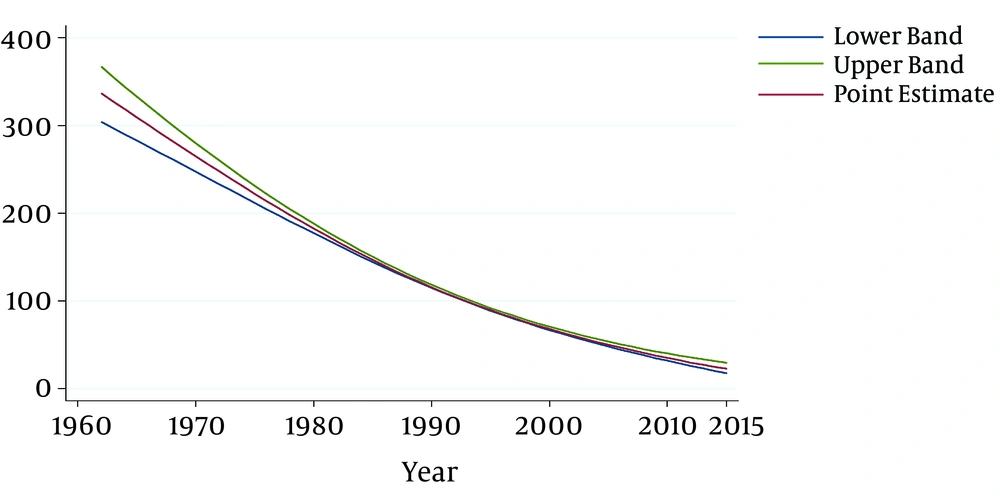
Figure 1.
Trend of CMR with 95% uncertainty in Sistan and Baluchistan Province from 1962 to 2015
As shown, the trend was a decreasing trend, although it was not monotonous over time, rather it had an inconsistent pattern. Figure 2 shows the trend of annual reduction in CMR from 1962 to 2015. Median annual reduction rate from 1962 to 2015 was approximately 5%. The current study results demonstrated that median annual reduction rate (ARR) from 1962 to 1970 was 3%. Moreover, from 1970 to 1980, from 1980 to 1990, and from 1990 to 2000, it was 3.6%, 4.4%, and 5.1%, respectively. The median ARR during 2000 to 2010 and 2010 to 2105 was 6.2% and 8.2%, respectively.
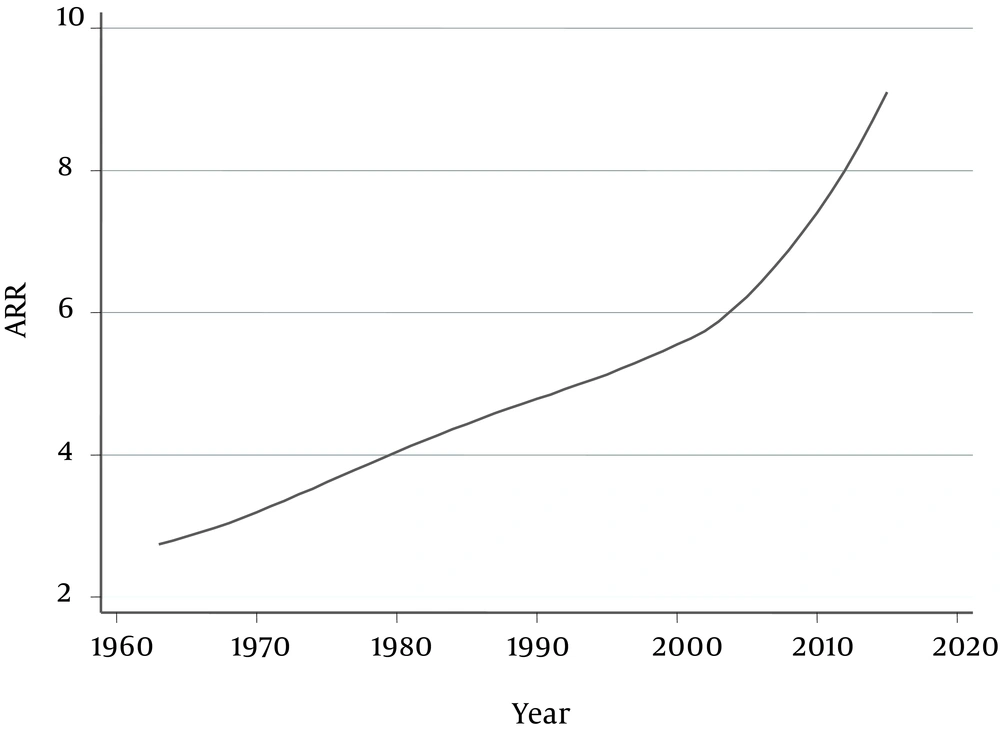
Figure 2.
Trend of ARR in CMR in Sistan and Baluchistan Province from 1962 to 2015
Table 1.
Estimation of CMR (Per 1000 Live Births) in Sistan and Baluchistan Province From 1962 to 2015
| Year | Point Estimate | 95% Uncertainty Interval | |
|---|---|---|---|
| 1962 | 336.48 | 303.66 | 366.64 |
| 1963 | 327.26 | 296.72 | 355.11 |
| 1964 | 318.12 | 289.73 | 343.8 |
| 1965 | 309.06 | 282.72 | 332.69 |
| 1966 | 300.08 | 275.68 | 321.78 |
| 1967 | 291.16 | 268.61 | 311.06 |
| 1968 | 282.3 | 261.52 | 300.52 |
| 1969 | 273.51 | 254.42 | 290.14 |
| 1970 | 264.79 | 247.31 | 279.94 |
| 1971 | 256.13 | 240.2 | 269.91 |
| 1972 | 247.55 | 233.09 | 260.04 |
| 1973 | 239.04 | 225.99 | 250.33 |
| 1974 | 230.62 | 218.91 | 240.8 |
| 1975 | 222.29 | 211.85 | 231.45 |
| 1976 | 214.06 | 204.81 | 222.3 |
| 1977 | 205.97 | 197.8 | 213.37 |
| 1978 | 198 | 190.84 | 204.69 |
| 1979 | 190.18 | 183.94 | 196.23 |
| 1980 | 182.5 | 177.1 | 188 |
| 1981 | 174.98 | 170.35 | 180 |
| 1982 | 167.63 | 163.68 | 172.23 |
| 1983 | 160.46 | 157.12 | 164.69 |
| 1984 | 153.47 | 150.67 | 157.39 |
| 1985 | 146.66 | 144.35 | 150.32 |
| 1986 | 140.05 | 138.15 | 143.47 |
| 1987 | 133.64 | 132.09 | 136.86 |
| 1988 | 127.43 | 126.17 | 130.47 |
| 1989 | 121.42 | 120.39 | 124.31 |
| 1990 | 115.61 | 114.75 | 118.37 |
| 1991 | 110 | 109.27 | 112.65 |
| 1992 | 104.58 | 103.93 | 107.15 |
| 1993 | 99.36 | 98.75 | 101.87 |
| 1994 | 94.33 | 93.73 | 96.79 |
| 1995 | 89.49 | 88.86 | 91.93 |
| 1996 | 84.83 | 84.15 | 87.27 |
| 1997 | 80.34 | 79.59 | 82.8 |
| 1998 | 76.03 | 75.18 | 78.54 |
| 1999 | 71.88 | 70.92 | 74.47 |
| 2000 | 67.89 | 66.8 | 70.59 |
| 2001 | 64.07 | 62.82 | 66.89 |
| 2002 | 60.39 | 58.98 | 63.38 |
| 2003 | 56.84 | 55.25 | 60.02 |
| 2004 | 53.41 | 51.62 | 56.8 |
| 2005 | 50.09 | 48.08 | 53.7 |
| 2006 | 46.87 | 44.65 | 50.74 |
| 2007 | 43.75 | 41.3 | 47.9 |
| 2008 | 40.74 | 38.06 | 45.19 |
| 2009 | 37.84 | 34.9 | 42.6 |
| 2010 | 35.04 | 31.84 | 40.14 |
| 2011 | 32.34 | 28.87 | 37.81 |
| 2012 | 29.75 | 25.98 | 35.61 |
| 2013 | 27.27 | 23.17 | 33.53 |
| 2014 | 24.9 | 20.43 | 31.58 |
| 2015 | 22.63 | 17.75 | 29.75 |
In addition, the percentage of reduction from 1962 to 2015 was 93%, while the percentage of reduction from 1990 to 2015 was 80%.
5. Discussion
The current study aimed at estimating the trend of child mortality in Sistan and Baluchistan Province using methods other than death registration system. The current study analysis showed that CMR in Sistan and Baluchistan Province dropped from 336 per 1000 live births in 1962 to 23 per 1000 live births in 2015, which indicated a 93% decline. It demonstrated a drastic advancement in the survival of children in Sistan and Baluchistan Province. As observed in the figure, the rate of reduction during the primary years was higher than the recent years. This may indicate a decrease in communicable diseases through health intervention such as vaccination, nourishment improvement, increasing people’s knowledge, and access to medical services (22). As noted in the introduction, MDG are a set of goals agreed by leaders of about 190 countries following the Millennium Summit of the United Nations in 2000. These leaders committed to take steps to achieve eight goals (23). The fourth goal called for reduction in CMR by two-thirds from 1990 to 2015. The current study helped to assess the achievement of Sistan and Baluchistan Province in terms of the fourth goal (23).
According to the MDG 4 (23), it can be stated that Sistan and Baluchistan Province reached the MDG4, since CMR in the province decreased by over two-thirds from 1990 to 2015. According to SDG's agenda calling for the reduction of CMR to less than 25 per 1000 live births in 2030, as a baseline analysis, it can be said that Sistan and Baluchistan Province already reached SDG in 2015.
The current study results showed that CMR in 1990 in Sistan and Baluchistan province was 115 per 1000 live births; therefore, in order to achieve MDG4, it should declined further to reach 33 per 1000 live births in 2015, while the current study result showed that CMR was 23 per 1000 live births in 2015. As a result, it can be concluded that Sistan and Baluchistan Province reached MDG4. Moreover, the current study baseline analysis revealed that CMR in Sistan and Baluchistan Province was less than 25 per 1000 live births; therefore, it can be concluded that Sistan and Baluchistan Province already achieved SDG. However, considering an uncertainty of 95%, child mortality should decrease further in the following years to achieve SDG in 2030, since the upper limit of this uncertainty is more than 25 per 1000 live births.
The association between the trend of CMR and several covariates were examined. The current study analysis showed a strong correlation between the trend of CMR and trend of years of schooling (r > -0.8), and wealth index (r > 0.8). In addition, vaccination coverage improved during the recent 40 years (24).
In a report published by MOHME in 2010, CMR in Sistan and Baluchistan Province was 17 per 1000 live births. However, the current study results were inconsistent with the report by MOHME. The most important reason for this inconsistency was under-registration of child mortality in Sistan and Baluchistan Province (25).
The current study had several limitations, which are worth mentioning. First, unfortunately, DHS 2010, which is an important data source, could not be used, since the current study quality assessment showed that gender ratio for these two data sources was equal to or less than 1, which indicated the low quality of data (16). In addition, for the years 2010 to 2015, there were no data sources available to estimate CMR, thus those years were extrapolated using spatio-temporal model (19). In fact, for these years, the model borrowed data from the rates and trends of the previous years. Therefore, the accuracy and quality of these estimates depend on the accuracy of model parameters. As shown in the figure, it affected the results. In the years before 1980 and after 2010, uncertainty interval was wider than that of the years 1980 and 2010. This indicated the effects of the number of data sources on the uncertainty. The more the data sources, the more accurate are the estimates. In fact, GPR can consider both sampling and non-sampling variance (17). Non-sampling bias refers to the accuracy and quality of data. Therefore, when the amount and quality of data such as censuses are low the method employed to obtain the results is making a wider level of uncertainty. GPR includes the time points and the time trends of the estimates. Previous studies showed that this method outperforms other methods such as Loess and Spline.
Moreover, the HIV epidemic may affect the results. Fortunately, Iran is not affected by an HIV epidemic, as a result, it is hoped that the current study results are not affected by this epidemic and there is no such bias in the obtained results (26). Moreover, the current study employed the SBH. This method assumed that survival of children of lived mother was the same as of dead mothers and there was no recall bias. If these assumptions were not held, the current study results might have been affected by selection bias (27). However, there was no way to examine these assumptions, but as the study used censuses data in a mass dimension, the effects of selection and information bias was expected to be insignificant. In order to identify inequalities and reasons for high CMR in Sistan and Baluchistan Province, it is recommended that the researchers should estimate this indicator at a district level.
5.1. Conclusions
Survival of children in Sistan and Baluchistan Province significantly improved in the past 53 years, which indicated the effectiveness of health interventions for children. Nevertheless, according to SDG, it is necessary to decrease CMR further in Sistan and Baluchistan Province in the following years to achieve SDG by 2030. Accordingly, policy makers and health professionals should identify districts with high CMR and decline CMR in such districts.