
1. Background
Unintended pregnancy, defined as a pregnancy that is unwanted or mistimed at the time of conception (1), has remained a global public health problem for decades (2). Induced abortion is one of the evident consequences of unintended pregnancy, which is often unsafe in countries with restrictive abortion laws (3). In 2012, unsafe abortions were responsible for seven million women’s hospital admissions in developing countries (4). Also, 7.9% of annual maternal deaths between 2003 and 2009 happened due to unsafe abortions (5). In addition to abortion-related morbidity and mortality, unintended pregnancy has adverse effects on utilization of antenatal care, breastfeeding behavior, and child nutrition. Moreover, low birth weight, incomplete vaccination, infant mortality, depression, anxiety, and abuse might be other consequences of unintended pregnancy that affect the health of child and mother (3). The rate of unintended pregnancies worldwide decreased from 74 per 1000 women aged 15 - 44 years in 1990 - 94 to 62 in 2010 - 2014. However, unintended pregnancy reduction in developed countries was about twice that of developing countries (30% vs. 16%). This public health problem was unequally more concentrated among developing than developed countries in 2010 - 2014 (2).
In Iran, the government’s policies to reduce unintended pregnancies were part of a greater anti-natalist population policy package introduced in 1989 and provided access to free family planning (FP) services for all married couples across the whole country, regardless of their socioeconomic status (SES). However, in 2012, Iran's population policy was transformed into pro-natalist ones and family planning policies were changed accordingly (6). The effect of the changes in government’s policies on unintended pregnancy inequality is unrecognized. Some studies have argued that changes in family planning policies may have reduced access to FP services for women from lower socioeconomic groups and may increase the rate of unintended pregnancies in these women (6, 7). However, as far as we know, there is no evidence indicating that women’s contraception behavior and pregnancy outcome were adversely affected by the changes in government’s policies.
The association between women’s socioeconomic background and unintended pregnancies has been addressed in the literature. While some studies have indicated that economic status has no effect on unintended pregnancies (3, 8), other studies have shown a significant association between unintended pregnancy or childbirth and economic status (9, 10). Although some studies have reported no association between unintended pregnancy and women’s education (11, 12) and employment status (11, 13), the results of other studies have revealed that the probability of experiencing an unintended pregnancy or childbirth is higher in less educated (7, 14) and employed women (9).
To the best of our knowledge, so far only one study has been done on the socioeconomic inequality of unintended pregnancies in Tehran, Iran (15). Currently, there is no research based on national data to measure the extent of socioeconomic inequality of unintended pregnancy and related factors among all Iranian married women.
2. Objectives
In this study, we first used concentration index (CI) and concentration index decomposition method to measure socioeconomic inequality of unintended pregnancy and identify its determinants in two periods with different FP policies in the country (2010 and 2015). Then, using Blinder-Oaxaca decomposition method, changes in unintended pregnancy inequality over the study period and its determinants were investigated.
3. Methods
3.1. Source of Data and Study Variables
This cross-sectional study was a secondary analysis of data extracted from two Iran's Multiple Indicator Demographic and Health Surveys (IrMIDHS) conducted by the Ministry of Health and Medical Education (MOHME) and the National Institute of Health Research (NIHR) in 2010 and 2015. The IrMIDHS was designed to provide reliable and internationally comparable data on health and population indices to assess the impact of social indicators on public health and help policymakers promote health outcomes and reduce health inequalities by designing effective strategies (16). In this study, we used data from 1123 and 900 married women aged 15 - 49 years who were pregnant at the time of the 2010 and 2015 surveys, respectively.
The outcome variable was pregnancy intention. According to the standard definition of unintended pregnancy outlined in other studies (1, 3, 12, 17), we classified women’s responses on their pregnancy intention as “intended” if they wanted to be pregnant at the time of conception and “unintended” if they did not want to be pregnant at the time of conception but wanted another child later (mistimed pregnancy) or if they did not want to be pregnant at all (unwanted pregnancy).
Household’s SES was measured by wealth index using principal component analysis (PCA). PCA is a statistical method that reduces the number of preliminary variables into a new set of uncorrelated factors or principal components. Since the first component accounts for the largest amount of variance across the preliminary variables, it is used to construct the wealth index. Relative importance of each variable to the constitution of the wealth index is determined with their factor weights (18). The wealth index is a more accurate proxy measure for estimating the level of households’ living standards than direct measures such as income and expenditure, especially in developing countries (19). Variables used in wealth index construction included the possession of television, personal computer or laptop, refrigerator, washing machine, landline, motorcycle, car, bathroom, ownership of the living house, number of rooms per person, access to piped drinking water, access to the internet, and the use of natural gas for cooking. According to their wealth indices, households were categorized into five socioeconomic quintiles as the poorest, poorer, medium, wealthier, and the wealthiest.
Other explanatory variables of the study were as follows: age at pregnancy (under 20, 20 - 34, and 35-49-years-old), age at the first marriage (under 20, 20 - 29, and above 29-years-old), parity (0, 1 - 2 and > 2), household size (2, 2 - 5, and > 5), having a history of abortion or stillbirth (yes/no), residence in urban areas (yes/no), women’s education level (illiterate, nonacademic, and academic), and contraceptive non-use before pregnancy (yes/no).
3.2. Inequality Measurement
In this study, the concentration index (c) was used to measure the socioeconomic inequality of unintended pregnancy, as follows:
Where yi is the outcome variable (pregnancy intention of the ith woman), ri is the fractional rank of the ith woman in the distribution of household’s SES, and µ is the mean of unintended pregnancy. Since unintended pregnancy is a binary variable, we normalized the concentration index using the Wagstaff approach (20), as follows:
In the above equation, C is the Wagstaff normalized concentration index. The range of C is between -1 and +1; taking the value of zero indicates no inequality while the negative (positive) values indicate a pro-rich (pro-poor) inequality in unintended pregnancy.
3.3. Decomposition of Inequality
Concentration index decomposition approach suggested by Wagstaff et al. (21) was applied to determine contribution of the explanatory variables to the measured inequality in unintended pregnancy (C). In this regard, by considering a linear association between unintended pregnancy and its determinants, the CI for unintended pregnancy was written as follows:
In the above equation, the measured inequality in unintended pregnancy (C) was decomposed into the inequality that is attributable to the variations of explanatory variables between SES quintiles (
3.4. Decomposition of Changes in Inequality
The Blinder-Oaxaca decomposition approach (21) was used to measure the contribution of changes in the explanatory variables to the measured changes in unintended pregnancy inequality in 2010 - 2015. The decomposition formula can be written as follows:
And alternatively:
where Ckt is the Wagstaff normalized CI, ηkt represents the elasticity of determinant k in 2015, C(kt-1) is the Wagstaff normalized CI, and η(kt-1) is the elasticity of determinant k in 2010.
All of the study’s analyses were carried out using Stata version 14 (StataCorp, College Station, TX, USA).
4. Results
Overall, 242 (21.3%) women in 2010 and 180 (20%) in 2015 rated their pregnancies as unintended. As illustrated in Figure 1, in 2010, the concentration curve is above the line of equality, which indicates a high concentration of unintended pregnancy among disadvantaged women. In 2015, the unintended pregnancy concentration curve crosses the line of equality suggesting that there may be no inequality in unintended pregnancy distribution across different socioeconomic strata provided that the areas below and above the line neutralize each other. Table 1 shows that the size of unintended pregnancy inequality was -0.145 in 2010, which decreased significantly by 0.175 units (120%) to 0.030 in 2015. The positive CI in 2015 was not statistically different from zero.
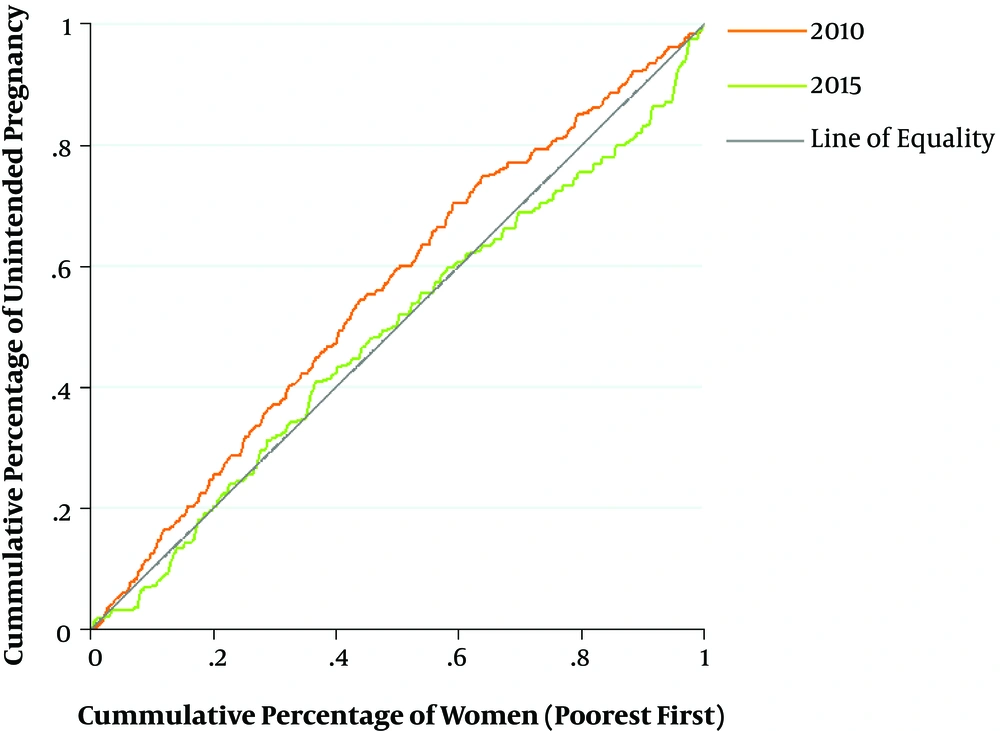
Figure 1.
Concentration curves of unintended pregnancy among Iranian married women aged 15 - 49 years, 2010 and 2015
Table 1.
Concentration Indices for Unintended Pregnancy Among Iranian Married Women Aged 15 - 49 Years in 2010 and 2015
| Index | Year | Index Value | Robust Standard Error | P Value | Difference | Standard Error | P Value |
|---|---|---|---|---|---|---|---|
| Wagstaff normalized concentration index | 2010 | -0.145 | 0.042 | < 0.001 | 0.175 | 0.089 | 0.048 |
| 2015 | 0.030 | 0.078 | 0.705 |
Table 2 illustrates the results of unintended pregnancy inequality decomposition in 2010 and 2015 using means, marginal effects, and CIs of the study’s variables. According to the percentage contributions, in 2010, the households’ economic status, age at pregnancy, and parity were the main factors that positively contributed to the pro-rich unintended pregnancy inequality by 120.4%, 28.5%, and 19.2%, respectively. Furthermore, contraceptive non-use before pregnancy and residence in urban areas had negative contributions to the measured inequality by 34.2% and 26.5%, respectively. In 2015, the positive contributions of living in urban areas (179.8%), economic status (156.2%), age at pregnancy (6.6%), and contraceptive non-use before pregnancy (4.5%) on the pro-poor unintended pregnancy inequality were largely offset by the negative contributions of women’s education level (122.5%), parity (65.8%), household size (61.4%), and having a history of abortion or stillbirth (5.3%).
Table 2.
Decomposition of Socioeconomic Inequality in Unintended Pregnancy Among Iranian Married Women Aged 15 - 49 Years in 2010 and 2015
| Variables | Mean | Marginal Effect | Elasticity | Concentration Index (Ck) | Absolute Contribution to CI | Contribution, % | ||||||
|---|---|---|---|---|---|---|---|---|---|---|---|---|
| 2010 | 2015 | 2010 | 2015 | 2010 | 2015 | 2010 | 2015 | 2010 | 2015 | 2010 | 2015 | |
| Age at pregnancy (RC: 35 - 49) | ||||||||||||
| < 20 | 0.11 | 0.04 | -0.092 | -0.077 | -0.046 | -0.017 | -0.328 | -0.194 | 0.015 | 0.003 | -10.3 | 11.2 |
| 20 - 34 | 0.78 | 0.73 | -0.183 | -0.013 | -0.672 | -0.049 | 0.084 | 0.027 | -0.056 | -0.001 | 38.7 | -4.5 |
| Sum | -0.041 | 0.002 | 28.5 | 6.6 | ||||||||
| Age at the first marriage (RC > 29) | ||||||||||||
| < 20 | 0.50 | 0.49 | 0.241 | -0.008 | 0.562 | -0.020 | -0.135 | -0.043 | -0.076 | 0.0009 | 52.0 | 3.0 |
| 20 - 29 | 0.47 | 0.47 | 0.259 | -0.010 | 0.567 | -0.024 | 0.116 | 0.059 | 0.066 | -0.0014 | -45.1 | -4.7 |
| Sum | -0.010 | -0.0005 | 6.9 | -1.8 | ||||||||
| Parity (RC > 2) | ||||||||||||
| 0 | 0.47 | 0.24 | -0.161 | -0.203 | -0.357 | -0.247 | 0.057 | 0.045 | -0.020 | -0.011 | 13.9 | -37.4 |
| 1 - 2 | 0.44 | 0.65 | -0.100 | -0.120 | -0.208 | -0.391 | 0.0371 | 0.0215 | -0.008 | -0.008 | 5.3 | -28.4 |
| Sum | -0.028 | -0.019 | 19.2 | -65.8 | ||||||||
| Household size (RC > 5) | ||||||||||||
| 2 | 0.37 | 0.18 | -0.070 | -0.143 | -0.122 | -0.131 | 0.031 | 0.071 | -0.004 | -0.009 | 2.6 | -31.6 |
| 2 - 5 | 0.51 | 0.74 | 0.016 | -0.080 | 0.039 | -0.296 | 0.073 | 0.030 | 0.003 | -0.009 | -2.0 | -29.8 |
| Sum | -0.001 | -0.018 | 0.6 | -61.4 | ||||||||
| Having a history of abortion or stillbirth | 0.18 | 0.21 | -0.075 | -0.022 | -0.064 | -0.023 | 0.102 | 0.069 | -0.007 | -0.002 | 4.5 | -5.3 |
| Residence in urban areas | 0.64 | 0.68 | 0.026 | 0.035 | 0.078 | 0.119 | 0.492 | 0.448 | 0.039 | 0.053 | -26.5 | 179.8 |
| Women’s education level (RC: academic) | ||||||||||||
| Illiterate | 0.10 | 0.05 | 0.024 | -0.064 | 0.011 | -0.017 | -0.591 | -0.541 | -0.007 | 0.009 | 4.5 | 30.5 |
| Nonacademic | 0.77 | 0.76 | -0.003 | 0.054 | -0.011 | 0.206 | -0.108 | -0.219 | 0.001 | -0.045 | -0.9 | -153.0 |
| Sum | -0.005 | -0.036 | 3.6 | -122.5 | ||||||||
| Household’s economic status (RC: wealthiest) | ||||||||||||
| Poorest | 0.27 | 0.26 | 0.136 | -0.119 | 0.172 | -0.157 | -1.000 | -1.000 | -0.172 | 0.157 | 118.2 | 529.9 |
| Poorer | 0.23 | 0.25 | 0.107 | -0.077 | 0.117 | -0.097 | -0.300 | -0.297 | -0.035 | 0.029 | 24.1 | 97.1 |
| Medium | 0.20 | 0.17 | 0.043 | -0.148 | 0.039 | -0.126 | 0.247 | 0.244 | 0.010 | -0.031 | -6.7 | -104.2 |
| Wealthier | 0.18 | 0.20 | 0.038 | -0.148 | 0.032 | -0.150 | 0.700 | 0.722 | 0.022 | -0.108 | -15.2 | -366.6 |
| Sum | -0.175 | 0.046 | 120.4 | 156.2 | ||||||||
| Contraceptive none-use before pregnancy | 0.45 | 0.42 | -0.131 | -0.007 | -0.277 | -0.014 | -0.179 | -0.093 | 0.050 | 0.001 | -34.2 | 4.5 |
| Total observed | -0.178 | 0.045 | 123.0 | 90.4 | ||||||||
| Residual | 0.033 | -0.015 | -23.0 | 9.6 | ||||||||
| Total | -0.145 | 0.030 | 100 | 100 | ||||||||
Abbreviation: RC, reference category.
Table 3 represents the results of the Blinder-Oaxaca decomposition analysis. The first and third columns show changes in the inequality of determinants and the second and fourth columns indicate changes in the elasticity of unintended pregnancy with respect to these determinants in Equations 4 and 5. Total absolute changes in the contribution of determinants, as well as their percentage contributions to the reduced pro-rich inequality of unintended pregnancy are presented in the last two columns. As seen in the last column, on the one hand, the household’s economic status and women’s age at pregnancy were two main determinants that positively contributed to the decline of the inequality in unintended pregnancy over the study period by 126.4% and 24.8%, respectively. On the other hand, contraceptive non-use before pregnancy and women’s education level had mainly negative contributions to the observed decrease in inequality by 27.7% and 17.7%, respectively.
Table 3.
Blinder-Oaxaca Decomposition of Change in Socioeconomic Inequality of Unintended Pregnancy Among Iranian Married Women Aged 15 - 49 Years in 2010 - 2015
| Variables | Change in Inequality (η2015.∆C) | Change in Elasticity (C2010.∆η) | Change in Inequality (η2010.∆C) | Change in Elasticity (C2015.∆η) | Total | Contribution, % |
|---|---|---|---|---|---|---|
| Age at pregnancy (RC: 35 - 49) | ||||||
| < 20 | -0.002 | -0.009 | -0.006 | -0.006 | -0.012 | -6.7 |
| 20 - 34 | 0.003 | 0.052 | 0.038 | 0.017 | 0.055 | 31.4 |
| Sum | 0.001 | 0.043 | 0.032 | 0.011 | 0.043 | 24.8 |
| Age at the first marriage (RC > 29) | ||||||
| < 20 | -0.002 | 0.078 | 0.051 | 0.025 | 0.076 | 43.7 |
| 20 - 29 | 0.001 | -0.068 | -0.032 | -0.035 | -0.067 | -38.3 |
| Sum | -0.001 | 0.010 | 0.019 | -0.010 | 0.009 | 5.4 |
| Parity (RC > 2) | ||||||
| 0 | 0.003 | 0.006 | 0.004 | 0.005 | 0.009 | 5.2 |
| 1 - 2 | 0.006 | -0.007 | 0.003 | -0.004 | -0.001 | -0.4 |
| Sum | 0.009 | -0.001 | 0.007 | 0.001 | 0.008 | 4.9 |
| Household size (RC > 5) | ||||||
| 2 | -0.005 | -0.0003 | -0.005 | -0.001 | -0.006 | -3.2 |
| 2 - 5 | 0.013 | -0.0244 | -0.002 | -0.010 | -0.012 | -6.7 |
| Sum | 0.008 | -0.025 | -0.007 | -0.011 | -0.017 | -9.8 |
| Having a history of abortion or stillbirth | 0.001 | 0.004 | 0.002 | 0.003 | 0.005 | 2.8 |
| Residence in urban areas | -0.005 | 0.020 | -0.003 | 0.018 | 0.015 | 8.4 |
| Women’s education level (RC: academic) | ||||||
| Illiterate | -0.001 | 0.016 | 0.001 | 0.015 | 0.016 | 8.9 |
| Nonacademic | -0.023 | -0.024 | 0.001 | -0.048 | -0.046 | -26.6 |
| Sum | -0.024 | -0.007 | 0.002 | -0.033 | -0.031 | -17.7 |
| Household’s economic status (RC: wealthiest) | ||||||
| Poorest | 0.000 | 0.328 | 0.000 | 0.328 | 0.328 | 187.7 |
| Poorer | 0.000 | 0.064 | 0.000 | 0.063 | 0.064 | 36.5 |
| Medium | 0.000 | -0.041 | 0.000 | -0.040 | -0.041 | -23.2 |
| Wealthier | -0.003 | -0.127 | 0.001 | -0.131 | -0.130 | -74.6 |
| Sum | -0.003 | 0.224 | 0.001 | 0.220 | 0.221 | 126.4 |
| Contraceptive none-use before pregnancy | -0.001 | -0.047 | -0.024 | -0.024 | -0.048 | -27.7 |
| Total observed | 0.206 | 117.5 | ||||
| Residual | -0.031 | -17.5 | ||||
| Total | 0.175 | 100.0 |
Abbreviation: RC, reference category.
5. Discussion
The results of the current study showed that, in 2010, the socioeconomic inequality of unintended pregnancy was pro-rich and unintended pregnancy was more concentrated among disadvantaged women. In 2010 - 2015, this pro-rich inequality was reduced by 120%. In 2015, unintended pregnancy, if ignoring its insignificant more concentration among advantaged women, was almost equally distributed among women from different socioeconomic strata. The pro-rich unintended pregnancy inequality in the period of the family planning program (FPP) implementation and its reduction after the changes in FP policies show that presence of this program could not guarantee equality in unintended pregnancy distribution among women from different socioeconomic strata. Therefore, there were some other factors affecting the reduction in unintended pregnancy inequality among Iranian married women.
According to the results of the decomposition analysis, in 2010, households’ economic status and women’s age at pregnancy were the main contributors to the pro-rich unintended pregnancy inequality. However, the contributions of these variables to the unintended pregnancy inequality were quite different in 2015. Furthermore, the results of the Blinder-Oaxaca decomposition analysis revealed that while changes in contributions of these two factors narrowed predominantly the pro-rich inequality gap over the study period, changes in contributions of the contraceptive non-use before pregnancy and women’s education level widened this inequality gap significantly.
As shown in Table 3, the positive contribution of household’s economic status to the reduced pro-rich inequality of unintended pregnancy was largely due to changes in elasticities, indicating that pregnant women’s sensitivity in reporting their pregnancies as unintended with respect to their economic status changed over the study period. These changes can be due to alterations in fertility preferences and relative effectiveness of women’s contraception behavior in practicing their fertility preferences in various socioeconomic groups.
Women’s fertility preferences can be affected by the household’s economic status. The results of a meta-analysis study in Iran indicated that economic uncertainties, such as inflation and rising costs of living, affect the decisions of couples on having a child, especially those who have insufficient resources to meet their household’s economic expectations (22). Furthermore, the results of Erfani’s study in the period of FPP implementation showed that, in comparison with women from higher socioeconomic groups, women from lower socioeconomic groups (poor, rural, and less educated) used the modern contraceptive methods more than withdrawal method (23). However, it was more likely to have reports of unwanted pregnancies due to the failure of modern methods than the time that women used the withdrawal method. In addition, the probability of reporting a mistimed pregnancy did not differ significantly when using either of the preceding methods (11). This implies that although disadvantaged women used more effective contraceptive methods than their advantaged counterparts in the period of FPP implementation (2010), they had more unintended pregnancy rate. This may be because of the high sensitivity of disadvantaged women against the financial risk of having more children and becoming pregnant.
In 2010 - 2015, more elasticity of unintended pregnancy with respect to economic status shifted from disadvantaged to advantaged woman. It seems that in this period, an improvement in economic conditions could decrease the risk of unintended pregnancy for disadvantaged women. In 2010 - 2015, the inflation rate decreased from 12.4% to 11.9% (24). Similarly, the unemployment rate was 13.5% in 2010, whereas it declined to 11.1% in 2015 (25). Furthermore, the Gini index decreased from 0.41 in 2010 to 0.38 in 2015 (26), indicating that the economic inequality gap between the rich and the poor narrowed between the two periods. Such changes in macroeconomic variables could improve the poor household’s economic status, as well as their level of living standards, and could reduce the risk of childbearing and unintended pregnancy in disadvantaged women more than their advantaged counterparts. Changes in the contraception behavior of advantaged women can be another reason for increased unintended pregnancy elasticity for this group after the changes in family planning policies. According to the results of Azmoude et al.'s study in the east of Iran, the probability of using long-acting and permanent sterilization methods was more among advantaged women than disadvantaged ones (27). Other studies across the world have reported similar findings, too (28, 29). In 2010, permanent sterilization was the second most common method for women’s contraception in Iran with a prevalence of 14.15% (30). Considering that advantaged women rely more on these methods than their disadvantaged counterparts, it seems that banning the permanent sterilization after the changes in FP policies affected advantaged women more and increased unintended pregnancy in these women more than their counterparts.
Women’s age at pregnancy was the second main factor that had a positive contribution to the reduced pro-rich unintended pregnancy inequality. According to the results of other studies, by increasing the age at pregnancy, women were more likely to experience unintended pregnancy and the rate of these pregnancies was higher in older women (7, 31). It seems that, in comparison to advantaged women, their disadvantaged counterparts are more willing to postpone their childbearing to prepare its prerequisite conditions (22). Therefore, a lower desire for early pregnancy among disadvantaged women could decrease the likelihood of their unintended pregnancy at higher ages. In this regard, an increment in women’s age at pregnancy in recent years (32) could increase unintended pregnancy in advantaged women more than in their disadvantaged counterparts.
Contrary to the household’s economic status and age at pregnancy, not using contraceptive methods before pregnancy and women’s education level were the main factors that negatively contributed to the reduced inequality of unintended pregnancy after the changes in FP policies. In both periods, the contraceptive non-use was more concentrated among disadvantaged women than in their advantaged counterparts. However, by a reduction in the negative elasticity of the unintended pregnancy with respect to the contraceptive non-use, the concentration of unintended pregnancy among disadvantaged women increased. This implies that in the period of FPP implementation, in most cases where disadvantaged women did not use contraceptive methods, they intended to become pregnant. However, after the changes in FP policies, there were some limitations in access to the FP services in the public sector and this may have decreased the contraceptive use among disadvantaged women who did not want to become pregnant and increased their unintended pregnancies.
In terms of education level, the results of other studies have shown that women with lower education levels were more likely to experience unintended pregnancy (7, 14, 33). In this regard, it seems that the changes in FP policies can be a reason for increased pregnancy among less-educated women in households from lower socioeconomic groups, who had a higher risk of experiencing unintended pregnancy than others and compared to the previous period of FPP implementation.
The negative contributions of contraceptive non-use and women’s education level were predominantly offset by the positive contributions of economic status and age at pregnancy. This implies that while limited access to FP services in the public sector could adversely affect the disadvantaged women’s contraception behavior, an improvement in household’s economic status could decrease the risk of childbearing and unintended pregnancy in these women. Furthermore, banning the permanent sterilization methods along with the increased pregnancy at higher ages might increase unintended pregnancy in disadvantaged women less than their advantaged counterparts and decrease its pro-rich inequality gap.
The present study has some strengths and limitations. As the required data were extracted from the IrMIDHS at a national level, the findings of this study can be generalized to all Iranian married women. In addition, due to not having reliable data from the households’ income and expenditure in the IrMIDHS, we used an asset-based index to measure the households’ socioeconomic status. Ultimately, since the present study is cross-sectional, the casualty between the outcome variable and the explanatory variables should be interpreted with caution.
5.1. Conclusions
The results of the current study showed that unintended pregnancy was more concentrated among disadvantaged women in the period of FPP implementation. After the changes in FP policies, not only there was no increase in this inequality gap but also it declined to zero. The household’s economic status had a more significant contribution to the reduced pro-rich inequality of unintended pregnancy in 2010 - 2015. Therefore, to maintain this favorable condition in the future, it is necessary to monitor the economic status of disadvantaged households with women at reproductive ages and adopt suitable policy options to provide a sustainable livelihood for them. It should be noted that the results of this study were obtained in only three years after the changes in FP policies and did not assess changes in unintended pregnancy inequality in long-term. In this regard, further researches needed to investigate the effects of long term changes in economic conditions, women's fertility preferences and contraception behavior on the socioeconomic inequality of unintended pregnancy in Iran.