Maintaining treatment efficacy and monitoring the side effects are the most critical points in the long-term treatment management of all chronic diseases. The NUCs with high barrier resistance, including ETV, TDF, and TAF, became first-line agents in the treatment of CHB due to the side effects of interferon-based therapies (
15,
16). However, NUC therapy can be stopped when the seroclearance of HBsAg is achieved. Furthermore, the indications of NUC discontinuation are limited. Consequently, it is recommended to be continued for a long time in most patients (
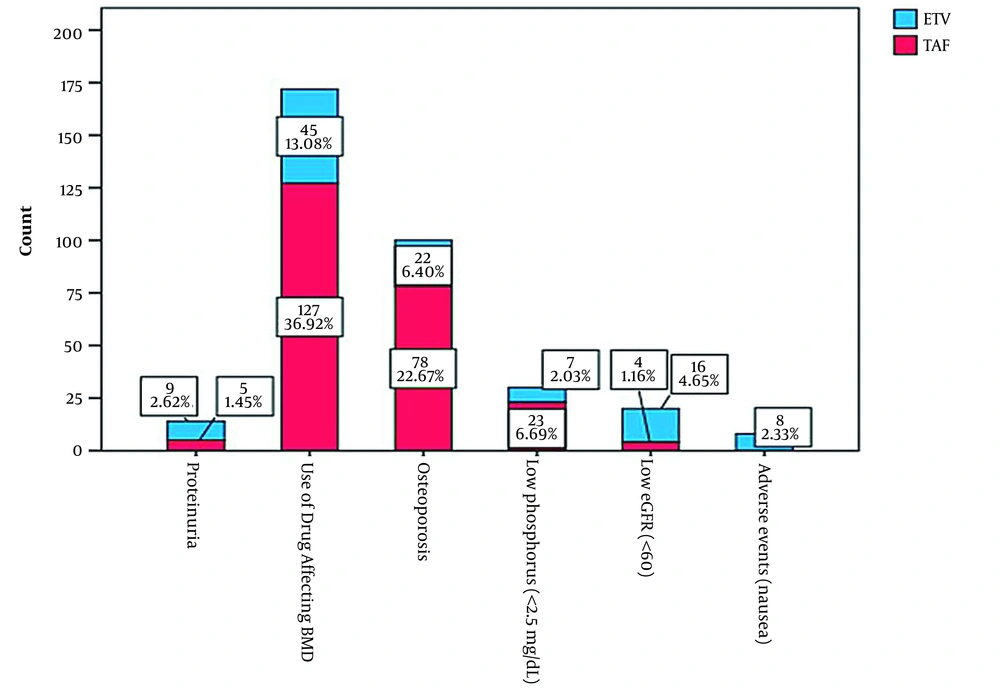
11). In the present study, the efficacy and safety of TAF and ETV were compared during the first 6 months in CHB patients with TDF experience.
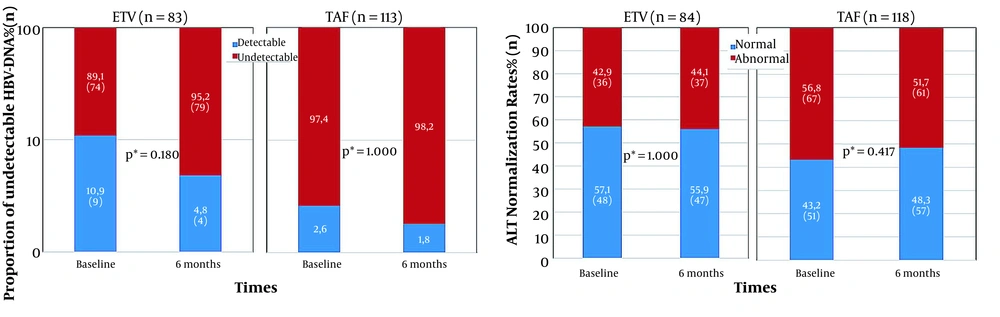
The virological response in HBV infection aims to obtain an undetectable HBV-DNA level without negative consequences, such as cirrhosis and HCC. In a randomized controlled study evaluating CHB patients who received TDF treatment for more than 10 years, virological response rates were found to be 100% for HBeAg-negative patients and 98% for HBeAg-positive patients. The median duration of TDF treatment before the treatment switch was 30 months. Therefore, the initial proportion of undetectable HBV-DNA in these TDF-experienced patients was high in both treatment groups (
17). In previous randomized controlled trials and real-life cohorts, the viral suppression rates of ETV and TAF were found to be similar to TDF (
18-
21).
The literature comparing ETV and TAF is limited. Half of the patients with ETV experience were switched to TAF in a study, and the groups were compared. No significant difference was found between the two groups after 24, 48, and 96 weeks in serum HBsAg levels (
22,
23). In our study, the median duration of TDF treatment for those with detectable HBV-DNA at baseline was 12 months. The proportion of undetectable HBV-DNA elevated from 89.1 to 95.2% in the ETV group and 97.2 to 98.2% in the TAF group. However, the two groups were not significantly different. Our findings showed that the virological response provided by TDF was persistent.
ALT normalization has been defined as an additional endpoint associated with a reduction in viral replication and necroinflammation under treatment (
11). In a study comparing TDF and TAF treatments, the proportion of ALT normalization was found to be significantly higher in those receiving TAF (
19). In real-life cohorts, ALT normalization was also higher in patients who switched from TDF to TAF (
24). In a meta-analysis of randomized controlled trials, the difference in the percentage of ALT normalization at 144 weeks between TDF and ETV in treatment-naive patients was not significant (
25). We found a partial reduction in ALT normalization after a switch to ETV. The ALT normalization decreased from 57.1 to 55.9% in patients who switched to ETV treatment and increased from 43.2 to 48.3% in those who switched to TAF. There were no significant differences between the ALT normalization proportion of the ETV and TAF groups in the sixth month compared to the baseline levels. Although no study has compared ALT normalization between ETV and TAF, in a study, a significant increase was observed in week 24 after the transition to TAF in patients with a median of 5 years of receiving ETV (
26). We suggested evaluating ALT normalization over longer observation periods.
TDF is actively secreted by the kidneys via organic anion transporters (i.e., OAT1 and OAT3), causing the exposure of the proximal renal tubules to high concentrations of tenofovir (
9,
27,
28). In contrast, TAF is not a substrate of renal OATs and does not show OAT-dependent cytotoxicity (
28). After switching from TDF to TAF, rapid recovery of lost renal function has been demonstrated with increased eGFR (
24). A study revealed that eGFR declined significantly after two years of treatment in the TDF group, while in the ETV group, eGFR was stable for the first three years and improved significantly in years 4 and 5 (
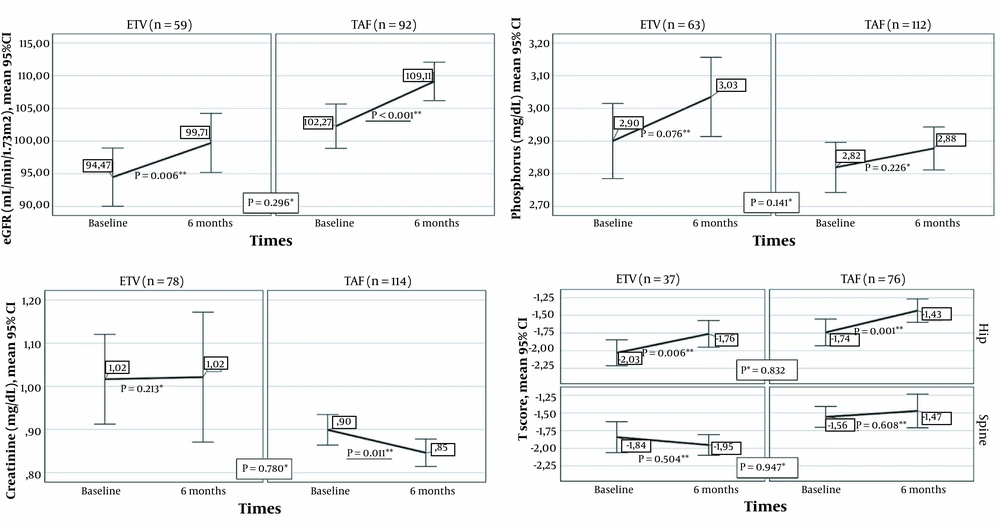
29). Consistent with the literature, in our study, eGFR augmented significantly in the sixth month in patients who switched from TDF to ETV and TDF to TAF. The absence of a significant difference between ETV and TAF therapy in terms of eGFR in month 6 of treatment supported the previous investigations (
22).
On the other hand, in the sixth month, creatinine levels diminished significantly among patients who switched to TAF, whereas no significant difference was observed in those who switched to ETV. The latter result might be due to the metabolization of TDF and ETV by the kidneys, the excretion of TAF mainly in the feces (37.1%), and a very small amount of TAF secreted by the kidneys (< 1%) (
30). There was no difference between the two treatment groups in terms of the change in creatinine values. This study indicated that treatment change to TAF and ETV was safe in terms of renal functions.
The adverse effect of TDF on BMD has been associated with phosphorus excretion and increased bone turnover (
9). Previous studies demonstrated that in CHB patients, TDF was a risk factor for a T-score ≤ -1 in week 24 of treatment and a 2% decrease in hip and spinal bone density (
31,
32). A study reported that the bone loss associated with TDF was observed in the hip, not the spine (
32). An improvement has been shown in BMD in the early period after the transition from TDF to TAF in real-life cohorts (
14). In the current study, there was a significant enhancement in the BMD rate in the TAF and ETV groups in the sixth month, and there was no significant difference between them regarding the prevalence of BMD (
22). The findings of our research indicated that ETV and TAF regimens were safe for improving BMD.
TAF therapy resulted in high LDL cholesterol levels in more patients than TDF therapy (
15,
19,
33). Significant reductions have been reported in triglycerides, LDL cholesterol, and HDL cholesterol levels of the CHB patients receiving TDF compared to ETV therapy (
34). Although the mechanism of the lipid-lowering effect was unknown, the positive effect of TDF on lipid expression has been revealed in various studies on patients with HIV/AIDS (
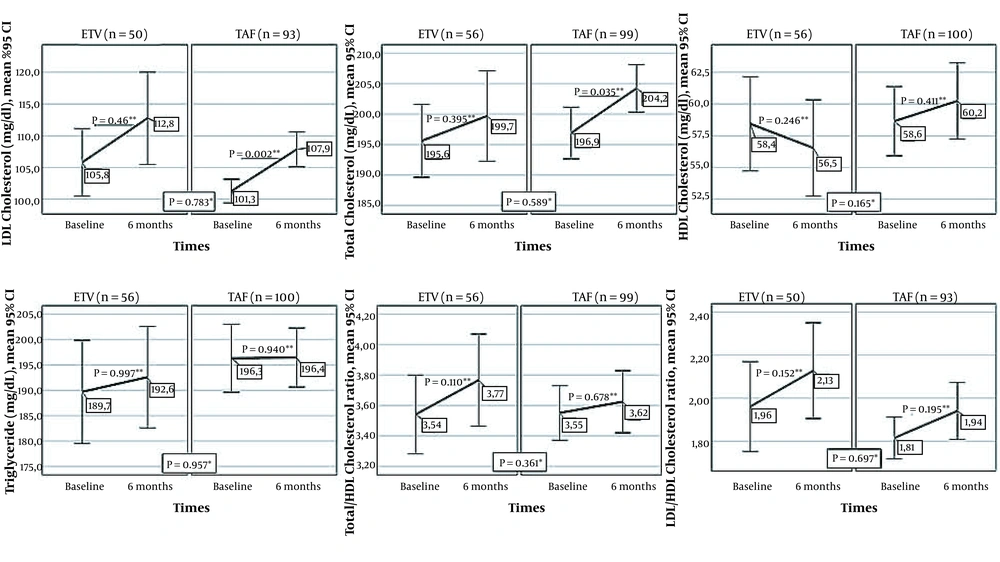
35). In this study, we observed increases in all lipid parameters with both TAF and ETV following the cessation of TDF therapy. The rise in LDL cholesterol was significant in both treatment groups. On the other hand, the change in lipid profile was not significantly different between the TAF and ETV groups. Our study indicated that TAF and ETV had similar impacts on the lipid profile of patients. We suggested evaluating the cardiac condition of the patients who have undergone treatment changes.
The main strength of this study was that real-life data were presented in a multicenter study from a region where hepatitis B infection is moderately endemic. To the best of our knowledge, our study is the largest series comparing treatment responses and changes in parameters with these treatment regimens. However, the use of retrospective analysis is one of the limitations of this study, and our results must be confirmed by prospective studies with larger series. Another limitation is that in this retrospective study, all evaluated parameters were not demanded, with the preference of the treating physician. This resulted in a reduction in the number of patients to evaluate each effect.
5.1. Conclusion
During the long-term treatment management of CHB, changing drug regimens to safe and effective medications may be required. In the clinical situations of TDF discontinuation, ETV and TAF are considered effective alternative treatments. Our study showed that ETV and TAF switching sustained viral suppression and biochemical response achieved by TDF therapy. The renal dysfunction and reduced BMD caused by TDF can be controlled by switching treatment to TAF or ETV.