
1. Context
Nonalcoholic fatty liver disease (NAFLD) is reported in all age groups including early childhood and is thought to be due to errors of metabolic disorders such as carnitine metabolism, paroxysmal disorders, lysosomal storage diseases, the Wilson disease, and cystic fibrosis (1).The prevalence of the disease among children in the United States is reported 9.6% in healthy children and 38% in children with obesity (2). In children as well as adults, the risk of fatty liver is greatly increased in the presence of metabolic syndromes, obesity, hypertension, insulin resistance, and increased blood lipids (3). The familial history of obesity, insulin resistance, and type 2 diabetes make the children prone to nonalcoholic fatty liver disease (NAFLD) (4). The prevalence of nonalcoholic steatohepatitis (NASH) increases after the age of 10 (4, 5).
Low birth weight and rapid weight gain during childhood and early-onset of obesity increase the risk of NAFLD (6). Higher intake of simple sugars and fructose are associated with metabolic syndrome and increased risk of fatty liver (7). Timely diagnosis and management of the disease prevents from progression to an advanced stage in adolescence and adulthood (8). Although tissue diagnosis is the gold standard to diagnosee NAFLD, the diagnosis of NAFLD in children is primarily based on anthropometric measurements, biochemical tests, and ultrasound results (9), and biopsy is reserved for cases where there is need to differentiate NASH from simple fatty liver (10). According to the documentation of ESPGHAN (the European society for pediatric gastroenterology hepatology and nutrition) committee regarding the diagnosis of NAFLD in children and adolescents, fatty liver screening should be performed for each child above 3 years with waist circumference of more than 2.5 Z score or with familial history of fatty liver. This should be definitely noted in 10 year-old or older children. The screening methods include ultrasound and liver function tests, but due to decreased sensitivity of these methods, further evaluation is warranted in children and adolescents with overweight (10). Due to poor diagnosis and lack of proper screening methods, diagnosis of fatty liver in children is often reported less than the actual prevalence (11). In several articles, with a variety of diagnostic tools, the prevalence of NAFLD in children and adolescents is reported differently. The difference in these statistics is due to difference in sensitivity and specificity of each diagnostic noninvasive procedure (1, 12).
Although the etiopathology of NAFLD in children is unknown, it is likely that similar to adults, it has multiple causes and its progress and extension is influenced by several factors (13). The current study aimed at collecting all related articles and evaluating the challenges in radiological and laboratory methods of diagnosis in children.
2. Methods
The current study was performed by searching in Scopus, Web of Science, Medline, and PubMed. Articles and guidelines in English about the diagnostic methods in NAFLD and NASH up to Oct 2016 were used. Search was performed with keywords of “Children OR Adolescents”, “Noninvasive diagnosis”, “NASH”, and “NAFLD” in MESH. The study evaluated conventional studies, diagnostic evaluation, and diagnostic guidelines in the age group of children and adolescents. The articles were searched by 2 researchteams, and then, categorized and selected by pediatrics gastroenterologists and radiologists.
2.1. Diagnostic Methods in Children and Adolescents
2.1.1. Invasive Diagnostic Method (Biopsy)
Biopsy is the gold standard to diagnose AFLDand NAFLD in children and adolescents (14, 15). Pathologic evaluation can depict the severity of fatty deposits, lobular inflammation, hepatocyte ballooning, and fibrosis. Although this is the standard diagnostic method of NAFLD and many other liver disorders, this method is quite invasive and is associated with possible complications including pain, bleeding, hypotension, infection, visceral rupture, pneumothorax, and death in some cases (16).
The biopsy report is totally dependent on the pathologist’s experience and skill and sometimes due to a doubtful pathology report; the need is felt for a report by another pathologist. The best reported accuracy of tissue diagnosis (reported by an expert pathologist) in fatty liver is 79% (17).
At each stage of fatty liver disease, only a small area is evaluated and fatty deposits inside the tissue are often ignored (15). In adults, the dominant pathologic finding is hepatocellular damage, lobular infiltration, and perisinusoidal fibrosis, while the predominant form in children is macro vesicular hepatocellular steatosis and post inflammation and fibrosis inside the port without ballooning. These factors make it difficult to obtain an accurate diagnosis by percutaneous biopsy (18).
The advantages and disadvantages of liver biopsy should be considered before opting for tissue diagnosis. Biopsy can detect congenital disorders, autoimmune disorders, and drug toxicity in children with increased aminotransferase level and doubtful clinical diagnosis.
2.1.2. Non-Invasive Diagnostic Method of Fatty Liver in Children
2.1.2.1. Determining the Amount of Fat and Its Distribution
In children, it is shown that waist measurements disregarding waist-to-hip ratio can estimate the amount of visceral fat (11). Age specific percentiles should be used for children and adolescents of 5 to 16 and 11 to 18 years (19).
Lin et al., concluded that for each 5 cm increase in waist circumference, odds ratio increased 1.4, which was consistent with sonography (20). Increased waist circumference is associated with increased fibrosis, but no percentile indicator is available for this age group.
The study by Lebensztein et al., demonstrated the relationship between nonalcoholic fatty liver and body mass index (BMI), waist and hip circumferences, visceral fat as well as subcutaneous fat in children (21, 22). Also, the study by Chan et al., suggested the positive relationship between the severity of disease with anthropometric parameters (BMI, waist circumference, hip circumference, waist-to-hip ratio, and subscapular skin fold thickness) and metabolic factors (insulin resistance, the homeostatic model assessment (HOMA), hyperlipidemia) (23). The power (ROC curve) of anthropometric factors to diagnose NAFLD in children is 0.720, 0.661, and 0.741 for waist, TFM, and visceral fat (24).
There are several methods to evaluate the amount of fat and its distribution, including bio impedance analysis (BIA) that determines the fat and the fat free tissue in any organ by evaluating the amount of water in the intracellular and extracellular matrix. The other tool is dual energy X-ray absorptiometry that by a small amount of X-ray and photons absorption in body tissue determines the bone density, the amount of fatty tissue, and fat free tissue with exact percentages. Air displacement plethysmography and quantitative magnetic resonance are also used in this field (25). BIA and DXA methods are used in research and can be easily used in the clinics. Although BIA method is more available and less expensive, it is less accurate than DXA to determine the amount of body fat in children, and underestimates the amount of fatty tissue (26).
In the evaluation of 100 children and adolescents aged 8 to 16 years, Hye Ran Yang et al., concluded that evaluation of visceral fat in children with obesity by the DXA method along with the use of laboratory methods was useful to diagnose fatty liver and markedly decreased diagnostic error in using biochemical tests only (27).
ROC curve for visceral fat in predicting NAFLD was 0.875 and suggested a threshold of 34.3 mm visceral fat (cutoff point) for NAFLD with sensitivity and specificity of 84.6% and 71.2%, respectively (27).
2.1.2.2. Laboratory Methods, Liver Tests
2.1.2.2.1. Aminotransferase
Alanine aminotransferase is a simple and cost-effective test that is considered appropriate to screen fatty liver disease, but not correlated with the presence and severity of histopathological signs of NAFLD (28). Only a few studies determined the accuracy of liver tests in children and adolescents (29).
Patton et al., determined the prevalence of NAFLD and metabolic syndrome in obese children based on alanine aminotransferase (ALT) > 40 IU/L. They reported the prevalence of NAFLD as 15.4%; it was 9.8% in females and 22% in males. In patients with fatty liver with increased liver parameters, the amount of fatty deposits and severity of disease are more in the liver and visceral organs (30). A steady and long lasting rise in serum levels of ALT and gamma-glutamyl transferase (GGT) in adolescents can be a sign of metabolic syndromes and cardiovascular diseases (31). Almost 20% of children with elevated aminotransferases have hidden NAFLD, NASH, or other acute and chronic liver diseases (32); therefore, not all cases of increase in liver enzymes can be related to fatty liver disease.
Recently, based on ESPEGAN diagnostic guidelines, it is concluded that to screen liver disease in children with obesity and BMI of 85 to 95 percentile along with other risk factors for metabolic syndrome, ALT/AST serum values should be evaluated after the age of 10 (33). Burgert TS showed in their study on 72 children with obesity who developed NAFLD, ALT ≥35 IU/L was associated with sensitivity of 48% and specificity of 94% to determine steatosis (34).
The Screening ALT for Elevation in Today’s Youth (SAFETY) study showed that the cutoff values presented in labs in America were too high for accurate diagnosis of chronic liver diseases including NAFLD in children (35). In many studies, high serum levels for ALT were considered as 40 IU/L (36); although in several other studies, the cutoff points of 30 to 45 IU/L were used (37, 38). Cortez-Pinto H determined the sensitivity of ALT as 80% and 92% in males and females, and its specificity as 79% and 85% in males and females, respectively (41-42). The cutoff points were determined as 38, 30, and 36 IU/L, and 133 mg/dL for ALT, aspartate aminotransferase (AST), GGT, and TG, respectively; these levels were lower than normal range for adults (39, 40).
In the national health and nutrition examination survey (NHANES), the 95th percentile for the healthy children with normal weight and metabolism without chronic liver disease, ALT was reported 25.8 and 22.1 U/L in males and females, respectively (41, 42). Also, the study by Schwimmer reported that the same amount was established in the pediatric population in Europe (38). In the study by Park et al., the 97.5th percentile, ALT was 33 and 25 IU/L in males and females, respectively (40). Canadian laboratory initiative in pediatric reference intervals (CALIPER) determined the normal range of ALT for children and adolescents based on age, regardless of gender. In the age group of 1 to 12 years, upper limit normal (ULN) of ALT was 25 IU/L and that of the 13 to 18 years age group was 24 IU/L in males and 22 IU/L in females. The general belief is to consider ULN for ALT as 25 IU/L for all children regardless of age and gender (41).
2.1.2.2.2. Other Serum Tests
According to enhanced liver fibrosis (ELF) panel of serum markers, serum level of tissue inhibitor of metalloproteinase-1, hyaluronic acid, and amine terminal peptide of procollagen III are approved tests to stage fibrosis in children with fatty liver; these tests decrease the need for biopsy (42).
2.1.3. Diagnostic Biomarkers in Children
Inflammatory biomarkers in active phase of the disease can show inflammation, apoptosis, oxidative stress, and fibrosis (43). The acceptable biomarkers should show changes in serum levels with disease activation or should change following modifying the lifestyle or after a successful drug therapy. Their measurement should also be easy, cheap, and safe (44). Sartorio et al., studied 267 children with obesity and concluded that ALT, uric acid, glucose, and fasting insulin were the useful parameters to determine the prognosis of NAFLD in children (45). Mandato et al., in a study on children with obesity concluded that insulin resistance, ferritin, C-reactive protein, and glutathione peroxidase increased in children with NAFLD and measuring their serum level helped to diagnose the disease (46). Manco et al., also found that the levels of TNF-α increased in children with NAFLD activating score (NAS) > 5 (47, 48). Alisi et al., found the useful diagnostic role of plasminogen activator inhibitor (PAI)-1 and endotoxin in children with histological NAS > 5; and in a case-control study, AUROC for adiponectin and HOMA in prediction of NASH was 0.79. TNF-α for NASH diagnosis, based on AUROC, was 0.91 and leptin had ROC curve of 0.8. Interleukin (IL)-6 and TNF-α together had AUROC of 0.96. In cases of NASH, lower adiponectin and greater chronic lymphocytic leukemia (CCL)-2 / monocyte chemoattractant protein (MCP)-1 were observed (49), but serum levels of adiponectin, IL-6, and TNF-α did not have enough specificity and sensitivity to diagnose NASH (50-54).
Feldstein et al., evaluated the role of adiponectin, high-sensitivity CRP, and cytokeratin-18 (Cytokeratin 18) to diagnose and determine NASH severity, and in this regard, hyaluronic acid and leptin were used to determine the stages of fibrosis in children (55). Children with NAFLD had significantly higher levels of CK-18, compared with the control group, and the level of this biomarker was higher in children with NASH, compared with the children with simple steatosis. In the current study, ROC curve of this biomarker was 0.85 and had the sensitivity and specificity of 84% and 88% to diagnose NASH, respectively (50, 56, 57). In another study by Lebensztein et al., on this biomarker, the following results were obtained: cutoff point 210 IU/L, sensitivity = 79%, specificity = 60%, positive predictive value (PPV) = 56%, and negative predictive value (NPV) = 82% (27); the results of serum levels of laminin and chitinase-3-like protein (CHI3L) 1, also known as YKL-40, were not enough to predict liver fibrosis (21).
In patients with fibrosis, leptin level was significantly associated with the severity of the disease, but it was not true in the case of hyaluronic acid (49). In another study by lebensztein that evaluated the accuracy and sensitivity of HA to detect liver fibrosis in children with NAFLD achieved the following results: cutoff point: 19.1 ng/mL, sensitivity = 84%, specificity = 55%, PPV = 52%, NPV = 86% (25). AST/PLT was an important factor to predict fibrosis in adults, especially in fibrosis stage > 3, but did not have this accuracy in children (58).
2.1.4. Genetic Analysis
Genetic analysis helps clinicians to identify the children at risk of nonalcoholic fatty liver (16, 59). Recently, knowledge of the etiology and pathogenesis of fatty liver in children is mostly based on genetic analysis (23). Due to lower impact of confounding factors such as time of disease, presence of severe obesity, usual life habits, drug abuse, and prolonged effects of the disease and a greater role of genetic factors in childhood, genetic data are more important in this age group (60). The original genetic study in children was designed based on genome-wide association studies (GWAS) (61, 62). Genetic variants, patatin-like phospholipase domain-containing protein-3 (PNPLA3), more specifically single nucleotide polymorphism (SNP), and rs738409 C > G, which encodes variant M 1148, do not show the fatty deposits and only show the severity and fibrosis of NASH (63-65).
The 1148M PNPLA3 variant increases triglyceride content of the liver, body mass index (BMI), serum lipid levels, and systemic insulin resistance (64-66). Association of 1148M variant with the disease progress to liver cancer and also shows the impact of this variant in the inflammation and exacerbation of the disease (60, 63, 65). Association between this variant, steatosis, and the levels of liver enzymes were observed in children with obesity in different races (67-69).
In a study on an Italian family, the increased levels of the enzyme was related to the size of abdominal fat as well as high intake of carbohydrate and sugar (70). An interventional study reported a close relationship between the fatty acid of diet, PNPLA3 genotype, and liver fat; however, high amounts of omega-3 and -6 in diet reduced liver fat and serum levels of ALT only in the children with homozygous PNPLA3 variant, which increased the risk of steatosis (71).
2.1.5. Scoring Method in Diagnosis of Fatty Liver in Children
In the scoring method, multiple-factors are used to estimate the non-alcoholic fatty liver, NASH, fibrosis, and steatosis alone. Each of them has specific definitions and sometimes alone or with a radiological method has diagnostic accuracy up to 100%.
2.1.5.1. Pediatric NAFLD fibrosis Index
This index can predict fibrosis or stiffness of liver in children with NAFLD. The factors include: age, waist circumference, and serum levels of triglycerides. PNFI > 9 is defined as fibrosis and PNFI < 3 is non-fibrosis. The index problem is the cases in the midrange, which include many cases. The area under the ROC curve for this index is 0.747. To increase the accuracy of the index, its association with fibro scan method or TE (transient elastography) leads to diagnostic accuracy of 98% (72).
2.1.5.2. The European Liver Fibrosis Test
Previous studies concluded that ELF score can accurately predict fibrosis in children with NAFLD. In the current study, the number of studied children was small and few of them had advanced fibrosis. In the two abovementioned studies, the diagnostic power of this factor (AUROC: area under the curve) was 0.90 that only 9 out of 76 patients had fibrosis stage 3 or higher (42, 49).
2.1.5.3. NAS Scoring or (NAFLD Active Score)
This system is not used enough in children (49).
2.1.6. Radiological Methods
2.1.6.1. Ultrasound
Ultrasound method is a convenient, cost-effective, and safe method to diagnose fatty liver disease in all age groups. It is often the first diagnostic test, but similar to histopathological method, it is completely dependent on the experience and skill of the radiologist (73). In the study by Alavian et al., the prevalence of fatty liver in children aged 7to 18 years was reported 7.1% with sonography and 1.8% with ALT methods in the same population (74). Shannon et al., in a study on 208 children and adolescents, with diagnosed fatty liver by biopsy, showedthat 69% had moderate to severe steatosis, by terms of histological evidence. Sonography steatosis score, based on the Brunt classification, was determined for all the children and ROC for sonography was 0.87 in the diagnosis of moderate to severe steatosis (75). In this study, serum levels of ALT and AST were not significantly associated with ultrasonography steatosis scores (75, 76). The study by Akcam et al., reported that the prevalence of fatty liver disease was 61.9% in the adolescents at puberty, compared with 40.8% in the ones before puberty; this finding had a significant correlation with sonography results. The HOMA was higher than normal in both groups; therefore, it is recommended to perform sonography to screen fatty liver in children with obesity and signs of insulin resistance (59).
2.1.6.2. Fibro Scan or Transient Elastography and CAP
Fibro scan or transient elastography is a device with ultrasound probe on the axis of a vibrator that can scan soft tissue and show the rate of fat deposit (steatosis) and stiffness (fibrosis) of the liver. The only limitation is the limited application in people with high obesity and small intercostal space or ascites (77). By CAP, one can estimate the steatosis or intra tissue fat and express them as percentages. It is shown based on the average of 10 measurements of stiffness using a device (kPa unit) with a normal range of 2.5 to 75 kPa (77, 78). The measured amount in CAP is related to steatosis and has the ROC curve of 0.80, specificity of 0.86, and sensitivity of 0.89 (81). Liver stiffness is observed in patients with metabolic syndrome even in the absence of NAFLD (79, 80). In the study by Noboli et al., the use of fibro scan to diagnose NAFLD in children was acceptable (81). Cutoff value of > 5.1 kPa had acceptable accuracy to detect any type of fibrosis with fibrosis stage > 1 in biopsy. TE value greater than 7.4 kPa is used to diagnose F3 - F4 in children (94). In others study concluded that the diagnostic accuracy of TE was more than that of PNFI (ROC curves of 1.00 vs. 0.747 in PNFI) (82). Yuki Cho et al., in a study on 214 Japanese children with obesity (BMI percentile > 95%), compared with the healthy children without obesity and their counterparts with other liver diseases using fibro scan and CAP, reported the following results: CAP score was greater in the group of children with obesity (n = 52, 285 ± 60 dB/m), compared with the other 2 groups. CAP in children with liver diseases (n = 40) was 202 ± 62 (P < 0.001) and in the healthy children without obesity (n = 107) was 179 ± 41 (P < 0.001). The liver stiffness measurement (LSM) or degree of hepatic steatosis was also significantly higher in children with obesity (5.5 ± 2.3 kPa) than the control group (3.9 ± 0.9 kPa), but had no significant difference with those of the children without obesity, but with previous liver disease (5.4 ± 4.2 kPa) (82, 83).
2.1.6.3. Magnetic Resonance Imaging
Schwimmer et al., in the largest study on this subject in children evaluated the accuracy of MRI and liver proton density fat fraction (PDFF) to determine the steatosis and assessed 174 children with the mean age of 14 years (ranged 8 to 17) and achieved the following results: all children could perform this procedure without any complications, diagnostic accuracy of this method was appropriate, compared with that of biopsy (0.725), diagnostic accuracy of this method was acceptable in both forms of the disease from mild to severe. In mild stages of the disease, stages 0 and 1, it had the most diagnostic accuracy. They used 4 diagnostic thresholds (1.8%, 5.5%, 6.4%, and 9%) for normal liver without fat, but could not determine ROC curve in any thresholds, which was the limitation of this approach. However, Schwimmer et al., analyzed a post hoc to set a high threshold to differentiate the healthy cases from the ones who developed the disease. With the cutoff point of 3.5%, they achieved 95% specificity and 83% sensitivity and 0.90 ROC curve (35). Due to the high accuracy of this method, most researchers seek to replace biopsy by this method, but for this purpose, it is necessary to validate this method by a cohort study using MRI and histology in children. One of the reasons why biopsy and even ultrasound are not yet replaced by this method to diagnose fatty liver, is the high price and need for sedation in younger children (37).
2.1.6.4. Computed Tomography Scan
Computed tomography (CT) scan can accurately show extensive and even local steatosis in the liver and is a convenient and accessible method to diagnose NAFLD. This method is mostly used in adults and with regard to the amount of radiation and the risk of sedation is less used in children. This method can measure the visceral fat, subcutaneous fat, and brown fat (with PET/CT) (10, 15).
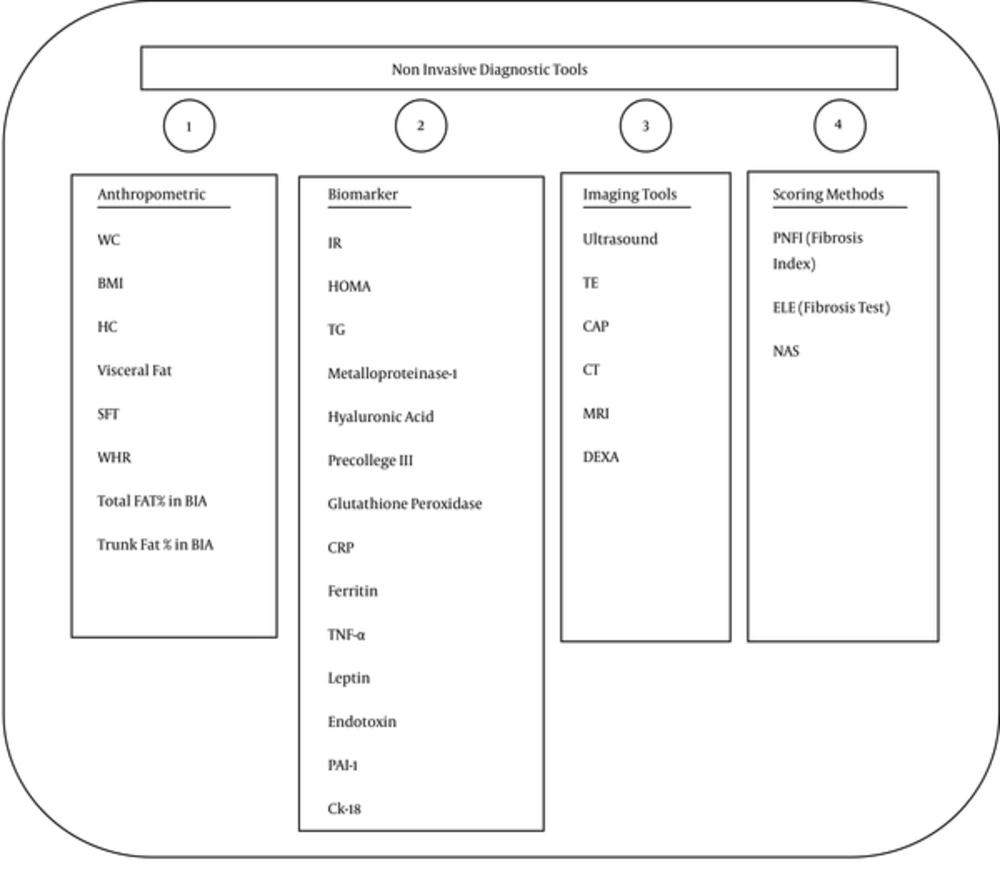
Figure 1.
MRI, Magnetic Resonance Imaging; TE, Transient Elastography; CT, Computerized Tomograph; CAP, Controlled Attenuation Parameter; PNFI, Pediatric NAFLD fibrosis Index; ELF, The European Liver Fibrosis Test; NAS Scoring or (NAFLD Active Score); WC, Waist Circumference; BMI, Body Mass Index; HC, Hip Circumference; SFT, Subscapular Skin Fold Thickness; IR, Insulin Resistance; TG, Triglyceride; Waist-to-Hip Ratio; BIA, Bio Impedance Analysis; C-Reactive Protein, PAI-1, Plasminogen Activator Inhibitor 1, HOMA, Homeostasis Model Assessment- Insulin Resistance, Cytokeratin-.
Table 1.
Studies in Anthropometric Measurement to Predict Non-alcoholic Fatty Liver Disease in the Pediatric Population
| Author/Year/Country | Sample Size, No. | Age, y | Tools, Correlation with, SE-SPE-ROC Curve |
|---|---|---|---|
| Waffa M. Ezzat /2012/Eygept | 72 obese child | 10.8 ± 3.5 | Anthropometric |
| BMI-WC-VFT-HC | |||
| Correlate with NAFLD | |||
| (P = 0.0001) | |||
| Monteiro /2014/USA | 145 | 11 - 17 | Anthropometric |
| WC (P = 0.001), AUC = 0.720 | |||
| TFM (P = 0.002), AUC = 0.661 | |||
| IAAT (P = 0.001), AUC = 0.741 | |||
| Jung JH/2016/Korea | 73 | 6 - 16 | Ultrasound |
| VFT (se = %84.6), (sp = %71.2) AUC = 0.875 | |||
| Cutoff 34.3 mm | |||
| Yang HR/2016/Korea | 100 | 12.4 ± 3.0 | DEXA |
| FM index (P < 0.001); FFM (P < 0.001); Trunk fat% (P = 0.003) | |||
| Sopher A/2005/ | Anthropometric | ||
| WC-IAAF, AUC = 0.661, AUC = 0.741 | |||
| Razmpour F/2017 | 70 obese | 9 - 18 | Anthropometric |
| Weight- BMI- MAC, BMI AUC = 0.472 | |||
| DEXA-BIA | |||
| Chest C- Neck C- WC, WC AUC = 0.464 | |||
| Stomach C-Thigh C- Hip C, Neck AUC = 0.378 |
Abbreviations: AUC, Area Under the Curve; BMI, Body Mass Index; Hip C, Hip Circumference; se, Sensitivity; SFT, Subcutaneous Fat Thickness; spe, Specificity; VFT, Visceral Fat Thickness; Waist C, Waist Circumference; Trunk Fat Percentage (%);Fat Mass Index, Fat-Free Mass Index.
Table 2.
Summarized Studies on the Diagnosis of Non-alcoholic Fatty Liver Disease with Biomarkers in the Pediatric Population
| Author/Year | Sample Size(N), Age, y | Biomarker | Significant Association with (SIG) |
|---|---|---|---|
| Gupta et al. 2011 | 700 obese children | ALT > 40 IU/L | 15.4% (9.8% in females and 22% in males) |
| 28% of children with NAFLD had MS(prevalence MS in age range of 5-9 years (21%), 10 - 16 years(30%),17 - 20 years (35%) (NAFLD had odd ratio 2.65 for having MS) | |||
| SIG with age, weight, TG, fasting serum insulin, HOMA-IR | |||
| Manco | 120, (3 - 18), children with NAFLD and NASH | ↑TG in 63%-↓ HDL in 45%- hypertension in 45% | |
| M/2007/ | IGT in 10% - Associated significant with BMI Z-score- glucose- cholesterol- WBC-body weight- fasting insulin-OGGT-HOMA-IR- beta cell secretion | ||
| Tania S/2006 | 392 obese, (9 - 18) | ALT > 35 IU/L | Rising ALT was associated with reduction of insulin sensitivity, glucose tolerance, adiponectin and rise of FFA, TG, viseral fat, deep to superficial SC fat ratio, Sensitivity ALT = 48%, Specificity ALT = 94% |
| Schwimmer JB/2005 | 127 obese student | ALT < 28 IU/L (normal), Abnormal ALT | Was (SIG) more prevalent in males 44% |
| ALT > 56IU/L (Abnor) | Than females 7%- race and ethnicity; Hispanic ethnicity | ||
| Significantly predicted greater ALT than black race | |||
| Sartorio/2007 | 267 obese children | ALT-Uric acid-Glucose | NAFLD was detected in 44% of the children with obesity |
| Fasting insulin | NAFLD was (SIG) with male gender, Z score, BMI-A | ||
| ALT-AST-GGT-Insulin-HOMA- CRP- systolic BP | |||
| Razmpour F/2017 | 70 obese children | ALT-AST-GGT | ALT for steatosis (se = 0.583, sp = 0.545, AUROC = 0.576, AST/PLT cutoff = 22.5); AST for steatosis (se = 0.438, sp = 0.409, AST/ALT, AUROC = 0.426, cutoff = 22.5); GGT for steatosis (se = 0.471, Sp = 0.358, AUROC = 0.342, cutoff = 18.5) |
| ALT for fibrosis (se = 0.416, sp = 0.852, AUC = 0.692, cutoff = 23.5); AST (se = 0.50, sp = 0.829, AUC = 0.634, cutoff = 25.5); GGT: (se = 0.667, sp = 0.527, AUC = 0.689, cutoff = 29.5) | |||
| Mandato C/ 2005 | 50 y obese, (7 - 14) | Insulin resistance-ferritin, CRP- GPX-FGIR- | This biomarker had significant association with NAFLD |
| Melania M/2007 | 72 NAFLD, Proven with biopsy | Inflammatory factor | TNF-α-leptin-TG-ALKP had significant association with NAS > 5 ROC analyses TNF-α (0.90), leptin (0.83) |
| Nobili V/2006 | 72 Obese, (9 - 18) | Inflammatory factor | Leptin correlated with sever steatosis, ballooning and NAS |
| Alisi /2012 | 40 obese | PAL-1, Endotoxin | AUROC for adiponectin and HOMA was 0.7, AUROC TNF-α for NASH diagnosis was 0.91 and leptin had ROC curve of 0.8. IL6 and TNF-α together have AUROC 0.96 |
| Feldstein AE/2013 | 201 NAFLD, (10.7 ± 2.5), Proven with biopsy | CK-18 | ck-18 increase in NASH with AUROC 0.933, sensitivity and specificity of 84% and 88% in diagnosis of NASH |
| Lebensztejn DM/2011 | 52 NAFLD, (4 - 19 ), Proven with biopsy | CK-18, Hyaluronic acid | CK-18 (Cut-off 210 u/l, Se = 79%, Spa = 60%, PPV = 56%, NPV = 82% AUROC = 0.73 for CK-18 in diagnosis of NASH) |
| Serum HA (cutoff 19.1 ng/mL, se = 84%, sp = 55% ppv = 52%, NPV = 86%) |
Abbreviations: ALKP; C- Reactive Protein, Alkaline phosphatase, FGIR, Fasting Glucose/Insulin Ratio; GPX, Glutathione Peroxidase; HOMA, Homeostasis Model Assessment- Insulin Resistance; IGT, Impaired Glucose Tolerance; PAI-1, Plasminogen Activator Inhibitor 1; se, Sensitivity; sp, Specificity; TG, Triglyceride; WBC, White Blood Cell; Cytokeratin -18.
Table 3.
Summarized Studies of Diagnosis of Non-alcoholic Fatty Liver Disease with Radiology Tools in the Pediatric Population
| Author/Year/Country | Sample Size, No. | Age, y | Diagnosis Tools | Sensitivity -Specificity - AUROC |
|---|---|---|---|---|
| Alavian SM/2007/Iran | 966 | 7 - 18 | Ultrasound | Se = 0.71 |
| Shannon A/2011/Ohio | 208 | Ultrasound | se = 0.69, AUROC = 0.87 | |
| Akcam M/1012/Turkey | 169 0bese | 12.7 ± 1.3 | Ultrasound, (BMI 26.3 ± 4.6) | In pubertal = 61.9% |
| Pre-pubertal = 40.8% | ||||
| Noboli V /2008/Italy | 52 with NASH | TE | Any F ≥ | |
| AUROC = 0.977, Significant F | ||||
| AUROC = 0.99 Advance F | ||||
| ≥ , AUROC = 1 | ||||
| Alkhouri N/2012/USA | 64 biopsy- proven NAFLD | TE | AURoc TE = 1, AUROC PNFI = 0.744 | |
| Cho y/2015/Japan | 214 | CAPTE(fibrosis) | LSM values were significantly higher in the obese group(5.5 ± 2.3 kPa) than in the control(3.9 ± 0.9, P < 0.001) | |
| Razmpour F/2017 | 70 obese | 9 - 18 | CAP(fibrosis), U, Ultrasound-DEXA | Ultrasound for steatosis (S) and fibrosis (F) (se (S) = 0.751, sp = 0.590, AUROC = 0.69), (se (f) = 0.361, sp = 0.869, ROC = 0.646); DEXA for steatosis(se = 0.974, sp = 0.686,AUROC = 0.596) |
| Schwimmer JB/2015/USA | 174 | mean age 14 | MRI | SE = 95%, SP = 83%, AUROC = 0.90 Liver PDFF estimated by MRI was significantly (P < 0.01) correlated (0.725) with steatosis grade |
| Razmpour F/2017/Iran | 70 obese | 9 - 18 | Ultrasound, DEXA-TE-CAP | SONO For steatosis: SE = 80% , sp = 56.5%, PPV = 79.1%, NPV = 59% AUC = 0.690; SONO For fibrosis: SE = 36.1%, SP = 86.9%, PPV = 85%, NPV = 40%, AUC = 0.646; DEXA For steatosis: SE = 72.5%, SP = 2.39%, PPV = 63%, NPV = 50%, AUC0.578 ; DEXA For fibrosis: SE = 30%, SP = 75%, PPV = 63.1%, NPV = 42.8%, AUC = 0.550 |
Abbreviations: CAP, Controlled Attenuation Parameter; F, Fibrosis; LSM, The Liver Stiffness Measurement; PDFF, Proton Density Fat Fraction; TE, Transit Elastography.
3. Conclusions
- Genetic evaluation and metabolic disorder assessment in terms of systemic causes was performed on each child without obesity and elevated liver enzymes (10). Very small under 3 years or no overweight children should be evaluated for single-gene causes of liver diseases such as fatty acid oxidation disorders, lysosomal storage diseases, and paradoxical diseases (11).
- Early biopsy is required in children aged > 10 years with family history of NASH, hepatosplenomegaly, hypothalamic complications, and hypertransaminase with increase in fibrosis serum markers (10).
- In most children with nonalcoholic fatty liver, the serum autoantibodies titers are low. The high level of this titer along with high serum levels of aminotransferase and globulin suggest a lower possibility of NAFLD. Such children should undergo biopsy and histopathological review to rule out the autoimmune hepatitis (11).
- The possibility of nonalcoholic fatty liver was less in children 3 to 10 years; fatty liver was diagnosed after ruling out viral, toxic, and metabolic causes. If the parameters were negative, then, the early biopsy should be considered (10).
- Liver tests and sonography should be done for every child with obesity (10).
- If these tests were normal, but there were clinical symptoms of insulin resistance, AST/ALT liver increased, and the ultrasound showed hyper echogenicity; the evaluation should be performed in terms of central obesity and fatty liver by MRI (10).
- Fibro scan and CAP should be done on every child with obesity and normal liver test or sonography (81).
- Children above 10 years are more likely to have fatty liver, if they have central obesity and insulin resistance, without any clinical symptoms of advanced liver disease, changes in lifestyle and reducing the amount of calories for 3 to 6 months should be done. If increased transaminase and hyper echogenicity of sonography remain, other laboratory tests are requested to rule out the other causes of differential diagnosis. Early biopsy is recommended if changes in transaminase levels and hyper echogenicity in ultrasound still remain for a long time (10).
- Biopsy should be performed pretreatment in cases where the diagnosis of NASH is suggested (11).