1. Background
Hepatitis A, a picornavirus, mainly infects the primates (1), and is mostly a fecal-oral transmitted disease (2, 3), with reported cases of transmission by IDU, sex with contaminated person, and blood transfusion (4). While Hepatitis A is an endemic disease of developing countries, it has a different prevalence pattern in European countries depending on socioeconomic status (5, 6). Various studies revealed greater seropositivity in older patients (6-10). Childhood exposure is dominant in developing countries (7), whereas adults are more at risk of exposure and severe hepatitis in the developed world (11-13). Interestingly, improved socioeconomic status in developing countries leads to a rise in the mean age of exposure in developing countries (2, 14). There is no gender prominence for Hepatitis A (14), except for sewage workers or male homosexuals (15). Historically, outbreaks of HAV (hepatitis A virus) due to fecal-oral contamination of food and water have been reported. For instance, enteral related diseases like HAV caused health disasters of the Second World War (15, 16).
Antibodies to hepatitis A virus have been decreased in most parts of the world because of the improved socioeconomic status (17-19). Although infected children are asymptomatic, the infection is important in adults due to clinical manifestation HAV involvement (2, 16). Vaccination is not suggested in endemic countries, since they are protected due to childhood exposure (14). However, Averhoff et al. recommended early childhood vaccination, especially in developed countries (20). Vaccination is also highly recommended for travelers to endemic region (21). Anti-HAV immunoglobulin seroprevalence in Middle East is among the highest parts of the world like most parts of the Africa and South America (17). Heterogeneous prevalence of HAV in Saudi Arabia is dependent on the socioeconomic status (22), and its prevalence in some parts of Middle East like Turkey has decreased during these two decades (17, 23).
The prevalence of HAV in Iran resembles to other Middle Eastern countries in this regard and also believed to be endemic in Iran (24). We designed a survey to study the seroepidemiology of HAV among military students in AJA University of Medical Sciences originating from various regions in Iran. A Previous study performed among Iranian soldiers showed that vaccination is not necessary in them (25). Recent changes in seroepidemiological features of HAV due to improved health in Iran show increased HAV among the adults (26, 27).
2. Objectives
As these students are health care providers who have more prone to illnesses and also can infect others (28) and because HAV is preventable by vaccination, we aimed to reevaluate the necessity of vaccination in AJA medical students and also to find out the risk factors for Hepatitis A infection in our population.
3. Materials and Methods
All students accepted at Aja University of Military Medical Sciences in 2012-2014 academic years were enrolled in this study with no age and field of study limitation. Because they would work as health-care personnel in future, and may be at risk of HAV contamination; it was supposed to be a good target population for this study. All students were informed about the study and took part in the survey voluntarily. Students’ data were collected with a questionnaire, designed specifically for this survey. Required data were age, area of resident, parents’ education, socioeconomic level of living region according to government segmentation, number of family members, parents’ job, family income, clean water availability, their estimation of region hygiene, their estimation of family hygiene, history of jaundice in them and their family. They had to complete the requested information before collection of their blood samples.
Two informed calibrated laboratory assistants were responsible for the collection of data and blood. They have used competitive enzyme-linked immunosorbent assay (ELISA) with sensitivity of 100% and specificity of 98% for the determination of immunoglobulin G (IgG) antibodies to hepatitis A virus in human plasma. Based on the guideline, tests were interpreted according to ratio of cut off value of OD450 nm of the samples and are assumed positive when the value is more than 1 and negative when the value is less than 1.
Collected data were imported to SPSS version 18 and descriptive statistical analysis was performed. Following variables were analyzed using χ2 test: pre-university entrance exam region, familial income, clean water availability, health statues estimation, and history of jaundice. P value less than 0.05 considered as significant risk factor for positive anti-HAV antibody. Regression analysis was performed to interpret relationship between pre-university entrance exam region and anti-HAV antibody titer.
4. Results
We observed 270 medical students who voluntarily took part in our survey. Their age ranged between 18 and 30 years old with the mean age of 20.58 years. According to the sampling frame characteristics, 240 persons were male, and only 30 of them were female. None of the cases has been vaccinated against HAV and 15 have previously experienced jaundice, but HAV was not approved as the cause of jaundice in these cases.
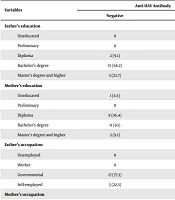
Amongst 270 persons with known serum level of IgG-anti HAV, 94 (33%) cases had positive level of this antibody. We have summarized the demographic data of our study population in Table 1.
Table 1.
Demographic Features of Study Population
| Number of cases | Positive IgG-antibody | Negative IgG-antibody | |
|---|---|---|---|
| Sex | |||
| Male | 240 | 82 | 158 |
| Female | 30 | 12 | 18 |
| Socioeconomic level | |||
| 1 | 31 | 2 | 29 |
| 2 | 140 | 37 | 103 |
| 3 | 99 | 55 | 44 |
| Father’s education | |||
| Undereducated | 91 | 49 | 42 |
| Diploma | 84 | 26 | 58 |
| License | 67 | 17 | 50 |
| Master | 20 | 2 | 18 |
| PhD | 6 | 0 | 6 |
| Mother’s education | |||
| Undereducated | 119 | 60 | 59 |
| Diploma | 95 | 21 | 74 |
| License | 46 | 13 | 33 |
| Master | 9 | 0 | 9 |
| PhD | 0 | 0 | 0 |
| Clean water availability | |||
| Yes | 259 | 84 | 175 |
| No | 10 | 10 | 0 |
| History of jaundice | |||
| Yes | 16 | 6 | 10 |
| No | 253 | 88 | 165 |
4.1. Age
All students admitted to AJA University of Medical Sciences between 2012 and 2014 and their age ranged from 18 to 30 years old. Mean age was 20.58 years and just two students were more than 24 years old. Because of the age limitation, interpretation of the age effect is not possible.
4.2. Region of Students Inhabitant Before University Entrance Exam
We divided students into 3 categories based on the government regional socioeconomic territories. Thirty-one students live in the first socioeconomic level, 140 people lived in the second socioeconomic level and 99 lived in the third socioeconomic level. The detailed information about their region of living is summarized in Table 1, and living in the third region of pre-university entrance exam leads to increased risk of positive HAV antibody in contrast to the first and second regional levels (P < 0.001). Furthermore, the titer of the anti-HAV antibody in students living in the third group was also more than two other classes (P < 0.001) (Figure 1).
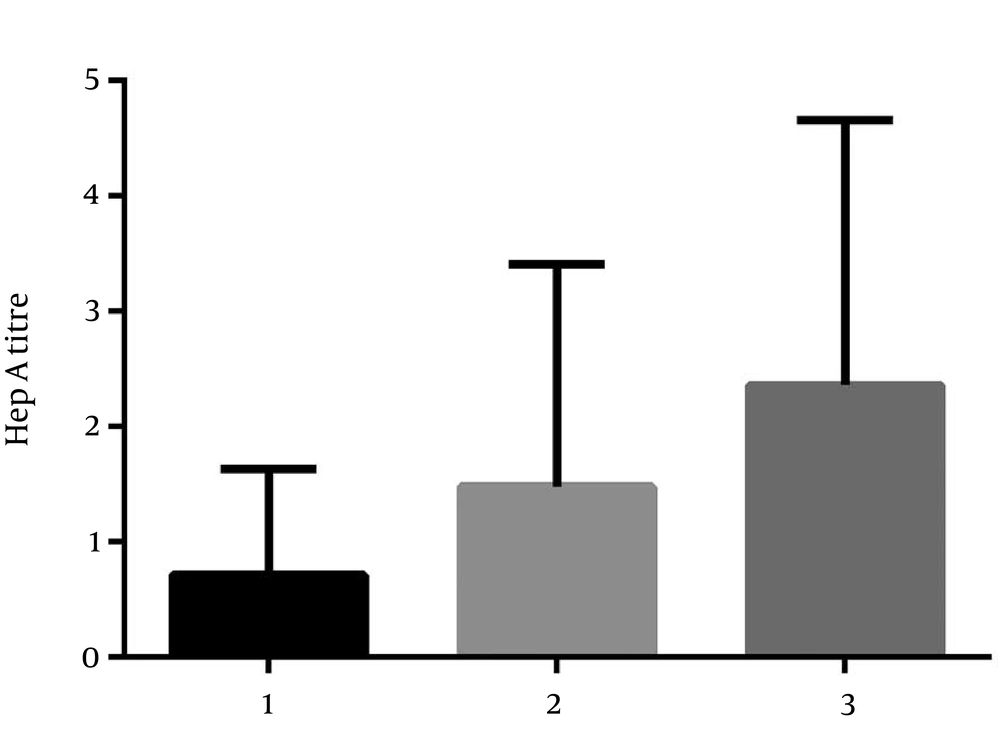
Figure 1.
Relationship Between anti-HAV Antibody and Region of Living
4.3. Familial Education
Majority of fathers had diploma or were undereducated and just 6 fathers had PhD degree. Also mothers were mostly undereducated and none of them had PhD degree. Lower familial educational degrees in either fathers or mothers were associated with positive anti-HAV antibody (P < 0.001).
4.4. Familial Income
Thirty-nine students lived in the families with income less than $166 per month, of which 18 were positive for anti-HAV antibody. On the other hand, among 22 students with familial income more than $662, just one student had positive anti-HAV antibody. However, familial income was not found to be statistically associated with the greater risk of positive anti-HAV antibody.
4.5. Clean Water Availability
Just 10 students had no access to clean water in their living house. All of these 10 students were positive for anti-HAV antibody. Absence of clean water availability seems to be a risk factor for HAV exposure and positive anti-HAV antibody (P < 0.0001).
4.6. Health Status Evaluation
Students were asked about health status situation of their family and residence place. Both medium and poor situation of hygiene were associated with positive result, which was statistically significant (P < 0.0001).
4.7. History of Jaundice
Just 2 out of 16 students with positive history of jaundice knew the cause of jaundice. No one reported hepatitis A as the cause of jaundice. Our analysis shows that history of previous jaundice is not a risk factor for positive anti-HAV antibody (P = 0.89).
5. Discussion
In the present study, we evaluated the serum level of hepatitis A antibody of 270 students at AJA University of Medical Students, and its relationship with potential risk-factors. In this survey, socioeconomic status of living place, familial educational grade, students’ estimation of regional, and familial health situation were statistically correlated with positive anti-HAV antibody. On the other hand, sex, age, and history of previous jaundice were not found as effective on serum titer of anti-HAV antibody. Our target group’s age ranged between 18 and 30 years old, and their diversity is not appropriate for statistical analysis. Also the impact of gender and previous jaundice could not be interpreted with confidence due to our limited sample size. Total positive anti-HAV antibody in our survey was 34%, which was lower than what is seen in Iranian soldiers (97%) (25), or some other studies in Iran (88.2%, 90%) (24, 29). In another study conducted in general population in Sari, the total prevalence of positive anti-HAV antibody was 38.9% and was similar to ours (30). In another population based study performed in Isfahan Province, the anti-HAV seropositivity percentage was 8.33%, even lower than that of our survey (31). In this survey, students have come from most parts of Iran, so it is better to divide them based on their origin to interpret this number.
Our study population consisted of young adults, ranging between 18 and 30 years old, from all around the country with different socioeconomic status. Because of this variety, our study differs from mentioned surveys. There were no close contacts in our population like what was seen in military services. In some studies, it is shown that the seropositivity increased as the population become older (32), but in our study population, difference in positive result in different age groups was not remarkable due to our age limitation. The lower immunity in younger age is a new finding in developing countries, and their immunity dynamically decreased by improving in health statues of these countries. Like other studies, gender was not a risk factor for seropositivity of anti-HAV antibody. Inaccessibility to clean water was a risk factor for Hepatitis A, like what Mosley et al. had showed previously (33), and all 10 students who had limited access to clean water were seropositive.
According to Das et al. the necessity of vaccination depends on total cost of vaccination, titer evaluation as well as serum-prevalence of anti-HAV antibody (34). Some studies in India believe that vaccination is necessary (35, 36), while other studies showed that vaccination was not necessary there (7, 10). These studies investigated the necessity of vaccination in childhood, however, our target population were 18-30 years old students with seroepidemiology less than 50% (2). They were mainly health care providers, and vaccination in this population seems to be rational because of the side effects of HAV infection in adulthood and their proneness to infection.
It is necessary to design a study with no age limitation to determine anti-HAV antibody titer in different age groups. As more than 65% of students had negative serum level of anti-HAV antibody and these students as health care workers are susceptible to Hepatitis A and its side effects, we suggest vaccination of all military medical students.