
1. Background
Portal vein thrombosis (PVT) is a potentially detrimental complication of liver cirrhosis that may lead to worsening of liver function, unexpected episodes of esophageal variceal bleeding, hyperdynamic circulation, and intestinal ischemia (1, 2). Depending on the method of diagnosis and the stage of cirrhosis, the prevalence of PVT in cirrhotic patients ranges from < 0.6% in compensated cirrhosis (3) to 28% in liver transplant candidates (4-7). PVT may make liver transplantation more technically difficult (8, 9).
In most patients, PVT is diagnosed as an incidental finding, but in some patients it presents with decompensation of chronic liver disease. It is not yet completely clear whether PVT is a consequence of severe liver cirrhosis or an aggravating factor, or both. The main pathogenic factor of PVT in cirrhosis is the decreased portal flow due to architectural liver damage, but acquired and inherited clotting abnormalities may play a role (10). There have been controversial findings regarding risk factors for this complication in cirrhotic patients. Male sex, previous surgery or endoscopic treatment for portal hypertension, history of variceal bleeding, low platelet count, hepatocellular carcinoma, and advanced liver failure have been postulated as possible risk factors for PVT (11, 12). There are also contradictory findings on the role of genetic mutations in the predisposition to this condition in cirrhotic patients (10, 13).
2. Objectives
The present study aimed to investigate the associations between various inherited and acquired risk factors in cirrhotic patients and the development of PVT.
3. Patients and Methods
This cross-sectional study was conducted from November 2010 to May 2011 at Shiraz liver transplantation center at Namazi general hospital in Shiraz, Iran (the only national liver transplantation center in the country). All cirrhotic patients (documented clinically or by liver biopsy), who were >18 years old and listed for liver transplantation, were analyzed using a questionnaire that included age, gender, Child-Pugh score, model for end-stage liver diseases (MELD) score, cause of liver cirrhosis, previous surgery, history of previous variceal bleeding and subsequent endoscopic treatment, amount of diuretic use (average use in the previous three months), history of intra-abdominal inflammation, abdominal trauma, oral contraceptive use, and pregnancy. Patients with end-stage renal disease, congestive heart failure, cystic fibrosis, malignancy, pylephlebitis, liver cysts or abscesses, Budd–Chiari syndrome, inflammatory bowel disease, vascular abnormalities, or pancreatitis were excluded. Those who had a confirmed diagnosis of hepatocellular carcinoma by imaging and/or biopsy at the time of listing were also excluded.
All patients consented to participate in the study. At the time of evaluation for transplantation, all candidates were screened by a single expert radiologist with color Doppler ultrasound and contrast-enhanced multi-detector 64-slice dynamic computed tomography (CT) for the evaluation of portal vein patency.
Laboratory studies were performed, including platelet count, alpha-feta protein, albumin levels, blood urea nitrogen, creatinine, fasting blood glucose, uric acid, protein C, protein S, antithrombin III, activated protein C resistance (APCR), factor VIII, homocysteine, JAK2 mutation, anticardiolipin antibody, prothrombin gene mutation (G20210A, determined by the Mbol restriction enzyme method), and factor V Leiden mutation (G1691A).
3.1. Statistical Analysis
Results for continuous variables were expressed as mean ± SD, and the Mann-Whitney U-test was used for comparison of means between the PVT and non-PVT groups. The chi-square test was used where appropriate for other variables. For all tests, P < 0.05 was considered statistically significant. Analysis was performed using SPSS version 17 software.
4. Results
The study included 219 adult cirrhotic patients who met all of the inclusion criteria and none of the exclusion criteria. Thirty-five of these patients (15.9%) had PVT.
The characteristics of the patients with PVT compared to the control group are shown in Table 1. Of 219 patients, 71 were female (nine with PVT and 62 without) and 148 were male (26 with PVT and 122 without). The mean age was 46 ± 9.99 years in the patients with PVT and 45 ± 12.71 years in those without PVT. The mean MELD score was 20 ± 6.46 in the PVT group and 19 ± 6.15 in the control group. According to the child classification, 32 patients had child class A cirrhosis (3 with PVT), 107 patients had child class B cirrhosis (20 with PVT), and 80 patients had child class C cirrhosis (12 with PVT). The mean values for serum albumin, platelets, fasting blood sugar, triglycerides, cholesterol, BUN, creatinine, and uric acid were not different between the two groups (Table 1).
Table 1.
Mean ± SD for Fasting Blood Glucose, Triglycerides, Cholesterol, Blood Urea Nitrogen, Creatinine, and Uric Acid Levels in Cirrhotic Patients With and Without Portal Vein Thrombosisa
| Patients With Portal Vein Thrombosis (n = 35) | Patients Without Portal VEIN Thrombosis (n = 184) | Significance (2-Tailed) | |
|---|---|---|---|
| Gender | .433 | ||
| Male | 26 | 122 | |
| Female | 9 | 62 | |
| Age | 46 ± 9.99 | 45 ± 12.71 | .756 |
| MELD score | 20 ± 6.46 | 19 ± 6.15 | .476 |
| Fasting blood glucose, mg/dl | 110 ± 42.5 | 110 ± 4.0 | .96 |
| Triglycerides, mg/dl | 80 ± 28 | 89 ± 51 | .287 |
| Cholesterol, mg/dl | 146 ± 80.5 | 133 ± 50 | .214 |
| Blood urea nitrogen, mg/dl | 19.6 ± 10.62 | 19.3 ± 12.52 | .882 |
| Creatinine, mg/dl | 1.11 ± 0.44 | 1.06 ± 0.44 | .57 |
| Uric acid, mg/dl | 5.47 ± 2.37 | 4.83 ± 1.87 | .076 |
| Frequency of hepatitis B | 11 (31.4) | 59 (32.06) | |
| Frequency of autoimmune hepatitis | 7 (20) | 19 (10.3) |
aValues are presented as mean ± SD or No. (%).
The average dose of spironolactone and furosemide taken by each patient in the previous three months was analyzed, and there was no statistically significant difference in the doses of these diuretics between the two groups. Of the 219 participants, 102 consumed both spironolactone and furosemide, while 54 used only one and 63 used neither. There was no statistically significant difference in PVT prevalence between these three groups (P = 0.338, 0.329, and 0.143, respectively).
The mean alpha-feta protein level was 34.04 µg/L in the PVT group (SD: 144.96), and 19.66 µg/L in the non-PVT group (SD: 102.72). The difference was not statistically significant (P = 0.481).
Among the female patients, six with PVT and 18 without PVT had used oral contraceptives for some months. There was no statistically significant difference between these two groups (P = 0.152).
The causes of cirrhosis in the participants were analyzed, and the most common etiology was hepatitis B (Table 1). There was no difference in patients with or without PVT in the etiology of cirrhosis. The presence or absence of previous surgery was also not different between the PVT and non-PVT groups (P = 0.327).
Among the 219 participants, variceal bleeding was detected in 62, and 16 of these patients had PVT. A history of variceal bleeding was more frequent in patients with PVT than in those without it, and this difference was statistically significant (P = 0.023, OR: 2.526, 95% CI: 1.200 - 5.317). However, the duration of variceal bleeding had no association with PVT. Since sclerotherapy with 50% alcohol was performed on only eight patients and all others received rubber-band ligation alone, a comparison between these two modalities was not meaningful in this study.
No patient in this study received a transjugular intrahepatic portosystemic shunt (TIPS), shunt surgery, or cyanoacrylate injection. A history of spontaneous bacterial peritonitis was present in four patients with PVT and 15 without PVT, with no statistically significant difference between the two groups (P = 0.516). There was no significant difference in history of abdominal trauma between the patients with and without PVT (P = 1.000). The same was true for histories of diabetes mellitus and ischemic heart disease (P = 0.437 and 0.415, respectively). There was no family history of thrombosis in any of our patients.
The presence or absence of ascites was assessed with sonography and CT. Of the 219 participants, ascites was observed in 118 patients by the former method and in 106 by the latter. The patients were divided into four groups based on the amount of ascitic fluid: none, mild, moderate, and severe. The amount of ascites was analyzed in two ways. First, it was compared between patients with various amounts of fluid on both sonography and CT scan, and second, the prevalence was compared between patients with moderate or severe ascites and those with mild or no ascites. No statistically significant difference was seen between the groups.
The levels of homocysteine, protein C, protein S, antithrombin III, APCR, factor VIII, and anticardiolipin antibodies showed no significant differences between the patients with PVT and the control group (P = 0.545, 0.625, 0.282, 0.678, 0.478, 0.479, and 0.481, respectively) (Figure 1).
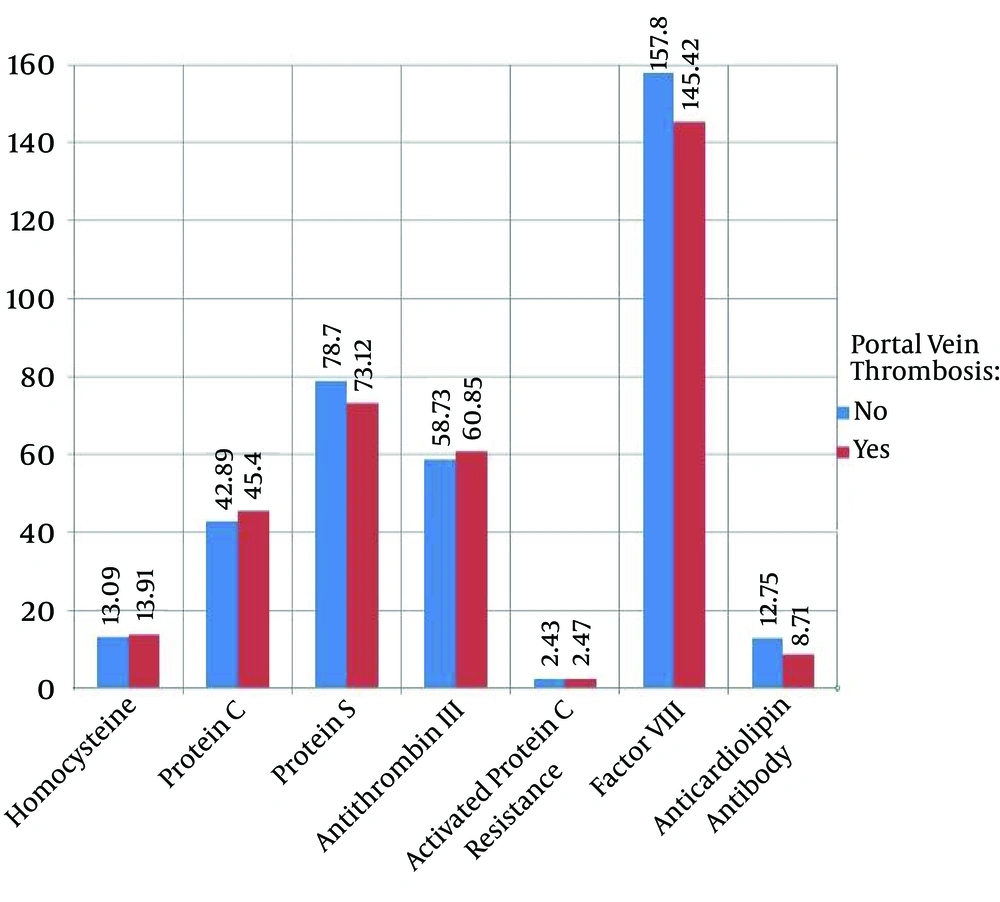
Figure 1.
Comparison of Procoagulant and Anticoagulant Factors in Cirrhotic Patients With and Without Portal Vein Thrombosis
Factor V Leiden polymorphism (G1691A) was compared between the PVT and non-PVT groups. Heterozygosity for G1691A polymorphism was detected in one patient with PVT and in six without PVT. No statistically significant difference was noted (P = 0.999). Prothrombin gene mutation and JAK2 mutation were totally absent among our patients.
5. Discussion
PVT is a common complication of end-stage liver disease in patients on the waiting list for liver transplantation. The overall prevalence of PVT in our study of cirrhotic patients was 15.9%, which was comparable to the prevalence of 8% - 25% reported in other studies of patients awaiting liver transplantation (4, 12, 14, 15). In studies that included patients with less severe disease, or that used sonography alone for the diagnosis of PVT, the prevalence of PVT was as low as 0.6% (3).
Despite bleeding tendencies in cirrhotic patients, mostly related to low platelet counts and high prothrombin times, this condition is now considered a hypercoagulable state (16, 17). Enhanced thrombin generation associated with low levels of protein C and elevated factor VIII has been implicated (18-20). However, it is not clear whether this is a genetic-based abnormality or is simply related to the consequences of synthetic dysfunction in cirrhotic patients. In this prospective study, we analyzed various predisposing factors for PVT in cirrhotic patients who were awaiting liver transplantation. There was no association between known hypercoagulable states and PVT in our study. (Figure 1) This is in contrast to some previous studies that reported thrombophilic risk factors in relationship to the prevalence of PVT in cirrhotic patients. Positivity for antiphospholipid antibodies, including anticardiolipin antibodies and lupus anticoagulant (10), as well as prothrombin gene mutation 20210A (21), the C677>T substitution in the methylene tetrahydrofolate reductase gene (a mutation that causes increased plasma levels of homocysteine), and factor V Leiden mutation, have been reported to be related to PVT (22). In our study, the levels of homocysteine, protein C, protein S, antithrombin III, APCR, factor VIII, and anticardiolipin antibodies in the cirrhotic patients were not associated with development of PVT. Furthermore, we did not find any prothrombin gene mutations in our 219 cirrhotic patients. This may be related to our strict inclusion and exclusion criteria, as well as to the fact that overall, it is the imbalance between procoagulants and anticoagulants that causes the hypercoagulable state of cirrhosis, rather than a single factor (17, 23).
A number of previous studies have found that the etiology of cirrhosis may influence the prevalence of PVT in patients, with the highest PVT incidence occurring in alcoholic and hepatitis B virus-related cirrhosis (24, 25). We did not find such a relationship in our study. This might be due to the high rate of hepatitis B virus-related cirrhosis in both groups.
In our study, only endoscopic therapy for esophageal varices (with sclerotherapy or variceal band ligation) increased the risk of PVT, but the frequency of episodes of variceal bleeding had no association with PVT. Consistent with our results, in one study of 251 cirrhotic patients awaiting transplantation, a multivariate analysis showed that a past history of variceal bleeding was a predictive factor for thrombosis (4). Episodes of variceal bleeding, reflecting the severity of portal hypertension, are more likely to be predisposing factors for, rather than a consequence of, PVT (4, 26). Other studies showed that endoscopic sclerotherapy for esophageal varices may represent a trigger factor for PVT in cirrhotic patients with genetic thrombophilia (21). In one study by Tripodi et al. the theoretical risk with cyanoacrylate glue was higher than with sclerotherapy; however, the existing evidence comes from case reports of small studies (17). Some recent studies have shown associations between thrombopoietin receptor agonists and the development of PVT in cirrhotic patients (27). The role of sclerotherapy is still controversial. Since esophageal variceal bleeding is an indicator of severe portal hypertension, further prospective studies should be done to evaluate the causative role of endoscopic treatment for varices in PVT. Alternatively, sluggish blood flow due to collateral formation might have a role in the development of PVT (7).
Ascites at baseline and worsening renal function have been related to new-onset PVT in patients with cirrhosis who are on waiting lists for transplantation (28). In our study, we could not confirm this association.
Our study had several limitations. Although we performed this study in a prospective manner, we evaluated our patients only upon their addition to the waiting list, and we did not follow them to determine whether they developed PVT later. We also did not study the patients’ fibrinolytic profiles, which have been recently reported to be associated with an increased risk of PVT in patients with cirrhosis (29).
In conclusion, in this study of cirrhotic patients on the waiting list for transplantation, PVT was common and was associated with previous episodes of variceal bleeding. We did not find any correlation between hypercoagulable disorders and the development of PVT.