1. Background
Hepatocellular carcinoma (HCC) is a leading cause of cancer-related mortality globally, with transcatheter arterial chemoembolization (TACE) being a standard treatment for intermediate-stage HCC (1-4). However, up to 50 - 60% of patients eventually develop TACE resistance or refractoriness, defined by the Japan Society of Hepatology-Liver Cancer Study Group of Japan (JSH-LCSGJ) criteria as either: (A) intrahepatic lesion progression after ≥ 2 consecutive TACE sessions within 6 months, or (B) continuous appearance of new lesions despite adequate embolization (5, 6). This condition severely limits further TACE benefit, leading to a median survival of less than 12 months without effective subsequent therapy, and thus necessitates alternative strategies. Systemic therapy, including tyrosine kinase inhibitors (e.g., sorafenib, lenvatinib) and immune checkpoint inhibitors (e.g., PD-1/PD-L1 antibodies), has become a cornerstone for TACE-resistant HCC (7, 8). Despite initial responses, resistance to systemic agents often emerges, underscoring the need for more effective approaches (9, 10).
Combining local therapies [such as modified TACE, hepatic artery infusion chemotherapy (HAIC), or radiotherapy] with systemic treatment is an emerging paradigm aimed at achieving both local control and systemic disease suppression (11, 12). While promising, the comparative efficacy and safety of this combined approach versus systemic therapy alone in TACE-resistant HCC remain insufficiently elucidated. Recent cohort studies (2023 - 2025) have begun to explore specific local modalities (e.g., HAIC combined with immunotherapy) in advanced HCC (13, 14), but real-world evidence directly comparing multiple local modalities (modified TACE, HAIC, IMRT) within a combined regimen for TACE-resistant patients is scarce. Moreover, most prior studies focus on single local techniques, leaving the relative effectiveness of different local approaches within a combined strategy unclear.
2. Objectives
This study aims to fill this gap by providing real-world retrospective data comparing the efficacy and safety of combined local-systemic therapy (incorporating three distinct local modalities) versus systemic therapy alone in a well-defined TACE-resistant HCC cohort. By analyzing outcomes across heterogeneous local treatments, we seek to inform personalized subsequent treatment decisions in this challenging patient population.
This study retrospectively compared the outcomes of local-systemic combination therapy versus systemic therapy alone in TACE-resistant HCC patients, with the goal of informing subsequent treatment decisions.
3. Methods
3.1. Study Design and Ethics
This was a single-center, retrospective observational cohort study. The study protocol was reviewed and approved by the Institutional Review Board. The requirement for informed consent was waived due to the retrospective nature of the study. All procedures followed the ethical standards of the Declaration of Helsinki.
3.2. Study Population
This retrospective analysis included 95 patients with HCC who developed resistance to transarterial chemoembolization (TACE) after undergoing TACE treatment in the Interventional Radiology Department of our hospital between September 2020 and September 2024. All patients were diagnosed with resistance following TACE (as defined above) and received at least one subsequent treatment cycle (systemic therapy alone or local+systemic therapy). Patient data were extracted from the hospital’s electronic medical record system and a prospectively maintained interventional oncology database. Key variables included demographic, clinical, laboratory, imaging, treatment, and outcome data. Missing data were handled by exclusion if critical for endpoint assessment (e.g., missing survival time or response evaluation). All eligible patients were followed until death or the censoring date (December 31, 2024). Patients alive at the last follow-up were right-censored for survival analysis.
3.3. Inclusion and Exclusion Criteria
3.3.1. Inclusion Criteria
Diagnosis of HCC confirmed by clinical (enhanced CT/MRI showing typical HCC features, alpha-fetoprotein (AFP) ≥ 400 ng/mL, and exclusion of other liver diseases) or pathological needle biopsy according to the “Diagnosis and Treatment Guidelines for Primary Liver Cancer (2019 Edition)”;
Met the operational definition of TACE resistance adapted from JSH-LCSGJ criteria (15) and recent clinical studies (5, 6): (A) received two or more consecutive standardized TACE sessions (interval 4-6 weeks) with adequate embolization (confirmed by post-procedure imaging); and (B) exhibited disease progression within 6 months after the last TACE, defined as either: (1) ≥ 20% increase in the sum of the longest diameters of intrahepatic target lesions according to mRECIST, or (2) appearance of new intrahepatic lesions, or (3) continuous growth of existing lesions despite technically successful TACE.
Presence of at least one measurable lesion (≥ 10 mm longest diameter per RECIST 1.1 criteria);
Child-Pugh liver function score ≤ 7 points (Class A: 5 - 6 points; Class B: 7 points), without severe hepatic insufficiency;
ECOG performance status score 0 - 1 (0: No limitations on daily activities; 1: Mild limitations on daily activities, able to tolerate mild physical exertion);
Received at least one cycle of subsequent therapy (systemic therapy alone or local therapy combined with systemic therapy) and able to complete follow-up (including imaging evaluation, laboratory tests, and survival status documentation).
3.3.2. Exclusion Criteria
Histopathological types such as fibrolamellar HCC, sarcomatoid HCC, cholangiocarcinoma, or other atypical HCC;
Contraindications for targeted or immunotherapy: Severe hepatic/renal failure (creatinine clearance < 30 mL/min, total bilirubin > 3× ULN), active infections (e.g., HBV DNA ≥ 10⁵ IU/mL without antiviral therapy), active autoimmune diseases (e.g., acute systemic lupus erythematosus flare);
Loss to follow-up (uncontactable for over 3 months) or missing key data (e.g., no survival time recorded, no imaging efficacy assessment performed);
Concurrent other malignancies (excluding early-stage curable tumors such as basal cell carcinoma of the skin or cervical carcinoma in situ);
Death during treatment due to non-tumor-related factors (e.g., acute myocardial infarction, cerebral hemorrhage).
3.4. Treatment Regimen
Based on patients' liver function status, tumor burden (number of lesions, maximum diameter), and treatment preferences, 95 patients were divided into two groups and assigned to different treatment regimens:
Systemic therapy group: Patients received targeted therapy combined with immunotherapy, with specific regimens adjusted based on individual disease status: Targeted agent: Lenvatinib (8 mg/day for patients weighing < 60 kg, 12 mg/day for patients weighing ≥ 60 kg, administered orally once daily); or Sorafenib (400 mg per dose, administered orally twice daily); Immunotherapy: Camrelizumab (200 mg/dose, intravenous infusion, every 2 weeks); or Tislelizumab (200 mg/dose, intravenous infusion, every 3 weeks); Treatment cycle: Each cycle spans 2 - 3 weeks. Treatment continues until tumor progression (as assessed by mRECIST criteria), occurrence of intolerable adverse reactions (e.g., grade 3 or higher proteinuria, rash), or patient-initiated discontinuation.
Patients in the local+systemic therapy group received systemic therapy with the same regimen as the systemic therapy group, supplemented with additional local therapy. The local therapy modality was selected based on lesion characteristics (location, size, blood supply) from the following options: (1) Modified TACE (mTACE): Performed via femoral artery access using superselective catheterization of tumor-feeding arteries. Drug-eluting microspheres (DC Bead®, 100 - 300 μm) loaded with epirubicin (50 mg per procedure) were injected until near-stasis of blood flow. The procedure was repeated every 4 - 6 weeks, with a planned 1 - 2 sessions per patient. Treatment was discontinued if complete devascularization was achieved or if liver function deterioration (increase in Child-Pugh score ≥ 2) occurred; (2) hepatic arterial infusion chemotherapy (HAIC): A 5-French catheter was placed in the proper hepatic artery via the femoral artery. The regimen consisted of fluorouracil (5-FU, 2.5 g/m²) as a 48-hour continuous infusion, combined with cisplatin (80 mg/m²) as a bolus injection on Day 1. Cycles were repeated every 3 - 4 weeks, with a planned 2-3 cycles. Treatment response was assessed after 2 cycles; continuation beyond 3 cycles required documented disease control; (3) intensity-modulated radiation therapy (IMRT): Indicated for localized residual or progressive lesions unsuitable for further embolization. The planning target volume included the gross tumor volume with a 5 - 10 mm margin. A total dose of 50 Gy was delivered in 20 fractions (2.5 Gy per fraction), 5 fractions per week. Systemic therapy was administered concurrently.
Switching between local modalities was allowed in case of progression or intolerance, but only the initial local modality was considered for group assignment in this analysis.
3.5. Clinical Data Collection
Baseline patient data and treatment-related information were collected via the hospital electronic medical record system and follow-up database. Specific details included: Age, gender, serum albumin, serum total bilirubin, Albumin-Bilirubin score (ALBI score), Child-Pugh liver function classification, tumor number (single or multiple), tumor maximum diameter (based on the longest diameter of the largest lesion on contrast-enhanced CT/MRI), Barcelona Clinic Liver Cancer stage (BCLC stage), serum Alpha-Fetoprotein (AFP), history of chronic hepatitis, and presence of concomitant arteriovenous fistula and extrahepatic blood supply.
3.6. Evaluation Criteria
(1) Overall survival (OS): Time from Day 1 of subsequent treatment initiation to patient death or last follow-up date; (2) progression-Free Survival (PFS): Time from day 1 of subsequent treatment initiation to first tumor progression (mRECIST criteria: ≥ 20% increase in sum of longest diameters of target lesions or emergence of new lesions) or patient death; (3) treatment response: Tumor response was assessed according to the modified response evaluation criteria in solid tumors (mRECIST). All baseline and follow-up imaging studies (contrast-enhanced CT or MRI) were independently reviewed by two experienced radiologists who were blinded to the treatment group assignment. Discrepancies were resolved by consensus or adjudication by a third senior radiologist. Response categories were defined as: Complete response (CR): Disappearance of all target lesions; partial response (PR): At least a 30% decrease in the sum of the longest diameters of target lesions; stable disease (SD): Neither sufficient shrinkage to qualify for PR nor sufficient increase to qualify for PD; progressive disease (PD): At least a 20% increase in the sum of the longest diameters of target lesions or the appearance of new lesion(s). The objective response rate (ORR) was calculated as (CR+PR) / total number of patients × 100%. The disease control rate (DCR) was calculated as (CR+PR+SD) / total number of patients × 100%.
3.7. Safety Indicators
Record all adverse reactions during treatment. Grade them according to the common terminology criteria for adverse events (CTCAE) version 5.0, categorized as grades 1 - 5. Focus on locally treatment-related adverse reactions (pain, fever, vomiting, abnormal liver function) and systemically treatment-related adverse reactions (hypertension, hand-foot syndrome, rash, hypothyroidism, diarrhea). Calculate the incidence and severity of adverse reactions.
3.8. Statistical Analysis
Data statistical analysis and graphing were performed using SPSS 27.0 statistical software (SPSS, Inc., Chicago, IL, USA) and GraphPad Prism 9.5.0 software (GraphPad Software Inc., San Diego, CA, USA). Normality of distribution was assessed using the Shapiro-Wilk test. Normally distributed quantitative data were expressed as mean ± standard deviation and compared between groups using the independent samples t-test. Non-normally distributed quantitative data were expressed as median (interquartile range) and compared between groups using the Mann-Whitney U test. Count data were expressed as counts and percentages and compared between groups using the chi-square test. Survival analysis employed the Kaplan-Meier method for survival curve construction, with intergroup survival differences assessed using the Log-rank test. To adjust for potential confounding factors due to the non-randomized treatment assignment, multivariate Cox proportional hazards regression models were applied for OS and PFS, incorporating covariates with potential clinical relevance (including age, gender, Child-Pugh grade, BCLC stage, maximum tumor diameter, number of tumors, AFP level, and ALBI score). P-values were calculated bilaterally, with P < 0.05 indicating statistically significant differences.
In addition to univariate Kaplan-Meier analysis, multivariable Cox proportional hazards regression models were applied for OS and PFS to adjust for potential confounders due to the non-randomized treatment assignment. Covariates with potential clinical relevance were included in the models: Age, gender, Child-Pugh grade (A vs. B), BCLC stage (A/B vs. C), maximum tumor diameter (continuous), number of tumors (single vs. multiple), AFP level (log-transformed), and ALBI score (continuous). Results are presented as hazard ratios (HR) with 95% confidence intervals (CI).
4. Results
4.1. Comparison of Baseline Characteristics Between Patient Groups
This study enrolled 95 patients with TACE-resistant HCC, divided into two groups based on treatment regimen: Systemic therapy (n = 39) and Local therapy+Systemic therapy (n = 56). The systemic therapy group received targeted therapy combined with immunotherapy, while the local+systemic therapy group received systemic therapy plus one of the following local treatments: Modified TACE, HAIC, or IMRT. Comparative analysis of baseline characteristics revealed no statistically significant differences between groups (Table 1) regarding gender, age, liver function markers (albumin, total bilirubin, ALBI score, Child-Pugh classification), tumor characteristics (number of tumors, maximum tumor diameter, BCLC stage, AFP level), history of chronic hepatitis, arteriovenous fistula, and extrahepatic blood supply. These findings indicate good comparability between the two groups, eliminating potential confounding effects from baseline differences in subsequent efficacy and safety analyses.
Table 1.
Comparison of Baseline Characteristics Between the Two Groups of Patients
| Project | Systemic Therapy (N = 39) | Local Therapy+Systemic Therapy (N = 56) | t/χ2/Z a | P-Value b |
|---|---|---|---|---|
| Age (y) c | 60.95 ± 11.18 | 60.43 ± 10.37 | 0.233 | 0.816 |
| Gender | 0.338 | 0.561 | ||
| Male | 35 (89.74) | 48 (85.71) | ||
| Female | 4 (10.26) | 8 (14.29) | ||
| Albumin (g/L) d | 41.20 (36.40, 45.30) | 43.05 (38.28, 45.75) | -0.851 | 0.398 |
| Total bilirubin (μmol/L) d | 19.40 (12.20, 25.90) | 16.15 (12.73, 21.60) | -1.400 | 0.163 |
| ALBI score d | -2.70 (-3.00, -2.30) | -2.84 (-3.07, -2.45) | -1.267 | 0.207 |
| Child-pugh grade e | 0.735 | 0.391 | ||
| A | 30 (76.92) | 47 (83.93) | ||
| B | 9 (23.08) | 9 (16.07) | ||
| Number of tumors e | 0.289 | 0.591 | ||
| Single | 4 (10.26) | 4 (7.14) | ||
| Multiple | 35 (89.74) | 52 (92.86) | ||
| Maximum tumor diameter (cm) d | 5.10 (2.80, 7.70) | 6.20 (3.73, 9.65) | -1.445 | 0.150 |
| BCLC stage e | 1.948 | 0.378 | ||
| A | 7 (17.95) | 5 (8.93) | ||
| B | 20 (51.28) | 29 (51.79) | ||
| C | 12 (30.77) | 22 (39.29) | ||
| AFP (ng/mL) d | 182.6 (30.80, 2227) | 157.0 (14.33, 2587) | -0.015 | 0.991 |
| History of chronic hepatitis e | 32 (82.05) | 45 (80.36) | 0.043 | 0.836 |
| Arteriovenous fistula e | 3 (7.69) | 10 (17.86) | 2.011 | 0.156 |
| Extrahepatic blood supply e | 9 (23.08) | 12 (21.43) | 0.036 | 0.849 |
Abbreviations: ALBI score, albumin-bilirubin score; BCLC stage, barcelona clinic liver cancer stage; AFP, alpha-fetoprotein.
a The Shapiro-Wilk test was used to assess normality.
b A P-value < 0.05 was considered statistically significant.
c Normally distributed quantitative data are presented as mean ± standard deviation, and comparisons between groups were performed using the independent samples t-test.
d Non-normally distributed quantitative data were expressed as median (interquartile range), and intergroup comparisons were performed using the Mann-Whitney U test.
e Categorical data were presented as counts and percentages, and intergroup comparisons were performed using the chi-square test.
4.2. Comparison of Overall Survival Between Two Patient Groups
At the end of follow-up, 52 of the 95 enrolled patients had died (23 in the systemic therapy group and 29 in the local combined systemic therapy group), while 43 remained alive. Survival curves were plotted using the Kaplan-Meier method and analyzed with the Log-rank test. Results showed (Figure 1) that the median OS in the local combined systemic therapy group was 20.29 months, significantly longer than the 14.67 months in the systemic therapy group, with a statistically significant difference (Log-rank χ² = 4.025, P = 0.045). These findings suggest that combining local therapy with systemic treatment significantly prolongs OS in TACE-resistant HCC patients.
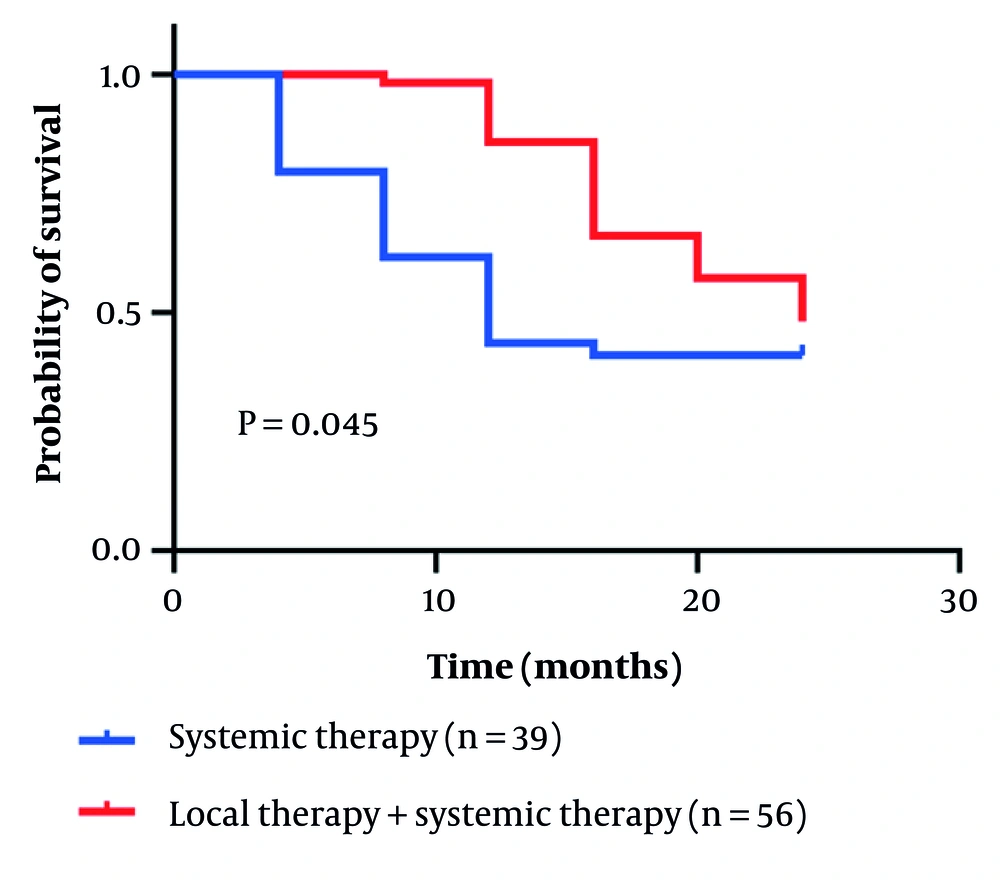
Figure 1.
Kaplan-Meier survival curves for overall survival (OS) in the two patient groups
4.3. Comparison of Progression-Free Survival Between Two Patient Groups
Kaplan-Meier analysis of PFS in both groups followed by Log-rank testing revealed (Figure 2) that the median PFS was 18.64 months in the local-systemic combination therapy group and 12.03 months in the systemic therapy group. Statistical analysis demonstrated that the PFS in the local combined systemic therapy group was significantly superior to that in the systemic therapy group, with a statistically significant difference (Log-rank χ² = 6.788, P = 0.009). This indicates that local combined systemic therapy holds greater advantages in delaying tumor progression in TACE-resistant HCC patients.
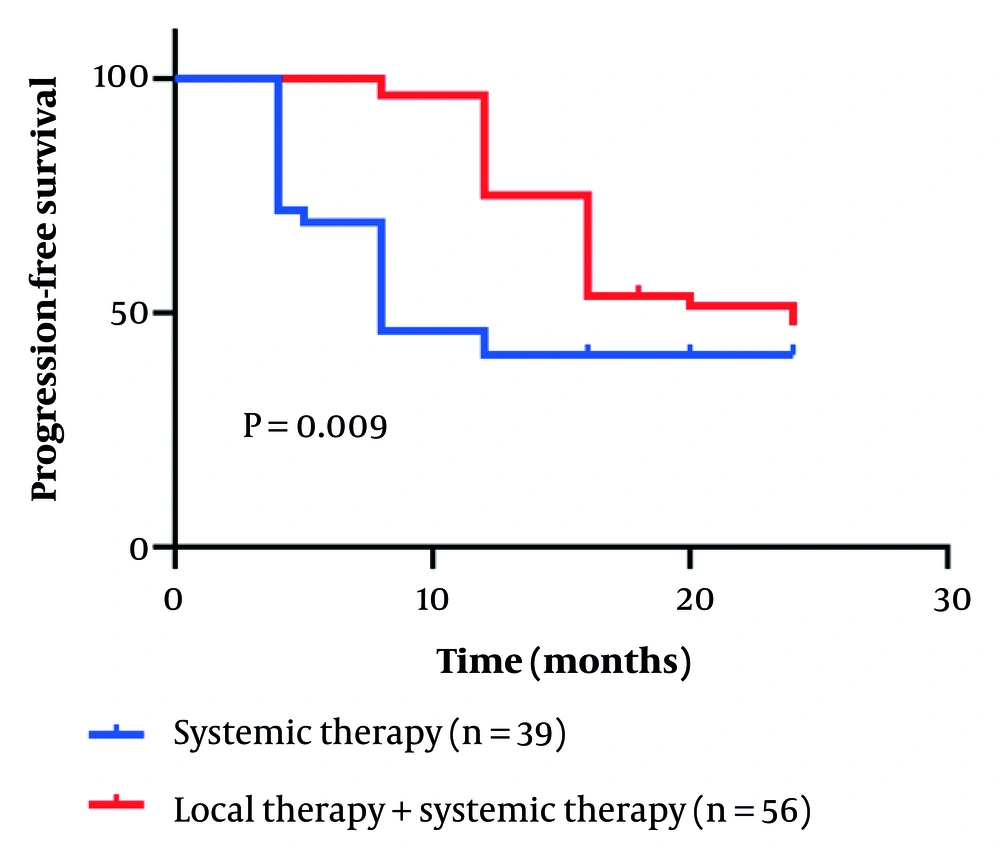
Figure 2.
Kaplan-Meier survival curves for progression-free survival (PFS) in the two patient groups
4.4. Comparison of Treatment Outcomes Between Two Patient Groups
Treatment outcomes were evaluated according to mRECIST criteria, yielding the following results (Table 2).
| Variables | Systemic Therapy (n = 39) | Local Therapy+Systemic Therapy (n = 56) | Χ2b | P-Value b |
|---|---|---|---|---|
| CR | 1 (2.56) | 3 (5.36) | ||
| PR | 7 (17.95) | 20 (35.71) | ||
| SD | 11 (28.21) | 20 (35.71) | ||
| PD | 20 (51.28) | 13 (23.21) | ||
| ORR | 8 (20.51) | 23 (41.07) | 4.420 | 0.036 |
| DCR | 19 (48.72) | 43 (76.79) | 7.989 | 0.005 |
Abbreviations: CR, complete response; PR, partial response; SD, stable disease; PD, progressive disease; ORR, objective response rate; DCR, disease control rate.
a Values are expressed as No. (%).
b Intergroup comparisons were performed using the chi-square test. P < 0.05 was considered statistically significant.
The local+systemic therapy group demonstrated an ORR of 41.07% (23/56), including 3 cases of CR (5.36%) and 20 cases of PR (35.71%); The ORR in the systemic therapy group was 20.51% (8/39), including 1 CR (2.56%) and 7 PR (17.95%). The difference in ORR between the two groups was statistically significant (χ² = 4.420, P = 0.036). The DCR in the local+systemic therapy group was 76.79% (43/56), including 20 cases (35.71%) with SD. The DCR in the systemic therapy group was 48.72% (19/56), including 11 cases (28.21%) with SD. The difference in DCR between the two groups was statistically significant (χ² = 7.989, P = 0.005). This suggests that combining local and systemic therapies can effectively improve tumor response rates and disease control outcomes in TACE-resistant HCC patients.
4.5. Comparison of Adverse Reaction Incidence Between the Two Groups
All adverse events (AEs) were graded according to the Common Terminology Criteria for Adverse Events (CTCAE) version 5.0. The incidence and severity of AEs are summarized in Table 3. Detailed adverse reaction incidence for both groups is presented in Table 3. Regarding locally treatment-related adverse reactions, only the locally combined systemic therapy group experienced pain (5 cases, 8.93%) and fever (4 cases, 7.14%), both classified as mild reactions (Grade 1 - 2) and resolved after symptomatic analgesic and antipyretic treatment. Vomiting occurred in 2.56% (1/39) of the systemic therapy group and 7.14% (4/56) of the local combined systemic therapy group, both presenting as Grade 1 nausea with mild vomiting. Symptoms resolved after oral ondansetron administration, with no statistically significant difference in incidence between groups (χ² = 0.967, P = 0.326). No Grade 2 or higher gastrointestinal reactions occurred. Additionally, the incidence of elevated ALT/AST and serum bilirubin was comparable between groups: Two cases (5.13%) of elevated ALT/AST and 2 cases (5.13%) of elevated serum bilirubin in the systemic therapy group, while the local combined systemic therapy group had 3 cases (5.36%) of elevated ALT/AST and 4 cases (7.14%) of elevated serum bilirubin. The differences between groups were not statistically significant (χ² values were 0.002 and 0.158, respectively, both P > 0.05).
Table 3.
Incidence and Severity of Adverse Events According to CTCAE v5.0 a
| Adverse Event | Systemic Therapy (N = 39) | Local+Systemic Therapy (N = 56) | P-Value b |
|---|---|---|---|
| Any adverse event | |||
| Grade 1 - 2 | 20 (51.28) | 49 (87.50) | < 0.001 |
| Grade ≥ 3 c | 0 (0) | 0 (0) | - |
| Local treatment-related | |||
| Pain | 0 (0) | 5 (8.93) | 0.055 |
| Grade 1 - 2 | 0 | 5 | |
| Fever | 0 (0) | 4 (7.14) | 0.089 |
| Grade 1 - 2 | 0 | 4 | |
| Vomiting | 1 (2.56) | 4 (7.14) | 0.326 |
| Grade 1 - 2 | 1 | 4 | |
| Systemic treatment-related | |||
| Hypertension | 4 (10.26) | 7 (12.50) | 0.737 |
| Grade 1 - 2 | 4 | 7 | |
| Hand-foot syndrome | 1 (2.56) | 4 (7.14) | 0.326 |
| Grade 1 - 2 | 1 | 4 | |
| Rash | 4 (10.26) | 6 (10.71) | 0.943 |
| Grade 1 - 2 | 4 | 6 | |
| Hypothyroidism | 3 (7.69) | 7 (12.50) | 0.453 |
| Grade 1 - 2 | 3 | 7 | |
| Diarrhea | 3 (7.69) | 5 (8.93) | 0.831 |
| Grade 1 - 2 | 3 | 5 | |
| Laboratory abnormalities | |||
| Elevated ALT/AST | 2 (5.13) | 3 (5.36) | 0.961 |
| Grade 1 - 2 | 2 | 3 | |
| Elevated bilirubin | 2 (5.13) | 4 (7.14) | 0.691 |
| Grade 1 - 2 | 2 | 4 |
a Values are expressed as No (%).
b P-values from chi-square test for incidence comparison.
c All events were Grade 1 - 2; no Grade ≥ 3 events occurred.
Regarding systemic treatment-related adverse reactions (hypertension, hand-foot syndrome, rash, hypothyroidism, diarrhea), both groups exhibited low incidence rates with no statistically significant differences. Hypertension occurred in 10.26% (4/39) of the systemic treatment group while the local plus systemic therapy group reported 12.50% (7/56). Both cases represented Grade 1-2 hypertension (systolic blood pressure 140-159 mmHg), which was controlled within normal ranges after adjusting calcium channel blocker (amlodipine) dosage; no Grade 3 or higher hypertension occurred. Hand-foot syndrome occurred in 2.56% (1/39) of the systemic therapy group and 7.14% (4/56) of the local-systemic combination therapy group, both presenting as Grade 1 mild palmar/plantar erythema and edema. Symptoms resolved with topical urea ointment application, with no Grade 2 or higher reactions affecting daily activities. The incidence rates of rash (10.26% vs 10.71%), hypothyroidism (7.69% vs 12.50%), and diarrhea (7.69% vs 8.93%) were similarly comparable between groups (χ² values: 0.005, 0.564, 0.046, all P > 0.05). All systemic treatment-related adverse events were Grade 1, requiring no adjustment to the systemic therapy regimen.
The overall incidence of adverse reactions was 87.50% (49/56) in the local-systemic combination therapy group, significantly higher than the 51.28% (20/39) observed in the systemic therapy group (χ² = 15.171, P < 0.001). This difference primarily stemmed from characteristic reactions associated with local therapy, such as pain and fever. Notably, neither group experienced grade 3 or higher severe adverse reactions. All adverse reactions resolved rapidly with symptomatic management and did not significantly impact patient treatment compliance or quality of life, confirming the controllable safety profile of local combined systemic therapy in TACE-resistant HCC patients.
5. Discussion
This study aimed to investigate the differences in efficacy and safety between local combined systemic therapy and systemic therapy alone in patients with HCC resistant to TACE. Our real-world retrospective analysis demonstrates that, for TACE-resistant HCC, combined local-systemic therapy significantly prolongs OS (adjusted HR 0.58, P = 0.042) and PFS (adjusted HR 0.51, P = 0.009), and improves ORR and DCR compared to systemic therapy alone, with a manageable safety profile. These findings align with and extend recent studies exploring combined modality approaches. For instance, another study reported an ORR of 46.7% with HAIC plus lenvatinib and PD-1 inhibitors in advanced HCC, similar to our ORR of 41.1% in the combination group. However, our study uniquely incorporates a heterogeneous mix of local modalities (mTACE, HAIC, IMRT) within the combination arm, reflecting real-world clinical flexibility and suggesting that the survival benefit may be achievable across different local techniques when integrated with systemic therapy.
The superior efficacy of the combined approach may be mechanistically explained by immunomodulatory effects. Local therapies like TACE and radiotherapy can induce immunogenic cell death, releasing tumor antigens and damage-associated molecular patterns, which may enhance dendritic cell maturation and tumor-specific T-cell priming. This can potentially reverse the immunosuppressive tumor microenvironment and synergize with immune checkpoint inhibitors, leading to an abscopal effect and improved systemic disease control (11-14). Our observed higher ORR in the combination group supports this potential synergy, as local tumor debulking may enhance the exposure of residual tumor to systemic immune surveillance. Adverse reactions remained generally manageable, providing robust evidence-based support for subsequent treatment strategies in TACE-resistant HCC patients.
In this study, the median OS in the local-systemic combination therapy group was 20.29 months, significantly superior to the 14.67 months observed in the systemic therapy group (P = 0.045). The median PFS also reached 18.64 months, markedly longer than the 12.03 months in the systemic therapy group (P = 0.009). These findings indicate that integrating local treatment modalities with systemic therapy can effectively delay tumor progression and prolong patient survival. The survival benefit may stem from the synergistic effects of “local tumor control” and “systemic metastasis prevention" (15, 16). Patients resistant to TACE typically exhibit complex tumor vasculature, high local disease burden (e.g., multiple tumors, extensive involvement), and elevated metastasis risk (17-19). While systemic therapy alone can act systemically, its direct killing capacity against large local lesions is limited and susceptible to tumor heterogeneity and resistance mechanisms (20-22). Conversely, combining local therapies (such as modified TACE, HAIC, or IMRT) enables precise targeting of major hepatic lesions, rapidly reducing tumor burden. This improves the local hepatic microenvironment, increases tumor antigen release, and enhances immunotherapy response (23, 24). Furthermore, local therapies may induce immunogenic cell death, promote T-cell infiltration, and synergize with immune checkpoint inhibitors to produce an “abscopal effect” — a distant antitumor response — thereby enhancing the efficacy of systemic treatments (25, 26).
In this study, the ORR (41.07%) and DCR (76.79%) in the local combined systemic therapy group were significantly higher than those in the systemic therapy group (20.51% and 48.72%), further confirming the superiority of combined therapy in tumor regression and disease control. A higher ORR not only signifies radiographic tumor shrinkage but also potentially offers patients symptom relief, improved quality of life, and even creates opportunities for potential downstaging surgery or local curative treatment (27). Notably, despite no significant differences between groups in baseline BCLC staging, tumor count, or AFP levels, the local-systemic combination group exhibited slightly larger median tumor maximum diameter (6.2 cm vs. 5.1 cm). This suggests combined therapy may be equally effective — or even superior — for patients with higher tumor burden, offering positive implications for treatment selection in such clinical settings.
Safety analysis revealed a significantly higher overall adverse event rate (87.50%) in the combined local-systemic therapy group compared to the systemic therapy group (51.28%). However, this difference primarily stemmed from mild local treatment-related reactions: pain (8.93%) and fever (7.14%) were both Grade 1-2 and resolved with analgesic and antipyretic interventions. Incidences of vomiting and liver function abnormalities (elevated ALT/AST, elevated serum bilirubin) showed no statistically significant difference compared to the systemic therapy-only group (all P > 0.05), with no Grade 2 or higher gastrointestinal reactions or liver function impairment observed. These findings align with previous studies: adverse reactions to local therapies (particularly modified TACE and IMRT) are predominantly localized and transient (28-30). Optimizing procedural protocols (e.g., using super-selective catheterization in modified TACE to minimize normal liver tissue injury) and implementing preoperative prophylaxis (e.g., administering antiemetics before radiotherapy) can further reduce incidence rates (28, 29). Regarding systemic therapy-related adverse events, both groups showed no significant differences in the incidence of common targeted and immunotherapy-related adverse events such as hypertension, hand-foot syndrome, rash, hypothyroidism, and diarrhea. All adverse events were Grade 1 - 2, with no Grade 3 or higher severe adverse events occurring. This indicates that local therapy does not increase the risk of systemic treatment-related toxicity, providing safety assurance for the clinical implementation of this combination approach (31, 32).
The findings of this study support the use of combined local and systemic therapy as a preferred follow-up treatment strategy for TACE-resistant HCC patients. Currently, there is no unified standard for managing TACE-resistant patients. While systemic therapy has become mainstream, its efficacy remains limited when used alone. This real-world data study demonstrates that an integrated approach combining local and systemic treatments can overcome the limitations of monotherapy and achieve superior survival benefits. Notably, this study incorporated multiple local treatment modalities (modified TACE, HAIC, IMRT), reflecting personalized and flexible treatment planning. These approaches can be precisely selected based on individual patient characteristics (e.g., lesion location, blood supply, liver function), enhancing clinical applicability.
This study has several limitations that should be acknowledged. First, its retrospective, single-center design and relatively small sample size may introduce selection bias and limit the generalizability of the findings. Although multivariate Cox regression was performed to adjust for key prognostic factors, unmeasured confounders could persist. Second, the treatment assignment was non-randomized and based on clinical factors and patient preference, which may have influenced outcomes. Third, the radiologists assessing tumor response, while blinded to treatment group, were part of the same institution, and central independent review was not performed. Fourth, the heterogeneity in local treatment modalities (modified TACE, HAIC, IMRT) precludes definitive conclusions about the superiority of any specific local approach within the combination strategy. Finally, the follow-up period ended in December 2024; longer-term survival data are needed to confirm the durability of the observed benefits.
Future prospective, randomized controlled trials with larger cohorts and longer follow-up are warranted to validate these findings. Investigations should also focus on identifying biomarkers to select patients most likely to benefit from combined local-systemic therapy and on determining the optimal sequence and type of local therapy to combine with systemic agents.
In summary, despite these limitations, for TACE-resistant HCC patients, local-systemic combination therapy significantly improves survival outcomes and tumor response compared to systemic therapy alone, with favorable safety and manageable adverse events. This treatment model embodies the principles of multidisciplinary collaboration and personalized precision medicine in modern HCC management, warranting clinical adoption and providing valuable insights for optimizing comprehensive treatment strategies.