
1. Background
Acute liver failure (ALF) is a rapidly progressing syndrome characterized by severe hepatic dysfunction, coagulopathy, and hepatic encephalopathy and is associated with high mortality despite advances in intensive care. Spontaneous survival remains low, and liver transplantation (LT) is often the only definitive life‑saving option (1-3). Early and accurate prognostication is essential for timely LT referral. Although prognostic systems such as the King’s College Criteria and the Model for End‑Stage Liver Disease (MELD) score remain widely used, their limited sensitivity has prompted the search for additional biomarkers capable of improving clinical decision-making (4). Recent studies have explored several inflammatory and hepatocellular injury–related markers—including C‑X‑C Motif Chemokine Ligand 9 (CXCL9), C‑X‑C Motif Chemokine Ligand 10 (CXCL10), Granzyme B, Factor V, and cytokines such as IL‑6—highlighting the need for reliable tools to better stratify disease severity (4). Procalcitonin (PCT), traditionally regarded as a bacterial infection marker (5), is increasingly recognized as a mediator of non‑infectious systemic inflammation. Under severe inflammatory states, endotoxemia and tissue injury stimulate extra‑thyroidal PCT synthesis in organs such as the lung, intestine, and liver through cytokine‑driven pathways involving IL‑6 and TNF‑α (5, 6). In ALF, massive hepatocellular necrosis triggers systemic inflammatory response syndrome (SIRS), leading to marked PCT elevation even in the absence of bacterial infection (7, 8). This pathophysiological mechanism suggests that PCT may reflect the intensity of systemic inflammation and hepatic injury in ALF. Sugihara et al. reported significantly elevated PCT levels in ALF patients, which correlated with adverse outcomes (9). However, the optimal thresholds for prognostication vary across studies and may depend on population characteristics, timing of sampling, and treatment modalities.
2. Objectives
Building upon this background, the present study investigates whether dynamic PCT monitoring—particularly peak PCT (PCTmax) rather than isolated admission values—provides incremental prognostic value. Importantly, this study was conducted in a rigorously infection‑free ALF cohort managed with standardized extracorporeal therapy, allowing for a clearer evaluation of PCT as an inflammation‑ and injury‑related biomarker rather than an infection‑driven parameter.
3. Methods
3.1. Study Design and Patient Population
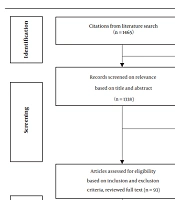
This retrospective observational study was conducted in the liver transplant intensive care unit between January 2021 and June 2025. During this period, 117 patients were screened, and 83 were included in the final analysis: 41 with ALF and 42 undergoing major hepatectomy as controls (Figure 1). Thirty‑four patients were excluded due to chronic liver disease or cirrhosis (n = 12), alcoholic liver disease (n = 5), active bacterial infection on admission (n = 10), immunosuppressive therapy (n = 4), or incomplete laboratory data (n = 3). All included patients were treated under intensive care conditions.The ALF group consisted of 41 patients (49.4%) and the control group consisted of 42 patients (50.6%). The cohort included 47 males (56.6%) and 36 females (43.4%), with a median age of 53 years (range 20 - 87). All ALF patients presented with Grade 1 - 4 hepatic encephalopathy, whereas no encephalopathy was observed in the control group.ALF patients received standard ICU management together with extracorporeal support therapy—Therapeutic Plasma Exchange (TPE) combined with Continuous Venovenous Hemodiafiltration (CVVHDF). CVVHDF was performed using the Fresenius Multifiltrate® system with AV 1000S high‑flux hemodiafilter membranes (Fresenius Medical Care, Germany). Control patients received routine postoperative care. Major hepatectomy was selected as a comparator because it represents significant but controlled hepatic injury, allowing the differentiation of PCT elevation caused by fulminant hepatic failure from that related to surgical inflammation. Postoperative inflammation may increase PCT levels, but elevations are typically lower and more transient than in ALF, making this group an appropriate clinical comparator (10-12).
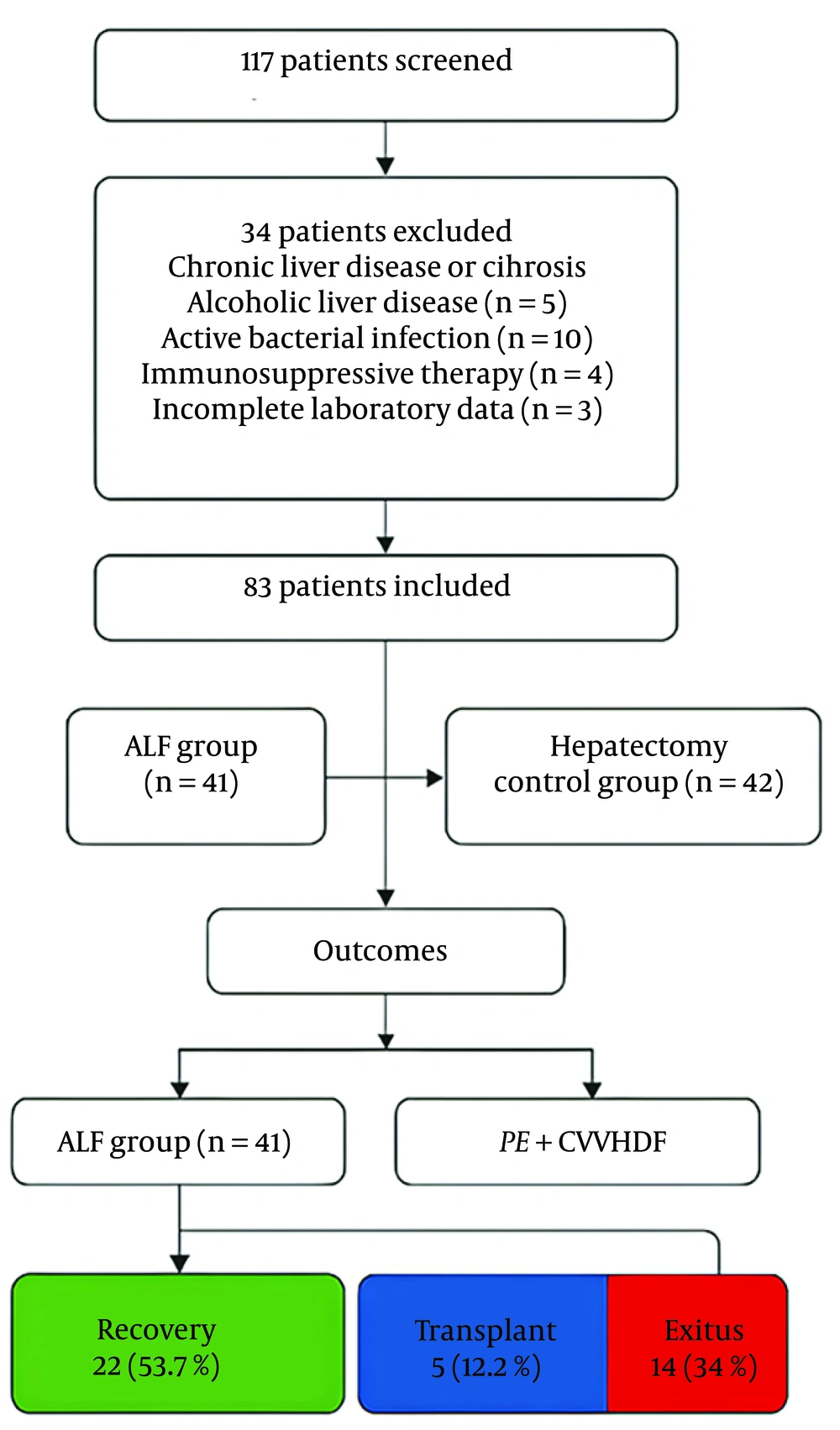
Figure 1.
Patient enrollment, treatment, and outcomes in the ALF cohort
3.2. Inclusion and Exclusion Criteria
ALF was defined as coagulopathy [international normalized ratio (INR) ≥ 1.5] and hepatic encephalopathy (grade 1 - 4) in individuals without pre‑existing chronic liver disease (1).
- Exclusion criteria: (1) Chronic liver disease or cirrhosis; (2) Alcoholic liver disease; (3) Active bacterial infection; (4) Use of immunosuppressive therapy.
These exclusions minimized the influence of infection or immune response differences on PCT levels.
3.3. Data Collection and Laboratory Measurements
Demographic and clinical data were collected retrospectively from the hospital information system. Laboratory parameters included alanine aminotransferase (ALT), aspartate aminotransferase (AST), gamma‑glutamyl transferase (GGT), total and direct bilirubin, creatinine, prothrombin time (PT), C‑reactive protein (CRP), and ammonia.
Serum PCT levels were measured within the first 24 hours (PCTmin) and monitored daily (PCTmax). Measurements were performed using electrochemiluminescence immunoassay (ECLIA) on Roche cobas e analyzers. The normal reference value was < 0.05 ng/mL; levels ≥ 0.5 ng/mL indicated systemic inflammation or possible infection.
Etiological evaluation included viral hepatitis [hepatitis B virus (HBV), hepatitis C virus (HCV)], autoimmune hepatitis, Wilson’s disease, and toxic causes. To exclude infection, all patients underwent standardized screening: blood and urine cultures, chest X‑ray, abdominal ultrasonography, and CT when indicated. Surveillance cultures were repeated every 48 - 72 hours if needed. No patient received prophylactic antibiotics; antimicrobial therapy was started only if microbiological confirmation was obtained.
3.4. Treatment ApproachesTherapeutic Plasma Exchange (TPE)
Using a continuous renal replacement device in combination with the Fresenius plasma exchange kit, plasma exchange was performed. Daily TPE (1 - 1.5 plasma volumes of fresh frozen plasma) continued until clinical and laboratory improvement—reduced encephalopathy grade, INR < 1.5, and decreasing bilirubin—or until LT. Treatment decisions were made daily by a multidisciplinary team.
3.5. Continuous Venovenous Hemodiafiltration (CVVHDF)
CVVHDF was performed using a renal replacement system (Fresenius Medical Care, Germany) with continuous citrate–calcium anticoagulation. Blood flow rates were 3 - 5 mL/kg/min; dialysate flow ranged from 180 - 300 mL/kg/h. Dialysate and replacement fluids included multibic, multiplus, citrate–calcium dialysate, citrate–calcium 2K solutions, and 4% sodium citrate.
Liver transplantation was performed in five patients with available donors. Among 36 ALF patients without donors, 22 recovered spontaneously, while 14 died despite therapy.
3.6. Statistical Analysis
Statistical analyses were performed using SPSS 25.0 and MedCalc 22.0. Data distribution was assessed with the Shapiro–Wilk test. Non‑normally distributed variables were expressed as medians (IQR). Group comparisons used the Mann–Whitney U test for continuous variables and the chi‑square or Fisher’s exact test for categorical variables.
Receiver operating characteristic (ROC) analysis assessed the predictive performance of PCT for poor outcome (death or LT). Variables associated with poor prognosis (P < 0.1) in univariate logistic regression were included in a multivariable backward stepwise regression model. Correlation between continuous variables was assessed using Spearman’s rho.
Area under the curve (AUC) values for PCTmax, MELD, and King’s college criteria (KCC) were compared using the DeLong test (13). The prognostic utility of ΔPCT over the first 48 - 72 hours (ΔPCT = PCT at 48/72 h - PCTmin) was also evaluated using ROC analysis, with optimal cutoff values determined by the Youden index (14). Kaplan–Meier curves assessed transplant‑free survival, and differences were compared using the log‑rank test. A P-value < 0.05 was considered significant.
No a priori sample size calculation was performed. Given the limited number of transplant events (n = 5), the statistical power for regression and survival analyses is constrained; findings should be interpreted as exploratory and hypothesis‑generating.
3.7. Ethical Approval
The study was approved by the Hospital Clinical Research Ethics Committee (approval No: 4.12.2025.402). The requirement for patient consent was waived due to the retrospective design.
4. Result
4.1. Patient Characteristics and Etiology
Of the 83 patients included in the study, 41 (49.4%) comprised the ALF group and 42 (50.6%) comprised the major hepatectomy control group. The median age was 53 years (range 20 - 87), and 47 patients (56.6%) were male, while 36 (43.4%) were female.
The etiological distribution in the ALF group (n = 41) was as follows (recalculated):
- Toxic hepatitis (non‑mushroom): 6 (14.6%)
- Toxic hepatitis (mushroom‑related): 12 (29.3%)
- Autoimmune hepatitis: 6 (14.6%)
- Wilson’s disease: 3 (7.3%)
- Drug‑induced (non‑paracetamol): 7 (17.1%)
- Cryptogenic: 7 (17.1%)
The control group (n = 42) included patients undergoing liver resection for:
- Other primary tumors: 20 (47.6%)
- Hepatocellular carcinoma (HCC): 9 (21.4%)
- Metastatic lesions: 7 (16.7%)
- Biliary obstruction/stricture: 6 (14.3%)
No systemic or localized bacterial infection was detected at baseline in either group. All ALF patients presented with grade 1 - 4 hepatic encephalopathy, whereas none of the control patients had encephalopathy (Table 1).
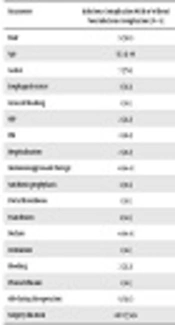
Table 1.
| Parameters | Group 1 (ALF) (n = 41) | Group 2 (Hepatectomy) (n = 42) | P-Value d, e |
|---|---|---|---|
| Demographics & scores | |||
| Age (y) | 53 (45 - 61) | 52 (44 - 60) | 0.48 |
| Gender (male/female), No. | 23/18 | 24/18 | 0.91 |
| APACHE II score | 18 (15 - 22) | 14 (12 - 18) | 0.03 |
| MELD score | 32 (28 - 36) | N/A | - |
| Serum PCT on admission (ng/mL) | 0.59 (0.27 - 2.28) | 0.38 (0.07 - 0.73) | 0.003 |
| Clinical course | |||
| Hepatic encephalopathy (grade 1 - 4); No. (%) | 41 (100) | 0 (0) | - |
| TPE duration (days) | 5 (3 - 7) | N/A | - |
| CVVHDF duration (days) | 4 (2 - 6) | N/A | - |
| LTICU stay (days) | 12 (8 - 18) | 7 (5 - 10) | 0.02 |
| Outcome (recovery/LT/death); No. | 22/5/14 | 42/0/0 | 0.001 |
| Etiology; No. (%) | |||
| Acute liver failure (group 1) | |||
| Cryptogenic | 7 (17.1) | - | - |
| Autoimmune hepatitis | 6 (14.6) | - | - |
| Toxic hepatitis (mushrooms) | 12 (29.3) | - | - |
| Toxic hepatitis (non-mushrooms) | 6 (14.6) | - | - |
| Wilson's disease | 3 (7.3) | - | - |
| Drug-induced (non-paracetamol) | 7 (17.1) | - | - |
| Hepatectomy (group 2) | |||
| Primary tumor (other) | - | 20 (47.6) | - |
| Hepatocellular carcinoma (HCC) | - | 9 (21.4) | - |
| Metastases | - | 7 (16.7) | - |
| Biliary stricture/obstruction | - | 6 (14.3) |
Abbreviations: ALF, acute liver failure; APACHE, acute physiologic assessment and chronic health evaluation; MELD, model for end-stage liver disease; TPE, therapeutic plasma exchange; CVVHDF, continuous venovenous hemodiafiltration; LT, liver transplant; LTICU, liver transplant intensive care unit; PCT, procalcitonin; N/A, not applicable.
a Values are expressed as median (IQR) unless otherwise indicated.
b Etiology percentages are calculated within groups.
c Dash (-) indicates not applicable.
d Mann-Whitney U test was used for continuous variables. Chi-square test was used for categorical variables.
e P < 0.05 was considered statistically significant.
4.2. Clinical and Treatment Outcomes
All 41 ALF patients received combined extracorporeal therapy (TPE + CVVHDF). Liver transplantation was performed in five patients with suitable donors, two of whom died within the first year. Among the 36 ALF patients without donors, 22 achieved spontaneous recovery, and 14 died despite therapy (Figure 1). All 42 control patients recovered without postoperative complications and were discharged.
The ICU length of stay was significantly longer in the ALF group [12 (IQR 8 - 18) days vs. 7 (5 - 10) days; P = 0.02]. The APACHE II scores were also higher in ALF patients [18 (15 - 22) vs. 14 (12 - 18); P = 0.03]. Serum PCT levels were positively associated with longer ICU stay and higher APACHE II scores (P = 0.009). Age and sex showed no significant association with PCT levels.
4.3. Laboratory Findings
Serum PCT levels were significantly higher in ALF patients compared with controls [0.59 (0.27 - 2.28) ng/mL vs. 0.38 (0.07 - 0.73) ng/mL; P = 0.003]. The ALT, AST, total bilirubin, direct bilirubin, PT/INR, and ammonia levels were also significantly elevated in ALF patients at both baseline and peak values (all P < 0.001).
4.3.1. Correlation Analyses
- Peak ALT vs. PCTmax: rho = 0.52, P < 0.001
- Peak INR vs. PCTmax: rho = 0.48, P = 0.002
- Peak ammonia vs. PCTmax: rho = 0.45, P = 0.004
- CRP (between‑group difference): P = 0.733 (non‑significant)
Acute kidney injury (AKI) was present in 15 ALF patients (36.6%). PCTmax was significantly higher in ALF patients with AKI [2.8 (1.4 - 4.1) ng/mL] than in those without AKI [1.1 (0.5 - 2.0) ng/mL] (P = 0.012) (Table 2).
| Parameters | Group 1 (ALF) Median (IQR) | Group 2 (Hepatectomy) Median (IQR) | P-Value (ALF vs Hepatectomy) d | P-Value (ALF Recovery vs LT/Death) d | Correlation with PCTmax (rho, P-Value) |
|---|---|---|---|---|---|
| Hematology | |||||
| WBC (× 10³/µL) | 7.98 (5.30 - 12.3) | 14.4 (11.3 - 18.7) | < 0.001 | 0.451 | 0.28, 0.08 |
| Hb (g/dL) | 13.1 (10.6 - 14.4) | 11.7 (10.1 - 12.5) | 0.002 | 0.623 | -0.15, 0.35 |
| Plt (× 10³/µL) | 169 (106 - 228) | 313 (216 - 353) | < 0.001 | 0.187 | -0.33, 0.04 |
| Coagulation | |||||
| INR | 1.90 (1.55 - 2.89) | 1.12 (1.07 - 1.30) | < 0.001 | 0.004 | 0.48, 0.002 |
| Liver Enzymes | |||||
| ALT (U/L) | 840 (740 - 2667) | 187 (123 - 320) | < 0.001 | 0.008 | 0.52, < 0.001 |
| AST (U/L) | 913 (156 - 2092) | 282 (147 - 440) | < 0.001 | 0.005 | 0.49, 0.001 |
| Liver Function & Metabolism | |||||
| Total Bilirubin (mg/dL) | 2.97 (1.6 - 13.5) | 1.08 (0.68 - 1.47) | < 0.001 | 0.005 | 0.41, 0.009 |
| Ammonia (µmol/L) | 60.4 (34.4 - 120) | 30.3 (27.2 - 39.5) | < 0.001 | 0.004 | 0.45, 0.004 |
| Creatinine (mg/dL) | 0.83 (0.65 - 1.85) | 0.78 (0.61 - 0.88) | 0.215 | 0.089 | 0.38, 0.016 |
| Inflammation | |||||
| CRP (mg/L) | 15.7 (7.50 - 24.4) | 10.0 (4.70 - 28.6) | 0.733 | 0.845 | 0.22, 0.18 |
| Procalcitonin, max (ng/mL) | 1.8 (0.9 - 4.2) | 0.6 (0.2 - 1.1) | 0.003 | 0.036 | - |
| Additional ALF Data | |||||
| AKI present, No. (%) | 15 (36.6) | 3 (7.1) | 0.001 | 0.025 | - |
| ΔPCT48h (ng/mL) | 0.3 (-0.1 - 1.5) | N/A | - | 0.018 | - |
Abbreviations: ALF, acute liver failure; LT, liver transplantation; PCTmax, maximum procalcitonin level; rho, Spearman's rank correlation coefficient; WBC, white blood cell; Hb, hemoglobin; Plt, platelets; INR, international normalized ratio; ALT, alanine aminotransferase; AST, aspartate aminotransferase; CRP, C-reactive protein; AKI, acute kidney injury (creatinine ≥ 1.5 mg/dL); ΔPCT48h, change in PCT from admission to 48 hours; IQR, interquartile range; N/A, not applicable.
a Mann–Whitney U test for group comparisons. Spearman correlation in ALF group (n = 41).
b PCTmax cutoff (Youden index): 1.625 ng/mL (sensitivity 84.2%, specificity 63.6%).
c Dash (-) indicates not applicable.
d P < 0.05 considered significant.
4.3.2. Subgroup Findings (ALF)
- Admission PCTmin: not associated with outcome (P=0.574)
- PCTmax: higher in the transplant/death subgroup (P=0.036)
- ΔPCT48h: higher in the poor‑prognosis group [1.2 (0.4–2.8) ng/mL] vs. recovery [0.1 (−0.2–0.5) ng/mL] (P=0.018)
- ROC for ΔPCT48h: AUC = 0.712 (95% CI 0.550–0.874; P=0.021)
PCTmax also showed moderate correlations with MELD (r=0.41, P=0.011) and with peak INR (r=0.38, P=0.018). No significant correlation was observed between PCT parameters and creatinine at admission (r=0.19, P=0.214). Collectively, these findings indicate that PCT reflects disease severity without problematic collinearity.
4.4. Multivariable Regression and Comparative ROC Analyses
Univariate regression identified the following predictors of poor outcome (all P < 0.05):
- PCTmax (OR 2.15)
- MELD (OR 1.12)
- Peak INR (OR 3.45)
- AKI (OR 3.80)
In the multivariable model, only PCTmax (adjusted OR 1.95, P = 0.022) and MELD (adjusted OR 1.10, P = 0.032) remained independent predictors. No multicollinearity was detected (all VIF < 2).AUC values for predicting poor outcome were:
- PCTmax: 0.693 (95% CI 0.527 - 0.859)
- MELD: 0.745 (95% CI 0.598 - 0.892)
- KCC: 0.698 (95% CI 0.540 - 0.856)
The difference between PCTmax and MELD was not significant (P = 0.521). The combined PCTmax + MELD model yielded an AUC of 0.801 (95% CI 0.673 - 0.929; P = 0.047).
4.4. ROC Analysis
The ROC analysis for PCTmax demonstrated:
- AUC: 0.693
- 95% CI: 0.527 - 0.859
- P‑value: 0.035
- Optimal cutoff (Youden): 1.625 ng/mL
- Sensitivity: 84.2%
- Specificity: 63.6%
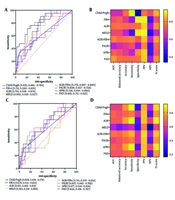
Figure 2 has been updated to clearly display the AUC and the 1.625 ng/mL cutoff (with sensitivity/specificity annotations).
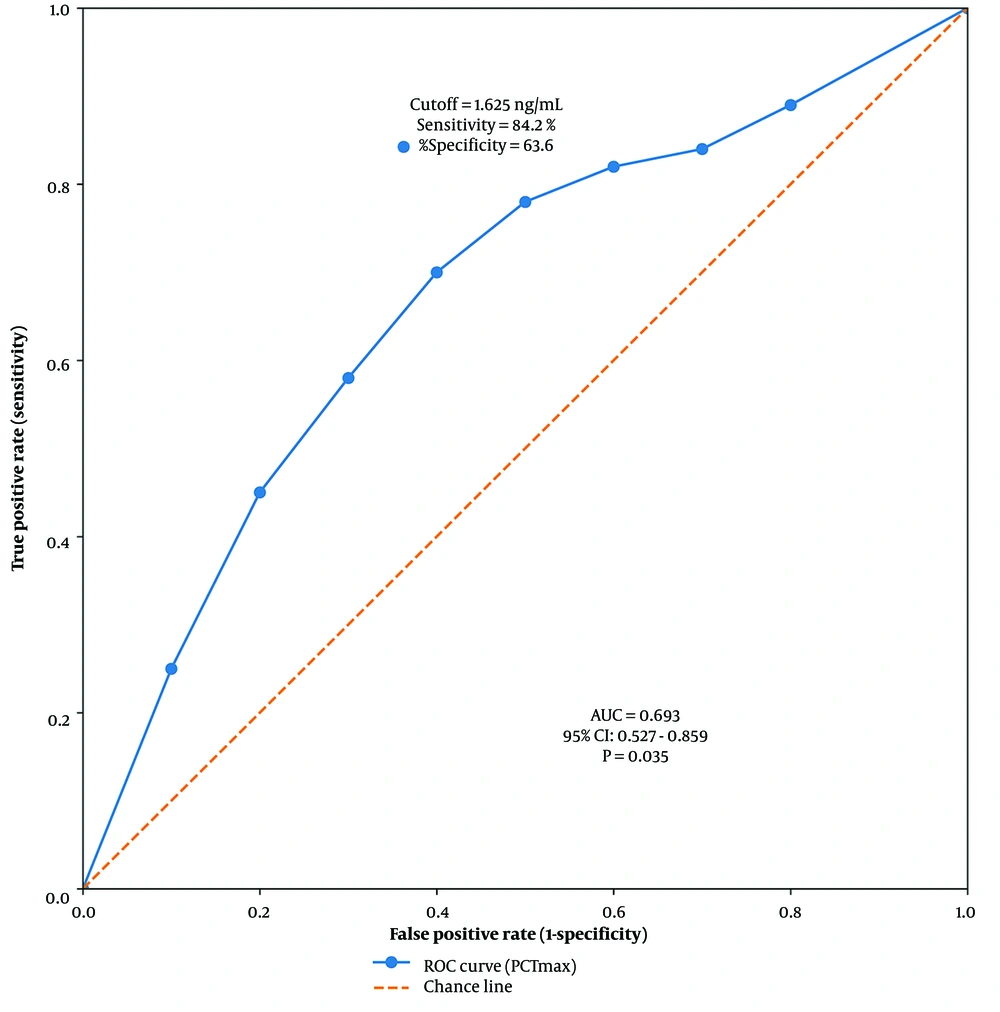
Figure 2.
ROC curve for PCT predicting poor prognosis in ALF (AUC = 0.693; optimal cutoff = 1.625 ng/mL; sensitivity = 84.2%; specificity = 63.6%).
4.5. Kaplan–Meier Survival Analysis
Kaplan–Meier analysis showed a 53.7% transplant‑free survival rate (log‑rank P = 0.03). The recovery subgroup exhibited a gradual decline in survival, while the LT/death subgroup showed an early and rapid decrease.
Figure 3 has been regenerated with a risk table at the bottom, as requested.
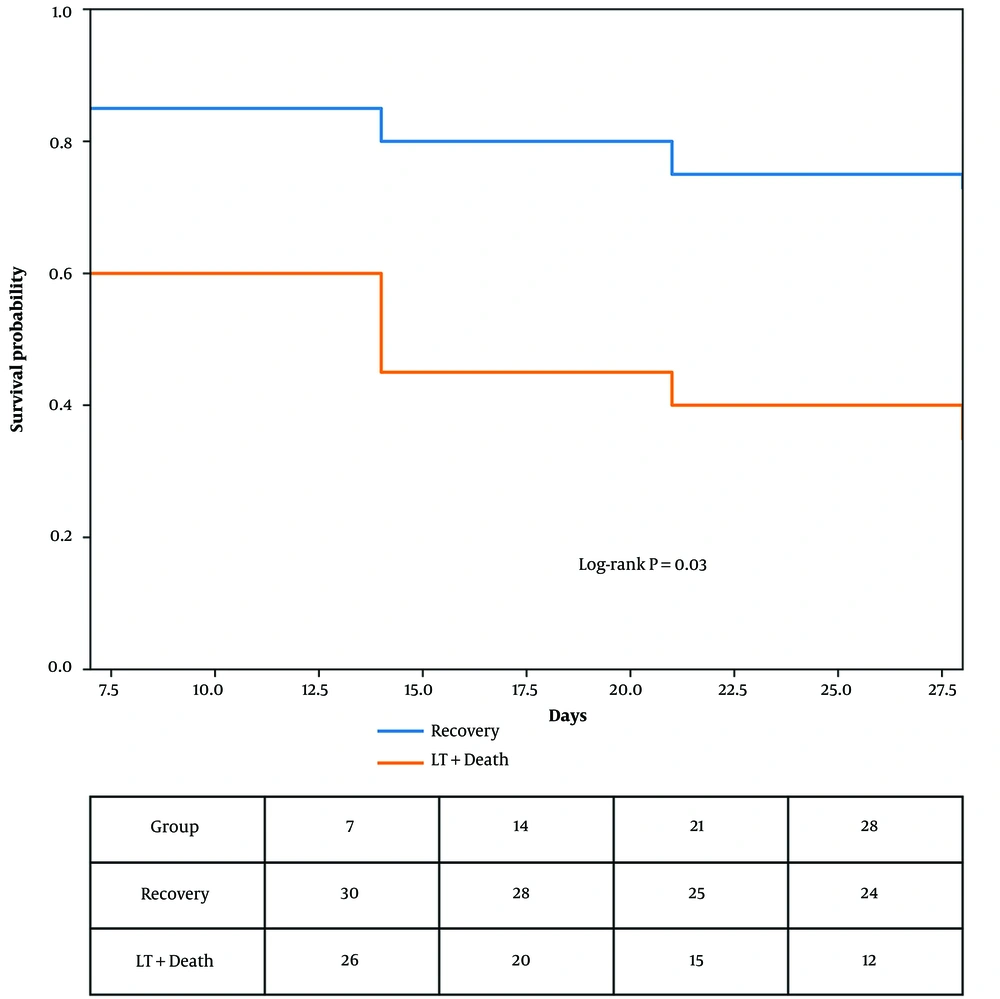
Figure 3.
Kaplan–Meier analysis of transplant‑free survival in ALF patients (overall 53.7%, log‑rank P = 0.03).
5. Discussion
This study is among the few to evaluate the prognostic significance of serum procalcitonin (PCT) in acute liver failure (ALF). Our findings demonstrate that maximum PCT levels (PCTmax), rather than admission PCT values, are significantly associated with poor outcomes—defined as liver transplantation or mortality. In line with this, dynamic indices (e.g., ΔPCT over 48 - 72 hours) also carried prognostic information, supporting the concept that trend‑based interpretation is superior to single measurements in ALF.
5.1. Comparison with Literature and Interpretation of Findings
Sugihara et al. (9)reported elevated PCT in ALF with an AUC of 0.74 and a 0.5 ng/mL cutoff yielding high specificity but low sensitivity (9). In contrast, we observed an optimal cutoff of 1.625 ng/mL with 84.2% sensitivity and 63.6% specificity, plausibly reflecting differences in disease severity, timing of sampling, and the use of combined extracorporeal therapy (TPE + CVVHDF), all of which affect PCT kinetics (15, 16). Rule et al. (2015) showed that PCT elevation in ALF is largely infection‑independent and instead reflects cellular injury and systemic inflammation (7); our rigorously infection‑free cohort and the moderate correlations between PCTmax and ALT/AST/INR/bilirubin are consistent with this interpretation (8). Together, these findings support the role of PCT as a surrogate of inflammatory burden and hepatic injury rather than a sole marker of infection in ALF. The proposed cutoff (1.625 ng/mL) requires external validation in independent multicenter cohorts before clinical implementation.
5.2. Pathophysiological Considerations and Confounding Factors
Systemic inflammation, endotoxemia, and hepatic dysfunction in ALF can trigger extra‑thyroidal PCT synthesis (notably in lung and intestinal tissues). Renal dysfunction further contributes by reducing PCT clearance, which is consistent with our observation of higher PCTmax in patients with AKI (5, 17). Extracorporeal therapies (TPE + CVVHDF) may partially clear PCT depending on membrane characteristics and adsorption, so dynamic metrics (PCTmax, ΔPCT) provide a more robust signal than a single time point (15, 16). Given our uniform use of TPE + CVVHDF, the absolute cutoff should be interpreted within this treatment context. Gut dysbiosis and bacterial translocation may also augment PCT generation even without overt infection, offering a mechanistic rationale for persistent elevations in ALF (18). Current international guidelines for acute liver failure management also emphasize the importance of early risk stratification and comprehensive clinical assessment in guiding treatment decisions and transplant referral (19, 20). Procalcitonin has also been shown in broader critical care settings to provide clinically meaningful diagnostic and prognostic information in systemic inflammatory states, supporting its relevance beyond overt bacterial infection (21).
5.3. Clinical Implications
Our results support PCTmax as an adjunctive early risk‑stratification biomarker in ALF. The PCT should complement rather than replace established scores (MELD, King’s College Criteria). The combined PCTmax + MELD model yielded higher discriminative performance (AUC = 0.801) than MELD alone, suggesting practical value for integrated decision‑support. Clinically, PCT > 1.5 ng/mL together with elevated MELD may flag patients who warrant earlier LT evaluation, whereas low or rapidly declining PCT may support expectant management in selected cases.
5.4. Comparison with Hepatectomy Controls
PCT elevations occur after major hepatectomy due to surgical stress and transient inflammation, but these increases are typically modest and short‑lived (10-12). By contrast, our ALF cohort demonstrated markedly higher and sustained PCT, mirroring the profound systemic inflammation of fulminant hepatic failure. This contrast supports the pathophysiological specificity of PCT elevation for ALF‑related injury rather than surgical factors alone. Prior associations between PCT and post‑hepatectomy liver dysfunction are compatible with our findings (19). Hepatectomy controls may not fully represent other non‑ALF acute hepatic injuries, limiting generalizability. This interpretation is also consistent with meta-analytic evidence showing that procalcitonin retains useful clinical performance as an inflammatory biomarker across heterogeneous critically ill populations (23).
5.5. Strengths and Limitations
Strengths include: (1) Comparison of two clinically relevant high‑risk cohorts (ALF vs. hepatectomy); (2) rigorous infection exclusion and standardized extracorporeal support; (3) evaluation of dynamic PCT (minimum, maximum, ΔPCT); (4) multivariable modeling showing independent prognostic value; and (5) integration with established scores.
Limitations include: (1) A single‑center, retrospective design; (2) a limited sample size and especially a very low number of transplant events (n = 5), which constrains statistical power and the precision of effect estimates; (3) session‑to‑session variability in extracorporeal therapy parameters despite a consistent protocol; (4) the possibility of subclinical bacterial translocation, which cannot be entirely excluded; (5) limited power for etiological subgroup analyses; and (6) hepatectomy controls may not fully represent other non‑ALF acute hepatic injuries, limiting generalizability. The limited number of transplant events (n = 5) constrains statistical power and the precision of effect estimates. Results should therefore be interpreted cautiously and considered hypothesis‑generating. Finally, PCT is not a standalone biomarker: it rises in other inflammatory states and may be affected by extracorporeal clearance; thus, it should be interpreted in combination with clinical scoring systems. This cautious multimodal approach is in line with contemporary acute liver failure management reviews emphasizing the need to integrate adjunctive biomarkers with established clinical decision tools (24).
In parallel, the broader critical care literature increasingly supports the incorporation of inflammatory biomarkers into multimodal risk-stratification frameworks rather than relying on single markers in isolation (25).
5.6. Future Research Directions
Future work should: (1) Test composite prognostic models that integrate PCT with biomarkers such as IL‑6, CXCL9, CXCL10, and GZMB; (2) quantify the impact of different extracorporeal modalities/membranes on PCT kinetics; (3) validate the prognostic utility of ΔPCT in larger ALF cohorts; and (4) externally validate the 1.625 ng/mL cutoff and the PCT–MELD model in prospective multicenter studies (26, 27).
5.7. Conclusions
Serum procalcitonin (PCT) levels are associated with prognosis in acute liver failure (ALF). While admission PCT provides limited prognostic information, peak PCT (PCTmax) is an independent predictor of poor outcomes—particularly when interpreted alongside established scoring systems such as MELD. Accordingly, PCT should not be used as a standalone marker but rather as an adjunctive tool integrated with MELD, the King’s College Criteria, and comprehensive clinical assessment.
Monitoring dynamic PCT trends—especially after combined extracorporeal therapy (TPE + CVVHDF)—may aid timely transplant decision‑making and early risk stratification. The proposed cutoff (1.625 ng/mL) and the PCT–MELD approach warrant external validation in independent cohorts; given the limited number of transplant events, the present findings should be regarded as hypothesis‑generating and interpreted with appropriate caution. Overall, PCT measurement is a practical and accessible adjunct that can contribute meaningfully to a comprehensive prognostic evaluation in ALF.