
1. Background
Hepatitis A virus (HAV) has a single-strand positive sense RNA in its nucleocapsid and is a member of Picornavaridae that belongs to the Hepatovirus genus. HAV infection is the most common form of acute viral hepatitis worldwide. It is estimated that 1.5 million infections occur annually (1, 2). HAV is thermostable and extremely resistant to environmental stress such as heat and chemical agents (2).
An infection with HAV provides lifelong immunity and it can cause fulminant hepatic failure and death. Nonetheless, the fatality rate in HAV infections is very low (3). One study conducted in Iran in 1980 indicated that 95% of the blood donors were positive for anti-HAV IgG (4). Therefore, in Iran, vaccination is not necessary (5). Nevertheless, in recent decades, health status has improved in Iran even in distant rural areas leading to a predictable increase in the percentage of adults susceptible to HAV (6). Primary symptoms include non-specific symptoms with a variable mixture of complaints such as fever, malaise, weakness, anorexia, nausea, and vomiting, and the symptoms decrease with the onset of jaundice though eating disorder, uncomfortableness, and weakness might persist or increase transiently. Jaundice lasts for many weeks until the person is a convalescent. The highest infectivity happens within virtually fourteen days before the onset of jaundice or elevation of liver catalyst levels once the concentration of the virus within the stool is highest. At the point when jaundice shows up, the viral population in the stool decreases and most patients become noninfectious in the subsequent several weeks (1, 7). In the acute phase of the disease, when the virus appears in the bloodstream, it is possible to be transferred through blood and blood products (2). During the acute phase, HAV-RNA can be detected in the blood of most patients. In recent years, some cases of hepatitis A transmission from blood transfusion have been reported. In 2012, an uncommon instance of transfusion transmission of hepatitis A infection to two patients with hematological illness was accounted for (8). If the blood donor is infected with the virus, plasma products may remain infected after the pasteurization process because the virus is non-enveloped and very resistant to temperature.
This study was done to determine the current seroprevalence of HAV and the viremic phase of hepatitis A among blood donors in Golestan province.
2. Methods
2.1. Samples
In this cross-sectional study, participants were selected randomly from volunteer blood donors in Golestan province. The study design was approved by the local Ethics Committee of the high institute for research and education in transfusion medicine. All subjects signed an informed consent form before being enrolled in the study. The Cochran formula was used to estimate the sample size needed (9).
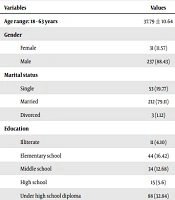
According to this formula, a sample of 384 people was needed. In this study, 400 participants were evaluated. The sera of the 400 volunteer blood donors in a period of one year from September 2016 to September 2017 were collected. Negative sera for HIV-Ab, HBV-S Ag, and HCV-Ab were selected randomly and used in this study (Table 1).
2.2. ELISA Method
Detecting total anti-HAV antibodies (IgG+IgM) was carried out by using anti-HAV enzyme-linked immunosorbent assays (ELISA) kits (competitive enzyme immunoassay) according to the manufacturer instructions. IgM anti-HAV was detected by ELISA kits (capture enzyme immune assay) (DIAPRO, Diagnostic Bioprobes, Milano, Italy) according to the manufacturer instructions.
2.3. RNA Extraction
High Pure Viral Nucleic Acid kits (Roche, Mannheim, Germany) were used to extract HAV-RNA from serum samples. Then, cDNA was synthesized from the extracted RNA using First strand cDNA Synthetic Kits (Roche, Mannheim, Germany). The components used in the RT-PCR method were as follows: 2 µL of 10 X reaction buffer, 4 µL of 25 mM MgCl2, 2 µL of 25 mM deoxynucleoside triphosphate, 1 µL of 20 U RNAase inhibitor, 1.7 µL of each 10 µm forward and reverse primers, 0.8 µL of 20-unit reverse transcriptase, and 1.8 µL deionized water. Thereafter, 5 µL of extracted nucleic acid was added to 15 µL RT-PCR mixture and reverse transcription was carried out for 1 h at 42°C.
2.4. Nested RT-PCR
Nested RT-PCR was used to detect HAV-RNA. The cDNA was amplified by specific primers; HHA1 was used as a forward primer (5' TGCAAATTAYAAYCAYTCTGATGA 3') and HHA2 (5' TTTCTGTCCATTTYTCATCATTC 3') as a reversed primer in the first-round PCR. The following components were mixed to make the PCR mixture: 2 µL of 10 X PCR Buffer, 1.6 µL of 25 mM MgCl2, 0.4 µL of 10 mM dNTP, 0.2 µL of each of 10 µm primers, 0.3 µL of 5-unit Taq polymerase, and 10.3 µL deionized water. Thereafter, 15 µL of the PCR mixture was added to 5µL of cDNA of the HAV genome. PCR amplification was performed for 30 cycles of denaturation for 1 minute at 95°C, annealing for 1 minute at 42°C, and extension for 1 minute at 72°C. For the second-round amplification, 2 µL of the reaction mixture was added to a new microtube of 18 µL of PCR mixture containing 10 µm of each of nested primers HHA3 (5' TTYAGTTGYTAYTTGTCTGT 3') as the forward primer and HHA4 (5' TCAAGAGTCCACACACTTC 3') at the reversed primer. For a new PCR amplification, the cycling was done as the same procedure.
2.5. Gel Electrophoresis
The PCR products were analyzed by agarose gel electrophoresis using DNA green viewer as a stain and photographing under UV light. In each run, a negative serum sample and an HAV-RNA positive serum sample as a positive control were used for extraction during testing.
2.6. Statistical Analysis
All data were analyzed by statistical software SPSS version 23. The Chi-square test was used to examine the relationship between two different factors. P < 0.05 was considered statistically significant.
3. Results
About 400 blood donors took part in this study. 91% of the 400 samples had total anti-hepatitis A virus antibody (Figure 1). No positive sample was found for IgM-Anti HAV in 400 (100%) of the serum samples. In addition, all samples were negative for the presence of HAV-RNA (Figure 2). There was no significant relationship between age, gender, level of education, and occupation of donors and the seroprevalence of HAV.
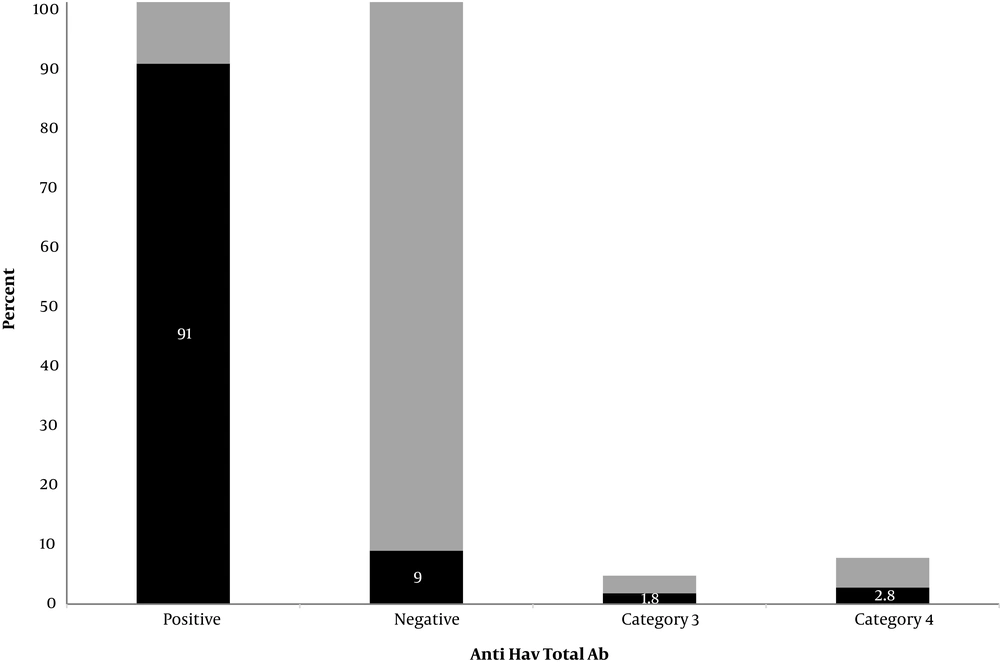
Figure 1.
The prevalence of anti-HAV antibodies in volunteer blood donors: 91% Positive, 9% Negative
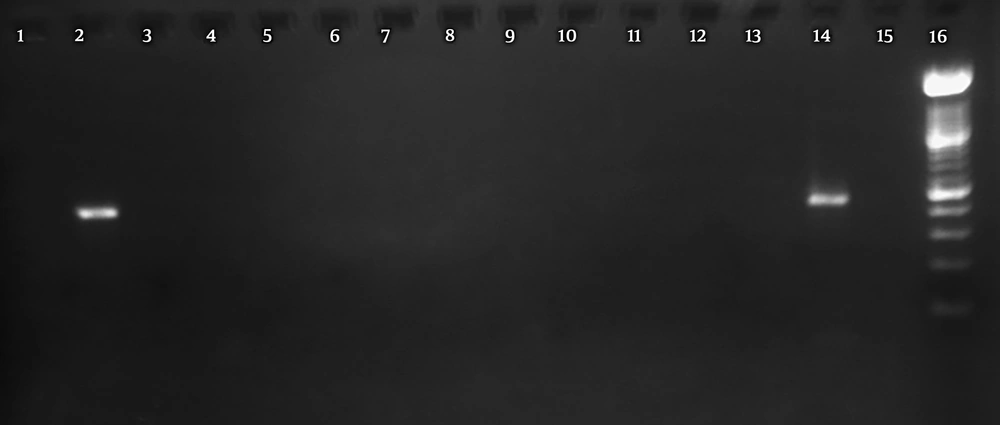
Figure 2.
Electrophoresis of an agarose gel of RT nested-PCR product of HAV. Lanes 3 - 13, PCR product of blood donors' serum samples. Lanes 1 and 15, negative control Lanes 2 and 14 Positive controls with 436 base pair lengths. Lane 16, DNA marker (100 bp ladder, Roche)
4. Discussion
HAV is extremely infectious and essentially transmitted through the fecal-oral route (1). A few investigations have demonstrated that HAV can be transmitted by blood transfusion when infections are in the circulatory system of asymptomatic HAV-infected blood donors (10). In many people, IgM anti-HAV becomes detectable a few days before the onset of symptoms and it can persevere for up to a half year after contamination. Immunoglobulin G (IgG) anti-HAV, which appears in the early phase of the infection course, stays discernible for the individual's lifetime and gives long-lasting immunity against the infection (2). The seroprevalence of anti-HAV is closely related to the hygiene status of the community and the safety of water and food (11). Moreover, high anti-HAV seroprevalence rates have been reported in developing countries (12). HAV is exceedingly pervasive in the Iranian populace. Previous reports, mostly from volunteer blood donors, demonstrated a rate of 95% or higher positivity for HAV antibodies in adults (4, 13). Nearly 20 years later, the prevalence of HAV was reported to be slightly less around 86% (2). Most people that are susceptible to the virus are schoolchildren and young adolescents. HAV is usually disseminated through sexual contact, the fecal-oral route within the household (22% - 26%), contact with daycare attendees or employees (14% - 16%), traveling abroad (5%), and ingestion of contaminated food and water (5%). However, in almost half of the instances, the route of HAV infection is unknown (14). Nowadays, because of the increasing level of public health, the age of infection is changing from childhood to adolescence.
As a result, adults in the community are at risk and a necessary proceeding must be taken (4). This suggests sensitive individuals are expanding and need measures to avoid being contaminated. Overall, inoculation for HAV is not suggested in countries where new contaminations are restricted to children. In contrast, when an infection occurs in adulthood, it can cause serious complications. The rate of jaundice and fulminant liver failure is significantly higher. Subsequently, in countries where a critical number of adults have no immunity, the expanded mortality that happens with HAV among adults may justify immunization, particularly when traveling to an endemic area and the higher treat is generally presented to young children and more seasoned adults with basic unending liver illness (14). In this study, the prevalence of total anti-HAV antibodies (IgG+IgM) was 91% that revealed the majority of blood donors had immunity to HAV and only 9% of them did not have exposures to HAV. In addition, the prevalence of hepatitis A increased with age and about 67.5% of the blood donors were at the age group of 26 - 45 years. A study in Jahrom city showed that HAV seroprevalence was 28.3% among 20 - 30-year-old people and 95% of them were in older age groups over 50 (15). In another study in Tehran conducted among 1018 children in 2002, the seroprevalence of hepatitis A was 22.3% (16).
In neighboring countries, Iraq and Turkey, the prevalence of HAV was reported to be 96.4% at age ≥ 20 years and 25.8% at age ≤ 6, respectively (17, 18). In other countries such as Syria, the seroprevalence of HAV was 50% among children between 5 and 15 years old and reached 95% between 11 and 15 years old (19, 20). The HAV outbreak in rural areas of Egypt was close to 100% in 2006. The pollution of drinking water with sewage was the main source of HAV transmission in the villages of Egypt (Table 2) (21). In a comparison, the seroprevalence of HAV was higher in blood donors of Iran (91%) than in those of China (47.7%) and Australia (61%) (22, 23).
Table 1.
General Characteristics of the Study Participants
| Variable | No. (%) |
|---|---|
| Gender | |
| Female | 130 (32.4) |
| Male | 270 (67.6) |
| Material status | |
| Single | 92 (23) |
| Married | 308 (77) |
| Level of education | |
| Illiterate | 8 (2) |
| High school graduate | 272 (68) |
| Associate degree | 100 (25) |
| Bachelor degree or higher | 20 (5) |
| Age | |
| 18 - 25 | 64 (16) |
| 26 - 35 | 156 (38.8) |
| 36 - 45 | 114 (28.7) |
| 46 - 55 | 53 (13.1) |
| 56 - 65 | 13 (3.4) |
| Jobs | |
| Housekeeper | 27 (6.9) |
| Student | 46 (11.5) |
| Self-employed | 210 (52.3) |
| Employee | 95 (23.9) |
| Unknown | 22 (5.4) |
Table 2.
Global Prevalence of Hepatitis Aa
| Country | Year | Participants / Number | Age | HAV (IgG+IgM), % | PCR | Reference |
|---|---|---|---|---|---|---|
| China | 2015 | Blood donors / 728 | 18 - 57 | 47.7 | 0% | (20) |
| Turkey (urban) | 2002 | Children / 210 | ≤ 6 | 25.8 | ND | (16) |
| Turkey (rural) | 2002 | Children / 210 | ≤ 6 | 67.8 | ND | (13) |
| Western Turkey | 2002 | Children / 711 | 2 - 16 | 44 | ND | (13) |
| Iraq | 2011 | General population / 2975 | ≥ 20 | 96.4 (IgG) | ND | (17) |
| Rural areas of Egypt | 2006 | General population / 1715 | 2 - 77 | 100 (IgG), 0.2 (IgM) | ND | (22) |
| Marrakech | 2009 | Children / 150 | ≤ 14 | 51 (IgG) | ND | (23) |
| Tunisia | 2005 | General population / 2400 | 5 - 20 | 60 | ND | (24) |
| Syria | 2000 | General population / 396 | 11 - 15 | 95 (IgG) | ND | (18) |
| Syria | 2000 | General population / 396 | 5 - 15 | 50 (IgG) | ND | (19) |
| Australia | 1997 | Prisoners / 2175 | ND | 45 | ND | (21) |
| Australia | 1997 | Blood donors / 2999 | ND | 30 | ND | (21) |
a ND, no data.
The prevalence of HAV in the general population was lower in Tehran (85%) than in other provinces such as Golestan (99%) and Hormozgan (96%) that can be due to the sanitation, treatment, and wastewater and waste disposal systems in Tehran (Table 3) (18).
Table 3.
Prevalence of Hepatitis A in Irana
| City | Year | Participants / Number | Age | HAV AB (IgG+IgM), % | PCR | Reference |
|---|---|---|---|---|---|---|
| Tehran | 2010 | General population / 791 | 35 ± 13 | 85 | ND | (18) |
| Tehran | 2016 | Soldiers / 1554 | 21.2 ± 1.2 | 80.3 | ND | (24) |
| Golestan | 2010 | General population / 625 | 40 ± 12 | 99 | ND | (18) |
| Hormozgan | 2010 | General population / 453 | 33 ± 11 | 96 | ND | (18) |
| Tehran | 2008 | Blood donors / 407 | 18 - 60 | 86 (IgG+IgM), 1 (IgM) | 0% | (2) |
| Qazvin | 2011 | Blood donors / 351 | 18 - 37 | 94.9 | ND | (14) |
| Shiraz | 2015 | School children / 617 | ≥ 16 | 95.3 (IgG+IgM), 0.9 (IgM) | ND | - |
| Tehran | 2002 | Children / 1018 | ND | 22.3 (IgG) | ND | (16) |
| Golestan | 2018 | Blood donors / 400 | 18 - 60 | 91 (IgG+IgM), 1 (IgM) | 0% | Present study |
a ND, no data.
The predominance of HAV in blood donors in our research was 91% positive for total anti HAV antibodies; also, none of the blood donors was positive for anti-HAV IgM and HAV-RNA. Overall, due to the high prevalence of anti-HAV antibodies in the general population, donor screening for anti-HAV antibodies is not recommended at the centers of blood transfusion in the world. On the other hand, in the manufacturing of plasma products, the viral inactivation process is done on the plasma pools but since HAV is a non-enveloped, heat-stable virus, its inactivation is not complete; therefore, performing NAT for removal of HAV-RNA samples is done in plasma industry to remove all donation samples with titers of more than 104 genome equivalents per milliliter (geq/mL). In addition, the presence of anti-HAV antibodies in blood donors can neutralize HAV and reduce its titer in plasma pools. However, the main route of transmission is fecal-oral but there is a possibility of HAV acute infection among blood donors that can cause transfusion transmission of HAV by whole blood, red blood cells, platelet concentrates, and fresh-frozen plasma. Therefore, antibody-screening tests for HAV or HAV vaccination is recommended for immunocompromised patients, bone marrow or solid organ transplantation candidates, and chronically infected HCV and HBV patients.
4.1. Conclusion
This investigation demonstrated that in spite of the fact that in Iran, the study of the transmission of HAV contamination might be changed due to enhanced social clean conditions and improved access to enhanced water sources in the ongoing years, the seroprevalence is still high. The proper donor selection causes people who have active viruses in the blood sample are excluded from blood donation.