1. Background
Intestinal cancer (IC) refers to cancer of the large intestine, including the colon, rectum, and rectosigmoid junction, and is the most prevalent cancer of the digestive system. It is notable for its high global prevalence. IC ranks third, with 1 900 000 new cases (9.6% of total cancer cases), after lung (12.4%) and breast cancer (11.6%). It ranks second in cancer-related deaths, with 900 000 deaths (9.3%) according to the WHO. Incidence differs markedly by region; it is higher in Australia, New Zealand, and North America (up to 49.9 per 100 000 individuals for Italy), whereas it increases moderately in Asia, Africa, and South America (16.4 per 100 000 individuals for Poland) (1). In Morocco, based on the Greater Casablanca Cancer Registry Data, intestinal cancer ranks highly, accounting for 52.5% of digestive cancer and 10% of cancer-related deaths. The incidence of IC in Greater Casablanca has increased markedly, with an average of 6.7/100 000 individuals (2004 - 2007 registry), 8.1/100 000 individuals (2008 - 2012 registry), 9.5/100 000 individuals (2013 - 2017 registry), and 11.2/100 000 individuals (2018 - 2021 registry) for both sexes. This cancer occurs relatively early in life, with an average age between 60 and 64 years, and a higher incidence in men (54.7% vs 49.8%) (2). Modifiable predisposing factors include obesity, diabetes, tobacco use, and an urban lifestyle due to adherence to Western habits (3-5). Given its worldwide and Moroccan prevalence and its substantial impact on cancer-related mortality due to recurrent progression and its specific epidemiological profile, intestinal cancer is a high priority in preventive research.
Dietary factors are important. Consumption of fruits (reducing risk up to 57%), vegetables, fish (exhibits considerable protective effect [OR = 0.3]), and coffee (reducing risk up to 25%) is beneficial, whereas high consumption of red meat (OR = 4.4 for meat eaten 4 - 7 times/week) and low consumption of fruits and vegetables are significant risk factors (6-7). Morocco is currently undergoing a profound nutritional transition, with the gradual abandonment of the traditional Mediterranean diet in favor of a Western diet characterized by high saturated fat intake and low fiber and protective nutrients, creating favorable conditions for IC development and thereby contributing, in part, to the increase in incidence reported in epidemiological surveys (8).
Effective preventive nutrition for IC remains insufficiently explored, as research related to diagnosis is limited. The study by Abdul Rahman et al. (9) addresses upstream preventive prediction by using artificial intelligence to provide predictive analysis and detection of individuals most vulnerable to cancer based on their diet. The study by Salmani et al. (10) addresses management after testing positive by providing an appropriate framework for those who already have the disease. However, current digital methods for prevention of this cancer rely on standardized dietary information, which is not appropriate for the specific characteristics of the Moroccan population. In addition, standard artificial intelligence approaches have limitations in transparency and interpretability because they operate as 'black boxes', and AI decisions are not readily interpretable (11). Explainable artificial intelligence (XAI) integrates approaches and methods that make AI decisions interpretable and justifiable to humans by incorporating transparency and accountability (12). Among the techniques used in this context, SHAP quantifies the effect of each element used in the prediction process (13). Another method used is LIME, which provides interpretable analyses for comparative assessment across different models (14).
Machine learning approaches for IC prediction have evolved considerably in recent years. Sun et al. (15) used several machine learning algorithms, such as XGBoost, Random Forest (RF), Logistic Regression (LR), and Support Vector Machine (SVM), on a cohort of 1 918 cases of early IC. The study incorporated SHAP to identify key risk factors, including digestive and immune system disorders, but was limited to clinical data without detailed nutritional integration. Wu et al. (16) applied Random Forest models to identify malnutrition in 4 487 patients with IC, with an AUC of 0.830, sensitivity of 0.835, and specificity of 0.742. Wang et al. (17) applied an XGBoost model to a population of 524 patients based only on clinical data. Their model showed acceptable performance with an AUC between 0.78 and 0.85, but it remains limited because it applies only to IC, and nutritional factors are not considered. Buk Cardoso et al. (18) compared several models, including neural networks, RF, and SVM, in more than 41 000 patients and obtained an AUC of 0.86. However, the study was based solely on Brazilian clinical data, without dietary variables, which limits risk personalization (Table 1).
Table 1.
Comparative Table of Related Works in the Literature
| Studies | Model | Dataset | Features | Performance |
|---|---|---|---|---|
| Abdul Rahman et al. (9) | ANN | n = 109 343 | Dietary (global) | AUC = 0.83 |
| Sun et al. (15) | XGBoost, RF, LR, SVM | n = 1 358 CC + 560 RC | Clinical (EHR, digestive disorders) | AUC = 0.829 (CC), 0.771 - 0.727 |
| Wu et al. (16) | RF | n = 4 487 | Clinical + nutritional (GLIM, NRS-2002) | AUC = 0.830, Sens = 0.835, Spec = 0.742 |
| Wang et al. (17) | XGBoost | n = 524 | Clinical (age, sex, diabetes, N stage) | AUC = 0.786(1y), 0.848(3y), 0.796(5y) |
| Buk Cardoso et al. (18) | NN, RF, SVM | n = 41 000 | Clinical (stage, treatments) | Acc = 77%, AUC = 0.86 |
2. Objectives
Existing studies have focused mainly on clinical or generic information, with limited consideration of lifestyle factors, even though these factors play an important role in the prevention of IC [Sun et al. (15), Wang et al. (17)]. Furthermore, geographic and cultural biases persist because the models are developed primarily using data from Western populations and are therefore not readily transferable to other settings. Finally, there appears to be an overreliance on “black box” artificial intelligence models, which limits interpretability in clinical settings.
This study aimed to develop a novel solution that integrates a transformer architecture with explainable predictions using the SHAP algorithm, together with nutritional personalization, to optimize prevention and care for patients with IC, tailored to the Moroccan context, including an automated menu suggestion tool. This paper is organized into four main sections. The second section describes the methodology used for data processing and the algorithmic architecture in greater detail. The third section presents the findings related to predictions, and the fourth section draws conclusions regarding the implications for the public health situation in Morocco.
3. Methods
This retrospective, observational, epidemiological case-control study used a dietary questionnaire for data collection. The research aimed to promote a healthy, personalized diet based on individual needs, with recommendations for improvement derived from in-depth analysis of a dataset using explainable artificial intelligence tools. The research is based on a Moroccan food database that reflects the actual diets of this population.
3.1. Dataset Collection
3.1.1. Participants
Data were collected using standardized assessment grids inspired by the Diet History Questionnaire (DHQ) proposed by the National Institutes of Health (19), from a total of 1 135 participants, including 493 cases of IC and 642 controls without oncological pathology, between January 2025 and November 2025. In this study, the term “intestinal cancer” refers specifically to malignant neoplasms involving the large intestine, including the colon, rectum, and rectosigmoid junction. All cases were histologically confirmed through colonoscopy biopsy and pathological examination.
Cases consisted of patients with a histologically confirmed diagnosis of IC, diagnosed within the previous 12 months, and registered at the Mohammed VI Marrakech University Hospital (Departments of Oncology, Pathology, and Gastroenterology). Eligible patients were recruited from the university hospital’s digital information system. Controls were identified in the same region (Marrakech-Safi) among the general population during the same study period, with no personal history of cancer. They were recruited during routine outpatient visits at the Mohammed VI University Hospital and from the general community via direct and electronic questionnaires. Matching was defined as frequency matching rather than one-to-one individual matching, whereby controls were selected to reflect the overall distribution of cases by age, sex, and place of residence, ensuring comparability and minimizing selection bias. The inclusion and exclusion criteria were carefully defined for both cases and controls. Both groups were required to be over 18 years of age, have resided in the Marrakech-Safi region for 10 years at the time of the study, be able to understand and answer the questionnaire, and provide consent. Participants must not have a serious illness that could affect their diet or require a special diet. Participants also must not have a mental illness and must not be pregnant or breastfeeding. Participants were excluded if they refused to participate. The most specific criteria for both groups are specified in Table 2. The mixed recruitment strategy, combining hospital outpatient consultations and community-based recruitment, was adopted to reduce the selection bias typically associated with exclusively hospital-based case-control studies and to improve the representativeness of controls relative to the source population.
Table 2.
Inclusion and Exclusion Criteria for Selecting Case and Control Participants
| Participant | Inclusion Criteria | Exclusion Criteria |
|---|---|---|
| Cases | Histological confirmation of IC (colon, rectum, or rectosigmoid junction); recent diagnosis (< 12 months) | Presence of metastases; advanced cancerous lesions |
| Controls | No personal history of cancer (past or current); frequency matching by age, sex, and area of residence | Severe digestive lesions; family history suggestive of IC |
Among the 493 confirmed cases, the majority involved the colon (58.3%), followed by the rectum (28.7%), the rectosigmoid junction (11.0%), and other or unspecified sites (2.0%), as detailed in Table 3.
Table 3.
Distribution of Intestinal Cancer Cases by Anatomical Site
| Cancer Site | No. (%) |
|---|---|
| Colon | 287 (58.3) |
| Rectum | 141 (28.7) |
| Rectosigmoid | 54 (11.0) |
| Other | 11 (2.0) |
Dietary and lifestyle data were collected at the time of study enrollment, which coincided with the period of initial diagnosis and before the initiation of oncological treatment. Participants were asked to report their habitual dietary patterns and lifestyle behaviors in the period preceding their diagnosis. This approach was adopted to capture pre-diagnosis exposure data and minimize the risk of reverse causation, as dietary habits may change substantially following diagnosis and treatment initiation.
3.1.2. Data Collection
The dataset includes 39 variables, comprising demographic data such as gender, age, body mass index (BMI), and place of residence. It also includes socioeconomic information such as education level and monthly income. Medical history was also considered, including the presence of polyps, inflammatory diseases, diabetes, hypertension, and a family history of cancer. Lifestyle data included smoking status, alcohol consumption, level of physical activity, and sleep quality. Finally, dietary habits were detailed in terms of consumption of red meat, processed meat, fish, poultry, vegetables, fruit, legumes, whole grains, and dairy products, as well as the frequency of consumption of fast food and fried foods (Table 4).
Table 4.
Dataset Characteristics a
| Variables | Cases (n = 493) | Controls (n = 642) |
|---|---|---|
| Mean Age (y) | 60.3 ± 6.2 | 55.9 ± 6.1 |
| Mean BMI (kg/m2) | 25.8 ± 1.8 | 24.2 ± 2.0 |
| Men (%) | 55.4 | 48.3 |
| History of Polyps (%) | 65.0 | 23.8 |
| Hypertension (%) | 59.2 | 45.2 |
| Diabetes (%) | 52.7 | 38.9 |
| Current Smoker (%) | 18.7 | 10.0 |
| Red Meat Frequency (per week) | 2.9 ± 1.5 | 1.7 ± 1.3 |
| Processed Meat Frequency (per wk) | 2.4 ± 1.4 | 1.5 ± 1.3 |
| Vegetable Frequency (per wk) | 1.9 ± 1.3 | 3.2 ± 1.4 |
| Fruit Frequency (per wk) | 2.1 ± 1.3 | 3.3 ± 1.3 |
| Fast-Food Frequency (per wk) | 2.3 ± 1.3 | 1.7 ± 1.3 |
a Values are expressed as mean ± SD unless indicated. Controls were selected using frequency matching to reproduce the distribution of cases by age, sex, and area of residence
The evaluation grid was developed in French and Arabic, and the consent form was provided in digital or paper form to patients with IC and patients admitted to Marrakech University Hospital. Written informed consent forms were signed and approved by all study participants. According to Table 4, the characteristics of the participants and control subjects show marked differences. Participants with IC are older, have a higher BMI, and are more frequently male. In terms of diet, cases consume more red meat, processed meat, and fast food, whereas controls consume more fish, fruit, and vegetables than cases. Significant differences in medical history were also observed between the two groups; diabetes, hypertension, and the presence of polyps are more common in cases than in controls. Smoking and alcohol consumption are also more prevalent in cases than in controls.
3.1.3. Food Database
The nutritional database comprises 104 traditional Moroccan foods and dishes, grouped into 3 categories depending on their value regarding IC: food with protective value, 45 foods; food with non-significant value, 36 foods; and food of risk value, 23 foods. The food database contains macronutrients including protein content, fat content, carb content, fiber content, and caloric value. It also contains several minerals of crucial importance to the human body: Iron, magnesium, phosphorus, zinc, and selenium, as well as other essential nutrients such as sodium and potassium. The vitamins listed include vitamins B1, B2, B3, B9, vitamins E and K, and vitamin C. The database also contains information on the quantity and rate at which the food must and can be consumed. Nutritional ratios calculated for the protein-caloric and fiber-carb ratios enable more precise analysis of the nutritional value of each food. The food database and recommendation logic were developed and validated in collaboration with certified nutritionists and oncologists. Their expertise informed the categorization of foods into protective, neutral, and risk groups, the definition of nutritional targets, and the adaptation of menus for specific clinical conditions, including patients undergoing chemotherapy, radiotherapy, or surgery, as well as those presenting with comorbidities such as diabetes, hypertension, diarrhea, nausea, and fever.
3.2. Data Preprocessing
Data preprocessing incorporated several key steps to ensure dataset quality. These steps included balancing the dataset with respect to classes, normalizing and standardizing features, and appropriately handling missing values. The dataset was partitioned into training (70%), validation (15%), and test (15%) sets using stratified splitting to preserve the case-control ratio across all subsets. A fixed random seed of 42 was applied throughout to ensure full reproducibility. All hyperparameter tuning and model selection decisions were made exclusively using training and validation data. The test set was held out until final evaluation and was never used during model development or tuning. To prevent data leakage, preprocessing operations, including normalization and encoding, were fitted only on the training data and subsequently applied to the validation and test sets. Hyperparameter details are provided in Table 5. Missing values were handled through median imputation applied independently to each feature. Categorical variables were represented as ordinal integers before analysis. Continuous features were standardized using z-score normalization (StandardScaler), fitted exclusively on the training set and subsequently applied to the validation and test sets to prevent data leakage. No additional feature engineering was performed beyond these steps.
Table 5.
Hyperparameter Configuration of the Transformer Model and Comparator Models
| Hyperparameters | Transformer | LR | RF | XGBoost |
|---|---|---|---|---|
| Blocks/Estimators | 3 | — | 100 | 100 |
| Attention heads | 8 | — | — | — |
| Embedding dimension | 128 | — | — | — |
| Feed-forward dimension | 256 | — | — | — |
| Dropout | 0.2 | — | — | — |
| Learning rate | 0.0001 | — | — | 0.3 |
| Batch size | 32 | — | — | — |
| Max epochs | 200 | — | — | — |
| Early stopping patience | 25 | — | — | — |
| Early stopping monitor | valauc | — | — | — |
| Optimizer | Adam | — | — | — |
| Regularization | Dropout + L2 | L2 (C = 1.0) | — | — |
| Max depth | — | — | None | 6 |
Comparator models were trained using scikit-learn and XGBoost hyperparameters without additional tuning to provide a baseline comparison.
Among the 39 variables included in the model, 6 variables were identified as potentially reflecting consequences of cancer diagnosis or clinical workup rather than true pre-diagnostic exposures: polyp history, duration of polyps, inflammatory disease, diabetes, duration of diabetes, and hypertension. These variables were retained in the main model, as they were reported by participants as pre-existing conditions before diagnosis and treatment initiation. Their potential influence on model performance was assessed through a dedicated sensitivity analysis described below.
3.3. Model Architecture
3.3.1. Transformer Block
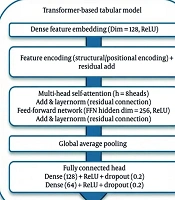
The model used 39 clinical, demographic, metabolic, and nutritional features. The main advantages of the Transformer model are its ability to identify intricate relationships between features through the self-attention mechanism and to provide a framework that supports XAI techniques such as SHAP. Figure 1 describes the full architecture of the model.
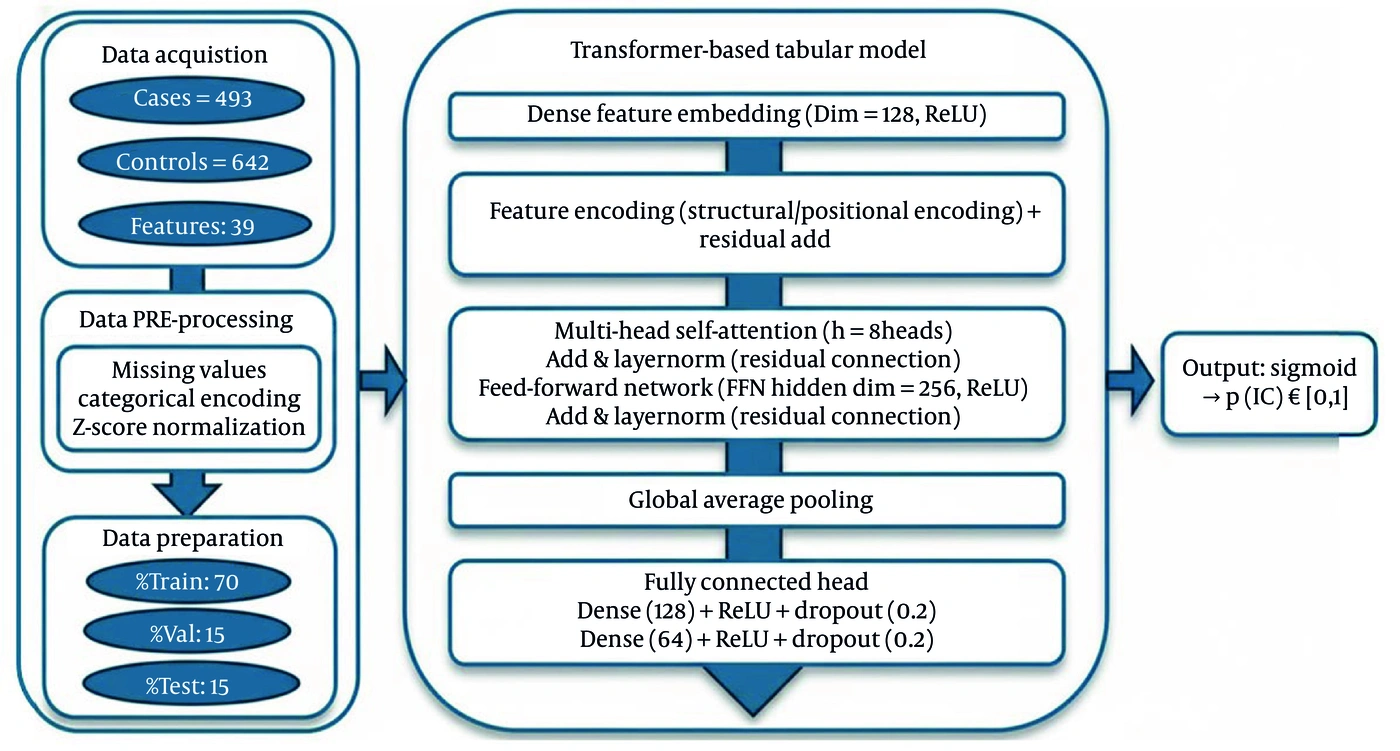
Figure 1.
Complete architecture of the proposed Model for IC risk prevention
To ensure adequate representation of the tabular data, each feature is first projected through a Dense layer (128-dimensional embedding), followed by positional embeddings that enable the model to capture the internal representation of the variables. Additionally, because each continuous feature was standardized through z-scoring using only training-set data, information that could contribute to overfitting was avoided (20). The core model architecture comprises three components:
Multi-Head Self-attention Mechanism:
Residual connection and layer normalization:
Feed-Forward Network (FFN) (the Position-Wise Feed-Forward Neural Network):
Second residual connection and normalization:
Latent features are aggregated using Global Average Pooling. Two fully connected layers are applied to the features, with 128 and 64 neurons, respectively, followed by ReLU activation and dropout of 0.2 for both (20). The output layer consists of a single neuron using a sigmoid activation function to produce the IC risk probability for a patient:
where Q, K, and V denote the query, key, and value matrices, dk is the key dimension, σ (·) is the sigmoid activation function, and W1, W2, Wout with b1, b2, bout are learnable parameters.
All experiments were conducted in Google Colab environments with GPU support (Tesla T4).
3.4. Model Interpretability with SHAP
SHAP is rooted in the Shapley values of cooperative game theory (13). Each feature in the model is treated as a “player” in the game that produces the output. SHAP helps estimate the approximate contribution of a variable to the model output. As in the SHAP explanation form, the value of feature i in the SHAP explanation for a predicted value of the function f(x) follows:
In this formula, ∅I represents the SHAP value of feature i, F represents the set of all features, and S denotes the set of all feature subsets, excluding feature i.
3.4.1. Stability Analysis
Stability was assessed using the coefficient of variation, calculated as follows:
where σ denotes the standard deviation and μ the mean of the SHAP values calculated after running the program 5 times (20). Features are classified as protective if P50controls > P50cases (P < 0.05), risk if P50controls < P50cases (P < 0.05), or neutral if P ≥ 0.05.
The values correspond to SHAP scores obtained across 5 independent executions of the model. The importance level of each characteristic is determined by (21):
where N denotes the total number of samples and ∅ij represents the SHAP contribution of feature i for sample j.
A sensitivity analysis was conducted using only the 33 plausibly pre-diagnostic variables, excluding the 6 variables identified above. The same model architecture, training procedure, and evaluation protocol were applied to ensure comparability with the main model.
3.4.2. Statistical Method
For each variable, the P25, P50, and P75 percentiles of the control group distribution were calculated (22). These provide a range of reference values that can be used to adjust targets based on the patient’s risk level. Cases and controls were statistically compared using the Mann-Whitney U test, which is appropriate for ordinal variables and does not require the normality assumption (23). The null hypothesis H0 (identical distributions) was tested using a statistical significance threshold of P < 0.05. Features were classified according to the results of the statistical comparison into three categories:
Protective if P50controls > P50cases and P < 0.05,
Risk if P50controls < P50cases and P < 0.05,
Neutral if P ≥ 0.05.
3.5. Personalized Menu Recommendation System
The WCRF (World Cancer Research Fund)/AICR (American Institute for Cancer Research) (24) recommendations propose nutritional targets presented in Table 6.
Table 6.
WCRF/AICR Recommendations
| Nutritional Composition | Recommendation |
|---|---|
| Fiber | ≥ 30 g/d |
| Red meat | < 500 g/wk |
| Processed meat | < 21 g/wk |
| Fruit and vegetables | ≥ 400 g/d |
The results of the statistical analysis enabled the development of a framework based on stratifying dietary variables according to their association with IC risk. The subject’s dietary needs, constraints, and international nutritional guidelines are integrated into this algorithm, enabling progressive meal plans. These recommendations form a stratified nutritional framework grounded in the empirical dietary profiles of healthy Moroccan controls, differentiated according to estimated percentiles. For high-risk patients, recommendations target optimal nutritional profiles aligned with P75 values, whereas moderate- and low-risk patients receive progressive and realistic dietary targets based on P50 reference values. Calorie requirements were determined using the Mifflin-St Jeor equation (25), with BMR (basal metabolic rate) calculated according to gender, weight, height, and age. Total energy expenditure was determined using the formula BMR × PAL, where PAL is the physical activity level, classified as sedentary, PAL = 1.2; lightly active 1 to 2 times a week, PAL = 1.375; moderately active 3 to 5 times a week, PAL = 1.55; or very active > 5 times a week, PAL = 1.725. Finally, for overweight or obese patients (BMI > 25), a calorie restriction of 15% was employed, which is known to be useful for lowering the risk of IC, a factor that has been proposed to increase disease risk (26-27). The personalized recommendation system presented in this study constitutes a research prototype developed to demonstrate the feasibility of integrating SHAP-based risk stratification with culturally adapted dietary guidance. It has not undergone formal clinical validation as a decision-support tool and should not be used as a substitute for professional medical or nutritional consultation. The recommendation system incorporates specific dietary adaptations for patients with common comorbidities, including diabetes, hypertension, and gastrointestinal symptoms associated with oncological treatment such as diarrhea, nausea, and fever.
4. Results
4.1. Model Performance
4.1.1. Overall Metrics
The data were split into 3 portions: 70% for training and 15% each for validation and testing. The model performed well on the test data (n = 171 participants, including 74 subjects diagnosed positively with IC and 97 controls). The proposed model achieved an accuracy of 95.3%, with only 4 false positives and 4 false negatives on the test data. The sensitivity of 94.6% and precision of 94.6% indicate strong predictive performance, as demonstrated by ROC curve analysis. The ROC curve analysis shows an AUC of 0.984, indicating a strong ability to distinguish between cases and controls. As shown in Figure 2, the ROC curve lies close to the upper-left corner of the plot, indicating a high true-positive rate relative to the false-positive rate. The performance measures provided in Table 7 correspond to the independent hold-out test set used for final model evaluation.
Table 7.
Model Performance Indicators
| Accuracy | Precision | Recall | AUC-ROC | F1-score | Brier | Loss |
|---|---|---|---|---|---|---|
| 95.3% | 94.6% | 94.6% | 0.984 | 94.6% | 0.046 | 0.146 |
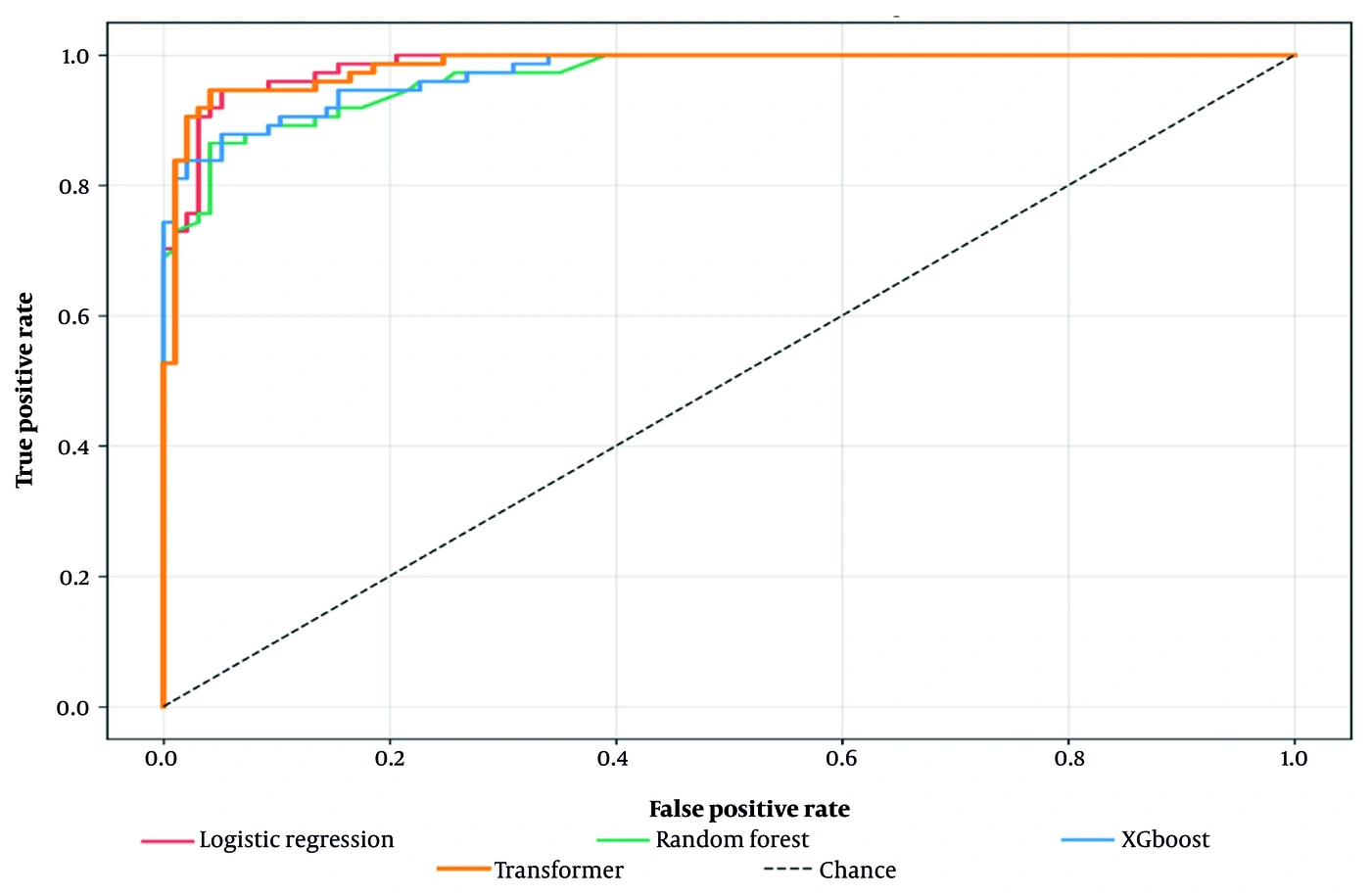
Figure 2.
AUC curve of the compared models
As shown in Table 8, the Transformer model performs better across all metrics, including classification accuracy and probability calibration. Comparative results were obtained using bootstrap resampling and stratified cross-validation to evaluate model robustness and stability. The Transformer model was compared with other models trained on the same data, namely LR, RF, and XGBoost. Bootstrapping with 1 000 resamples was used to assess the sensitivity of performance to changes in the data. The Transformer model showed higher discriminative performance than the comparator models on the same internal dataset, with an average AUC of 0.984 and a 95% confidence interval of [0.966 - 0.996], indicating higher overall performance compared with the other models, as shown in the graph provided in the problem statement. It also had the lowest Brier score among the models (0.046), indicating strong calibration and close alignment between predicted probabilities and observed frequencies. The Transformer model achieved an averaged AUC of 0.984 ± 0.008, indicating minimal variability in the 5-fold stratified cross-validation.
Table 8.
Comparative Results of the Different Trained Models
| Model | AUC | 95% CI | Accuracy (%) | Precision (%) | Recall (%) | F1-score (%) | Brier |
|---|---|---|---|---|---|---|---|
| LR | 0.985 | [0.970 - 0.996] | 93.6 | 93.2 | 91.9 | 92.5 | 0.048 |
| RF | 0.967 | [0.941 - 0.986] | 90.1 | 90.1 | 86.5 | 88.3 | 0.088 |
| XGBoost | 0.972 | [0.952 - 0.988] | 89.5 | 87.8 | 87.8 | 87.8 | 0.070 |
| Transformer | 0.984 | [0.966 - 0.996] | 95.3 | 94.6 | 94.6 | 94.6 | 0.046 |
Table 7 reports performance metrics obtained on the independent hold-out test set (n = 171), which was never used during model training or tuning. Model calibration was assessed using the Brier score and a calibration plot. The Transformer model achieved a Brier score of 0.046, the lowest among all compared models, indicating strong alignment between predicted probabilities and observed outcomes. The calibration plot (Figure 3) shows that the model assigns low probabilities to controls and high probabilities to cases, with the calibration curve closely following the perfect calibration diagonal. Minor deviations at intermediate probability ranges are expected given the relatively small test set size (n = 171).
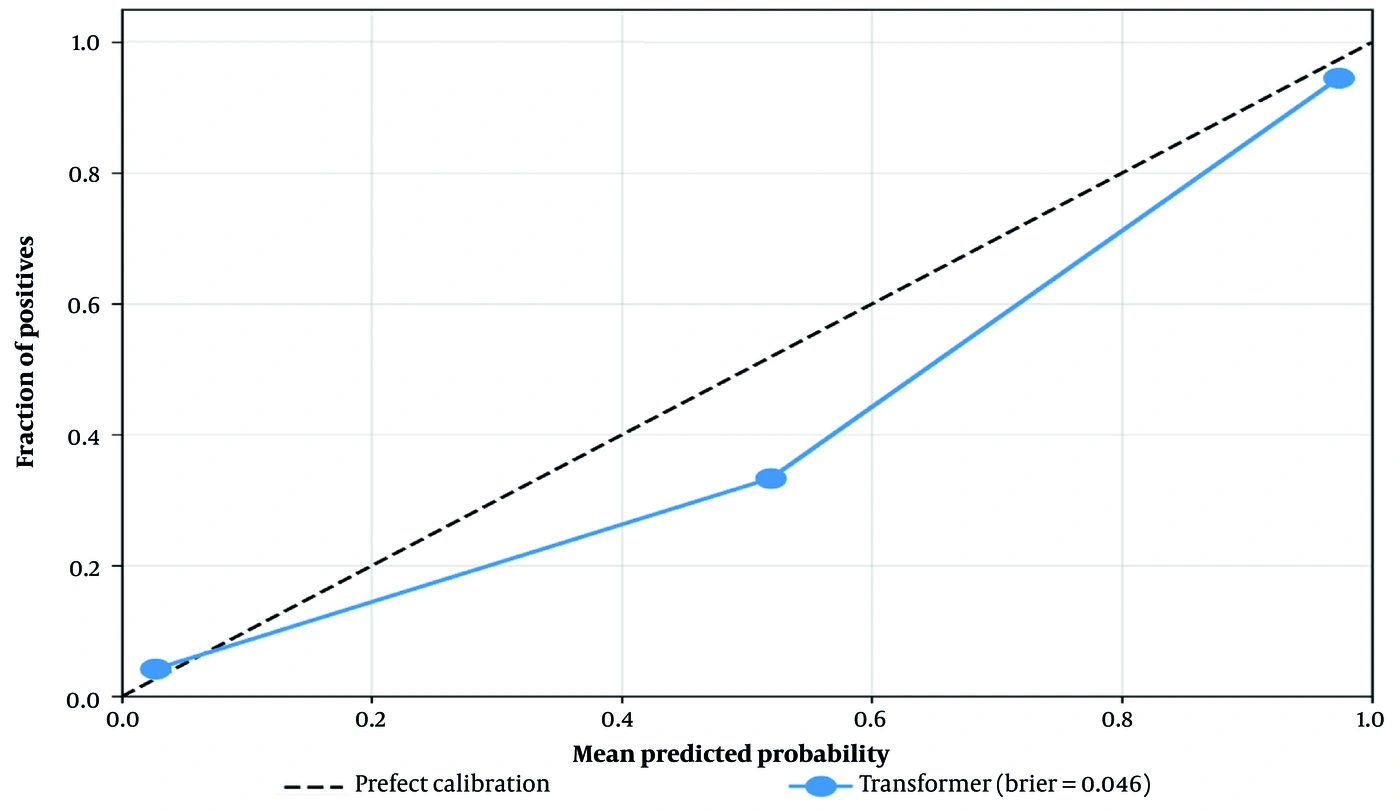
Figure 3.
Calibration plot of the Transformer model
Table 8 reports comparative results obtained through bootstrap resampling (1 000 resamples) and 5-fold stratified cross-validation, providing estimates of model robustness and stability across different data subsets.
Figure 3 shows the calibration curve for the Transformer model, where the dashed line represents perfect calibration. The solid blue curve illustrates the alignment between the predicted mean probabilities and the observed proportions of positive results on the independent test set (n = 171), with a Brier score of 0.046.
The sensitivity analysis conducted using only plausibly pre-diagnostic variables (n = 33) yielded AUC = 0.984, accuracy = 95.3%, precision = 94.6%, recall = 94.6%, F1-score = 94.6%, and Brier score = 0.046—results identical to the full 39-variable model. This confirms that predictive performance is not driven by variables potentially influenced by clinical workup and that dietary and lifestyle variables remain the primary contributors to model discrimination.
4.2. SHAP Analysis Results
4.2.1. Feature Importance
Analysis of the absolute mean SHAP contribution values highlights the most important features, which are linked to diet, lifestyle, and medical history. Based on Figure 4, lifestyle factors, particularly dietary habits, appear to play an important role in determining IC, supported by epidemiological information. The figure highlights the contribution of each factor: consumption of fruit, vegetables, fish, and olive oil is associated with lower risk, whereas red meat, processed meat, smoking, increased BMI, and polyps are associated with a higher risk of IC. Individual prediction analyses were conducted using representative cases, with waterfall plots to support interpretation. Figure 5 presents a low-prediction example (P ≈ 0.003 - 0.005), and Figure 6 presents a very high-prediction example (P ≈ 0.95). The former shows negative SHAP contributions associated with high consumption of fruits, vegetables, whole grains, and fish, whereas the latter reflects positive contributions associated with low consumption of protective foods and unfavorable lifestyle habits.
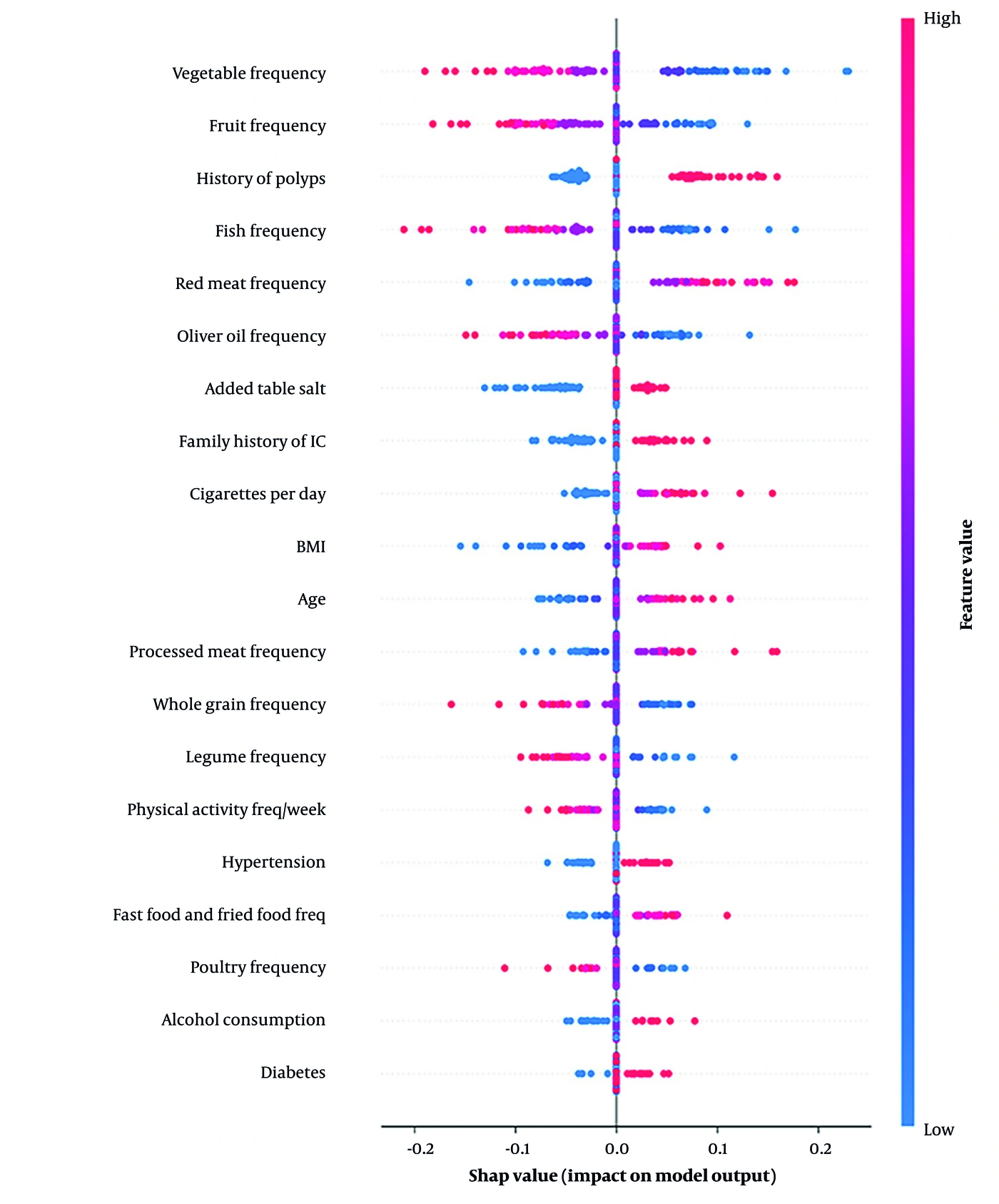
Figure 4.
SHAP Summary Plot: Impact Features
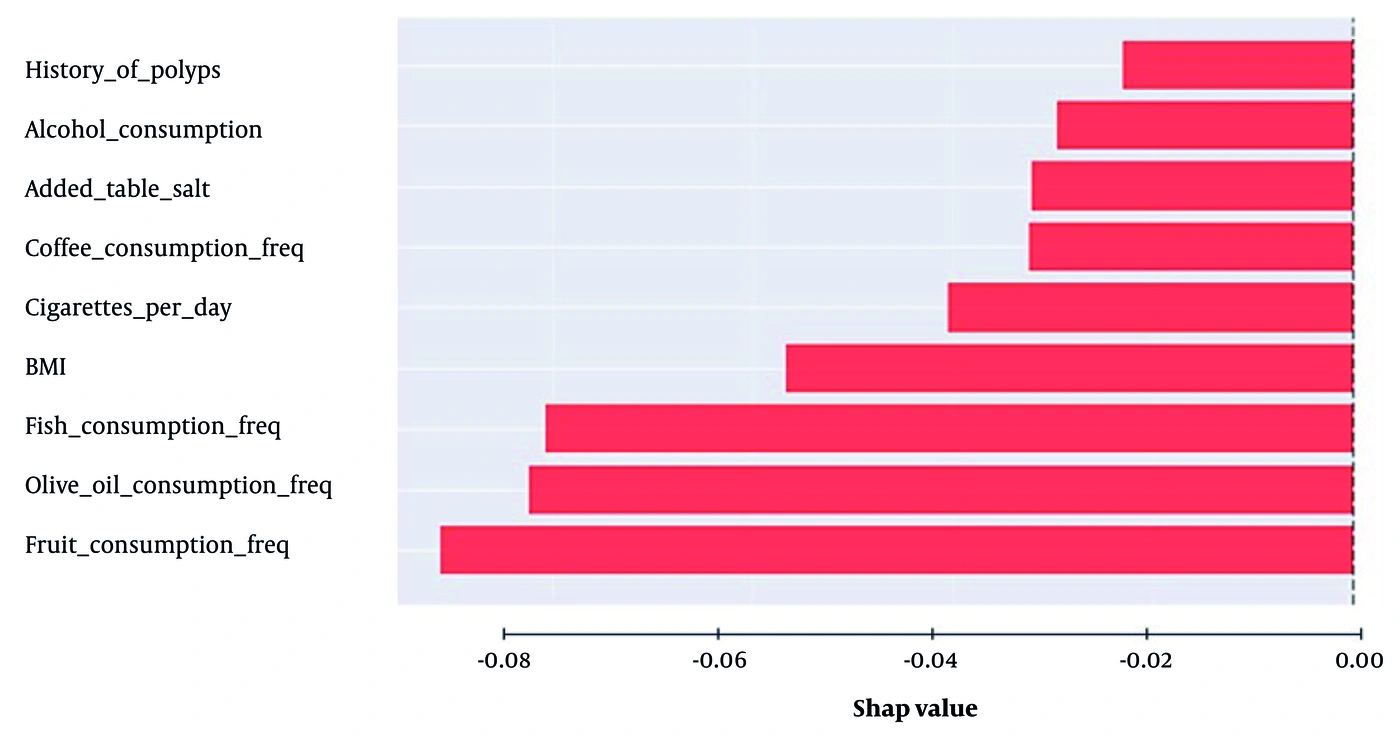
Figure 5.
Waterfall plots for two different prediction cases: with low predictions, P ≈ 0.003 - 0.005
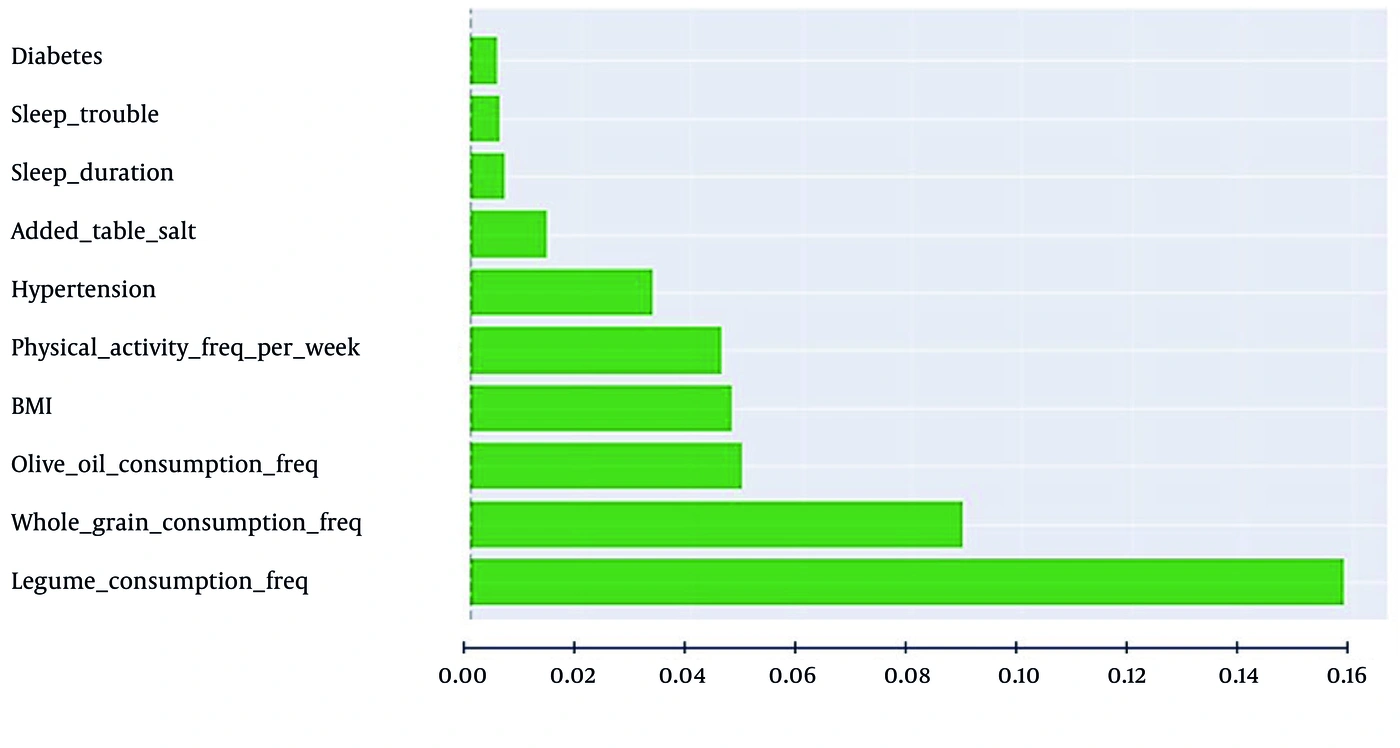
Figure 6.
Waterfall plots for two different prediction cases: with very high predictions, P ≈ 0.95
4.2.2. Stability Analysis of SHAP Explanation
To examine the stability and robustness of the SHAP explanations, CV variation coefficients for the most important SHAP values were calculated for each variable across 5 independent iterations. Some variables showed stability (CV ≈ 0), whereas other variables in Table 9 showed CVs close to 0, supporting the reliability of the model explanations. These results further support the clinical validity of the model and its potential utility for decision-making in personalized IC risk assessment.
Table 9.
Stability Analysis of SHAP Variables (CV Different from Zero)
| Variables | Average SHAP importance | CV |
|---|---|---|
| Olive oil frequency | 0.0488 | 0.189 |
| Red meat frequency | 0.0430 | 0.187 |
| BMI | 0.0429 | 0.063 |
| Fish frequency | 0.0398 | 0.161 |
| History of polyps | 0.0365 | 0.114 |
| Vegetable frequency | 0.0323 | 0.084 |
| Whole grain frequency | 0.0268 | 0.052 |
| Dairy product frequency | 0.0245 | 0.141 |
4.3. Clinical Case Studies
Two representative cases from the test set, reflecting different risk profiles, are presented in Table 10 to illustrate model interpretability. Case 1 illustrates a typical very high-risk profile, combining family history, a history of polyps, and unhealthy eating habits. Accordingly, the model estimates a very high risk, requiring prompt referral to a specialist for clinical evaluation. Personalized recommendations are provided in Tables 11 and 12, considering the patient’s nutritional needs in a logical order of priority: avoidance of processed meats, reduction of red meat, and increased daily vegetable consumption, among others. Case 2 represents an exemplary subject whose lifestyle is fully aligned with WCRF recommendations. The model correctly classified him as very low risk (3.3%), which is logically explained by the absence of unfavorable family or medical factors and an overall protective diet. Therefore, the predicted risk is very small.
Table 10.
Clinical Case Studies
| Category | Case 1 | Case 2 |
|---|---|---|
| Sex / Age (y) | Male, [60 - 69] | Female, [40 - 49] |
| BMI | 31 (Obesity I) | 22.5 |
| Personal medical history | Polyps (5 years ago) | No |
| Family history of IC | Yes | No |
| Diabetes | Yes (8 y) | No |
| Hypertension | Yes | No |
| Smoking | Yes (20 cigarettes/day) | No |
| Physical activity | None | 4x/wk |
| Processed meat | Daily (5/5) | Never |
| Red meat | ≥ 4 times/wk (4/5) | 1x/wk |
| Vegetables | 2 - 3x/wk (2/5) | Daily |
| Fruits | 1x/wk (1/5) | Daily |
| Fish | 1x/wk | ≥ 4 times/wk |
| Predicted risk | 90.8% | 3.3% |
Table 11.
Personalized Nutritional Objectives and Sample Menu for Case 1 (High-Risk Profile)
| Component | Details |
|---|---|
| Nutritional targets | Calories: 1700/day; Proteins: 76 g/day; Fiber: 35 g/day; Red meat: 0/week; Processed meat: 0/week; Vegetables: 3 servings/day; Fruits: 3 servings/day; Fish: 3/week; Legumes: 3/week |
| Daily totals | Total calories: 1675 kcal; Fiber: 35.9 g |
Table 12.
Personalized Dietary Advice and Clinical Recommendations
| Categories | Case 1 (High Risk) | Case 2 (Low Risk) |
|---|---|---|
| Dietary advice | Increase vegetables to 3 - 4 servings/day; start walking 30 min/day; eliminate processed meats; limit red meat to zero initially, reintroduce monthly after 3 months. | Maintain current dietary habits; continue regular physical activity. |
| Clinical recommendations | Enhanced surveillance due to polyp history; enhanced endoscopic surveillance as per oncologist recommendation; nutritionist follow-up in 1 month; risk reassessment in 3 months | Standard intestinal cancer screening as per national guidelines and physician judgment |
5. Discussion
The Transformer-based model, incorporating 39 variables related to clinical, demographic, metabolic, and nutritional factors, demonstrated strong performance in predicting IC risk. An AUC-ROC of 0.984, accuracy of 95.3%, recall of 94.6%, F1-score of 94.7%, and Brier score of 0.046 are within the range of previously reported performance metrics, although direct comparisons are limited by differences in populations, outcomes, and validation designs, as listed in Table 1. These results indicate a substantial capacity to detect high-risk patients while maintaining a low false-negative rate, which may be useful for identifying high-risk individuals. A crucial contributor to these outcomes is the inclusion and interaction of specific nutritional parameters, particularly because several other proposals, including those advanced by Wang et al. in (17) and others such as Buk Cardoso et al. in (18), rely solely on clinical or hospital information.
In other words, the level of detail in our information directly contributes to improved performance. The Transformer architecture, based on self-attention, can capture non-linear dependencies among variables (age, BMI, experience, diet). This may represent an improvement over standard models (RF, SVM, XGB) because it leverages attention mechanisms.
SHAP-based interpretations were consistent with established epidemiology of IC risk factors; key determinants were vegetable intake (SHAP = -0.0585, a strongly significant protective factor), physical activity (SHAP = -0.0420), processed meat (SHAP = +0.0394), red meat (SHAP = +0.0343), polyps (SHAP = +0.0239), and family history of IC (SHAP = +0.0213). This correspondence between SHAP explanations and epidemiologic relationships increased the interpretability of the findings in relation to the WCRF/AICR (24). A stability test across 5 distinct runs showed that 84.6% of variables had a coefficient of variation (CV) below 10% for SHAP values. High-impact features showed satisfactory robustness (CV ≤ 6%), suggesting stable interpretability patterns. Waterfall graphs provided representative examples (high risk: 89.6%, low risk: 2.9%) and offered a clear additive view of individual risk calculations, explaining an overall risk of 90.8% resulting from the accumulation of risk factors (for example, daily processed meats +18.2%, presence of polyps +12.6%, regular red meats +10.4%, among others). This strategy has 3 key strengths in the context of WCRF/AICR general risk factor guidelines: risk-level stratification (for high-risk patients > 70% target P75 and for moderate/low-risk patients target P50), grounding in reality (targets are set according to the average intake of healthy Moroccans), and achievability (a substantial proportion of the control group has already met the targets). Consequently, a high-risk patient will have more restrictive targets (4 servings/day of vegetables = P75) than a low-risk patient (2 servings/day = P50), both based on local evidence. The 2 specific cases presented below demonstrate a personalized adaptation pattern, in which a high-risk patient (90.8%) would follow 7 HIGH-priority recommendations with intensive support (P75 for vegetables/fruit, 0 red/processed meat), whereas a low-risk patient (3.3%) would receive positive reinforcement without intervention (because their personal habits already meet P50/P75 standards). This approach, which has been less frequently investigated in previous studies, may provide a more patient-centered nutritional support strategy.
This study contributes by integrating a personalized nutrition recommendation module based on patient characteristics and key risk factors identified via SHAP. Unlike previous works, our system provides realistic menus that are culturally adapted to the Moroccan context, which, beyond scientific relevance, may enhance practical applicability. This level of contextualization, which is not present in the work of Abdul Rahman et al. (9), Wu et al. (16), and Buk Cardoso et al. (18), represents a potentially useful patient-centered contribution. The developed model may help identify individuals at elevated IC risk in primary care who are considered high risk and therefore require closer monitoring or early colonoscopy. Using SHAP, clinicians can clearly understand why a patient is considered high risk, facilitating doctor–patient communication and potentially improving adherence. An innovative aspect of this project was tailoring the system to the Moroccan environment, including development of a database containing 104 foods with traditional Moroccan names.
The generalizability of the proposed model beyond the Marrakech-Safi region requires careful consideration. The model was trained in a population with specific dietary habits, socioeconomic characteristics, and disease-prevalence patterns that may differ substantially from those of other Moroccan regions, North African populations, or international settings. The food database, comprising 104 traditional Moroccan foods, reflects local dietary patterns and may not be directly applicable to populations with different culinary traditions. External validation in geographically and culturally diverse populations is therefore essential before broader clinical application.
Several limitations should be acknowledged. First, the retrospective case-control design means that the model discriminates between existing cases and controls rather than predicting future cancer incidence, which limits direct clinical application. Second, model evaluation relied exclusively on internal procedures, and external validation in independent cohorts is necessary before any clinical deployment. Third, the study population was drawn only from the Marrakech-Safi region, which may constrain generalizability to other geographic or cultural contexts. Fourth, self-reported dietary and lifestyle data may introduce recall bias and measurement inaccuracies, particularly because recently diagnosed cases may recall past exposures differently than controls. Fifth, some behavioral variables may reflect post-diagnosis changes, introducing a risk of reverse causation. Finally, despite regularization and cross-validation, the combination of a relatively small sample and a high-capacity Transformer architecture carries a residual risk of overfitting. Future work should prioritize external validation, prospective multicenter designs, and longitudinal follow-up before real-world implementation. The current system does not account for individual food allergies or intolerances and does not include specific adaptations for obesity beyond caloric restriction. These are important areas for future development to improve the safety and personalization of the recommendation module.
5.1. Conclusions
This study presents a data-driven approach to IC risk prediction by combining a high-performance Transformer-based risk prediction model, detailed SHAP analysis to support explainability and identify modifiable factors, and an automated approach for providing personalized dietary guidance based on the true health parameters of controls and informed by SHAP values. The proposed model was developed using a cohort of 1 135 samples (493 cases and 642 controls) and 39 clinical, demographic, metabolic, and nutritional variables, providing an integrated approach to address the problem comprehensively. The dataset was split into training (70%), validation (15%), and testing sets to ensure rigorous model appraisal. Test-set results were strong: the model achieved an overall accuracy of 95.3% and an AUC of 0.984. These findings demonstrate favorable performance relative to other models in the recent literature and indicate the capability of the Transformer model to model tabulated data for IC risk prediction. The results showed that SHAP identified dietary variables as major drivers of predicted risk, with vegetable intake (SHAP = –0.0585) and frequency of meat consumption (SHAP = 0.0394) as key driving variables, while stability analysis indicated that results remained stable after 5 iterations, with 84.6% of features having a CV of < 10%. Waterfall plots for 3 cases demonstrated the model’s interpretability for explaining risk to patients.
A key novelty of this work is the implementation of a complete personalized menu-generation system based on a database comprising 104 traditional Moroccan foods, enabling automatic generation of a weekly meal plan. The system is customized to patients’ nutritional needs and culturally adapted to the local context. Whereas most previous studies defined targets using arbitrary thresholds, our system empirically extracts nutritional targets from the actual profile of healthy controls, represented by percentiles P25/P50/P75, to ensure that targets are scientifically sound and locally achievable. Validation across 5 diverse examples showed that the system generally satisfied constraints related to quality (100% achievement of fiber/protein, 77% protective foods, 73.6% variation, 100% cultural accordance).
The recommendations are directly informed by SHAP-based feature contributions, establishing a clear link between the model-identified risk factors and the nutritional recommendations. This study supports the feasibility of smart prevention systems that are culturally adapted and implementable in resource-limited environments, such as Morocco. Future directions include prospective multicenter cohort designs, longitudinal follow-up assessments, and external validation in independent and diverse populations, all of which are required before clinical implementation and may support the development of more individualized and widely accessible nutritional prevention frameworks.