
1. Background
Cancer is one of the most important public health challenges worldwide and is recognized as the second leading cause of death globally. According to GLOBOCAN 2022 estimates, in 2022, about 20 million new cases of cancer and nearly 9.7 million cancer deaths were reported worldwide, and the number of new cancer cases is predicted to reach more than 35 million cases per year by 2050 (1). In Iran, this disease is also the third leading cause of death after cardiovascular diseases and traffic accidents (2). Despite significant advances in diagnosis and treatment, the burden of this disease continues to increase. The incidence and prevalence of cancer are expected to rise substantially in the coming decades.
Cancer, especially in advanced stages, is associated with decreased functioning, increased physical and psychological symptoms, and greater dependency on others (3). Under these circumstances, the patient’s family members and relatives, known as informal caregivers, play a fundamental role in providing long-term care. However, assuming this role is associated with a substantial caregiving burden that can affect caregivers’ quality of life and mental health. Studies have shown that increased caregiving burden is associated with decreased quality of life among caregivers of patients with cancer (4). As the disease progresses and the end-of-life phase approaches, caregivers, in addition to their caregiving role, face emotional experiences related to the patient’s death, which can strengthen their sense of attachment and, at the same time, anticipatory grief (5, 6). Under these circumstances, caring for a dying person may lead to emotional reactions after loss that go beyond normal grief and may manifest as complex and debilitating symptoms (7, 8).
In family-centered and collectivistic societies such as Iran, caring for patients with cancer is often viewed as a moral and familial responsibility, with a large portion of physical, emotional, and spiritual care provided by family members (3). Furthermore, religious and spiritual beliefs in Iranian culture play an important role in how people cope with illness, suffering, and death, and many caregivers use spirituality as a source of psychological adjustment and meaning-making (9, 10). However, prolonged exposure to the patient’s suffering, the pressures of ongoing caregiving, and the experience of impending loss may weaken these coping resources and increase caregivers’ vulnerability to psychological consequences, including prolonged grief disorder (PGD) (11, 12). Moreover, the limited availability of formal palliative care services and psychological support in some Iranian treatment settings may exacerbate caregiving burden and emotional stress among family caregivers (13, 14).
Grief is a normal response to the loss of a significant person in one’s life; most bereaved individuals can adjust to their loss, and the normal course of grief is usually accompanied by a gradual decrease in symptoms over time (15, 16). However, approximately 5% to 10% of individuals experience persistent and severe grief, which can lead to PGD (17, 18). This disorder is characterized by persistent and intense sadness, yearning for the deceased person, and impairment in daily functioning, and can lead to significant psychological consequences, including anxiety and depression (11). Grief reactions last for at least 6 months according to ICD-11 criteria or 12 months according to DSM-5 and cause significant functional impairment (8).
Several risk factors for the development of PGD symptoms have been identified in different populations, reflecting the complex and multifactorial nature of this phenomenon (12, 19). Evidence suggests that family caregivers of patients with cancer, particularly in palliative care, are more vulnerable to PGD than other populations because of their continuous exposure to the patient’s suffering, emotional exhaustion, anticipatory grief, and emotional dependency (20). These factors may contribute to the persistence of grief symptoms by impairing emotional regulation, reducing the ability to cope with loss, and weakening the process of meaning-making (12).
Studies have shown that PGD has substantial overlap with other psychological conditions, such as depression and post-traumatic stress symptoms (21). Evidence also suggests that post-traumatic stress symptoms are associated with higher levels and greater persistence of PGD symptoms (22, 23). A meta-analysis also reported a high rate of co-occurrence between post-traumatic stress disorder (PTSD) and clinical levels of anxiety, depression, and post-traumatic stress (24). In addition, research findings suggest that attachment anxiety and attachment avoidance, 2 major attachment dimensions, are positively and significantly associated with increased severity of PTSD symptoms (25).
In addition to psychological factors, increasing evidence emphasizes the role of spiritual factors in the experience of grief (26). Spirituality serves as a major source of coping and psychological adjustment for many caregivers of patients with cancer. It may play a protective role in meaning-seeking and adaptation to loss (27). However, prolonged exposure to the patient’s suffering, treatment uncertainty, and the experience of loss may weaken individuals’ meaning and spiritual systems (9, 10). Spiritual dryness, as a type of spiritual crisis, refers to the experience of a lack of positive spiritual emotions, a feeling of distance from God, and a decrease in the sense of meaning and spiritual consolation (28). Various studies have shown that spiritual dryness can be associated with psychological distress, anxiety, depression, and reduced psychological adjustment (10, 29). However, the role of spiritual dryness in the emergence or persistence of PGD, especially among family caregivers of patients with cancer, remains underexplored.
This study addresses a research gap, as most existing studies examine psychological and spiritual factors for PGD in isolation, with a particular lack of integrated research in non-Western, religious, and cultural contexts such as Iran (11, 12, 30, 31). Additionally, evidence remains insufficient regarding factors associated with PGD severity among Iranian family caregivers of patients with cancer.
1.1. Conceptual Framework
This study was designed based on the cognitive-behavioral model of complex grief disorder proposed by Boelen et al. (2006) (32). This model posits that PGD results from interactions among contextual factors, central psychological processes, and clinical outcomes. In the present study, this framework was cross-culturally adapted according to the research objectives and variables.
Based on this model, contextual factors include individual characteristics and psychological vulnerabilities, loss-related characteristics, and socio-environmental conditions that can increase an individual’s readiness to experience complex grief reactions. Demographic variables and attachment styles were considered contextual factors. Attachment style can affect an individual’s emotional regulation, perception of loss, and adjustment to grief; therefore, anxious, secure, and avoidant attachment dimensions were included in the research model.
According to Boelen’s model, central processes include poor integration of loss into autobiographical memory, negative beliefs, and emotional avoidance strategies that can intensify the persistence of grief symptoms. In the present study, symptoms of PTSD were considered an indicator of emotional distress and avoidance processes related to loss. In addition, given the role of spirituality in coping with grief, spiritual dryness was included in the model as one of the psychological-spiritual factors related to impaired loss processing.
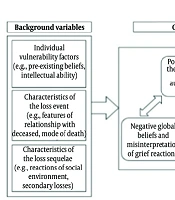
Accordingly, PGD was considered the main clinical outcome and the dependent variable of the study. Based on this framework, it was hypothesized that psychological and spiritual variables, in interaction with individual vulnerabilities and contextual characteristics, would be associated with the severity of PGD symptoms in family caregivers of patients with cancer. Figure 1 illustrates the conceptual model of the study and the relationships among contextual factors, psychological processes, and clinical outcomes.
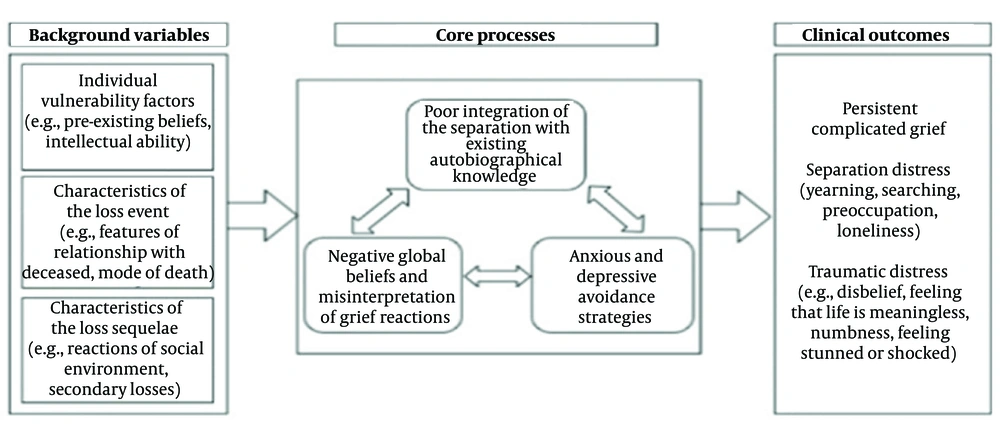
Figure 1.
Conceptual model for determining research variables, adapted from the cognitive-behavioral model of complex grief disorder presented by Boelen et al. (2006) (32).
2. Objectives
Recognizing the central role of family and spirituality in Iranian culture, this study aimed to simultaneously examine psychological and spiritual factors associated with PGD severity in this population. The objective was to enhance understanding of this phenomenon and to inform the development of culturally tailored supportive interventions.
3. Methods
3.1. Study Design
This study used a descriptive-analytic, cross-sectional design to examine factors associated with PGD severity among family caregivers of deceased cancer patients. The role of psychological variables, including symptoms of PTSD, attachment dimensions, and spiritual dryness, was examined using a hierarchical multiple linear regression model. The study design and reporting followed the STROBE guidelines for observational studies.
3.2. Study Setting and Participants
Data were collected between 2024 and 2025 at oncology service providers and forensic medicine centers in Tehran, Ilam, and Dezful, Iran. These centers, selected based on the high volume of cancer patients and access to reliable information on cancer deaths, included Shariati and Shohada Tajrish Hospitals in Tehran, the Oncology Center of Shahid Mustafa Khomeini Hospital in Ilam, the Oncology Department of Imam Hassan Mojtaba Hospital in Dezful, the Cancer Patients Support Charity (MACSA), and the forensic medicine departments of the aforementioned cities.
Family caregivers (defined as individuals with primary responsibility for the patient’s physical and/or emotional care during the course of the illness) of cancer patients who had died of cancer between 6 and 12 months before the study were selected by convenience sampling. After deceased cancer patients were identified through healthcare centers and forensic offices, eligible family caregivers were identified using the contact information recorded in the patients’ files and were invited to participate. An electronic questionnaire link was sent to those who expressed interest in participating. Because recruitment was based on available contact information in medical records and voluntary response to an electronic questionnaire link, complete information on non-respondents and reasons for non-participation could not be consistently documented across all recruitment centers. The participant recruitment and inclusion process is summarized in Figure 2.
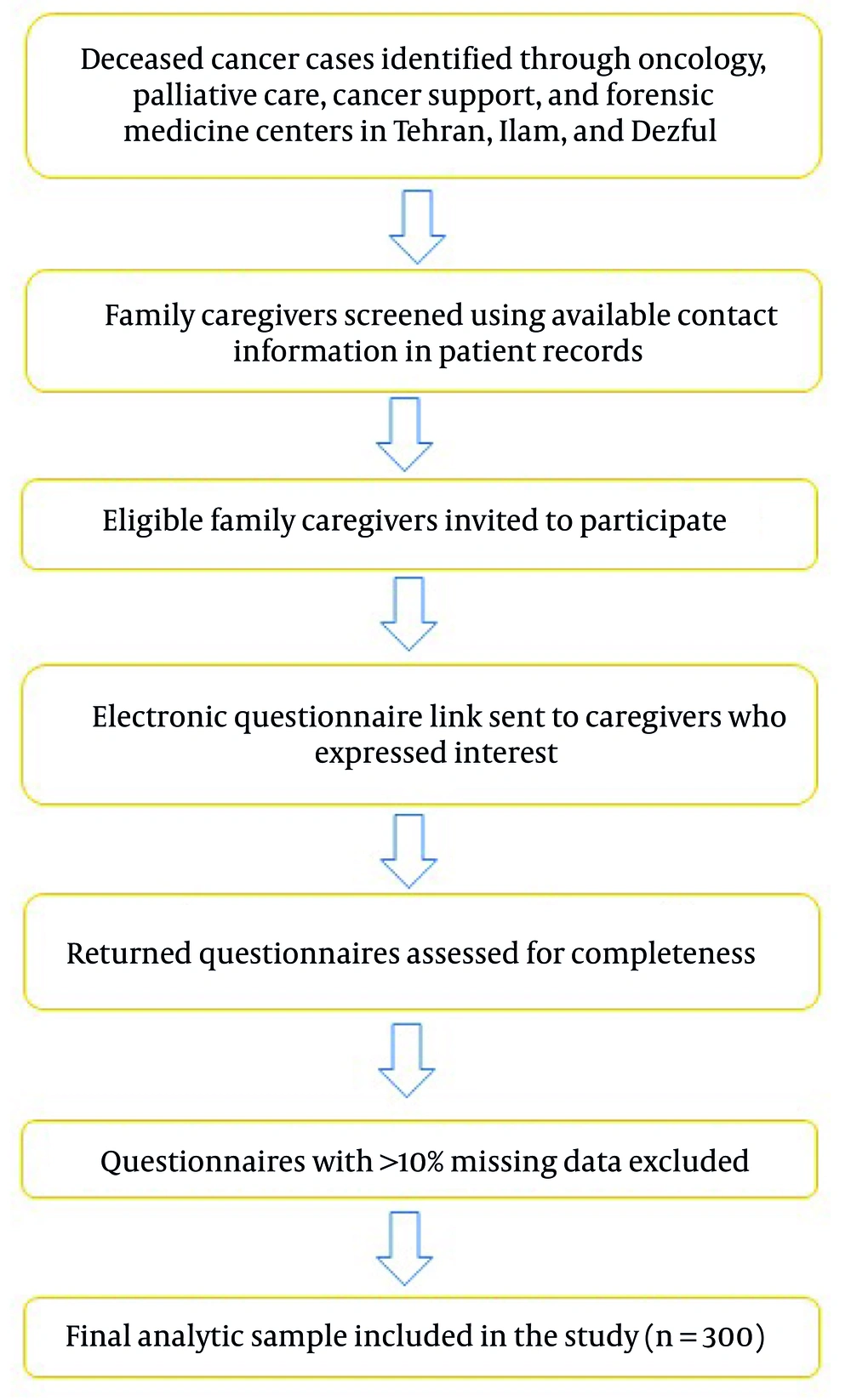
Figure 2.
Flow diagram of participant recruitment and inclusion.
Inclusion criteria were: a confirmed cancer diagnosis documented in the medical record and confirmation that death was due to cancer based on the death certificate; 6 to 12 months having elapsed since the patient’s death; (1) age 18 years or older; (2) ability to read and write in Persian; and provision of written informed consent to participate in the study. Exclusion criteria included incomplete questionnaires or more than 10% missing data in the research instruments. Cases with limited missing values were managed using the listwise deletion method. Several clinical and caregiving-related variables, including cancer type and stage, duration and intensity of caregiving, time from diagnosis to death, prior mental health history, social support, and caregiver–patient relationship, had substantial missing data and therefore were not included in the final regression analyses.
The sample size was calculated using G*Power software (version 3.1) based on a medium effect size (f2 = 0.15), a power of 0.80, a significance level of 0.05, and the number of predictor variables, resulting in a minimum required sample size of 220. Accounting for potential attrition, 300 family caregivers were enrolled.
3.3. Study Instruments
3.3.1. Demographic Information
This section included age, gender, education level, marital status, occupation, residence, relationship to the patient, and the time elapsed since the patient’s death. Residence was included in the analyses to examine possible differences related to access to support resources, healthcare services, and sociocultural variations. In addition, time elapsed since the patient’s death was examined because of its potential association with the severity of grief reactions and PGD.
3.3.2. Prolonged Grief Disorder Scale (PG-13-R)
The Prolonged Grief Disorder Scale (PG-13) was developed by Prigerson et al. in 2009 as a diagnostic criterion–based instrument designed to assess PGD in bereaved individuals. The revised version (PG-13-R) was used in this study; it aligns with the updated DSM-5-TR and ICD-11 criteria and places greater emphasis on functional aspects and new diagnostic criteria than the original version. The scale consists of 10 symptom items assessing key dimensions of the grief experience, including yearning, preoccupation, identity disturbance, disbelief, avoidance, intense emotional pain, difficulty returning to normal life, emotional numbness, feelings of meaninglessness, and profound loneliness. Responses are rated on a 5-point Likert scale ranging from “not at all” to “very much,” with higher scores indicating greater symptom severity. In addition to the symptom items, the instrument includes 3 screening items assessing the experience of losing a significant person, time elapsed since the loss, and the degree of functional impairment caused by the symptoms. These screening items are used to ensure that the necessary criteria for evaluating PGD are met. Overall, by covering emotional, cognitive, behavioral, and functional dimensions, this tool provides a comprehensive assessment of the severity of symptoms associated with PGD (33).
The Persian version of this scale has been translated and validated in Iran. In the study by Ashouri et al., McDonald’s omega coefficient was reported as 0.93 and test–retest reliability as 0.89. In addition, Mirhosseini et al., using exploratory and confirmatory factor analysis, confirmed the instrument’s one-factor structure and satisfactory internal consistency (34, 35). In the present study, Cronbach’s alpha for this scale was 0.888.
3.3.3. Post-Traumatic Stress Disorder Scale (PCL)
The PTSD Checklist (PCL) was developed by Weathers et al. in 1993 based on DSM diagnostic criteria. This 17-item instrument assesses PTSD symptoms and encompasses 3 main symptom clusters: re-experiencing the traumatic event (items 1 to 5), avoidance and emotional numbness (items 6 to 12), and hyperarousal (items 13 to 17). Responses are rated on a 5-point Likert scale from 1 “not at all” to 5 “extremely,” with higher scores indicating greater PTSD symptom severity. The Persian version of this instrument has been translated and validated in Iran. Goudarzi et al. reported favorable psychometric properties for the Persian version and a Cronbach’s alpha coefficient of 0.93. In this study, Cronbach’s alpha for the instrument was 0.863, indicating satisfactory internal consistency in the sample examined.
3.3.4. Adult Attachment Styles Questionnaire
The Adult Attachment Styles Questionnaire (Collins & Read) was developed by Collins and Read in 1990 to assess attachment patterns in adult interpersonal relationships. This instrument consists of 18 items and evaluates 3 dimensions of attachment: attachment anxiety, closeness/security, and dependency. Responses are recorded on a 5-point Likert scale ranging from 0 (“strongly disagree”) to 4 (“strongly agree”), and 6 items are reverse-scored. Higher scores on each subscale indicate greater severity of the trait related to that attachment dimension. In their initial studies, Collins and Read reported satisfactory Cronbach’s alpha coefficients for the subscales: 0.80 to 0.82 for the closeness/security dimension, 0.78 to 0.80 for the dependency/avoidant dimension, and 0.83 to 0.85 for the anxiety dimension (36). In this study, Cronbach’s alpha coefficients for attachment anxiety, closeness/security, and dependency/avoidance were 0.885, 0.690, and 0.246, respectively. Because the dependency/avoidance dimension showed very poor internal consistency, it was excluded from the main analyses and was not used for independent interpretation. Because the closeness/security dimension had an alpha value slightly below the conventional threshold, findings related to this dimension were interpreted with caution.
3.3.5. Spiritual Dryness Scale
The Spiritual Dryness Scale was developed by Büssing et al. in 2013 to assess experiences related to spiritual distance, a reduced sense of the presence of the sacred, and estrangement from God. This instrument is one of the well-known scales for measuring negative aspects of spiritual experience in clinical and spiritual research. The version used in this study included 10 items and assessed 2 dimensions of spiritual dryness: Active Spiritual Dryness and Growth and Adjustment following Spiritual Dryness. The Active Spiritual Dryness dimension includes items SDS1 to SDS6 and reflects negative spiritual experiences such as a reduced sense of spiritual closeness, lack of spiritual consolation, and feelings of distance from God. Item SDS0 reflects spiritual eagerness and was reverse-scored when calculating the spiritual dryness score. Higher scores on this dimension indicate greater intensity of spiritual dryness. The Growth and Adjustment dimension includes items SDS8 to SDS10 and reflects adaptive or growth-related responses following experiences of spiritual dryness. This dimension was scored and reported separately from Active Spiritual Dryness. Previous studies have reported good reliability with a Cronbach’s alpha of approximately 0.87 (29). In Iran, in Ebrahimiabadi et al.'s cross-cultural adaptation study, the Cronbach’s alpha coefficient for the Persian version was reported as 0.899 (37). In accordance with the instrument’s scoring approach, the Spiritual Dryness Scale was treated as an overall measure in the present study, and internal consistency was reported for the whole questionnaire rather than for each dimension separately. In the present study, Cronbach’s alpha for the whole Spiritual Dryness Scale was 0.789, indicating acceptable internal consistency.
3.4. Study Procedures
This study was conducted after obtaining ethical approval from the Ethics Committee of Dezful University of Medical Sciences (Ethics Code: IR.DUMS.REC.1403.043) and in accordance with the Declaration of Helsinki. Before accessing the online questionnaire, all participants received information about the study aims, voluntary participation, confidentiality, data anonymity, and their right to withdraw at any time. Written informed consent was obtained electronically from all participants before completing the questionnaire. No identifying information was collected, and all data were analyzed anonymously.
3.5. Statistical Analysis
Data were analyzed using IBM SPSS Statistics version 26. Descriptive statistics (mean, standard deviation, frequency, percentage) were used to summarize variables. The normality of continuous variables was assessed using the Shapiro–Wilk test. Spearman correlation was used because some variables were not normally distributed. Group comparisons were performed using the Mann–Whitney U test and the Kruskal–Wallis test, as appropriate. Hierarchical multiple linear regression was conducted to identify factors independently associated with PGD severity, with demographic variables entered in the first step and psychological/spiritual variables in the second. Regression assumptions were assessed before analysis, including linearity, independence of errors, homoscedasticity, normality of residuals, and multicollinearity. Multicollinearity was assessed using variance inflation factor (VIF) values. Standardized β coefficients, unstandardized coefficients, standard errors, 95% confidence intervals, changes in R2, and VIF values were reported. Statistical significance was set at P < 0.05 for all tests.
4. Results
4.1. Participant Characteristics
Of the participants, 185 (61.9%) were female and 114 (38.1%) were male. The largest age group was 36 to 40 years; 192 (64%) were married and 108 (36%) were single. The most common educational level was a bachelor’s degree. Moreover, 182 (60.9%) were employed and 117 (39.1%) were unemployed. Regarding residence, 257 (85.7%) lived in urban areas and 43 (14.3%) lived in rural areas. The demographic variables are detailed in Table 1. A total of 300 bereaved family caregivers were included in the final analysis. The participant recruitment process is presented in Figure 2.
Table 1.
Demographic Characteristics of Participants
| Variables and Categories | No. (%) |
|---|---|
| Gender | |
| Male | 114 (38.1) |
| Female | 185 (61.9) |
| Age group | |
| 18 - 23 | 13 (4.3) |
| 24 - 29 | 25 (8.3) |
| 30 - 35 | 57 (19.0) |
| 36 - 40 | 90 (30.0) |
| 41 - 50 | 72 (24.0) |
| > 50 | 43 (14.3) |
| Marital status | |
| Married | 192 (64.0) |
| Single | 108 (36.0) |
| Educational status | |
| Diploma | 61 (20.5) |
| Associate degree | 13 (4.4) |
| Bachelor | 124 (41.6) |
| Master | 80 (26.8) |
| PhD | 20 (6.7) |
| Job status | |
| Employed | 182 (60.9) |
| Unemployed | 117 (39.1) |
| Residency | |
| City | 257 (85.7) |
| Village | 43 (14.3) |
4.2. Descriptive Characteristics of the Main Study Variables
The mean PGD score was 36.28 ± 8.25. The mean score for the PTSD Checklist (PCL) was 48.36 ± 12.70, and the mean score for the total Spiritual Dryness Scale was 26.43 ± 6.39. The mean score for the closeness/security attachment dimension was 13.27 ± 4.27, and the mean score for attachment anxiety was 11.61 ± 6.36. The internal consistency of the closeness/security dimension was slightly below the conventional threshold but acceptable for cautious interpretation (Cronbach’s α = 0.690). However, the dependency/avoidance dimension showed very poor internal consistency (Cronbach’s α = 0.246); therefore, this dimension was excluded from the main analyses and was not used for independent interpretation (Table 2).
Table 2.
Descriptive Statistics of Main Study Variables
| Variables | Minimum - Maximum | Mean ± SD |
|---|---|---|
| PGD severity | 14.00 - 55.00 | 36.28 ± 8.25 |
| Post - traumatic stress symptoms | 17.00 - 85.00 | 48.36 ± 12.70 |
| Overall Spiritual Dryness Scale | 13.00 - 44.00 | 26.43 ± 6.39 |
| PCLB (Re - experiencing) | 5.00 - 25.00 | 15.43 ± 4.20 |
| PCLC (Avoidance /Emotional Numbing) | 7.00 - 35.00 | 19.61 ± 5.61 |
| PCLD (Hyperarousal) | 5.00 - 25.00 | 13.33 ± 4.32 |
| Spiritual dryness | 6.00 - 30.00 | 14.66 ± 5.55 |
| Spiritual coping/growth and adjustment | 3.00 - 15.00 | 9.01 ± 2.55 |
| Secure attachment | 4.00 - 24.00 | 13.27 ± 4.27 |
| Anxious attachment | 0.00 - 24.00 | 11.61 ± 6.36 |
4.3. Bivariate Analyses
To examine differences in grief scores across demographic variables, the Mann–Whitney U test was used for dichotomous variables, and the Kruskal–Wallis test was used for polytomous variables (Table 3). In bivariate analyses, differences in grief scores by gender, age, marital status, education, and residence were not significant (all P > 0.05). Only employment status showed a significant association with PGD severity; unemployed individuals reported higher grief scores than employed individuals (U = 8826.500, Z = -2.317, P = 0.021).
Table 3.
Bivariate Comparisons of PGD Severity According to Attachment Dimensions and Demographic Variables a
| Variables and Categories | Data b | Values c |
|---|---|---|
| Panel A. Mean ranks of PGD severity across study groups | ||
| Attachment anxiety | ||
| Low | 161 | 127.70 |
| High | 136 | 174.21 |
| Closeness/security attachment | ||
| Low | 160 | 157.46 |
| High | 137 | 139.12 |
| Gender | ||
| Male | 113 | 140.65 |
| Female | 184 | 154.13 |
| Age group | ||
| 18 - 23 | 13 | 128.04 |
| 24 - 29 | 25 | 132.08 |
| 30 - 35 | 57 | 159.02 |
| 36 - 40 | 90 | 159.97 |
| 41 - 50 | 72 | 147.18 |
| > 50 | 41 | 134.79 |
| Marital status | ||
| Married | 190 | 151.08 |
| Single | 108 | 146.72 |
| Job status | ||
| Employed | 181 | 139.77 |
| Unemployed | 116 | 163.41 |
| Educational status | ||
| Diploma | 60 | 157.81 |
| Associate degree | 13 | 145.08 |
| Bachelor | 123 | 149.34 |
| Master | 80 | 138.57 |
| PhD | 20 | 157.35 |
| Residency | ||
| City | 255 | 148.79 |
| Village | 43 | 153.73 |
| Panel B. Overall nonparametric test results | ||
| Attachment anxiety | < 0.001 | |
| Mann–Whitney U | U = 7519.500, Z = −4.653 | |
| Closeness/security attachment | 0.066 | |
| Mann–Whitney U | U = 9607.000, Z = −1.835 | |
| Gender | 0.189 | |
| Mann–Whitney U | U = 9453.000, Z = −1.313 | |
| Age group | 0.403 | |
| Kruskal–Wallis | H = 5.106, df = 5 | |
| Marital status | 0.675 | |
| Mann–Whitney U | U = 9960.000, Z = −0.420 | |
| Job status | 0.021 | |
| Mann–Whitney U | U = 8826.500, Z = −2.317 | |
| Educational status | 0.729 | |
| Kruskal–Wallis | H = 2.035, df = 4 | |
| Residency | 0.727 | |
| Mann–Whitney U | U = 5300.500, Z = −0.348 |
a Mann–Whitney U tests were used for two-category variables, and Kruskal–Wallis tests were used for variables with more than two categories. Attachment anxiety and closeness/security attachment were categorized into low and high groups based on the median score. Findings related to closeness/security attachment should be interpreted with caution because of its limited internal consistency. Abbreviation: PGD, Prolonged Grief Disorder.
b For Panel A, data are expressed as numbers; for Panel B, values represent test statistics.
c For Panel A, data represent test statistics; for Panel B, values represent P values.
4.4. Spearman Correlation Analyses
Spearman correlation was used to examine initial associations between PGD severity and psychological, spiritual, and attachment-related variables with acceptable or cautiously interpretable reliability (Table 4). The total PCL score showed the strongest correlation with PGD severity (Spearman’s ρ = 0.825, P < 0.001). The total Spiritual Dryness Scale score also showed a positive and significant correlation with PGD severity (ρ = 0.485, P < 0.001). The closeness/security attachment dimension showed a weak but significant negative correlation with PGD severity (ρ = −0.119, P = 0.040); however, this finding was interpreted with caution because the internal consistency of this dimension was slightly below the conventional threshold.
Table 4.
Spearman Correlations Between PGD Severity and Psychological, Spiritual, and Attachment-Related Variables
| Domains and Variables | Spearman’s ρ with PGD severity | P-Value |
|---|---|---|
| Post-traumatic stress symptoms | ||
| Total PCL score | 0.825 | < 0.001 |
| PCLB: Re-experiencing | 0.769 | < 0.001 |
| PCLC: Avoidance/emotional numbing | 0.781 | < 0.001 |
| PCLD: Hyperarousal | 0.692 | < 0.001 |
| Spiritual dryness | ||
| Overall Spiritual Dryness Scale | 0.485 | < 0.001 |
| Spiritual dryness | 0.454 | < 0.001 |
| Spiritual coping/growth and adjustment | 0.297 | < 0.001 |
| Attachment-related variable | ||
| Closeness/security attachment | −0.119 | 0.040 |
4.5. Hierarchical Multiple Linear Regression
Hierarchical multiple linear regression was conducted to examine factors independently associated with PGD severity (Table 5). In the first block, demographic variables, including gender, age group, marital status, education level, employment status, and residence, were entered into the model. This block explained only 1.8% of the variance in PGD severity and was not statistically significant, R2 = 0.018, F(6, 267) = 0.817, P = 0.558. Therefore, demographic variables alone showed limited explanatory value for PGD severity.
Table 5.
Hierarchical Multiple Linear Regression Examining Factors Associated with PGD Severity a
| Variables | B | SE | β | t | P Value | 95% CI for B | Tolerance | VIF |
|---|---|---|---|---|---|---|---|---|
| Constant | 6.094 | 3.225 | — | 1.890 | 0.060 | [−0.256, 12.443] | — | — |
| Gender | −1.031 | 0.651 | −0.061 | −1.582 | 0.115 | [−2.313, 0.252] | 0.789 | 1.267 |
| Sex | 0.221 | 0.269 | 0.035 | 0.820 | 0.413 | [−0.309, 0.751] | 0.638 | 1.568 |
| Marital status | −0.507 | 0.706 | −0.030 | −0.717 | 0.474 | [−1.897, 0.884] | 0.669 | 1.495 |
| Educational status | −0.042 | 0.272 | −0.006 | −0.153 | 0.879 | [−0.577, 0.494] | 0.756 | 1.324 |
| Job status | 1.184 | 0.717 | 0.071 | 1.651 | 0.100 | [−0.228, 2.597] | 0.639 | 1.565 |
| Residency | 1.704 | 0.794 | 0.076 | 2.147 | 0.033 | [0.141, 3.266] | 0.939 | 1.065 |
| Total PCL score | 0.504 | 0.027 | 0.768 | 18.987 | <0.001 | [0.452, 0.556] | 0.721 | 1.386 |
| Total SDS score | 0.155 | 0.057 | 0.121 | 2.715 | 0.007 | [0.042, 0.267] | 0.593 | 1.687 |
| Attachment anxiety | −0.024 | 0.055 | −0.019 | −0.438 | 0.661 | [−0.133, 0.085] | 0.616 | 1.623 |
| Closeness/security attachment | −0.010 | 0.080 | −0.005 | −0.128 | 0.898 | [−0.167, 0.147] | 0.702 | 1.424 |
a Model 1: R2 = 0.018, adjusted R2 = −0.004, F-change = 0.817, P = 0.558. Final model: R2 = 0.689, adjusted R2 = 0.678, ΔR2 = 0.671, F-change = 142.146, P < 0.001. Durbin–Watson = 1.665. The coefficients presented are from the final model. VIF values were within acceptable limits, indicating no serious multicollinearity among the variables included in the model. Findings related to closeness/security attachment should be interpreted with caution because of its limited internal consistency. Abbreviations: PGD, Prolonged Grief Disorder; PCL, PTSD Checklist; SDS, Spiritual Dryness Scale; SE, standard error; CI, confidence interval; VIF, variance inflation factor.
In the second block, psychological, spiritual, and attachment-related variables were entered into the model, including the total PCL score, the total Spiritual Dryness Scale score, closeness/security attachment, and attachment anxiety. With the addition of these variables, the explanatory value of the model increased substantially. The final model explained 68.9% of the variance in PGD severity, R2 = 0.689, adjusted R2 = 0.678. The increase in R2 in the second block was 0.671 and was statistically significant, F-change = 142.146, P < 0.001. The Durbin–Watson statistic was 1.665, and VIF values ranged from 1.065 to 1.687, indicating no serious multicollinearity.
In the final model, the total PCL score showed the strongest independent association with PGD severity (B = 0.504, β = 0.768, t = 18.987, P < 0.001). This finding indicates that, after controlling for other variables in the model, higher post-traumatic stress symptoms were strongly associated with higher PGD severity. The total Spiritual Dryness Scale score also remained significantly associated with PGD severity, although with a smaller effect size (B = 0.155, β = 0.121, t = 2.715, P = 0.007).
Among demographic variables, residence became significant in the final model (B = 1.704, β = 0.076, t = 2.147, P = 0.033). Based on the coding of this variable, rural residence was associated with higher PGD scores. However, because residence was not significantly associated with PGD severity in the bivariate analysis, this finding should be interpreted cautiously. Its significance in the final model may reflect a suppression effect, model instability, or statistical chance rather than a robust independent association.
Closeness/security attachment was not significantly associated with PGD severity in the final model (B = −0.010, β = −0.005, P = 0.898). Similarly, attachment anxiety was not independently associated with PGD severity after entering the PCL and spiritual dryness into the model (B = −0.024, β = −0.019, P = 0.661). The dependency/avoidance attachment dimension was not entered into the regression model because of very poor internal consistency. Other demographic variables, including gender, age group, marital status, education level, and employment status, were not significant in the final model.
5. Discussion
This study examined psychological, spiritual, and demographic factors associated with PGD severity among bereaved family caregivers of deceased cancer patients. Post-traumatic stress symptoms showed the strongest independent association with PGD severity, and spiritual dryness also remained independently associated with PGD severity, although with a smaller effect size. Attachment dimensions showed some associations in bivariate analyses but did not remain independently associated with PGD severity in the final regression model.
5.1. Association of Post-Traumatic Stress Symptoms With Prolonged Grief
One of the most significant findings of the current study was the strong, significant relationship between the PG-13-R score and symptoms of PTSD. In the correlation analysis, the total PCL score showed the strongest association with PGD severity and retained the strongest independent association with PGD severity in the regression model. This finding suggests that grief experienced by family caregivers of cancer patients, particularly after a prolonged caregiving period and repeated exposure to the patient’s suffering, may include traumatic and post-traumatic components. This is consistent with prior studies showing that, although prolonged grief and post-traumatic stress symptoms are conceptually distinct constructs, they often overlap substantially in many bereaved individuals (38, 39). In the original study by Prigerson et al., a significant association was also reported between prolonged grief symptoms and PTSD symptoms, emphasizing the conceptual distinction between these 2 constructs alongside their clinical overlap (40). Likewise, validation studies conducted in Iran have shown that scores on the Persian version of the PG-13-R are positively and significantly correlated with post-traumatic stress symptoms, supporting the convergent validity of the instrument and the theoretical relationship between these 2 constructs (34).
From a theoretical perspective, cognitive-behavioral models of PGD propose that difficulty accepting the loss, inadequate integration of the death experience into autobiographical memory, and avoidant strategies can perpetuate grief-related distress (32). PTSD symptoms, particularly cognitive and behavioral avoidance, intrusive memories, and persistent hyperarousal, may impede the emotional processing of the loss and disrupt natural adjustment to the death of a loved one. Consequently, a caregiver who has witnessed the patient’s pain, decline in functioning, dependency, and the dying process may not only experience the loss of the emotional bond but also continuously re-experience traumatic memories associated with the caregiving period and the patient’s death.
Longitudinal studies have also supported the complex, bidirectional relationship between PGD and PTSD. Some evidence suggests that PGD symptoms can predict subsequent PTSD symptoms, whereas other studies indicate that PTSD symptoms, particularly after the first year of bereavement, can predict the persistence or exacerbation of PGD symptoms (41-44). These findings suggest that the relationship between prolonged grief and post-traumatic symptoms is unlikely to be simple or unidirectional; rather, these 2 domains may reinforce each other over time. In the current study, the strong association between the PCL score and PGD severity suggests that, among family caregivers of cancer patients, the experience of loss may be accompanied by traumatic and unprocessed components.
5.2. Role of Spiritual Dryness in Prolonged Grief Severity
Another significant finding of the current research was the positive, significant relationship between spiritual dryness and prolonged grief severity. In addition to the bivariate correlation, spiritual dryness remained independently associated with PGD severity in the regression model, even after controlling for demographic variables, PCL symptoms, and attachment dimensions. This finding is particularly important, as it indicates that spiritual aspects of the loss experience may contribute to prolonged grief severity beyond general psychological distress.
This finding aligns with the literature on spirituality, grief, and spiritual dryness. Previous studies have shown that loss can affect an individual’s relationship with God, sense of meaning, hope, and foundational beliefs, leading some individuals to experience spiritual doubt, spiritual abandonment, anger at God, or a sense of existential emptiness (45-47). In their conceptualization of "complicated spiritual grief," Burke et al. highlighted that some mourners, following the loss of a loved one, may undergo profound crises in their relationship with God, within their faith community, and in their overarching system of meaning. These spiritual disruptions can intensify grief-related distress and complicate the mourning process (9).
Conceptually, spiritual dryness can be understood as an erosion of an individual’s spiritual and meaning-seeking resources. For many caregivers, spirituality initially serves as a source of endurance, hope, patience, and meaning. However, under long-term caregiving conditions, witnessing the patient’s persistent suffering, treatment failures, and repeated exposure to death may deplete this resource. In such a state, rather than experiencing spiritual solace, the caregiver may experience distance from God, existential emptiness, diminished meaning, and feelings of abandonment (9, 10).
Among family caregivers of cancer patients, prolonged treatment and failure to achieve desired outcomes may create a conflict between hope and religious beliefs. This may result in spiritual crises, such as difficulty interpreting the illness, doubts about divine justice, and perceiving the disease as a form of divine punishment (48, 49). Such a state frequently distances caregivers from religious practices and restricts their connection with God. This process may also be associated with difficulty accepting the loss and the persistence of prolonged grief symptoms.
This finding is particularly relevant in the Iranian cultural context. In Iranian society, caregiving for cancer patients is often provided within a family-centered structure and is deeply intertwined with moral, religious, and emotional expectations. Caregivers may perceive their role not merely as a family responsibility but as a moral or religious duty (48-50). In such a context, continued patient suffering, treatment failures, and the death of a loved one can create a profound conflict between spiritual beliefs and lived reality (29, 51). Therefore, spiritual dryness in this population may not be solely an individual experience but may also reflect chronic caregiving stress, a lack of structural support, and challenges in finding religious and existential meaning.
However, this finding does not imply that spirituality is always a risk factor. Some studies have indicated that faith and religious beliefs can help bereaved individuals find meaning, endure loss, and experience post-traumatic growth (52-55). Therefore, the role of spirituality in grief is ambivalent and context-dependent: although it can be protective for some individuals, it may be associated with greater distress in others who experience spiritual struggle or dryness. The present study’s findings support the perspective that, in grief research, focusing solely on the positive aspects of spirituality is insufficient and that negative or compromised dimensions of spiritual experience should also be addressed.
5.3. Attachment Dimensions and Prolonged Grief
In the present study, bivariate analyses indicated that attachment dimensions were associated with prolonged grief severity. Specifically, individuals with higher anxious attachment reported greater grief symptom severity, whereas secure attachment showed a weak yet significant negative correlation with grief scores. Furthermore, avoidant attachment demonstrated a positive, significant correlation with grief intensity; however, because of the very low reliability of the dependency/avoidance subscale, this variable was excluded from the final regression model. In the final regression model, after controlling for demographic variables, post-traumatic stress symptoms, and spiritual dryness, attachment dimensions were not independently associated with PGD severity.
This pattern is consistent with a substantial body of literature. Recent systematic reviews and meta-analyses have shown that attachment anxiety and attachment avoidance are generally associated with small-to-moderate positive correlations with prolonged grief symptoms, whereas secure attachment is often associated with lower grief symptom severity (31). Based on attachment theory, individuals with attachment anxiety may experience more intense activation of the attachment system following a loss, greater fear of separation, an intensified need for proximity, and greater difficulty with emotion regulation. These characteristics may cause the loss of a significant person, particularly in the context of long-term caregiving for a cancer patient, to be accompanied by more severe emotional distress and persistent grief symptoms.
Nevertheless, the current study’s finding that attachment anxiety and secure attachment did not remain independently associated with PGD severity in the final model may be explained by evidence from longitudinal studies. Some longitudinal research has shown that, although attachment anxiety and avoidance are associated with higher grief intensity in concurrent analyses, their independent associations diminish or disappear when initial grief symptom severity or other psychological variables are controlled (56-58). Therefore, insecure attachment may function more as an underlying vulnerability factor rather than as a direct and independent predictor of prolonged grief persistence.
The lack of significance of attachment dimensions in the final model suggests that their impact on grief is largely mediated by variables more proximal to the loss experience, such as PTSD symptoms and spiritual dryness. Individuals with anxious attachment may initially experience greater distress, but the independent effect of attachment diminishes when traumatic and spiritual factors are accounted for. Although avoidant attachment showed a positive correlation with PGD severity, theoretical considerations suggest that short-term emotional suppression may mask long-term difficulties (59-61). However, due to the low reliability of the avoidant subscale, no definitive conclusions can be drawn regarding its independent predictive association with prolonged grief.
Findings regarding secure attachment should also be interpreted with caution. Although a weak negative correlation was observed between secure attachment and PGD severity, this relationship did not remain significant in the final model. Theoretically, secure attachment may be associated with better emotional regulation, a greater capacity to seek support, more realistic acceptance of loss, and gradual reconstruction of meaning after the death of a loved one. However, the limited reliability of the secure attachment subscale in the present sample may have reduced the power to detect the true relationship between this variable and grief.
Overall, the present study’s findings indicate that attachment, particularly anxious attachment, is associated with prolonged grief severity at the bivariate level; however, this association loses independence in the presence of post-traumatic stress symptoms and spiritual dryness. This result is consistent with emerging evidence suggesting that the link between insecure attachment and prolonged grief is real but likely indirect, contextual, and dependent on mediating variables. Therefore, in clinical interventions, while attention to attachment style remains important, assessing and treating post-traumatic symptoms and spiritual dryness may represent more direct priorities for reducing prolonged grief severity in family caregivers of cancer patients.
5.4. Role of Residence and Demographic Variables
In the present study, most demographic variables, including gender, age, marital status, education level, and employment status, were not significantly associated with PGD severity in the final model. However, residence remained significantly associated with PGD severity after psychological and spiritual variables were entered into the model, with living in rural areas associated with higher PGD scores. Given that residence was not significant in the bivariate analysis, this finding should be interpreted with caution.
One possible explanation is disparities between urban and rural areas in access to support services, palliative care, psychological counseling, and bereavement support. Caregivers living in rural areas may have less access to specialized mental health resources, cancer support services, and spiritual or bereavement counseling. Furthermore, in some rural contexts, cultural norms regarding enduring suffering, maintaining social appearance, or constraints on expressing psychological distress may hinder help-seeking behaviors. However, because this finding was not observed in the initial analyses, future studies should investigate the role of residence while considering variables such as access to services, social support, socioeconomic status, and distance from healthcare centers.
5.5. Study Limitations
This study has several limitations. First, the use of self-report questionnaires may have introduced recall and response bias. Second, convenience sampling and electronic data collection may have led to selection bias, as caregivers with better internet access, higher digital literacy, or greater willingness to discuss bereavement-related experiences may have been more likely to participate. In addition, complete information on response rates and reasons for non-participation could not be consistently documented across all recruitment centers, limiting the assessment of potential selection bias and generalizability. Third, because of the cross-sectional design, the findings should be interpreted as associations rather than causal relationships. Fourth, several clinically relevant and caregiving-related variables, including cancer type and stage, duration and intensity of caregiving, time from diagnosis to death, caregiver–patient relationship, social support, and prior mental health history, could not be included in the final analyses because of substantial missing data. Their absence may have resulted in residual confounding and limits the explanatory interpretation of the regression model. Fifth, the reliability of some attachment dimensions was limited; therefore, findings related to attachment were interpreted with caution, and the dependency/avoidance dimension was excluded from the final regression model because of very poor internal consistency. Finally, because PGD was assessed using questionnaire-based measures rather than structured clinical interviews, the results reflect symptom severity and should not be considered equivalent to a definitive clinical diagnosis.
5.6. Conclusions
The results of the present study showed that prolonged grief in family caregivers of cancer patients is a multidimensional phenomenon closely related to psychological distress after loss and negative spiritual experiences. PCL symptoms showed the strongest association with PGD severity, and spiritual dryness also maintained an independent association beyond demographic and attachment-related variables. These findings emphasize that understanding and managing prolonged grief in family caregivers of cancer patients requires an integrated approach that addresses both the traumatic dimensions of the caregiving and loss experience and the spiritual and meaning-seeking challenges that may arise after the patient's death.
The findings of the present study have several important implications for the care of family caregivers of cancer patients. First, the strong association between PCL scores and PGD severity suggests that screening for post-traumatic symptoms in bereaved caregivers, especially after the death of cancer patients, is essential. In addition to grief, caregivers may experience intrusive memories, avoidance, arousal, and feelings of helplessness associated with the caregiving period and the patient's death; therefore, grief interventions should adopt a trauma-informed approach.
Second, the independent association between spiritual dryness and PGD severity suggests that the assessment of spiritual health and spiritual struggles should be incorporated into supportive and palliative care. In the Iranian context, where spirituality and religious beliefs play an important role in coping with illness and death, supportive interventions should address caregivers’ spiritual and meaning-seeking needs in addition to psychological dimensions. This could include spiritual counseling, dialogue about meaning, spiritual support, or interventions based on acceptance, meaning, and grief.
Third, the findings suggest that general interventions may be insufficient to reduce psychological distress. Family caregivers of cancer patients may need integrated programs that simultaneously target post-traumatic symptoms, prolonged grief, and spiritual dryness. Such programs could be implemented in oncology centers, palliative care, and cancer support organizations.