
1. Background
Cancer is of particular importance due to its prevalence, life threat, emotional and psychological effects and complications on the patient, family and caregivers (1). Family members of the patient play an important role as the caregivers of the moribund. These individuals have some needs which are often not recognized (2). Therefore, cancer is a familial disease which goes beyond the patient itself (3). The nature and severity of the problems affecting the caregivers are unknown in the developing countries, and such individuals have been called as the hidden patients (4). Hence, screening the needs and psychological pressures among family members of cancer patients is a vital and important matter in all the phases of this disease (5).
The terminal phase of the disease is recognized with deterioration of the patient’s health status and shifting the focus of treatment from medical treatment to palliative care; therefore, caregiving for the patient in the final phase is palliative, rather than being remedial, and this palliation means providing psychological-emotional-spiritual-interpersonal adjustments with the death process and accepting the death (6). Palliative care is also the most important part of the caregiving in the last stages of life (2) which is provided for the life-threatening diseases, and it is an inclusive approach which is focused on enhancing life in the last stages (6). Several researches from around the world have been conducted on family caregivers of cancer patients in the terminal phase, suggesting that their common problems include depression (7), financial pressure, low quality of life, cessation of work and running out of financial savings (8), grief and anxiety (9). There are certain ethnic, racial, value-related, cultural belief-based and family system characteristics, which might cause the caregivers of different countries to experience their role differently (10), and according to the knowledge of the researcher, up to now in Iran, no reliable research has been conducted on family caregivers of cancer patients in the terminal phase and in accordance with care conditions in the country. By considering the difference of psychological pressure sources according to treatment stages for cancer (11), the present qualitative research has been conducted by the aim of gaining a deep understanding of the experiences of family caregivers and consequences of taking care of cancer patients in terminal phase in Iran.
2. Methods
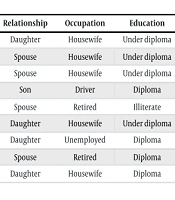
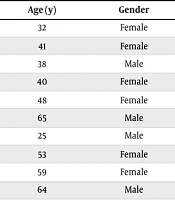
The present research has been conducted by content analysis method. The sample of the present research included all the main family caregivers of cancer patients in the terminal phase of the disease, whose patients were hospitalized in the palliative care ward of ALA cancer prevention and control center, Tehran, Iran. The sample was selected by purposeful sampling method, the data were saturated after the17th and 18th interviews, after which the sampling procedure was over. In sum, 15 participants were interviewed in the present research, so that three participants were interviewed for more than one time. The Sociodemographic Characteristics of them are presented in Table 1. The sample selection criteria were as follows: 1, the caregivers who are a member of the patient’s family and have been caregiving the patient for at least 6 months; 2, they should be aware of the terminal phase of the disease; 3, they should not be affected by any specific medical and psychiatric illnesses; and 4, they should be able to describe their experiences and have full and conscious consent for participating in the interviews. The study is reviewed and approved by ethics committee of University of Social Welfare and Rehabilitation Sciences.
2.1. Data Collection and Analysis
For the purpose of respecting the participants’ rights, the researcher took written-informed consent letter from them. For gathering the data, the researcher took in-depth face to face semi-structured interviews from the participants. The interviews duration has been 40 - 65 minutes, which were recorded by participants’ notice. These interviews and the additional notes (which were written by the researcher during the interview) were transcribed on paper as soon as possible, and then, the text would be typed into a computer. After several reviews, the transcribed texts of the interviews were broken down into constituent semantic units, and then into smallest meaningful units, and a number would be assigned to them, as the initial concept. Afterwards, the codes were reviewed for several times, to be placed in main categories and sub-categories based on their semantic similarity. The initial texts and final categories were reviewed for several times until the researcher and participants reached a semantic agreement about the categories. For determining the data accuracy, four criteria were used: acceptability, reliability, verifiability, and transferability (12). For determining the data acceptability, a constant engagement existed with the research topic and data. The corrective comments of professors of the research team on interview procedure, analysis, and the extracted data were used. Interview contexts and their extracted codes and categories, were handed to some of the participants and two PhD students of rehabilitation counseling as researcher colleagues, and their comments were also considered. By using synthesis in the data gathering method (interview and in-field notes) and finally in selecting the sample, the necessary variety was provided. For determining data reliability, as mentioned in determining the acceptability, the synthesis method was used for data gathering and an external observer, familiar with qualitative research, was employed for examining the data, and there was an agreement on the process and results. For determining the verifiability of the results, all the activities including the work procedure and the finding results procedure were recorded with great detail and a report on research procedure was provided. Also, for determining the transferability of the data, the results were shared with two main family caregivers who were outside the study with a condition similar to research participants, and the results were confirmed by these caregivers, as well.
3. Results
Table 1.
Sociodemographic Characteristics of Family Caregivers (N = 15)
| Variables | Value |
|---|---|
| Age range | 25 - 53 |
| Mean age | 41 |
| Marital status | 2 single and 13 married |
| Employment status | 4 unemployed, 1 university student, 5 employed, 4 housekeepers, and 1 retired |
| Average of caregiving | 1 year and 7 months |
From a total of 18 interviews, 413 initial concepts were obtained, and three categories were extracted after the analysis, including: 1, inhibition; 2, care challenges and consequences; and 3, supportive-palliative factors. Each of these main categories are constituted by several sub-categories and initial categories.
3.1. Inhibition
The first main concept is inhibition, which has two sub-categories:
3.1.1. Informational Inhibition with Three Initial Categories
1, full concealment of information from the patient: suggests that the caregivers have given no information about cancer development to the patient and they do not intend to inform the patient about his illness. 2, censoring the information on the disease phase: in the case of such caregivers, the patient knows about his illness, but he does not know about the terminal phase and the progress of his cancer. One of the caregivers says: “I don’t dare to tell him that his illness has progressed. I fear that he would lose his spirit”. One of the main reasons for such informational censorship is that they believe the patient would lose his spirit in case of knowing about the final phase. 3, informational inhibition from the family: some of these caregivers, conceal or censor information about the illness and its progress from their family members. Such caregivers, due to the important, heavy responsibility they have, are always worried about their family members, and they would not fully inform them about the illness because of being worried about the mental state of the older and younger members of the family.
3.1.2. Emotional Inhibition Includes Two Initial Categories
1, emotional inhibition in front of the patient: suggests that the caregivers prevent themselves form expressing any emotions or affection such as crying, tiredness, worries, sympathies, and so on, in front of the patient. A caregiver’s quote: “the hard thing is that I am internally wrecked up, but I have to stay strong. But without any frowns or cries”. 2, emotional inhibition in front of the family: the main family caregivers have a burdensome role to play, and in addition to the patient, they are worried about other members of the family, as well. Thus, they try to present themselves as a strong person with high spirit in front of their family members. One of the caregivers says: “I had a lump in my throat in front of my mother and family, but I didn’t cry, because if I cry, they’d think I have lost hope”.
3.2. Care Challenges and Consequences
The second category obtained from the current research is care challenges and consequences, which has four sub-categories.
3.2.1. Economic Pressures
Including 1, financial and 2, career pressures. Financial pressures include running out of savings, financial and insurance problems, transportation (commuting), and for some caregivers, financial crisis. Career problems have also been considerable, so much that the self-employed caregivers have abandoned their jobs, and the government employed caregivers have faced certain career challenges. As one of them says, “I’m a government employee, but now I don’t know whether I’m still an employee or not. Because it has been about two weeks that I have left my job due to the severity of my father’s condition”.
3.2.2. Physical Problems
1, weight change: weight gain/loss at the same time with the disease’s progress. One of the reasons for this upsetting change is the disturbance that occurs for the sleep cycle and appetite of such individuals. 2, fatigue and pain: because of the physical condition of the patient, the caregivers have to be always vigilant in order to help the patient with pains, medicine intake, hygienic issues, bandage change and so on. In this point, the patient has nearly a disturbed physical function, and he cannot take care of himself on his own. Additionally, the irregular sleep of the caregivers is also among the physical fatigue factors. One of the caregivers says: “Day and night, I just go back-and-forth between the hospital and pharmacy. I’m so tired. Sometimes that I can take a nap or sleep, my knee-pain and feet-pain disturb my sleep. My body is exhausted”.
3.2.3. Family Challenges
1, disturbing the life routine: clearly, cancer and particularly its progress can lead to disturbance in the daily routine of the family life. These caregivers have reported that they have experienced reduced family relationships, interruption in their education, limitation in social relationships, suspension of the plans, and disturbance in long-term and short-term personal/family goals of theirs. 2, failing in the roles: due to the burdens of taking care of the patient, such caregivers would fail to play their role in the family. They have reported the following problems: stopping the sexual relationship with the patient or with the non-patient spouse, or failing to play their marital/parental role. Such failures from the family roles lead to certain problems and conflicts between the family members and the caregiver, particularly when the mother/wife of the family is the main caregiver. 3, conflict with family members: this sub-category is partly due to failing to play the family role. Anger and conflict feelings between the caregivers and patients have been reported, so much that one of them says, “I’m all at my husband’s (patient) service, but he doesn’t understand me”. The caregivers have also reported to have conflicts with their family members for the type of treatment.
3.2.4. Emotional-Psychological Pressure
Including 9 initial categories. 1, patient-related stress: A, psychological pressures due to the patient’s pain: since the patient is in the final phase, he would suffer from severe physical pain because of metastasis and the progress of the disease. B, Frustration and concern about decline of the patient’s spirit: in fact, those caregivers who are still hopeful about the miracle and their patients’ healing, while their patient has lost his hope, would experience the feelings of frustration and worry. 2, future-oriented concerns include two parts: A, the concerns related to family members: this is the major concern of the caregivers about the younger family members, who might suffer a trauma due to the patient’s death. Some of them are also worried for the genetic base of cancer; their fear is for their children are also likely to develop cancer. B, self-related concerns: generally, those husbands of a cancer patient are worried that they would lose a strong supportive source, and they feel worried and anxious. Also, some of them are worried about the genetic basis of cancer, lest they develop cancer, too. 3, depression and grief: such caregivers experience a great deal of grief. They reported crying, depression symptoms, losing spirit, hopelessness, and despair. 4, stress: due to the physical condition of the patient, the caregiver is vigilant in any moment in order to present himself beside the patient. Also, because of the serious physical condition of the patient, the caregiver feels an anxiety about the patient’s upcoming death. 5, functional-psychological problems: some caregivers reported an increased use of smoking and smoking relapse. They have also reported the following: irritability, reduced tolerance threshold, occasional amnesia, increased dose of sedative drugs, and feelings of numbness. 6, sleep-related disorders: this category has been included in the emotional-psychological pressures because sleep-cycle disturbance, lack of sleep, low-quality sleep, and also having disturbed dreams lead to psychological pressures for the caregivers. 7, resent from the relatives: although the caregivers refer to the relatives as supportive factors, but occasionally, they get resented by the kind of look and intentional/unintentional words of the relatives. They get resented from the sympathy and pity feelings of the relatives and some of them get severely resented by the relatives’ comments. 8, Feelings of loneliness-caregiving pressure: as mentioned earlier, the main caregiver tolerates a great deal of caregiving pressure, and according to this sub-category, they are alone for the patient care; and they feel lonely. 9, Annoying and dysfunctional beliefs: this sub-category refers to the beliefs that the caregivers have about the cause of the disease. They usually assume one particular cause for the disease, and this belief gets annoying if they blame the patient or themselves for the disease; and this belief leads to the feeling of guilt about oneself. One of them says, “I stressed mama for many years, and I feel one reason for the disease is the stress that I caused.”
3.3. Supportive-Palliative Factors
This is the third concept of the present research which includes three sub-categories.
3.3.1. Associates
Associates means all the family, friends and relatives. Family caregivers have reported that family, relatives, friends of theirs or those of the patient’s, constitute their psychological and emotional support sources.
3.3.2. Spirituality
This category includes 4 sub-categories, as follows: 1, spiritual comfort: the caregivers reported the following factors as their spiritual and psychological comfort source: praying to God, Azadari (religious mourning rituals for Imam Hossein), reading Quran, and religious practices. 2, spiritual beliefs: this sub-category involves spiritually-based beliefs that the caregivers hold about their caregiving and the disease. They consider this tough condition as a divine test, which they must pass proudly. Some have a destiny-based attitude (Taghdir in Islamic terms) towards the disease. In fact, this sub-category suggests the meanings that the caregivers attribute to the disease and consequently to the caregiving. These adaptive spiritual beliefs lead to some calm and comfort for such individuals. 3, comforting beliefs about death and afterlife of the patient: this group of beliefs is also suggesting adaptive meanings that the caregivers attribute to death and particularly the patient’s death. One of them says, “I think at least after all this illness she would be in peace in heaven”. However, all the caregivers do not possess religious attitudes, such that one of them says, “The world is finite. One day we come, one day we go. We never perish. We’ll come back to nature again”. 4, religious practices for healing the patient: this group of caregivers are still hopeful about divine miracles and, as they say, they have still a high spirit; and they find the religious practices as a way of finding peace and hope.
3.3.3. Positive Outcomes of Caregiving
This category includes two sub-categories: 1, transcendence: this term in this research is used to refer to the beneficial and valuable experience that caregivers have gained as a result of taking care of the patient. These experiences include: increased sense of responsibility towards family, valuing the moments of being with the patient and family, the feeling of getting close to God, getting in touch with death and the transient nature of life, recognizing the value of the parents very existence, spiritual growth and transcendence, and recognizing the love between the patient and self. 2, feeling satisfaction from caregiving: this sub-category refers to a positive and valuable feeling which the caregiver obtains by taking care of the patient.
4. Discussion
In the present study, three main concepts (categories) were obtained from the experiences of family caregivers of cancer patients in the terminal phase. The inhibition concept indicates emotional and informational inhibition, by which the caregivers try to deny or censor the disease-related information from the patient and other family members. Emotional inhibition is partly derived from informational inhibition, that is, the caregivers try not to express their emotions by the purpose that the patient would not know about the condition, keep his spirit, and get hopeful. Such inhibition would lead to some psychological conflicts and problems for the caregiver. To the best of the author’s knowledge, this concept has not been referred to in the related research on the subject. Conversely, according the research conducted by Yun and colleagues (13), the majority of the patients (58%) and caregivers (83.4%) were aware of the disease’s final phase, and the patients (78.6%) preferred more, in comparison to caregivers (69.6%), that the patients would be informed about the final phase of the disease. The caregivers of the current research think that factors such as being young or educated are accountable for inhibition. They were also worried that in case of informing the patient about the condition, his condition would deteriorate, and this pressure would consequently turn back to the caregiver.
The second main concept in the present research has been negative challenges and outcomes of care, which has several sub-categories. Some categories of this concept, that is, patient-related stress, concern about future, stress, depression and grief, financial and physical problems, family challenges, sleep-related changes, psychological functional problems, loneliness and caregiving pressure are consistent with some research (4, 7, 8, 14-18). However, two sub-categories, namely, annoying and dysfunctional beliefs and resentment from the relatives are not seen in prior research. This concept suggests a high care burden among family caregivers of patients with cancer in terminal phase in Iran.
The medical staff, including physician, nurse, social worker, psychologist, counselor, psychiatrist, and so on, should pay attention to numerous problems of these individuals. They are hidden patients who experience high levels of psychological, physical, family, and social symptoms. They even experience spiritual/religious challenges, and they need spiritual-psychological support for the purpose of adapting with the imminent death of the patient and getting prepared to mourn for the loss, so that they would feel less severe consequences in the loss phase.
Overall, based on this concept, they have dysfunctional and insufficient information about cancer, they do not know how to take care of themselves and the patient appropriately, their coping strategies against stress and various problems are limited and insufficient, and they suffer from various psychological distress and physical problems in relation to the caregiving.
The third concept is related to supportive-palliative factors. This concept is comprised of three categories: associates, spirituality and positive outcomes of care. Associates suggests that caregivers who share caregiving responsibilities are less prone to negative consequences (19). Spirituality suggests that the caregivers in the Iranian culture are affected by spiritual/religious beliefs, and they use religion and spirituality for adapting to and coping with the crisis condition. The present results are consistent with research conducted by Hatamipour (20) and Lotfi Kashani and colleagues (21). Spirituality and religious beliefs are among the main factors for psychological comfort and healing among these caregivers. On the other hand, the annoying spiritual/religious beliefs indicate the attention and importance that such individuals assign to spirituality, and they also suggest cognitive distortions and distortion in God’s image. Also, the positive outcome or post-traumatic growth are among significant factors which reduce distress in caregivers and their patients (22).
4.1. Conclusion
According to the three obtained concepts, it can be said that for providing spiritual, psychological, financial, informational and physical support for the caregivers of cancer patients, it is better that some programs and actions be designed which are consistent with Iranian culture, so that a ground for healing and reducing negative care consequences would be provided for such individuals. Regarding clear exposure of the disease’s information, cultural and other issues should be considered, and we should have conversations and clarification sessions regarding the outcomes of inhibition -especially informational inhibition- with the caregivers. Also, the medical staff can increase the adaptability of such individuals by emphasizing the positive outcomes of caregiving. In addition, most participant caregivers of the present study stated that in the terminal phase (metastasis and disease progression), they feel more severe problems and conflicts, and some have referred to this phase as a kind of crisis. This means that these family caregivers need more therapeutic and supportive attention in this phase of the disease. In fact, they were satisfied with the presence of their patient in the palliative care ward, because they could not manage the patient’s symptoms at home, which means, they need medical information about taking care of both themselves and the patient in order to be able to manage the patient’s symptoms in case of patient discharge, and take care of themselves, too.
4.2. Limitations
Having an interview with those caregivers who talked with just one local dialect was not possible. Due to the research method we used, comparing the experiences of caregivers in different phases of the disease was not possible. Therefore, these issues must be considered in future research.
4.3. Recommendations
According the results of the present study, it seems that more research should be conducted on the informational inhibition subject and its solution in Iranian culture. This is necessary that the patients’ experiences in this phase of the disease be evaluated.