
1. Background
Cancer is one of the main public health problems (1) and the most well-known life-threatening disease in Western societies (2). It is predicted that 1,958,310 new cancer cases and 609,820 related deaths will occur in the United States by 2023 (1). The incidence of cancer among Iranian men and women is 19.4% and 17.2% per 100,000 people, respectively, and it is the third cause of death and disability after cardiovascular diseases and traffic accidents (3).
Today, early diagnosis and advanced treatments have increased the survival rate of cancer patients (4). The care of these patients has shifted towards home care (5), and family members play an important role in this regard (6). This role is more pronounced in Middle East countries, including Iran, with a predominantly Muslim population and a great emphasis on family cohesion (7).
Family caregivers of cancer patients undertake complex care tasks such as medication prescription, symptom evaluation and management, wound dressing, and caring for colostomy, but they carry out these tasks with little preparedness (8). Therefore, playing such a caring role has positive effects on them, such as creating a sense of self-esteem, personal satisfaction, love, closeness, and intimacy (9), but it can also cause CB. Caregiver burden is a unique understanding based on which caregivers consider caring situations stressful (10). In other words, caring for a cancer patient affects caregivers' communication patterns, job performance, and social roles and confronts them with complex challenges (11). These challenges include physical and emotional issues such as fatigue, sleep problems, pain, weakness, anxiety, and depression (12). In addition, according to studies, cancer often leads to financial problems for these families (7). Moreover, caring for cancer patients can cause tension in caregivers' marital and family relationships and restrictions in daily activities (9). All these problems can ultimately increase cancer patient caregivers' care burden (13). According to a study in Iran, 33.8% of the caregivers of cancer patients experience severe CB (3). In addition, a study in China has stated that the CB of family caregivers of male patients with advanced cancer is significantly high (14).
Increased CB in family caregivers can lead to a decline in their mental and physical health (13) and negatively affect their QOL (6). In addition, life satisfaction decreases significantly in caregivers as their CB increases (15). In other words, care is provided in an atmosphere of suffering, and family caregivers of people with cancer find themselves overwhelmed with responsibilities and problems that can reduce their efficiency and QOL (11). According to studies, the increased CB in caregivers of cancer patients can significantly reduce their QOL (3).
Quality of life is a multidimensional structure of a person's life, including various physical, emotional, social, and welfare aspects (16), and it has recently been accepted as an important criterion in evaluating the effectiveness of oncology treatments (17). A literature review demonstrated that family caregivers of cancer patients have a low quality of life (18), affecting the quality of their care and, ultimately, the QOL of the patients (13).
Despite the adverse effects of CB, early detection and effective solutions can significantly improve the QOL of cancer patients and their family caregivers. However, there have been few relevant studies in Iran. According to studies, the cancer pain and subsequent psychological stress, which affects the patient and their caregivers, differ depending on the geographical, ethnic, and religious conditions. Therefore, it is very important to conduct population-specific research (19). On the other hand, a review of previous studies shows that nurses play a key role in supporting the caregivers of cancer patients (20), which requires sufficient information in this field. Besides, according to previous studies, general instruments have often been used to evaluate the QOL of family caregivers of cancer patients (12). This indicates the need to investigate the QOL of family caregivers using a specific instrument.
2. Objectives
The present study aims to determine CB and its relationship with QOL in family caregivers of cancer patients referred to Bagai 2 Hospital of Ahvaz City between 2021 and 2022.
3. Methods
3.1. Study Design and Setting
This cross-sectional study investigated the relationship between QOL and CB in family caregivers of cancer patients between 2021 and 2022. The study population included all family caregivers of cancer patients referred to Baqaei 2 Hospital in Ahvaz.
3.2. Participants
The sample size was estimated at 166 people based on a previous pilot study on 20 caregivers of cancer patients and using the following formula considering the test power = 0.95, α = 0.05, d = 4.8, and SD = 30.93. The questionnaire was distributed among 185 eligible caregivers of cancer patients. Convenience-sampling method used for sampling.
Study inclusion criteria included having a family relationship with the patient and being recognized as the patient's main caregiver. Other inclusion criteria included being at least 18 years old, absence of other diseases in a patient, being diagnosed with cancer and undergoing treatment for at least 3 months, consent to participate in the study, lack of known psychological problems or chronic diseases among caregivers, reading and writing literacy, and the ability to answer the questions of the questionnaire. Exclusion criteria included incomplete questionnaires.
3.3. Measurements
The data collection instruments included three questionnaires.
Demographic-clinical questionnaire: This questionnaire included the demographic information of family caregivers of cancer patients (age, gender, level of education, occupation, etc.) and patients (age, gender, type of cancer, type of treatment, and duration of the disease).
Caregiver Burden Scale (CBS): This questionnaire was designed by Elmstahl et al. in 1996 (21). It was translated and validated by Farajzadeh et al., and its reliability for all subscales was estimated at 0.74 to 0.9 by Cronbach's alpha method (22). This questionnaire consists of 22 items in five areas: General strain (8 items), isolation (3 items), disappointment (5 items), emotional involvement (3 items), and environment (3 items). Each item is scored based on a 4-point Likert scale ranging from one (never) to four (most of the time). Scores 22 - 43.99, 44 - 65.99, and 66 - 88 show low, moderate, and severe care burden, respectively.
Caregiver Quality of Life – Cancer (CQOLC): This questionnaire was prepared in 1997 by Weitzner et al. (23) and validated and translated into Farsi by Khanjari et al. The questionnaire's face, content, and construct validity were confirmed. Its reliability was reported as 0.89 by Cronbach's alpha (24). This questionnaire consists of 35 items in five areas: Mental/emotional burden (14 items), lifestyle disruption (9 items), positive adaptation (8 items), financial concerns (3 items), and family interest in caregiving (one item). Each item is scored based on a 5-point Likert scale ranging from zero (not at all) to four (always). The possible score range is 0-140. A lower score indicates a better QOL in most questions of this questionnaire. However, the scoring in questions 34, 28, 27, 22, 4, 10, 12, and 16 are reversed, and a higher score indicates a better QOL.
3.4. Statistical Analysis
Data analysis was conducted using SPSS v22 software. Descriptive statistics for numeric variables were displayed as mean (SD), and categorical variables were expressed using numbers (percentages). Independent-sample t-test and one-way ANOVA were used to compare CB and QOL by demographic-clinical factors. Correlations between QOL and CB scores were assessed using Pearson's correlation analysis. The predictors of QOL and CB scores were determined using stepwise multivariate linear regression analysis. P-value < 0.05 was considered a significance level in all tests.
3.5. Ethical Considerations
The present study was approved by the Ethics Committee of Ahvaz Jundishapur University of Medical Sciences (ethics code: IR.AJUMS.REC.1399.200). Ethical considerations included obtaining permission from the competent authorities, obtaining informed written and oral consent from the participants, voluntary participation and withdrawing from the study at any time, and information confidentiality.
4. Results
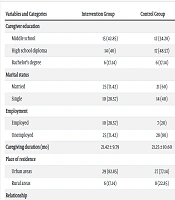
The study involved 178 caregivers of cancer patients. The mean ± SD of the caregivers' age was 42.2 ± 4.5 years. Most caregivers were male (58.4 percent), and 70.8 percent were married. The majority (64%) of the caregivers had diplomas and sub-diploma. Other demographic information of the caregivers is shown in Table 1.
Table 1.
General Characteristics of Caregivers
| Variables | No. (%) |
|---|---|
| Gender | |
| Male | 104 (58.4) |
| Female | 74 (41.6) |
| Relationship to patient | |
| Parents | 20 (11.2) |
| Daughter/son | 57 (32) |
| Spouse | 51 (28.7) |
| Sister/brother | 26 (14.7) |
| Others | 24 (13.5) |
| Education | |
| > High school diploma | 64 (36) |
| ≥ High school diploma | 114 (64) |
| Marital status | |
| Single | 35 (19.7) |
| Married | 126 (70.8) |
| Divorced/widow | 17 (9.5) |
| Employment status | |
| Employed | 94 (52.8) |
| Not employed | 72 (40.4) |
| Student | 12 (6.7) |
| Family income (tomans/mo) | |
| ≤ 3 | 121 (68) |
| 3 - 5 | 53 (29.8) |
| 5 - 10 | 2 (1.1) |
| ≥ 10 | 2 (1.1) |
| Place of residence | |
| City | 115 (64.6) |
| Village | 63 (35.4) |
The mean ± SD of the patients’ age was 52.22 ± 14.31 years. Most of the patients (57.9 percent) were women. The most common cancer among patients was breast cancer (29.8 percent). The most common treatment type among patients was chemotherapy (42.7 percent), and the most common Duration of disease in the patients was 24 - 36 months (38.8 percent).
The mean ± SD of CB score reported by caregivers was 15.79 ± 50.23, and 35.4%, 47.8%, and 16.9% of caregivers reported low, moderate, and severe CB, respectively. The mean ± SD of caregivers' QOL was 80.84 ± 23.29 (Table 2).
Table 2.
Caregiver Burden and Quality of Life Mean in Caregivers of Patients with Cancer
| Variables | Mean ± SD |
|---|---|
| General strain | 18.65 ± 6.09 |
| Isolation | 7.59 ± 2.93 |
| Disappointment | 12.62 ± 4.33 |
| Emotional involvement | 5.42 ± 2.83 |
| Environment | 5.93 ± 2.60 |
| Care burden (total score) | 50.23 ± 15.79 |
| Lifestyle disruption | 25.79 ± 8.424 |
| Mental/ emotional burden | 31.74 ± 12.48 |
| Financial concerns | 4.45 ± 3.64 |
| Positive adaptation | 16.09 ± 5.53 |
| Family interest in caregiving | 2.76 ± 1.40 |
| QOL (total score) | 80.84 ± 23.29 |
Before the regression analysis, the relationships between the research variables were investigated using an independent t-test, one-way ANOVA, and correlation matrix.
Results of investigating CB and QOL of caregivers of cancer patients by clinical and demographic factors showed that men reported higher CB and lower QOL than women. This difference was significant in isolation (t = 2.96, P = 0.004), disappointment (t = 2.98, P = 0.003), environment (t = 2.91, P = 0.01), total care burden score (t = 2.49, P = 0.01,) and financial concerns quality of life (t = 3.68, P < 0.001) dimensions.
ANOVA showed a statistically significant difference between the married and single individuals in disappointment (F = 7.83, P = 0.001) and environment (F = 3.86, P = 0.02), positive adaptation, and QOL (F = 9.81, P < 0.001). Based on Tukey's post hoc test, this difference was significant between single and married people. Single people reported higher CB and lower QOL than married people.
ANOVA also showed a statistically significant difference in all aspects of CB (P < 0.05) and the total caregiving burden score (F = 12.73, P < 0.001), lifestyle disruption (F = 6.6, P = 0.002) and the total QOL score (F = 4.41, P = 0.01) based on employment status. Based on Tukey's post hoc test, employed people and students reported higher CB and lower QOL than unemployed or housewives.
Independent t-test demonstrated a higher CB in isolation (t = 2.48, P = 0.01), environment (t = 2.16, P = 0.03), and the total care burden score (t = 2.14, P = 0.03) and a lower QOL in positive adaptation (t = 2.94, P = 0.004) in people with an education level less than a diploma compared to people with a diploma education and higher.
In terms of the type of caregiver, a significant difference was found in the general strain of caregiver burden (F = 3.79, P = 0.005) and in the dimensions of mental or emotional burden (F = 2.97, P = 0.02), positive adaptation (F = 3.84, P = 0.005), and family interest in QOL (F = 2.68, P = 0.03). Post-hoc analysis suggested that the main difference was between sister-brother and parents in caregiver burden (P = 0.003) and between spouse and parents in terms of QOL (P < 0.05).
Regarding the place of residence, rural people had higher CB in the dimensions of disappointment (t = 2.74, P = 0.007) and mental-emotional burden (t = 2.58, P = 0.01). Also, they have poorer QOL in lifestyle disruption (t = 4.28, P < 0.001), mental-emotional burden (t = 3.4, P = 0.001), financial concerns (t = 5.13, P < 0.001), and total QOL score (t = 4.21, P < 0.001) in comparison with urban residents.
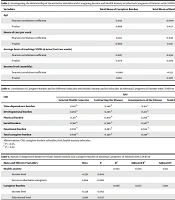
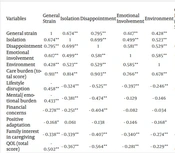
The Pearson correlation results also showed an inverse and significant correlation between the age of the caregivers and CB and a positive and significant correlation between the duration of the disease and CB. There was a positive significant correlation between the caregivers' age and their income with their QOL and an inverse significant correlation between the duration of the disease and QOL (Table 3). In addition, Pearson's correlation coefficient test showed a significant and negative correlation between CB and all subscales of QOL (Table 3).
Table 3.
Correlation Matrix Between Variables of the Caregiver Burden, Quality of Life, Age, Income, and Duration of Disease in Caregivers of Patients with Cancer a
| Variables | General Strain | Isolation | Disappointment | Emotional Involvement | Environment | Care Burden (Total Score) | Age | Income | Duration of Disease |
|---|---|---|---|---|---|---|---|---|---|
| General strain | 1 | 0.674** | 0.795** | 0.617** | 0.428** | 0.911** | - 0.164* | - 0.106 | 0.223** |
| Isolation | 0.674** | 1 | 0.699** | 0.499** | 0.523** | 0.814** | - 0.112 | - 0.012 | 0.249** |
| Disappointment | 0.795** | 0.699** | 1 | 0.581** | 0.529** | 0.903** | - 0.181* | - 0.113 | 0.133 |
| Emotional involvement | 0.617** | 0.499** | 0.581** | 1 | 0.585** | 0.766** | - 0.196** | 0.106 | 0.126 |
| Environment | 0.428** | 0.523** | 0.529** | 0.585** | 1 | 0.678** | - 0.133 | 0.174* | 0.268** |
| Care burden (total score) | 0.911** | 0.814** | 0.903** | 0.766** | 0.678** | 1 | - 0.191* | - 0.026 | 0.236** |
| Lifestyle disruption | - 0.458** | - 0.324** | - 0.525** | - 0.397** | - 0.246** | - 0.493** | 0.174* | 0.161* | - 0.217** |
| Mental/ emotional burden | - 0.433** | - 0.381** | - 0.474** | - 0.129 | - 0.146 | - 0.415** | 0.209** | 0.169* | - 0.284** |
| Financial concerns | - 0.278** | - 0.251** | - 0.404** | - 0.082 | - 0.034 | - 0.285** | 0.232** | 0.231** | - 0.113 |
| Positive adaptation | - 0.168* | 0.061 | - 0.138 | - 0.146 | - 0.168* | - 0.146 | 0.080 | - 0.058 | - 0.211** |
| Family interest in caregiving | - 0.338** | - 0.339** | - 0.407** | - 0.340** | - 0.274** | - 0.411** | - 0.036 | 0.020 | - 0.106 |
| QOL (total score) | - 0.502** | - 0.367** | - 0.564** | - 0.281** | - 0.229** | - 0.505** | 0.228** | 0.173* | - 0.305** |
a According to Pearson correlation coefficients: *P < 0.05; **P < 0.001.
Independent variables significantly associated with the QOL and CB outcomes were included in the multiple regression. The stepwise multiple linear regression analysis results revealed that CB, rural residence, duration, and type of disease were predictors of QOL in caregivers of cancer patients. This model explained 41% of the variance in QOL (F = 32.05, P < 0.001). In addition, this model indicated that increasing CB reduced QOL by 0.61 (Table 4). Results also showed a significant relationship between marital status, employment status, duration of the disease, type of cancer, level of education, and type of caregiver with CB. The model explained 32% of the variance in CB (F = 11.32, P < 0.001) (Table 4).
Table 4.
Summary Results of the Multiple Linear Regression Analyses with the Quality of Life and the Caregiver Burden as Dependent Variable
| Dependent Variables | R | R2 | Adj. R2 | Independent Variables | B | SE | β | t | P | |
|---|---|---|---|---|---|---|---|---|---|---|
| QOL | 0. 65 | 0.42 | 0.41 | Constant | 105.670 | 6.991 | - | 15.115 | < 0.001 | |
| Caregiver burden | - 0.614 | 0.087 | - 0.416 | - 7.021 | < 0.001 | |||||
| Living in the village | 13.534 | 2.822 | 0.279 | 4.795 | < 0.001 | |||||
| Duration of disease | - 5.609 | 1.310 | - 0.254 | - 4.283 | < 0.001 | |||||
| Cancer type (breast cancer as reference category) | Cervical cancer | - 5.317 | 1.666 | - 0.185 | - 3.191 | 0.002 | ||||
| Caregiver burden | 0.59 | 0.34 | 0.32 | Constant | - 29.072 | 16.969 | - | - 1.713 | 0.089 | |
| Cancer type, (Brest cancer as reference category) | Gastrointestinal cancer | - 3.274 | 0.643 | - 0.343 | - 5.089 | < 0.001 | ||||
| Lymphoma | -3.233 | 1.377 | - 0.154 | - 2.347 | 0.020 | |||||
| Marital status, (Marriage as reference category) | Single | - 6.943 | 2.503 | - 0.201 | - 2.774 | 0.006 | ||||
| Duration of disease | 2.674 | 1.038 | 0.179 | 2.575 | 0.011 | |||||
| Type of caregiver, (Parents as reference category | Sister/Brother | 2.906 | 0.799 | 0.259 | 3.637 | < 0.0001 | ||||
| Employment status, (Unemployed as reference category) | Employed | 33.581 | 5.730 | 2.338 | 5.861 | < 0.001 | ||||
| Student | 56.870 | 10.255 | 2.236 | 5.546 | < 0.001 | |||||
| level of education, (High school diploma < as reference category) | High school diploma ≥ | - 7.066 | 2.265 | - 0.215 | - 3.120 | 0.002 | ||||
5. Discussion
The present study aimed to determine CB and its relationship with the QOL of family caregivers of cancer patients. Results revealed that the mean scores of caregivers' QOL was 80.84 ± 23.29. In addition, it was demonstrated that most family caregivers of cancer patients experienced moderate CB. In this regard, a previous study reported the mean scores of the caregivers' QOL was 59.79 ± 19.65 and observed moderate CB for most caregivers of cancer patients (3). However, Gabriel reported high CB among informal caregivers of women with breast cancer (25). This difference in results may be due to the inclusion of caregivers of patients with different types of cancer in this study because only women with breast cancer were investigated in the Gabriel study. According to the evidence, the type of cancer can affect CB (10).
This study showed a significant and negative correlation between the CB of family caregivers of cancer patients and their QOL, and with an increase in CB, the QOL of family caregivers of cancer patients decreased significantly. In this regard, previous studies showed that an increase in the CB of caregivers of cancer patients had an adverse and negative effect on their QOL (26) and significantly reduced it (3). A decline in the QOL of caregivers affects the quality of their care and, ultimately, the QOL of patients (13). Therefore, identifying and paying more attention to caregivers exposed to higher CB and lower QOL seems necessary.
In this study, the regression analysis results showed that CB was influenced by demographic and clinical factors such as marital status, employment status, level of education of the caregiver, the family relationship with the patient, and the duration and type of cancer. QOL is influenced by factors such as CB, rural residence, duration, and type of disease.
Results also revealed that married people had lower CB and better QOL than single people. Consistent with these results, previous studies have shown significantly higher CB and lower QOL in single caregivers than married ones (27, 28). According to previous studies, single caregivers experience more caregiving stress than married ones (29), which can significantly increase CB and reduce their QOL.
The results of the present study showed that employed or student caregivers had a higher CB and a lower QOL than other caregivers. According to previous studies, caregivers' employment status significantly affects their QOL (30). In contrast to the results of the present study, evidence shows that employed caregivers have a lower CB than unemployed people (27). The discrepancy in the results of this study and the previous evidence may be attributed to the fact that students or working caregivers have more responsibilities. Therefore, they are exposed to higher CB and lower QOL. However, homemakers or the unemployed suffer more economic problems and, if they have financial support from their partner or others, have more time to perform their caring role.
The results of this study showed that caregivers with a university education had a lower CB and a higher QOL than caregivers with a diploma education. Consistent with this study, previous studies demonstrated that caregivers with a high school education level had a lower QOL in the area of negative affect tolerance than caregivers with at least a bachelor's degree (28). In addition, a lower education level is associated with a greater financial burden (31), which can increase CB and reduce the QOL of caregivers with a lower level of education.
According to the results of this study, brothers and sisters had a higher CB in the general strain domain than other caregivers. In addition, parents reported a lower QOL in the positive adaptation domain than other caregivers. Consistent with the present study, previous studies demonstrated that patients’ first-degree relatives had a greater CB than second-degree relatives (27). However, contrary to the results of this study, evidence indicates that spouses’ caregivers, compared to other family caregivers, have had more schedule burdens over time (10). In addition, married or partner caregivers had a worse QOL (30). The reason for the discrepancy between the results of this study and previous ones is that in our country, parents, children, or spouses of the patient often consider it their duty to take care of the patient and do not consider it an additional burden. This attitude often does not exist in the patient's sibling, which can significantly increase their CB.
According to the results of this study, the increased duration of the disease caused an increase in CB and a decrease in QOL of family caregivers of cancer patients. According to the evidence, family caregivers of cancer patients are overwhelmed by responsibilities and problems that reduce their efficiency and QOL (11). Therefore, any increase in the disease duration will increase the responsibilities and problems of the caregivers, especially their financial problems, which can, in turn, cause an increase in CB and a decrease in the QOL of the caregivers.
The results of the present study also showed that the family caregivers of ovarian and cervical cancer patients experience a higher CB and lower QOL compared to the caregivers of other types of cancer. Consistent with the results of the present study, the evidence indicates that the type of cancer can affect caregiver burden (10). Regarding the effect of the type of cancer on the QOL of caregivers, a study reported that caregivers of patients with lung, head and neck, skin, and brain cancer had a worse QOL than others (30). However, contrary to the results of this study, no significant relationship has been found between the type of cancer and the QOL of caregivers (32). The discrepancy between the results of different studies may be due to the difference between the participants of different studies from different durations or stages of the disease. Evidence shows that the time spent since the diagnosis and the stage of the disease have a statistically significant effect on the QOL of caregivers (30).
In this study, rural family caregivers had higher CB and lower QOL than urban caregivers. Consistent with the results of this study, there is evidence that rural residents have less access to specialized health care than urban residents in the United States (33). Some Iranian cancer patients have to commute from the village to the city even to inject their GCSF injection, which can put additional pressure on the patients and their families (4), increase their CB, and decrease their QOL.
5.1. Limitations
The data collection was concurrent with the COVID-19 pandemic in Iran, which may have affected the study results. Other limitations of this study include the convenience sampling method or the study's cross-sectional design. Despite its limitations, this study provides important insights that can inform health research and practice.
5.2. Conclusions
According to the present study's results, most caregivers had moderate CB, but the QOL of the caregivers decreased significantly with an increase in CB. Therefore, oncology administrators and nurses should pay special attention to the caregivers who experience high CB and low QOL and implement necessary measures to reduce their CB and improve their QOL.
In order to gather more comprehensive information, it is necessary to conduct qualitative studies. It is also recommended to study the effect of the type of cancer on the CB and QOL of family caregivers separately to identify people who are vulnerable to higher CB and lower QOL by the type of cancer and took the necessary supportive measures.