
1. Background
According to GLOBOCAN 2020, prostate cancer is the second most common cancer and the fifth leading cause of cancer-related death among men worldwide (1). In Iran, the incidence of prostate cancer has increased in recent years, highlighting its growing public health importance (2). The main curative treatment options for nonmetastatic prostate cancer include radical prostatectomy, with or without adjuvant radiotherapy, and definitive radiotherapy (3). In recent years, positron emission tomography/computed tomography imaging has been increasingly used in prostate cancer management for staging, restaging, and treatment planning (4).
Approximately one-third of patients with localized prostate cancer are treated with definitive radiotherapy (5). Definitive radiotherapy can be delivered using conventional fractionation, hypofractionation, ultrahypofractionation, brachytherapy, or a combination of external beam radiotherapy and brachytherapy.
Although some observational studies have suggested improved overall survival with radical prostatectomy in high-risk prostate cancer, randomized clinical trials have reported similar overall survival between the 2 treatment modalities (6-9). However, differences in radiotherapy and surgical techniques may limit the interpretation of these findings.
A recent observational study of high-risk prostate cancer reported improved 10-year prostate cancer-specific mortality among patients treated with external beam radiotherapy combined with brachytherapy, compared with those treated with radical prostatectomy (10).
2. Objectives
3. Methods
3.1. Study Design, Setting, and Participants
This observational study was conducted in the Radiation Oncology Department of Mahdie Radiotherapy Center, Hamadan University of Medical Sciences, Hamadan, Iran. The study evaluated biochemical recurrence (BCR), local failure (LF), and distant failure (DF) in patients with nonmetastatic prostate cancer after definitive radiotherapy. Patient information was coded to ensure confidentiality.
The medical records of 54 patients with prostate cancer treated in the radiation oncology department were reviewed. The inclusion criteria were biopsy-proven prostatic adenocarcinoma; local staging with pelvic magnetic resonance imaging; whole-body bone scanning; and chest computed tomography to exclude metastatic disease in high-risk patients. Seven patients were excluded because of an inadequate diagnostic workup or insufficient follow-up. The collected data included age, pretreatment prostate-specific antigen (PSA) level, perineural invasion (PNI), Gleason score based on the International Society of Urological Pathology grading system (13), TNM stage according to the American Joint Committee on Cancer eighth edition (14), D'Amico risk-group classification (15), medical treatment, treatment date, radiotherapy field, and dose.
3.2. Treatment
All patients were treated with 3D-CRT. The planning target volume (PTV) margin was 1 cm in all directions except posteriorly, where it was 0.8 cm. The 95% isodose was required to cover the PTV.
Whole-pelvis radiotherapy (WPRT) was delivered using 4 fields (anterior, posterior, and 2 lateral fields) to a total dose of 46 Gy in 23 fractions. The irradiated volume included the distal common iliac, internal iliac, external iliac, and presacral lymph nodes, as well as the prostate and seminal vesicles.
Image-guided radiotherapy was not available for daily treatment verification. During the second phase, treatment was directed to the prostate with or without the seminal vesicles, depending on risk stratification, and was delivered using 3 fields to a total dose of 70 Gy.
Dose constraints for the organs at risk (rectum and penile bulb) were applied according to the Quantitative Analyses of Normal Tissue Effects in the Clinic guidelines (16). No specific dose constraints were applied to the femoral heads or the bladder. Androgen deprivation therapy (ADT) was administered according to risk group: 6 months for intermediate-risk disease and at least 2 years for high-risk disease.
3.3. Follow-Up and Outcome Definitions
Patients were followed with serum PSA measurements every 3 to 6 months for the first 5 years and every 6 to 12 months thereafter. According to the Phoenix consensus definition (17), BCR was defined as a PSA increase of ≥ 2 ng/mL above the nadir (nadir + 2 ng/mL).
In cases of suspected recurrence, pelvic magnetic resonance imaging, chest and abdominal computed tomography, and whole-body bone scanning (or prostate-specific membrane antigen positron emission tomography/computed tomography when available) were performed to determine the site of recurrence. LF was defined as recurrence in the prostate, seminal vesicles, or regional lymph nodes confirmed by biopsy. Distant metastasis was defined as the involvement of any distant organ or nonregional lymph nodes.
3.4. Ethical Considerations
This study was conducted in accordance with the principles of the Declaration of Helsinki. The study involving human participants was reviewed and approved by Iran University of Medical Sciences. The patients provided written informed consent to participate in the study. All patient data were anonymized before analysis, and confidentiality was maintained throughout the study.
3.5. Statistical Analysis
Statistical analyses were performed using SPSS version 22. The chi-square and Fisher exact tests were used to assess associations of the Gleason grade group, PNI, pretreatment PSA level, tumor extension, and risk group with BCR, LF, and DF. Continuous variables were expressed as mean ± standard deviation, and categorical variables were expressed as numbers and percentages. Kaplan-Meier analysis was used to estimate local failure-free and metastasis-free survival. Univariate Cox proportional hazards regression analyses were performed to identify prognostic factors associated with BCR. Variables with P < 0.10 in the univariate analysis were entered into a multivariable Cox regression model. Hazard ratios (HRs), 95% confidence intervals (CIs), and P values were reported. Cox regression analyses were not performed for LF and DF because of the low number of events, which could have produced unstable estimates. A P value < 0.05 was considered statistically significant.
4. Results
4.1. Patient Characteristics
A total of 47 patients with prostate cancer were enrolled in this observational study. All patients received definitive radiotherapy at Mahdie Radiotherapy Center from 2014 onward. The mean age was 69.77 ± 8.44 years.
All patients had prostatic adenocarcinoma and were classified as having intermediate- or high-risk disease. Table 1 presents the demographic and baseline characteristics of the study population. Most patients had high-risk disease (66%), and no patients had low-risk disease. In addition, 42.6% of patients had Gleason grade group 4 or 5.
Table 1.
Patient Characteristics a
| Characteristic | Values |
|---|---|
| Total | 47 |
| Age (y) | |
| < 70 | 21 (44.7) |
| > 70 | 26 (55.3) |
| Tumor extension | |
| Intraprostatic | 23 (48.9) |
| Extraprostatic | 24 (51.1) |
| Gleason score | |
| Low = 6 | 8 (17) |
| Intermediate = 7 | 19 (40.4) |
| High = 8 - 10 | 20 (42.6) |
| Grade group | |
| 1 | 8 (17) |
| 2 | 8 (17) |
| 3 | 11 (23.4) |
| 4 | 11 (23.4) |
| 5 | 9 (19.1) |
| PSA level (ng/mL) | |
| < 10 | 7 (14.9) |
| 10 - 20 | 25 (53.2) |
| > 20 | 15 (31.9) |
| PNI | |
| Negative | 20 (42.6) |
| Positive | 27 (57.4) |
| Risk group | |
| Low | 0 (0) |
| Intermediate | 16 (34) |
| High | 31 (66) |
a Values are expressed as No. or No. (%). Abbreviations: PNI, perineural invasion; PSA, prostate-specific antigen.
4.2. Outcomes
Overall, after a median follow-up of 45 months (25th percentile, 36 months; 75th percentile, 53 months), 13 treatment failures were observed. Biochemical recurrence occurred in 13 patients (27.6%), 7 patients experienced local recurrence (14.9%), and all 6 distant failures involved bone metastases (12.8%).
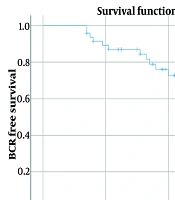
The 3-year biochemical recurrence-free, local failure-free, and metastasis-free survival rates were 76%, 88%, and 88%, respectively (Figures 1-3).
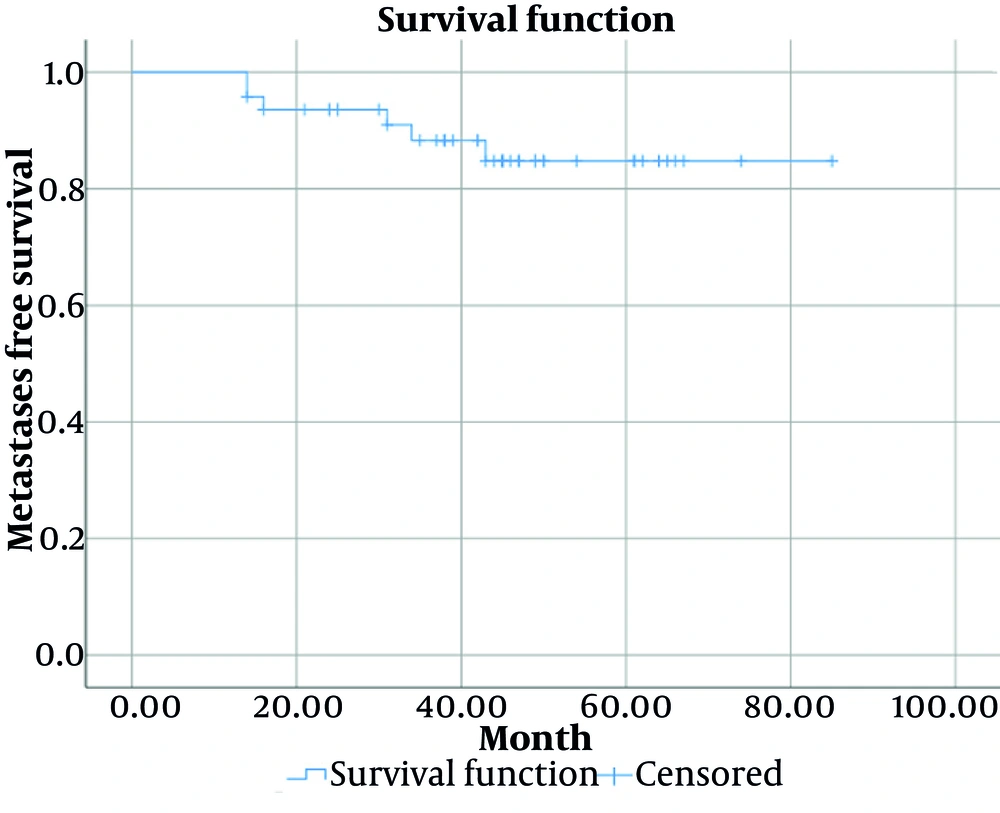
Figure 1.
Biochemical recurrence-free survival
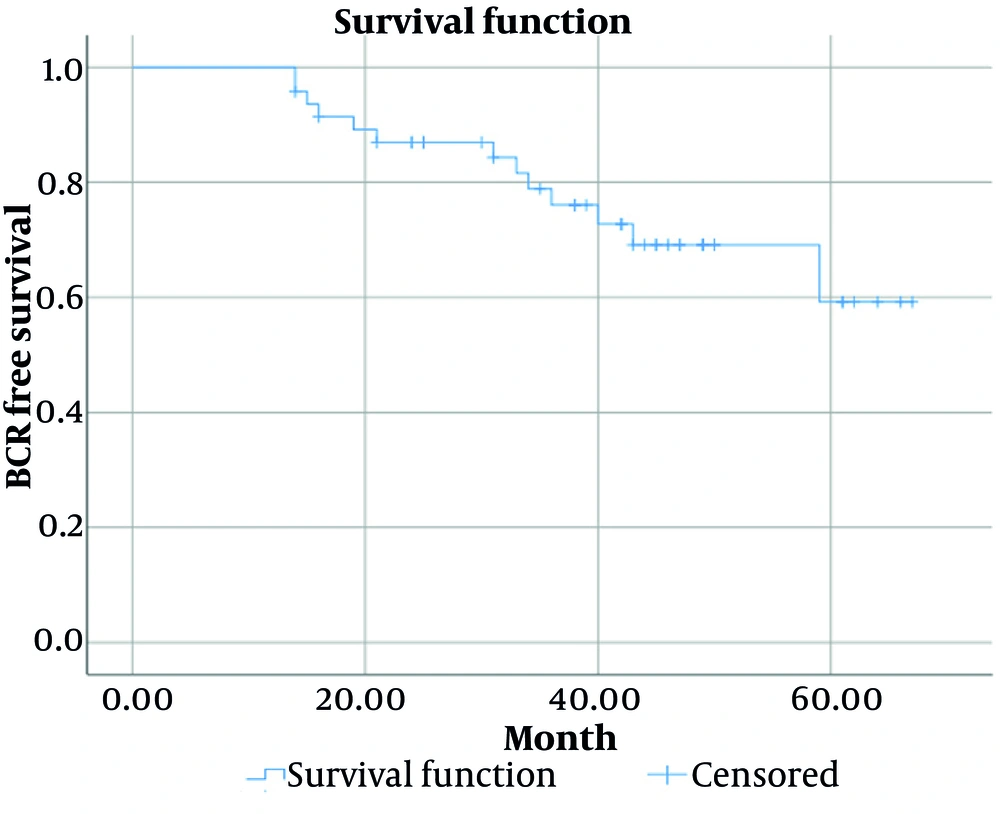
Figure 2.
Local failure-free survival
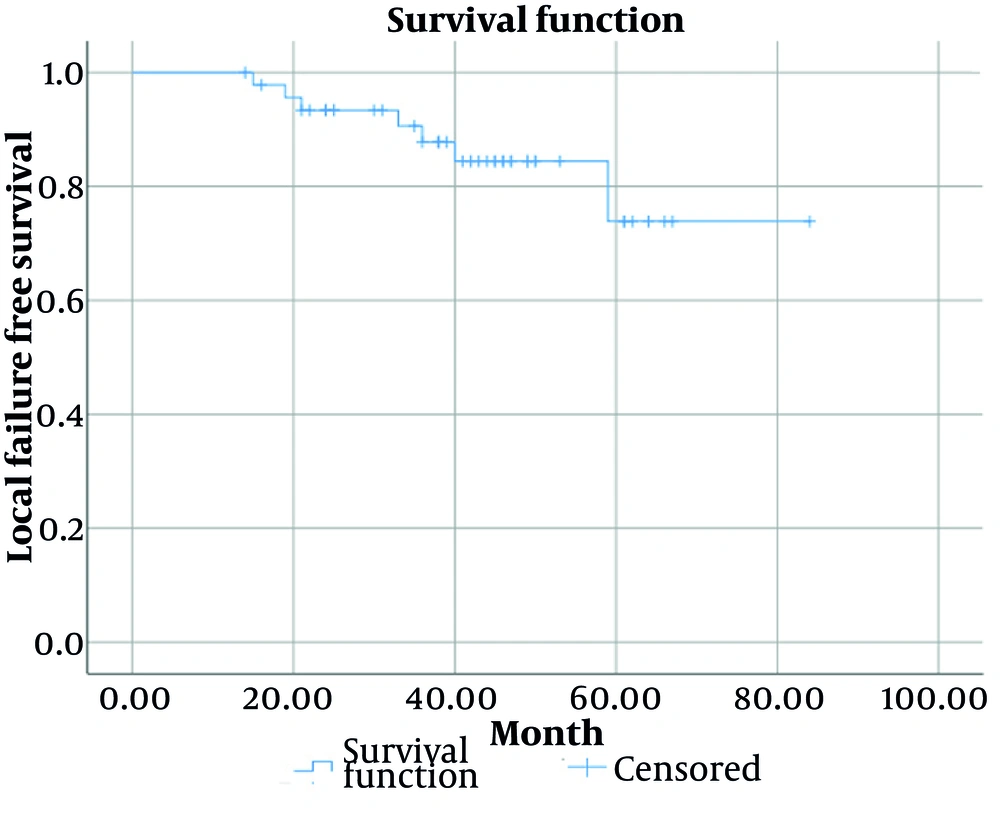
Figure 3.
Metastasis-free survival
4.3. Relationship Between Clinicopathologic Factors and Outcomes
The associations between clinicopathologic characteristics and the different types of failure are shown in Table 2. None of the evaluated factors were significantly associated with local recurrence. The local recurrence rate was 12.5% in the intermediate-risk group and 16.1% in the high-risk group.
Table 2.
Relationship of Clinicopathologic Characteristics with BCR, LF, and DF a
| Variables | BCR | LF | DF | |||
|---|---|---|---|---|---|---|
| Number (n) | n = 13P | P-Value | n = 7 | P-Value | n = 6 | P-Value |
| Age (y) | NS | NS | NS | |||
| < 70 | 5 (23.8) | 2 (9.5) | 3 (14.3) | |||
| > 70 | 8 (30.8) | 5 (19.5) | 3 (11.5) | |||
| Tumor extension | 0.04 | NS | 0.02 | |||
| Intraprostatic | 3 (13) | 3 (13) | 0 (0) | |||
| Extraprostatic | 10 (41.7) | 4 (16.7) | 6 (25) | |||
| Gleason score | NS | NS | 0.06 | |||
| Low = 6 | 2 (25) | 1 (12.5) | 1 (12.5) | |||
| Intermediate = 7 | 3 (15.8) | 3 (15.8) | 0 (0.0) | |||
| High = 8 - 10 | 8 (40) | 3 (15) | 5 (25) | |||
| Gleason grade group | NS | NS | 0.02 | |||
| 1 | 2 (25) | 1 (12.5) | 1 (12.5) | |||
| 2 | 1 (12.5) | 1 (12.5) | 0 (0) | |||
| 3 | 2 (18.2) | 2 (18.2) | 0 (0) | |||
| 4 | 3 (27.3) | 2 (18.2) | 1 (9.1) | |||
| 5 | 5 (55.6) | 1 (11.1) | 4 (44.4) | |||
| PSA level (ng/mL) | NS | NS | NS | |||
| < 10 | 0 (0) | 0 (0) | 0 (0) | |||
| 10 - 20 | 8 (32) | 4 (16) | 4 (16) | |||
| > 20 | 5 (33.3) | 3 (20) | 2 (13.3) | |||
| PNI | NS | NS | NS | |||
| Negative | 5 (25) | 2 (10) | 3 (15) | |||
| Positive | 8 (29.6) | 5 (18.5) | 3 (11.1) | |||
| Risk group | NS | NS | 0.08 | |||
| Intermediate | 2 (12.5) | 2 (12.5) | 0 (12.5) | |||
| High | 11 (35.5) | 5 (16.1) | 6 (16.1) | |||
a Values are expressed as No. (%). Abbreviations: BCR, biochemical recurrence; DF, distant failure; LF, local failure; PNI, perineural invasion; PSA, prostate-specific antigen.
Using the detailed Gleason grade group classification (grade groups 1 - 5), the rate of metastatic failure as the first site of recurrence differed among groups, with higher rates in grade groups 4 and 5. However, this association was not significant when the simplified Gleason score classification (low, intermediate, and high) was used.
All metastatic failures occurred in the high-risk group, whereas no metastatic events occurred in the intermediate-risk group; however, this difference did not reach statistical significance (19.4% vs 0%, P = 0.08).
4.4. Prognostic Factors for Biochemical Recurrence
Univariate Cox proportional hazards regression analysis was performed to evaluate factors associated with BCR (Table 3). Extraprostatic tumor extension was significantly associated with an increased risk of BCR. A Gleason score ≥ 8 showed a nonsignificant trend toward a higher risk compared with a score ≤ 7, whereas the other variables were not significantly associated with BCR.
Table 3.
Univariate Cox Proportional Hazards Regression Analysis for Biochemical Recurrence a
| Variables | HR (95% CI) for BCR | P-Value |
|---|---|---|
| Age ≥ 70 vs < 70 years | 1.36 (0.43 - 4.22) | 0.5 |
| Tumor extension: Extraprostatic vs intraprostatic | 4.15 (1.13 - 15.22) | 0.03 |
| Gleason score ≥ 8 vs ≤ 7 | 2.75 (0.88 - 8.58) | 0.08 |
| PSA > 20 vs ≤ 20 ng/mL | 1.17 (0.38 - 3.60) | 0.7 |
| PNI positive vs negative | 1.21 (0.39 - 3.70) | 0.7 |
| Risk group: High vs intermediate | 3.48 (0.76 - 15.86) | 0.1 |
a Abbreviations: BCR, biochemical recurrence; CI, confidence interval; HR, hazard ratio; PNI, perineural invasion; PSA, prostate-specific antigen.
Variables with P < 0.10 in the univariate analysis were included in the multivariable Cox regression model. In the multivariable analysis, extraprostatic tumor extension showed a nonsignificant trend toward an increased risk of BCR compared with intraprostatic disease (adjusted HR = 3.43; 95% CI, 0.88 - 13.25; P = 0.07). Similarly, a Gleason score ≥ 8 was associated with a nonsignificant increase in risk compared with a score ≤ 7 (adjusted HR = 1.98; 95% CI, 0.59 - 6.57; P = 0.26).
5. Discussion
Prostate cancer is the second most common cancer and the fifth leading cause of cancer-related death among men (1). Treatment for localized prostate cancer is selected according to stage, Gleason score, serum PSA level, age, and comorbidities. Treatment options include radical prostatectomy, external beam radiotherapy (EBRT), brachytherapy (BT), active surveillance, or a combination of these approaches (18). EBRT with ADT is the standard approach for patients with intermediate- and high-risk disease, in whom the addition of ADT to radiotherapy provides a survival benefit (19-22). In this study, we investigated the therapeutic outcomes of 47 patients with localized prostate cancer who underwent definitive radiotherapy.
EBRT with or without ADT in patients with low- and intermediate-risk disease has been reported to result in a 5-year prostate relapse-free survival (PRFS) rate of 70% to 90% and a 10-year PRFS rate of 50% to 70% (23). In our study, the 3-year biochemical recurrence-free survival rate was 76%. However, as previously noted, all patients in this study had intermediate- or high-risk disease. This finding may indicate selection bias in the choice of radiotherapy, whereby patients with lower-risk disease and better performance status are generally considered for surgery.
In the study by Zagars et al., 874 patients with localized prostate cancer underwent definitive radiotherapy. The 5-year local recurrence rate was 12%, and the 5-year metastasis rate was 25%. Factors associated with metastasis included age younger than 60 years and a higher grade (24). In our study, the 3-year local recurrence and distant metastasis rates were 14.9% and 12.8%, respectively. Age was not significantly associated with treatment outcomes.
Vora et al. reported the outcomes of definitive radiotherapy in 460 patients with prostate cancer. Patients were treated using 2 techniques: three-dimensional conformal radiotherapy at a mean dose of 68.4 Gy or intensity-modulated radiotherapy at a mean dose of 75.6 Gy. The 5-year biochemical control rates in the 3D-CRT and intensity-modulated radiotherapy groups were 74.4% and 84.6%, respectively. Factors associated with biochemical control were PSA level, Gleason score, PNI, and radiotherapy dose (25). In our study, all patients were treated using 3D-CRT, and the rate of BCR after 45 months of follow-up was 27.6%.
In a study by Coen et al., 1469 patients with localized prostate cancer were treated with definitive radiotherapy. The 10-year local control rate was 79%, and the distant metastasis-free survival rate was 74%. Factors associated with LF included a Gleason score ≥ 7, a serum PSA level above 15 ng/mL, and T3 - T4 stage. The most important predictive factor for distant metastasis was LF (11). Consistent with that study, our results also showed an association between Gleason grade group and distant metastasis, and patients with Gleason grade groups 4 and 5 had more distant metastases. However, when patients were classified using the previous Gleason score system (low = 6, intermediate = 7, and high = 8 - 10), no correlation with distant metastasis was observed. This observation may suggest greater accuracy and sensitivity of the newer grade group system.
Perineural invasion has been considered a prognostic factor in many cancers. In a study of 586 patients with prostate cancer who underwent definitive radiotherapy, the prevalence of PNI was higher among high-risk patients and was associated with BCR and cancer-specific survival (26). In this study, although the associations were not statistically significant, PNI was associated with higher rates of BCR and DF, particularly LF (10% vs 18.5%).
The extension of the radiation field, whether WPRT or prostate-only radiotherapy (PORT), as a predictive factor for locoregional recurrence remains under discussion. The rationale is that WPRT treats micrometastases in the pelvic lymph nodes and may result in improved locoregional control; however, its definitive benefit remains unclear.
In a phase III randomized trial by Murthy et al., patients with node-negative prostate cancer and a high risk of pelvic lymph node involvement (> 20% according to the Roach formula) underwent PORT or WPRT using intensity-modulated radiotherapy. Whole-pelvis radiotherapy improved biochemical failure-free survival and disease-free survival but not overall survival (27). In our study, all patients were treated using whole-pelvis fields because all had intermediate- or high-risk disease.
5.1. Study Limitations
This study has several limitations. First, its retrospective design introduces inherent selection bias and limits the generalizability and causal interpretation of the findings. Second, the relatively small number of patients and events reduced the statistical power of some analyses. In particular, the numbers of LF and metastatic failure events were low (7 and 6 events, respectively), making Cox regression analyses for these end points potentially unstable and associated with very wide CIs. Therefore, Cox regression analyses were not performed for these outcomes. In addition, data on acute and late genitourinary and gastrointestinal toxicities were not systematically available and therefore were not included. These limitations should be considered when interpreting the results.
5.2. Conclusions
Oncologic outcomes in our study were inferior to those reported in developed countries. This finding indicates that modern radiotherapy techniques, such as intensity-modulated radiotherapy, are essential in prostate cancer treatment because of their improved efficacy and reduced treatment-related toxicity. This is an important issue in developing countries, and health care policies should facilitate patient access to these newer techniques.