
1. Context
The Merriam Webster dictionary has defined the word “publish” as “to make generally known”, “to disseminate to the public” and, “to produce or release for distribution”. Research that fails to reach others is of little value and a research project may be considered complete if it is published, read, understood, and believed by others (1). Publishing makes research findings publicly available, and allows the rest of the academic audience to use that information and evaluate its quality (2). Publishing in international journals is now a prerequisite for academicians, bringing with it attention to the researchers and their institutions (3, 4). Moreover, scientific publishing in biomedicine has been an essential tool for medical progress (5).
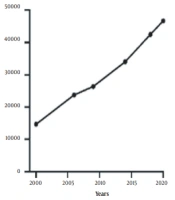
According to the International Association of Scientific, Technical and Medical (STM) Publishers (6), around 42,500 scientific peer-reviewed English and non-English language journals actively contribute to publish scientific works; considering such a huge number of journals, choosing the right one to submit a manuscript is not easy (4). Choosing the wrong journal may lead to fast rejection, delayed publication, and waste of time/resources (7, 8). Targeting the best journal has no clear-cut criteria or a practical model; it is a complex issue, compounded by the increasing numbers of journals and the emerging changes in the publishing landscape (8, 9).
In the present study, we discussed important factors that should be considered for choosing the right journal, which facilitates achieving a successful and effective publication.
2. Factors Affecting Journal Targeting
The story of selecting a right journal may be narrated from three main points of view: (1) The journal’s characteristics, which includes scientific prestige, performance, publishing models, acceptance rate, and specialty and audience; (2) characteristics of the manuscript, including its novelty, soundness of methodology, potential impact and its alignment with the journal’s aims and scope; and (3) the authors’ priorities and limitations. Box 1 summarizes the most important factors that need to be considered when choosing a journal before submitting a manuscript.
Box 1.
Factors Affecting Journal’s Targeting
| Factors |
|---|
| Journal’s characteristics |
| Scientific quality and prestige |
| Indexing by established bibliographic databases |
| Having peer-review process |
| Citation-based metrics (e.g. impact factor) |
| Reputation of publisher |
| Reputation of editorial board |
| Adopting publication ethics (e.g. COPE, STM, ICMJE) |
| Journal’s longevity |
| Expert’s opinion |
| Journal’s performance |
| Publication periodicity |
| Timelines, quality and models of peer-review process |
| Author-friendly options of journal |
| Publication charge |
| Ethics in publishing process (confidentiality, considering ethics guidelines) |
| Publishing model |
| Open access vs. subscription journals |
| Print vs. online journals |
| Acceptance possibility |
| Rate of acceptance |
| Authors’ country and affiliations |
| A well-known co-author |
| Past communication experience with editors and reviewers |
| The journal’s specialty and potential audience |
| Characteristics of the manuscript |
| The relevance of the manuscript |
| Topic relevance |
| Type relevance |
| The quality of the manuscript |
| Novelty |
| Priority |
| Soundness of research method |
| Potential impact |
| Potential implication |
| Author’s priorities and limitations |
| Push of rapid publication |
| Push (desire) for publication in prestigious journals with high impact factor |
| Institutional policies |
| Regulations of research funding agencies |
2.1. The Journal’s Characteristics
2.1.1. The Journal’s Quality and Prestige
The quality and prestige of the target journal is a critical factor affecting the authors’ choices, because it directly influences the author’s evaluation as a faculty member (9, 10). Publishing in prestigious journals has its rewards, including successful grant application opportunities and invitations from other journals to publish more (11). Publishing in high-impact and prestigious journals is also considered as a quality signal in hiring, promotion and funding decisions (12).
The words “quality” and “prestige” are not defined clearly and accurately (9, 13); as discussed by Suber (13), if quality is considered as real excellence, then prestige is reputed excellence. The “objective” quality indicators are often used as basis for the “subjective” rating of journal’s prestige (9, 13). Ranking a journal as high-quality is not straightforward due to lack of clarity on the issue (9, 14); indexing in the well-established databases, having peer-review, high-impact factor, high visibility with wide distribution, well-known editor(s) and robust editorial board members, and affiliation with a prestigious organization or well-established societies have been proposed as important quality indicators (9). Journal’s longevity (i.e. years in print) and “experts opinion” or “being included on a core list of journals compiled by experts” make a journal more prestigious (15).
2.1.1.1. Indexing
High-quality and reputed journals are well-indexed and have widespread coverage in the established bibliographic databases; on the other hand, indexing by the major citation databases makes the journal more visible (16). The most important international platforms for medical journals include PubMed, PubMed Central (PMC), MEDLINE, SCOPUS, and Web of Science (ISI); journals that are indexed in these databases have rigorous review or selection criteria (17). Although indexing in well-known database is an important quality indicator (14, 17), it’s not a criterion for confirming the validity of the journal per se, because there are examples of poor quality journals that are indexed in the well-established databases (16).
2.1.1.2. Peer-Review Process
The peer review process ensures the quality of biomedical publications. It is an indicator of the journal’s quality, which is useful for assessing validity and adds to the scientific veracity of the submitted manuscript (18, 19). It is the best available practice of pre-publication scrutiny (20), acts as a foundation (21) and integral part of publishing in the sciences (22).
2.1.1.3. Citation-Based Metrics
While several objective metrics (e.g. absolute citation frequency, immediacy index, cited half-life, Eigen-factor score, and article influence score) are proposed for ranking journals (23), the impact factor (IF) is the most commonly used quantitative tool for ranking, evaluating, categorizing, and comparing journals (24). IF reflects the annual mean number of citations of published articles of a journal during the past two years, and is annually released by the Journal Citation Reports (JCR) (24). Journals with high IF are more likely to be considered as prestigious journals (25). Although IF has some shortcomings including limitations regarding inter-field comparisons, and misuse and incorrect use (26, 27), it is the most commonly used indicator of the subjective ranking of journals (12). The journal IF also serves as a surrogate for citation statistics of the papers (28).
To cover inter-field incomparability of journals’ IF, field-normalized IF, i.e. IF quartiles has been developed; quartile 1 (Q1) indicates that a journal’s IF is within the top 25% of the IF distribution of a specific field, and quartile 4 (Q4) means it is within the lowest 25% (29, 30). Journals can also be categorized within the quartiles based on other quality indicators (30).
A new citation metric developed by Elsevier in 2016 is CiteScore, which is calculated using 22,800 journals indexed in Scopus (31). In the last modified version in 2019, the “CiteScore counts the citations received in 2016 - 2019 to articles, reviews, conference papers, book chapters and data papers published in 2016 - 2019, and divides this by the number of publications published in 2016-2019” (see https://www.scopus.com/sources).
2.1.1.4. Reputation of Publisher
Publishing by an established publisher or recognized professional society is one of the most important quality indicators of a journal (32, 33). For example, publication history of a journal with a reputable medical publisher (i.e. Elsevier, Wolters Kluwer, Springer Nature, John Wiley and Sons, Informa) may be considered as a quality indicator for a medical journal.
2.1.1.5. Reputation of Editorial Board
The prestige and standing of a journal depends on the reputation of the editor-in-chief and its editorial board (34). A fulltime, well-known Editor-in-Chief who may be a pioneer in a specific field, as well as the reputation, internationally and geographically diversity of editorial board increases the journal’s prestige (16). The authors are advised to look at the list of the editorial board members to evaluate their reputation and familiarity with the submitted work (34).
2.1.1.6. Membership of Ethics Organizations
Membership in the Committee on Publication Ethics (COPE), International Association of STM publishers, and International Committee of Medical Journal Editors (ICMJE) may be considered by the authors as an indicator of journal’s quality.
2.2. Journal’s Performance
2.2.1. Publication Periodicity
Authors are advised to consider journal’s publication years (i.e. number of volumes), frequency of publication (e.g. annual, semiannual, triannual, quarterly, bimonthly, monthly, semimonthly, and means publishing 1, 2, 3, 4, 6, 12, 24 issue(s) per year, respectively), and the number of articles published per year. The higher the number of issues published per year, may increase the chances of publication of the submitted manuscript (33).
The authors should be aware that some journals do not precisely follow the publication frequency (named as irregular); for example, a journal may be listed as a monthly journal, but publishes ten issues per year. Hence, checking the last available issue is necessary to ensure the publication frequency.
2.2.2. Timelines, Quality and Models of the Peer-Review Process
Timelines of peer-review and publication process is one of the important criteria for selecting a journal; the authors should check the average number of days it takes to receive the editorial review process, the average time for external peer-review, and the average time from acceptance to publication (35). A significant negative correlation observed between the peer-review cycle time and the journal’s IF, which indicates that high-quality journals are more professionally organized and handled by editors and editorial offices (36).
Beyond the timely peer-review process and fast editorial decision, providing a fair, high-quality and rigorous peer-review, is an important criteria for targeting a journal (32, 33). High-quality and evidence-based peer-review in biomedical journals, critically contributes to medical progress and improves health outcomes. Inviting knowledgeable and outstanding reviewers, providing strict rules and guidelines for the review process, quality control of the peer-review, encouraging transparency, and the handling speed of the manuscript make the journal’s peer-review process more credible (19, 37).
Some journals [e.g. PeerJ (www.peerj.com), F1000research (https://f1000research.com/), ScienceOpen (www.scienceopen.com)] use a “Post-Publication Peer-Review model”, which is a new platform for the peer review process combining open access (OA), open peer-review and pre-print model leading to a more rapid and robust publication.
2.2.3. Author-Friendly Options of Journals
Several factors including providing an online submission system, facilitated online tracking system enabling authors to follow every stage of a manuscript’s process, and offering additional services for improvement of the manuscript (e.g. language editing for non-native English speakers) are among the most important author-friendly options (32). Furthermore, providing online extensive guidance and templates for different types of manuscripts, tables and figures, abbreviations, referencing styles, reference template availability within reference management software products, templates for conflict of interest declaration, and examples of funding acknowledgement, are good options that allow the authors to easily prepare their manuscript according to the journal’s style.
Other author-friendly options that may motivate the authors to submit their manuscripts to a particular journal include, the possibility of editor and reviewer suggestion (i.e. preferred and non-preferred reviewers), providing annual awards, invitations and call for papers, providing good peer-review feedbacks, free hard copies of the issues, and providing an official acceptance letter (16). Likelihood of press attention and widespread circulation of the journal may also be considered as an author-friendly option of a journal (38).
2.2.4. Publication Charge
Beyond OA journals that usually charge the authors for article processing charges (APC), a number of journals may have structured fees till final publication; for example, established journals published by Mary Ann Liebert. These charges may include pre-publication processing fees, charges for exceeding word count limits, prescribed per page print charges, and charges for colored figures (32). Submission fees typically range $50 - $125 and must be paid by the authors at the time of submission to help with the peer-review process; however, the authors may be charged a higher submission fee of ~$350 - $400 by some, e.g. Journal of Financial Intermediation. It should be noted that submission fees are non-refundable and the manuscript may be rejected by the editors; without entering the formal review process. Per page print charges usually range $100 - $250, while fees for color figures can be $150 - $1000 per figure. The authors are advised to carefully read the fee requirements when choosing a journal. Some journals offer a discount or full-waiver options upon author’s request (e.g. for low-income countries, unfunded research or junior investigators) prior to submission (32).
2.2.5. Ethics in Publishing Process
Considering ethical issues during the publication process and providing practical guidance in ethics to editors, reviewers and authors is an important factor that should be considered when evaluating the target journal’s performance (16). The journal should provide a clear description of ethical principles; this should help the authors during their submission process. These include clear guidelines for submission, questions about probable duplicate submission, approval statement of co-authors or responsible authorities at the institute or organization where the work has been carried out, Ethical Committee approval and conflict of interest statement (16). The journal may also follow the COPE guidelines on ethical issues that covers data fabrication/falsification, duplicate submission/publication, redundant publication or “salami publishing”, plagiarism, and authorship issues (39, 40). The journals should also keep the manuscripts, associated material and information strictly confidential, and follow rules of confidentiality as provided by ICMJE (41).
2.3. Publishing Models
2.3.1. Open Access vs. Subscription Journals
From the economic point of view, journals are categorized as traditional or OA (42). Traditional journals are primarily funded through institutional subscriptions, authors render the copyright to the journal publisher, and are not required to pay any processing fee (APC) (43). In 2019, more than 12,000 OA journals were registered by the Directory of Open Access Journals (DOAJ), and over 10,000 OA journals were reported by the Cabell’s Blacklist, a subscription-based blacklist of predatory OA journals (44).
OA journals remove barriers of sharing scientific knowledge by expanding access free-of-charge to published papers and allowing digital journal content to be freely available to all readers regardless of institutional subscription (45). Although the OA publishing model does not necessarily mean that the authors must pay an APC, the vast majority of OA journals do charge the authors €500 - €2000, compensating for the reader/institution subscription fees (4).
Surveys indicate that ISI- or Scopus-indexed OA journals are approaching the same scientific impact and quality as subscription journals, especially in the biomedicine field (42). Some suggest that “there is no reason for authors not to choose to publish in OA journals just because of the OA label” (42); however, this remains somewhat controversial. Box 2 summarizes the pros and cons of publishing with OA journals.
Box 2.
The Pros and Cons of Open Access Journals
| Pros and Cons |
|---|
| Pros |
| No financial or copyright barriers for readers |
| Free access to scientific works, new idea and research methods |
| Shorter peer-review and publication times |
| Increased visibility and impact of the work |
| Cons |
| Author processing charges (APC) |
| Higher rate of predatory journals |
| Relatively lower impact factor |
| Potential low quality of peer-review |
| Lower established reputation and prestige compared to traditional journals |
2.3.2. Print vs. Online Journals
Checking the availability of electronic and/or print formats of the journals can also be helpful when authors are seeking a journal. Most journals are published in both formats, however, having a printed version brings additional prestige (for both the journal and authors), whereas online access increase availability of the published papers (32). On the other hand, online journals usually have a shorter publishing processing time, with little or no backlog of finalized, accepted articles awaiting publication (9).
2.4. Acceptance Possibility
In general, since the number of submitted manuscripts are growing at a faster pace than the available journal spaces, getting a manuscript accepted is highly competitive (46). Thus this becomes one of the most important determinants affecting the author’s choices for submission (38). Several factors needs to be considered by the authors to estimate potential acceptance; these include, journal’s periodicity (numbers of published papers and issues per year), history of the journal in publishing papers from authors’ country and affiliations of the authors, inclusion of well-known co-authors on the manuscript, past communications experience with editors and reviewers, and the acceptance/rejection rate (16). Being affiliated with a less prestigious institution, or submission from specific countries may have negative impact on acceptance rate, especially for prestigious journals (47, 48). Some evidence also indicates that there is an acceptance-bias favoring authors from English-speaking countries and prestigious institutions (49); in some cases, reviewers are more likely to accept manuscripts from famous authors and high-ranked institutions (50). Past experiences of authors and their colleagues with a journal (i.e. editor’s and reviewers’ feedbacks and handling process of the manuscript) enable authors to have a good estimation about their chance for publishing. A practical way to be informed about the chance of acceptance may be therefore “relying on word of mouth from colleagues” (35).
2.4.1. Rate of Acceptance
The acceptance rate, defined as the percentage of formally submitted manuscripts that are accepted and published, is an important factor influencing a journal’s choice (43). The acceptance rates vary widely within the journals; according to Thomson Reuters database, a mean acceptance rate of 37% (ranged 35% - 40%) is estimated for reputable journals published by established publishers and ISI or Scopus-indexed journals (51). However, the acceptance rate of top-quality journals may be as low as ~5% (51). Although medical scientists would desire to publish with prestigious medical journals e.g. The New England Journal of Medicine, Lancet, The Journal of the American Medical Association, or British Medical Journal, they should keep in mind that getting acceptance from these are extremely difficult. Therefore, considering candidate journals with a realistic acceptance rate is crucial for a successful submission (35).
A limited number of journals openly display their acceptance rate, however, it is very difficult to find such data systematically (35). Some journals provide statistics which include number of manuscripts received, accepted and rejected annually; some publishers e.g. Elsevier provides the acceptance rate of their own journals (See Box 3).
Box 3.
Useful Links/Tools for Journal Targeting
| Journal’s Useful Links |
|---|
| Journal finder online softwares |
| Elsevier journal finder (https://journalfinder.elsevier.com/) |
| Springer Journal Suggester (https://journalsuggester.springer.com/) |
| Wiley (https://journalfinder.wiley.com/) |
| Ednaz journal selector (https://en-author-services.edanzgroup.com/journal-selector) |
| Journals databases |
| NLM catalog (https://www.ncbi.nlm.nih.gov/nlmcatalog?term=currentlyindexed) |
| Web of Science Master Journal List (https://mjl.clarivate.com/home) |
| Elsevier journal list (https://www.elsevier.com/solutions/sciencedirect/content/journal-title-lists) |
| List of potential predatory OA publishers |
| Beall list (https://beallist.net) |
| Cabell’s Blacklist (https://www.cabells.com/) |
| List of indexed, high-quality, and peer-reviewed OA journals |
| DOAJ (http://doaj.org) |
| Useful information about the acceptance rate of journals |
| Elsevier (https://journalfinder.elsevier.com/) |
| MedSci (http://medsciediting.com/sci) |
| Journals’ ranking databases |
| SCImago (https://www.scimagojr.com/journalrank.php) |
Although not always true, the acceptance rates of OA journals are significantly higher than non-open access journals (52). The average acceptance rates of different tiers of OA journals is quite variable, it can be as low as 15% in high-quality journals (e.g. eLife, Nature communications, PLoS biology, PLoS medicine), ~50% in mega journals (e.g. PLoS one, Nature research reports, Sage open) to more than 80% in predatory publisher journals (51).
2.5. The Journal’s Specialty and Potential Audience
When the authors start the journal’s selection, they initially should think about the audience and potential readers (53). If the authors’ work is a multidisciplinary research area that has broad implications, a journal that covers a wide range of research topics is the best target; in contrast, if the scientific work includes a specific method or may be of interest to researchers of a specific field, the authors should target specialized journals as their work would be acknowledged by editorials and will reach the target audience directly. Some publishers and journals databases (see Box 3), list journals with their subject categories (i.e. general subject, primary and secondary subjects, etc.), this can be helpful.
2.6. The Characteristics of the Manuscript
2.6.1. The Relevance
The first and important factor for choosing the right journal is “the goodness of fit” of a manuscript for the journal (54, 55). This is not an easy task and needs considerable skills; the authors “should be familiar with the field and should be up-to-date on what has and has not been published already” (5). The manuscript needs to be relevant and fit within the “Aims and Scope” of the journal. Not falling within the scope of the journal (~11%) and irrelevant topic to the journal mission (~37%) are some of the most common reasons for a fast rejection in the field of medicine (7, 56). Prior to submission, authors are therefore encouraged to carefully read the journal’s mission/vision statement and be familiar with the topics and types of manuscripts published by the journal (56). These include, original vs. review, qualitative vs. quantitative, case report, and evidence-based practice manuscript (57). Checking the guide for authors and looking at the latest list of published papers in the target journal would help to shed light on these factors.
2.6.2. The Quality of the Manuscript
The authors should be honest about the quality of their work (4); they are supposed to assess the work for its novelty, priority, soundness of the research methods, impact, and the potential implications (5). If the material is absolutely original, innovative, and contains outstanding methodology, the authors may think about high-ranking journals (58).
2.7. Author’s Priorities and Limitations
Keeping the balance with the desire to publish with a top-quality prestigious journal and the need for a rapid publication is a key factor for successful publishing (4); for example, a PhD student or a junior investigator seeking an academic position by a particular date, is most likely to consider a rapid publication rather than IF or a specific target audience. Researchers may also have particularly tight timeframes for publication if the data or subject matter is of greatest significance for a limited time (9). Authors also need to follow their institutional policies and regulations outlined by the funding agencies (59).
3. Steps Toward Choosing the Right Journal
Selection of a target journal when starting to write a manuscript, is a practical advice given by the experts in writing and editing. This helps the authors in preparing their manuscript for the intended audience and present it in a general style and length preferred by that journal (59, 60). Overall, the fit of the manuscript can be enhanced during the writing process when the target journal is initially considered. In contrast, some believe that journal targeting should be postponed until the manuscript is prepared, since this approach results in free writing (16). Here we suggest a stepwise process to be followed in order to reach a right decision regarding the target journal choice (Figure 1).
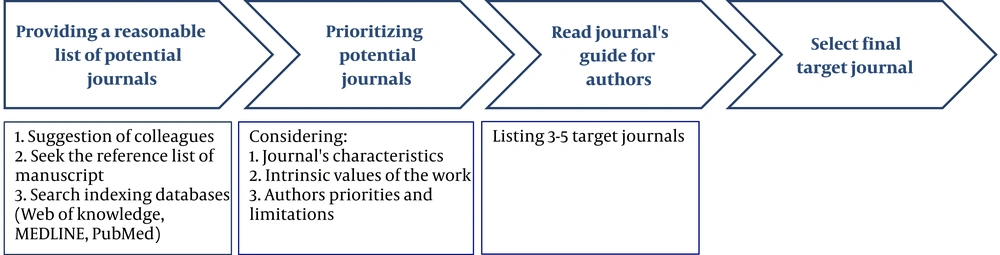
Figure 1.
Steps toward choosing the right journal
3.1. Listing Potential Journals
A list of targeted journals should be developed before the right one can be selected. To building such a list, authors may consider their previous experiences, consult with their colleagues, seek the reference list of their own manuscript for related journals, or search the indexing databases (Web of knowledge, MEDLINE, PubMed). If the authors have no idea about where/how to start the search process for a suitable journal, they can try using a publisher’s journal finder (See Box 3); these online tools generate a list of journals that match the topic of the manuscript (based on the title, abstract and keywords) with potential journals. They are useful for the manuscript with intermediate field of research subjects or junior researchers who are at the early stages of their research career. The authors are also advised to seek the relevant literature to get an idea about the potential target journals (4).
When journal searching, authors should be aware regarding “fake” publishers and predatory journals. The term “predatory publisher” was initially coined by Jeffrey Beall in 2010, where he described a number of publishers and journals who “often fail to properly manage peer-review process, allowing pseudo-science to be published and dressed up as authentic science” (61). Diagnostic criteria and dangers of predatory journals and publishers are well described by Beall (See Box 3) (61, 62). If the desire is to publish in an OA journal, then one should check DOAJ (http://doaj.org), which provides a list of indexed, high-quality, and peer-reviewed journals.
3.2. Prioritizing Potential Journals: Focusing on Author’s Work and Desires
After compiling a list of potential journals, authors should prioritize them according to the work’s characteristics and their desires. First, take-home message should be summarized in 2 - 3 sentences, target audience is considered (32); second, authors need to focus on their priorities (e.g. publishing in a prestige of journal, rapid publishing process, openness of the published paper, and payment of publication charges); third, they should balance their desires, be honest about the quality of the manuscript and draw up a prioritized list of 3 - 5 journals (4). Finally, the authors should carefully read the journal’s “guide for authors” and check whether the journal is an invitation-only, since some journals only accept manuscript upon editorial invitation.
4. Conclusions
Choosing the right journal for a manuscript is a crucial decision affecting not only the pre-publication process but also the post-publication success of the paper i.e. paper’s visibility, effectiveness of the research findings and getting more citation. Journal’s characteristics, intrinsic value of the manuscript, and authors’ priorities and limitations are the most important factors that need to be considered for journal targeting.