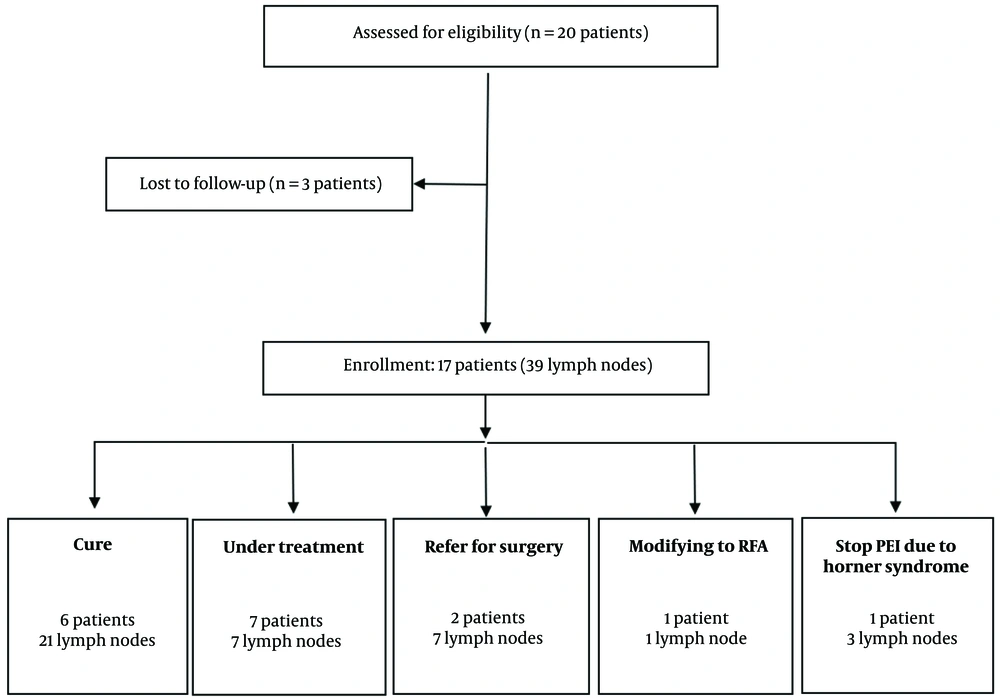
Our study aimed to evaluate the mid-term outcomes of PEI in patients with recurrent PTC in cervical lymph nodes who were either poor surgical candidates or preferred not to undergo further surgery. Our findings indicate that PEI is an effective, safe, and well-tolerated minimally invasive treatment option for selected PTC patients with local recurrence in cervical lymph nodes. Of the 39 lymph nodes treated, 21 met the criteria for successful treatment, while treatment for 7 lymph nodes is ongoing. In response to an increase in lymph node size or the emergence of complications, surgery was required for seven lymph nodes in two patients.
Percutaneous ethanol injection is a minimally invasive procedure involving the injection of ethanol into thyroid cysts or nodules under US guidance, promoting scar tissue formation and reducing nodule size. Percutaneous ethanol injection has been used for over two decades to treat solitary hot, toxic, and cold thyroid nodules and is considered the first-line treatment for thyroid cystic nodules (
3). Percutaneous ethanol injection is also recommended for managing PTC recurrence in cervical lymph nodes, particularly for patients who are unsuitable for surgery or wish to avoid further operations (
18). Ethanol induces cell death by causing cellular dehydration, protein denaturation, coagulative necrosis, and blood vessel thrombosis (
19), resulting in stable regression of the treated cystic lesion.
Cervical lymph node metastases in PTC may necessitate additional treatment beyond surgery and RAIT (
20). One alternative treatment under study is PEI for metastatic lymph nodes. Since Lewis et al. (
17) first reported favorable outcomes from ethanol injection for recurrent neck lymph node disease in 2002, multiple studies have demonstrated satisfactory results. Previous short-term studies on PEI, with follow-up periods ranging from 18 to 65 months, have reported success rates between 79% and 100% (
17,
21). In our study, 39 lymph nodes were treated, and after a median follow-up of 21.4 months (range 4.1 - 37.9), 21 lymph nodes (54%) met the criteria for cure, while 7 lymph nodes (18%) remain under observation.
The safety of PEI is essential for its clinical viability. In our study, one patient developed Horner’s syndrome, which ultimately led to surgical intervention. No other significant complications, such as vocal cord palsy or tracheal injury, were observed, consistent with previous findings on PEI’s safety (
12,
13,
21). Prior research has identified mild, self-limited pain and discomfort at the injection site as the most common side effect, likely due to minimal ethanol leakage into surrounding tissue (
12). Percutaneous ethanol injection can become more challenging with an increased number of involved lymph nodes, leading to longer procedure times and greater patient discomfort. Larger lesions present technical difficulties and often require multiple sessions for complete ablation. In our study, 8 lymph nodes (20%) required more than three PEI sessions. Thus, PEI demands careful patient selection and skilled operators to optimize outcomes.
Notable trials with extended follow-up periods in the United States, Norway, and Korea have shown that PEI produces acceptable outcomes with minimal side effects for treating PTC lymph node recurrence (
12,
13,
22). For instance, Frich et al. (
22) re-evaluated 44 patients who had received PEI for metastatic lymph nodes from PTC, with a median follow-up of 124 months. Of the 67 lymph nodes initially treated, 97% met response criteria by the end of the earlier study (
11). At the latest follow-up, 81% (54/67) maintained a durable response, while 19% (13/67) experienced recurrence. Although no randomized trials have directly compared PEI with surgery or other procedures, guidelines continue to favor surgery due to limited long-term follow-up data (
3). Nonetheless, the low cost and minimal side effects of PEI suggest it could be a viable treatment alternative for PTC lymph node recurrence.
This study represents the first evaluation of ethanol injection for PTC recurrence in Iran. All procedures were conducted by a single radiologist with over 15 years of experience, enhancing the reliability of the findings. However, the study has limitations, including a relatively small sample size and the absence of a control group, which limits comparisons with other treatments such as reoperation or RFA. While the follow-up period of 21.4 months was longer than that of several similar studies, it still did not allow for an assessment of the long-term effects of PEI on recurrence rates. Given that PTC metastases can occur up to 47 years post-treatment (
23), with a mean recurrence time of 5.1 years (
24), larger studies with extended follow-up are necessary to confirm the long-term efficacy and safety of PEI for PTC patients.
In conclusion, our study demonstrated that PEI is an effective and safe minimally invasive treatment option for PTC recurrence in cervical lymph nodes for selected patients who are either ineligible for surgery or decline reoperation.