
1. Context
The high prevalence of chronic diseases such as type 2 diabetes (T2DM), cardiovascular (CVD) and chronic kidney disease (CKD) is becoming a major public health concern in most countries, although this can be avoided or managed by specific changes in lifestyle patterns of individuals (1). One such change is dietary factors; hence the accurate estimation of dietary intakes is crucial (2). To prevent inaccurate estimations of dietary intakes leading to incorrect data on the association between diet and disease, the reproducibility and validity of measurement tools is vital (3).
The importance of healthful dietary pattern (DP) has been emphasized using dietary guidelines and recommendations. The diet quality has been evaluated, by assessing adherence to dietary guidelines to identify inappropriate DPs, and implementing timely policy revisions and strategies (4, 5).
Dietary factors related to chronic disease may differ across populations because of cultural, social and genetic differences. In this regard limited and inconsistent data are available from developing countries (1). Recently the role of different DPs such as the Mediterranean diet (MD) (6) or dietary approach to stop hypertension (DASH) (7, 8), functional foods (9), nutraceuticals (10) and patterns of amino-acid intakes (11) has been emphasized in the prevention and management of cardio-metabolic diseases. On the other hand, in recent decades consumption of unhealthy foods like sugar sweetened beverages, fast foods, salty and sweet snacks, hydrogenated and animal fats has shown a fast increasing trend worldwide, which is associated with high incidence of chronic diseases (12, 13). The Tehran Lipid and Glucose Study (TLGS) is an ongoing study started in 1999 with a representative sample of 15005 individuals, aged ≥ 3 years, recruited from among residents of district no.13 of Tehran, the capital of Iran (14). This prospective study provides an opportunity to study different aspects of NCDs in this Middle-Eastern population.
The objective of this study was to review all findings of studies conducted within the framework of TLGS regarding the validity and reliability of the food frequency questionnaire (FFQ), used for evaluating dietary quality and association of dietary factors in relation to T2DM, dysglycemia, CVD and CKD to provide a deeper insight into these diseases in this population in order to design better preventive strategies for high risk individuals at high risk for these diseases.
2. Evidence Acquisition
In this review, related documents were searched in England language through PubMed, Scopus, and Embase databases, 2000 to 2017. To obtain studies focusing on reliability and validity of TLGS food frequency questionnaire, overall diet quality and nutritional behaviors of TLGS population, we used different combinations of “diet”, “nutrition”, “food frequency questionnaire”, “quality”, habit”, “validity”, and “reliability”. Following key words were used to search papers investigating potential relations between dietary factors and risk of cardio-renal diseases and diabetes: “diet”, “nutrition”, “cardiovascular”, “kidney disease” and “type 2 diabetes”. Finally, 52 relevant documents were eligible for inclusion in this review. Three papers focused on development of the TLGS, the FFQ, and its validity and reliability. Dietary habits and diet quality of TLGS population were described in 9 papers. The associations of dietary factors with the prevalence or incidence of CVD events, CKD, T2DM or dysglycemia were investigated in 6, 9 and 28 papers, respectively.
3. Results
3.1. Reliability and Validity of Food Frequency Questionnaire
The FFQ, one of the most commonly simple and practical methods used to evaluate usual long-term dietary intakes in epidemiological studies, was developed for the TLGS. The FFQ is consists of food items standard serving size commonly consumed by 132 Iranians subjects. The reliability and validity of this FFQ was evaluated using twelve 24-hour dietary recalls repeated every month, two FFQs (completed one year apart) and comparing dietary intakes with serum and urine biomarkers. The results showed relative validity and good reliability of the FFQ for nutrient intakes and main food groups and accurate ranking of individuals, based on nutrient and food group intakes (2, 3). Mean adjusted and deattenuated correlation coefficients between the 24-hour-DR and FFQ2 were 0.53 and 0.39 in men and women, respectively. Mean adjusted intraclass correlation coefficients between the two FFQ’s were 0.59 and 0.60 in men and women, respectively (3). For food groups, median correlation coefficients between the 24-hour-DR and FFQ2 were 0.44 and 0.37 in men and women, respectively. The median of adjusted intra-class correlation coefficients were 0.52 and 0.57 in men and women, respectively. This FFQ can be an acceptable tool for assessing nutrient and food group intakes in this population and rank individuals accurately according to the levels of dietary intakes.
Moreover obtaining DPs yields a better perception of dietary habits and various combinations of foods consumed. Hence, the reliability and comparative validity of DPs using FFQ data shows precision and accuracy of extracted patterns; the stability shows the constancy of DPs when it may have changed. There was strong reliability between two FFQs and reasonable validity for the two extracted DPs; Iranian traditional and western DPs. After 8 years of follow-up, the western DP remained fairly stable whereas there was instability of Iranian traditional DP over the follow-up years (15). Hence this FFQ is an acceptable tool for determining DPs of Iranians to investigate the relationship of DPs with health outcomes in epidemiological studies.
3.2. Dietary Quality
Consumption of a wide number of foods and food groups (variety) was included as part of dietary recommendations. Mean dietary diversity score (DDS) was 6.25 ± 1.08 (ranged 0 - 10) in adolescents and had a positive correlation with mean adequacy ratio of nutrients (16). Mean DDS were 6.05 ± 1.02 and 6.01 ± 1.0 in men and women, respectively, both were associated with the nutrient adequacy (5, 17).
The mean healthy eating index (HEI) score was 64.9 ± 9.6 in boys and 64.8 ± 9.4 in girls (range 0 - 90); diets of most Tehranian adolescents (74%) needs improvement (18).
The mean ± SD score for dietary guidelines for American adherence index (DGAI) 2005 was 8.31 ± 1.9 (range 2.5 - 15.0); about two-thirds of participants achieved less than half of the possible scores of the DGAI (19). Compliance of the WHO/FAO nutrition targets for n-3 poly-unsaturated fatty acids (PUFAs), sodium, fruit and vegetable intakes was weak and the largest disparity with recommendation was seen for n-3 PUFAs (4).
The above findings reveal that DPs of over two-thirds of Tehranian population were not in accordance with dietary recommendations, indicating that unbalanced dietary intakes of Tehranian population must be examined for timely policy revisions, and implementation of dietary interventions strategies to promote diet quality.
3.3. Dietary Behaviors
Age, educational level, gender and marital status were items that impact the nutritional knowledge, attitude and practice of Tehranian adults (20). Moreover dietary behavior of adolescents may not be based on their nutritional knowledge of adolescents; 82% of girls and 75% of boys had good nutritional knowledge, while 25% of boys and 15% of girls had good nutritional practice (21).
3.4. Under-Reporting of Energy Intakes
Obese subjects had the highest rate of under-reporting of energy intake. The amounts of macro- and micro-nutrient intakes were lower in under-reporters compared to normal-reporters (22).
3.5. Nutrition, Diabetes and Dysglycemia
In a nested case-control study conducted on 178 patients with T2DM and 520 matched controls, associations between total dairy intakes, different dairy subtypes and major DPs with odds of T2DM were investigated. Odds of T2DM decreased 27% for each 100 g/day increase in total dairy intake (95% CI = 0.52 - 1.02; P = 0.064). The odds of T2DM was also significantly lower in individuals with highest intake of milk (tertile 3) compared to lowest (OR = 0.62, 95% CI = 0.38 - 0.99) (23). A higher score of traditional DP, characterized by high intakes of whole grains, legumes, eggs, and red meat was associated with reduced odds of T2DM (OR per 1-SD = 0.82, 95% CI = 0.67 - 0.99) (7). A prospective study of 904 adults followed for 3 years showed that the odds of IGT was significantly higher in those with highest adherence to the western DP, compared to lowest (OR = 3.09, 95% CI = 1.28 - 7.50) (24). No significant association was observed between the Dietary inflammatory index (DII) and odds of glucose intolerance or T2DM in a cross-sectional study of 2975 adults (9).
The odds of T2DM after 6-years of follow-up was significantly lower in those with weekly nut intakes of 2 - 3.99 serving (quartile 3; OR = 0.51, 95% CI = 0.26 - 0.97)) and intakes of ≥ 4 serving (quartile 4; OR = 0.47, 95% CI = 0.25 - 0.90), compared to those with an intake of < 1 serving per week (quartile 1) (25). No significant association was observed between usual intake of allium vegetables (garlic and onion) and incidence of T2DM after 6 years of follow-up (1). The risk of T2DM increases with higher intakes of total nitrite (HR = 2.43, 95% CI = 1.45 - 4.05) and animal-based (HR = 1.88, 95% CI = 1.12 - 3.15) only in individuals with a low intake of vitamin C. No significant association was observed for nitrate (26).
Food security did not differ significantly between diabetic (2.38 ± 2.1) and non-diabetic (2.25 ± 2.5) adults (6).
The odds of T2DM was significant lower in quartile 4 compared with quartile 1 of whole grains (OR = 0.88, 95% CI = 0.80 - 0.94); the odds of having FBG ≥ 110 mg/dL as a component of MetS was gradually decreased by increasing the quartiles of whole grain intakes (Ptrend = 0.04) and becoming significant in those with the highest intake compared to those with the lowest intake (OR = 0.75, 95% CI = 0.63 - 0.90) (27). In a case-control study, an inverse association was reported between legumes intake and FBG (28).
In a cross-sectional study of 581 healthy adults, mean FBG was significantly lower in those with the highest DDS quartile than in the lowest (86 ± 5 vs. 91 ± 5 mg/dL; P < 0.05). The odds of having FBG ≥ 110 mg/dL decreased significantly across quartiles of the DDS (Ptrend = 0.02) (29). Mean FPG and odds of having FPG ≥ 100 mg/dL significantly reduced across quartiles of the DGAI-2005 score (19). The effects of a weight reducing diet and DASH diet on metabolic components were compared on 116 adults with MetS in a randomized clinical trial. After 6 months adherence to the DASH diet, FPG decreased significantly in both men and women (30).
In two cross-sectional studies of adults, dietary fatty acid composition including intakes of SFA, oleic acids, linoleic acids (31), and PUFA either ω3 or ω6, and the ω6/ω3 ratio showed no significant associations with FPG and odds of having FPG ≥ 100 mg/dL (32). However, one cross-sectional study of 2750 adults, reported an inverse associations for FBG with total PUFA intake (β = -0.27) and with ratio of PUFA-to-SFA ratio (β = -0.05) (20). In a cross-sectional study of 2537 adults, FBG was positively associated with total protein intake (β = 0.06 in men and β = 0.11 in women, P < 0.05) and negatively associated with animal-to-plant protein ratio (β = -0.078 in men and β = -0.056 in women, P < 0.05) (33). Dietary total anti-oxidant capacity (TAC) was negatively associated with FBG after a 3-year follow-up of 1983 adults but odds of having FBG ≥ 100 mg/dL did not differ significantly across quartiles of TAC intakes (34). The odds of having FBG ≥ 110 mg/dL was significantly decreased across quartiles of flavonoid intakes (P < 0.005) and increased across quartiles of lignan intakes (Ptrend = 0.039) (35). An inverse significant association was observed between magnesium intakes and FBG concentrations (β = -0.08, 95% CI = -0.76, -0.017) (36). FBG or odds of FBG ≥ 100 mg/dL was not significantly associated with fructose intake (37), phytochemical index (38), glycemic index and glycemic load (39), or HEI-2005 (40). Higher adherence of LCD was not associated with higher odds of elevated blood glucose levels after 3.6 years follow-up in children and adolescents, aged 6-19 (41). After 3.6 years of community lifestyle modification aiming at improving nutrition intakes, physical activity, and smoking cessation, the number of participants with high FBG in the intervention group was significantly lower than that observed in the control group (23.7% vs. 29%, P < 0.001) (42).
A 3-year follow-up of participants in the TLGS showed that higher intake of green fruits and vegetables was negatively related to change of FPG (β = -0.02, P = 0.04) in women whereas in men higher intake of red/purple fruits and vegetables was related to FPG (β = -0.08, P = 0.05) (43). In a cross-sectional analysis of 4677 adults aged (19 to 84 years) an increased chance of having abnormal glucose homeostasis was observed in subjects who had higher intakes of SFAs along with high-fat diet (OR = 1.32, 95% CI = 1.06 - 1.65) (44). The risk of high FBG (OR = 2.43, 95% CI = 1.23 - 4.81) and IFG/IGT (OR = 2.94, 95% CI = 1.55 - 5.57) also increased per 1 SD increase of the visceral adiposity index DP, characterized by high intake of fried vegetables, vegetable oils (except olive oil), salty snacks, legumes, eggs, fast foods and low intake of traditional sweets, high and low fat dairy, cruciferous vegetables, sugars and honey (45). In a 3-year follow-up of healthy children and adolescents, higher adherence to DASH diet led to decreased incidence of high FBG (OR = 0.40, 95% CI = 0.15 - 0.99, highest compared to the lowest quartile, Ptrend = 0.038) (46). In another prospective analysis, FBG was inversely related to LCD score (β = -0.002, 95% CI = -0.005, -0.001) (47).
Overall, based on findings of TLGS, higher intakes of legumes, total PUFA, PUFA-SFA-ratio, animal-to-plant protein ratio, TAC, and magnesium were associated with lower FPG while FPG significantly increased by higher intakes of total protein. The risk of high FPG was decreased by higher intakes of whole grain and flavonoids while higher intake of lignin increased odds of having high FPG. Higher dietary scores of DDS, DGAI, and DASH were also associated with reduced odds of high FPG.
Higher adherence to the traditional Iranian diet, and higher intakes of total dairy, milk, and nut were associated with reduced odds of T2DM, although the risk of T2DM increased with higher intake of dietary nitrite in those with low vitamin C intake (Figure 1).
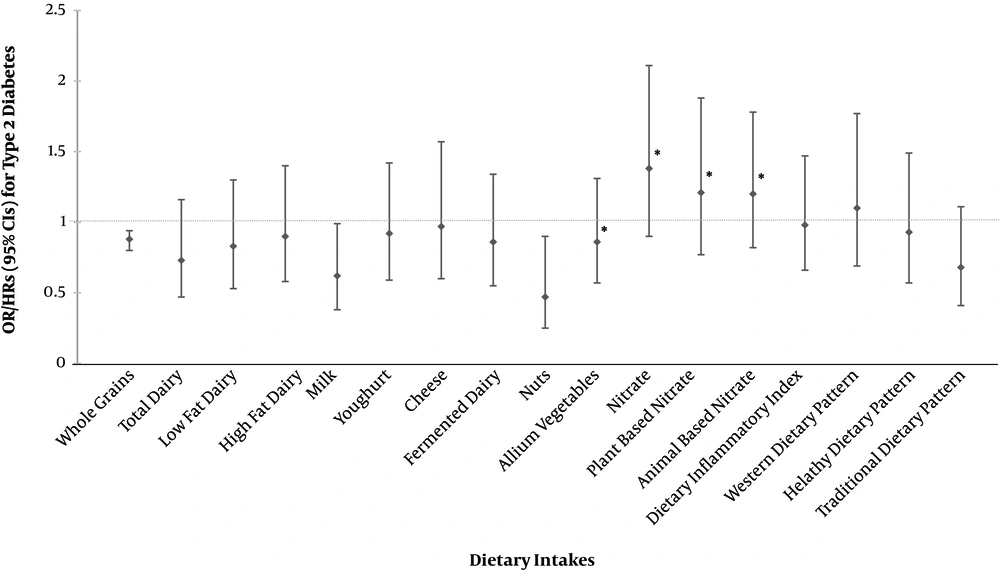
Figure 1.
Risk of type 2 diabetes in individuals with highest vs. lowest categories of dietary parameters: Tehran Lipid and Glucose Study. *Presented as HRs (95%CIs). HRs, hazard ratios; ORs, odds ratios; CIs, confidence intervals.
3.6. Nutrition and Cardiovascular Disease (CVD)
Several dietary factors were identified as potential risk factors of cardiovascular events in our population; Western DP score (HR = 2.07, 95% CI = 1.03 - 4.18) and a high-fructose diet (HR = 1.81, 95% CI = 1.04 - 3.15) was accompanied with an increased risk of CVD (12, 48), whereas higher intake of allium vegetables was related to 64% reduced risk of CVD outcomes (HR = 0.36, 95% CI = 0.18 - 0.71) (1). Our novel data also revealed that amino acid patterns of diet may also contribute to incidence of CVD (49); the amino acid pattern with a higher load of glycine, cysteine, arginine and tryptophan, was negatively related to CVD (HR = 0.28, 95% CI = 0.09 - 0.88); higher consumpton of sulfur-containing amino acids (cysteine and methionine), and potentially cardio-protective amino acids (arginine, cysteine, glutamic acid, glycine, histidine, leucine and tyrosine) had a 73% (HR = 0.27, 95% CI = 0.09 - 0.86) and 74% (HR = 0.26, 95% CI = 0.09 - 0.78) decreased risk of CVD events; however higher intakes of glutamic acid and proline increased the risk of CVD (49). We also showed that higher intake of plant derived L-arginine may have a protective effect whereas animal-derived L-arginine may be a risk factor for development of hypertension and CHD events (Figure 2) (50).
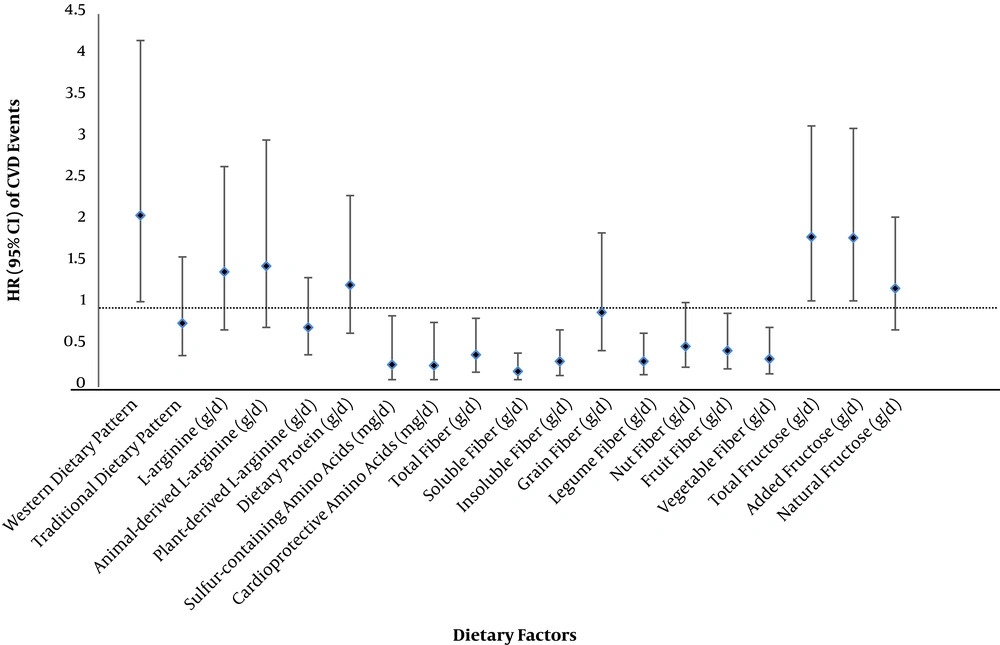
Figure 2.
Risk of cardiovascular disease (CVD) in individuals with highest vs. lowest categories of dietary parameters: Tehran Lipid and Glucose Study. HRs, hazard ratios.
Main dietary factor related to increased risk of CVD in our population was western DP, whereas higher consumption of allium vegetables had a protective effect. Our novel analysis also revealed that pattern of amino acid intakes may contribute in the development of CVD.
3.7. Nutrition and Chronic Kidney Disease
Previous studies in the framework of the TLGS, conducted on the association of dietary factors with kidney function, estimated glomerular filtration rate (eGFR) was calculated using the modification of diet in renal disease study equation and CKD was defined as eGFR < 60 mL/min/1.73 m2.
In a cross-sectional study of adults without T2DM, the ORs (95% CI) of CKD in the highest quartile compared to lowest quartile, were 0.70 (0.51 - 0.97) for plant protein, 0.73 (0.55 - 0.99) for PUFA, and 0.75 (0.57 - 0.97) for ω6 fatty acids, although the ORs (95% CI) of CKD in the highest quartile of animal protein, compared to the lowest was 1.37 (1.05 - 1.79) after adjustment for confounders. However, carbohydrate, simple sugar, fructose, total fat, SFAs, MUFAs, and ω3 fatty acids did not show any significant findings (51). In a 3-year longitudinal analyses, individuals in the top quintile of folate (OR: 0.44, 95% CI: 0.24 - 0.80), cobalamin (OR: 0.57, 95% CI: 0.34 - 0.93), vitamin C (OR: 0.38, 95% CI: 0.21 - 0.69), vitamin E (OR: 0.45, 95% CI: 0.22 - 0.92), vitamin D (OR: 0.39, 95% CI: 0.21 - 0.70), potassium (OR: 0.47, 95% CI: 0.23 - 0.97) and magnesium (OR: 0.41, 95% CI: 0.22 - 0.76) had decreased risk of CKD, and those in the highest quintile of sodium (OR: 1.64, 95% CI: 1.03 - 2.61), subjects had increased risk of CKD, in comparison to the lowest quintile in the fully adjusted model. No significant associations were found between the intakes of thiamin, riboflavin, niacin, pyridoxine, vitamin A, calcium, phosphorus, selenium, and zinc (52). From a holistic point of view, emphasizing high consumption of vitamins C, D, E, B12, and potassium, folate, and magnesium and low intake of sodium, predominantly found in fruits, vegetables, dairy foods, whole grains, legumes, nuts, and fish can decrease the risk of incidence CKD. This point has been supported by studies indicating that micronutrient-rich DPs lead to promoting the kidney function, thereby decreasing risk of renal failure. In two longitudinal studies conducted within the framework of TLGS, subjects in the highest quartile of the MDS were 51% less likely to have CKD than those in the lowest quartile (OR: 0.49; 95% CI: 0.30 - 0.82) after adjustment for all potential confounding variables. The inverse relationship between the MDS and the 6-year incidence of CKD remained significant (OR: 0.53; 95% CI: 0.31 - 0.91) after further adjustment for baseline eGFR (53). Furthermore, the OR for participants in the highest, compared with the lowest quintile of the DASH-style diet was 0.41 (95% CI: 0.24 - 0.70) after adjustment for age, sex, smoking, total energy intake, BMI, eGFR, triglycerides, physical activity, hypertension and T2DM (8).
Regarding food groups, in a cross-sectional study, compared to participants taking < 0.5 serving/week, consumption of over four servings of sugar sweetened beverages (SSBs) and sugar sweetened carbonated soft drinks (SSSDs) per week was related to increased OR of prevalent CKD (1.77 and 2.14, respectively). In a longitudinal analysis, risk of incident CKD increased by consumption of four servings/week, compared to less than 0.5 serving/week of SSBs (OR: 1.96, 95% CI: 1.23 - 3.15) and SSSDs (OR: 2.45, 95% CI: 1.55 - 3.89) (55). In a cross-sectional study higher risk (OR: 1.48, 95% CI: 1.05 - 2.13) of CKD was found comparing the highest tertile to the lowest one of nitrate-containing vegetables (NCVs); however, after 3 years of follow-up, there was no significant association between consumption of total NCVs and its categories with the occurrence of CKD (54). In a 6-year longitudinal analysis, the highest, compared to the lowest tertile of dietary nitrite was accompanied with a reduced risk of CKD (OR: 0.50, 95% CI: 0.24 - 0.89). However, dietary intake of nitrate had no significant association with the risk of CKD (57). In a cross-sectional analysis, the OR (95% CI) of CKD in the highest, compared to the lowest quartile of potential renal acid load (PRAL) of dietary intakes was 1.38 (95% CI: 1.02 - 1.83) after adjustment for age, sex, and body mass index. The positive association of PRAL and risk of CKD remained significant (OR: 1.42; 95% CI: 1.06 - 1.91) after additional adjustment for energy intake, smoking, dietary intake of total fat, carbohydrate, dietary fiber, fructose, sodium, T2DM, and hypertension (11). In a 3-year longitudinal analyses, compared to the first quartile of dietary AGEs intakes from fat, participants of the fourth quartile had higher risk of CKD (OR: 2.02; 95% CI: 1.16 - 3.54); the association between AGE intakes from meat and CKD was not statistically significant (55). In a 6-year longitudinal analyses, a higher habitual intake of allium vegetables was related to 32% lower incidence of CKD (hazard ratio: 0.68; 95% CI: 0.46 - 0.98; P for trend < 0.11) in a multivariable-adjusted model (1).
Overall, the results of our previous investigations suggest that higher intakes of dietary nitrate, MDS and DASH style DP, allium vegetables, and micro- and macronutrients such as vitamins C, E, D, B12, folate, potassium, magnesium, plant protein, PUFA, and ω6 fatty acid, decrease risk of CKD, whereas higher intakes of sodium, animal protein, SSBs, SSSDs, dietary acid load, and advanced glycation end-products were related to increased risk of CKD, findings showed that dietary sources of renal-protective nutrients should be emphasized among the general population (Figure 3).
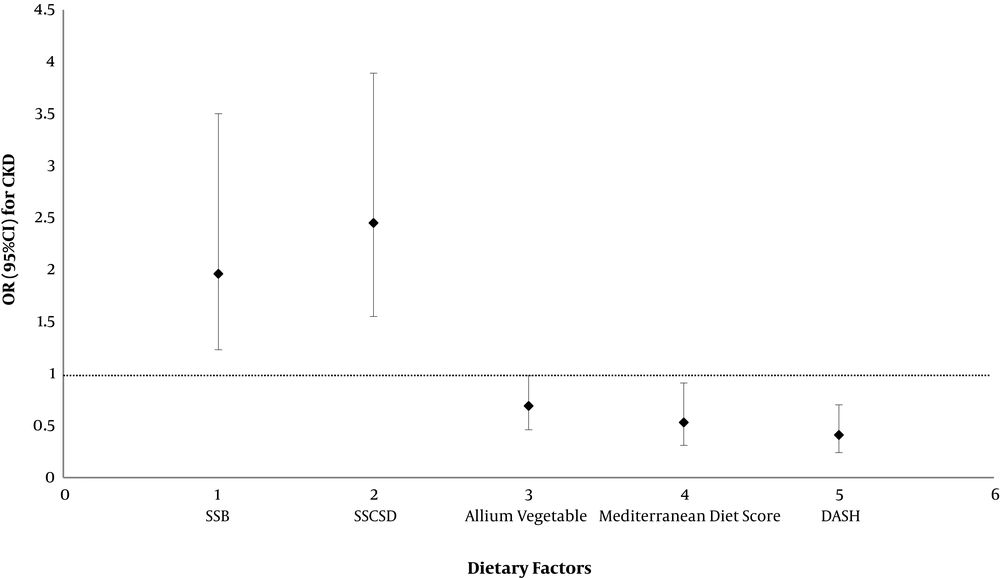
Figure 3.
Risk of chronic kidney disease (CKD) in individuals with highest vs. lowest categories of dietary parameters: Tehran Lipid and Glucose Study. ORs, odds ratios; CIs, confidence intervals; SSB, sugar sweetened beverage; SSCSD, sugar sweetened carbonated soft drinks; DASH, dietary approaches to stop hypertension.
4. Conclusions
Dietary patterns of most Tehranian adults need improvement. The FFQ is an acceptable tool for estimation of nutrient and food group intakes and determining DPs of Iranians to study association between DPs and health outcomes in epidemiological studies.
Some micro- and macronutrients, healthy DPs and allium vegetables were dietary sources of renal-protective nutrients. Higher adherence to healthy food choices were associated with reduced odds of dysglycemia and CVD.
It is recommended to investigate time trends of conforming dietary factors in accordance with dietary guidelines and their relations to T2DM, CVD and CKD to ensure precious dietary recommendations.